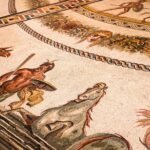
The Rape of the Sabine Women
Introduction

The Rape of the Sabine Women is one of the best-known episodes in early Roman legend. It refers to the abduction of Sabine women by the first Romans, an event traditionally placed in the legendary period of Rome’s foundation. In modern English, the word rape in this context means abduction or carrying off by force, not necessarily sexual assault, though the ancient story includes the forced taking of women into marriage and, in some accounts, violence.
The story has been influential in Roman historiography, Renaissance painting, sculpture, opera, and political symbolism. It was used by Roman writers to explain early Rome’s growth, the formation of alliances with neighboring peoples, and the city’s mixed origins. In later centuries, the episode became a famous subject for artists because it combined drama, conflict, and the founding myth of a great civilization.
Origin and Meaning
The phrase “Rape of the Sabine Women” comes from Latin traditions describing the abduction of the Sabine maidens by the Romans. The key Latin term is raptio, meaning “seizure” or “abduction.” This is why many modern scholars prefer translations such as “The Abduction of the Sabine Women” or “The Seizure of the Sabine Women.”
The word “Sabine” refers to the Sabines, an ancient Italic people who lived in central Italy, northeast of Rome. In Roman legend, they were among the early neighbors and later rivals of the Romans. The abduction narrative emerged as part of the mythic history of Rome’s first generations, especially in accounts of Romulus, Rome’s founder.
The story does not belong to Greek mythology in the strict sense, but it occupies a similar place in Roman legendary history: it explains origins, conflicts, and the integration of different peoples into a single civic identity.
Historical Context
The episode is set in Rome’s semi-legendary early period, after the city’s foundation by Romulus. According to Roman tradition, the new city initially lacked enough women to ensure its future. The neighboring communities allegedly refused marriage alliances with the Romans, seeing them as outsiders and potentially dangerous rivals.
In this context, the abduction of Sabine women appears as a founding crisis. Rome is portrayed as a young and unstable community, surrounded by more established peoples. The story addresses several themes central to Roman identity:
- the shortage of women and the need for legitimate family formation
- conflict between Rome and neighboring Italic communities
- the transformation of violence into political integration
- the role of women as mediators of peace between hostile groups
The historical accuracy of the event cannot be verified. Most modern historians treat it as a legendary or mythic tradition, though it may preserve distant memories of real interactions, marriage alliances, and conflicts among early Italic communities.
Main Characteristics
The episode is defined by several recurring elements in ancient sources and later retellings:
- A public festival or spectacle is organized by Romulus to attract neighboring peoples.
- The Sabine women are seized by Roman men during the event.
- Marriage and integration follow, with the women incorporated into Roman households.
- War breaks out between Romans and Sabines.
- The abducted women intervene, stopping the battle and persuading both sides to unite.
The story is unusual because it combines aggression with reconciliation. It begins with a violent seizure but ends in the creation of a new political and social order. That dual structure made it especially useful for Roman moral and civic storytelling.
Family and Genealogy
The central figures in the legend are not gods but early Roman and Sabine human characters. Ancient authors provide several versions of the genealogical details, but the overall pattern is consistent.
Key figures
| Figure | Role in the story | Notes |
|---|---|---|
| Romulus | Founder of Rome | Organizes the abduction according to Roman tradition |
| Sabine women | Abducted women | Later become wives of Roman men |
| Titus Tatius | King of the Sabines | Leads the war against Rome in some accounts |
| Hersilia | Often named as the wife of Romulus | Sometimes portrayed as a Sabine woman who helps reconcile the sides |
The legend suggests that the first Romans formed families through the integration of women from neighboring peoples. In some accounts, the abducted women became mothers of the first Roman generation. Their descendants symbolically represented the blending of Roman and Sabine bloodlines.
Symbols
The story is not associated with a fixed religious symbol system in the way that a deity or cult figure would be. However, certain objects and motifs recur in art and literature:
- The wedding veil or bridal attire: symbolizes the women’s intended role as wives, contrasted with the violence of their seizure.
- Raised arms and gestures of supplication: common in artistic depictions of the women pleading with fathers, husbands, or abductors.
- Spears and weapons: represent war and the martial foundation of Rome.
- The festival setting: emphasizes deception and sudden disruption.
In visual art, the scene is often framed as a clash between domestic order and military force. The women themselves become symbols of peace, continuity, and civic union.
Sacred Animals
There are no sacred animals specifically connected to the Rape of the Sabine Women in the way one might find for a deity or cult. However, Roman artists and later interpreters sometimes included animals indirectly through festival or pastoral settings.
In symbolic terms, animals are not central to the narrative. The story’s emphasis lies instead on human kinship, marriage, and state formation.
Sacred Plants
No plants are specifically sacred to this legend. Yet in Roman visual culture, some scenes may include:
- garlands or festal wreaths
- greenery associated with ceremonies
- floral imagery linked to marriage and youth
These elements are decorative rather than doctrinal. They reinforce the contrast between celebration and violence.
Sacred Places
The story is attached to several important places in Rome’s legendary geography.
The Forum and early Rome
Some versions place the abduction during public games or festivals in early Rome, likely in the area later associated with the Forum or nearby communal spaces. This setting underscores the public and civic nature of the act.
The Capitol and the Roman settlement
The conflict between Romans and Sabines is often linked to the Capitoline Hill and the early Roman settlement. In some versions, the women intervene at the moment of battle near the city’s core.
Sabine territory
The Sabines are associated with central Italian highland regions. Ancient tradition does not agree on a single exact geographic origin, but they were imagined as living in the hills northeast of Rome.
Powers and Attributes
The Sabine women themselves are not divine beings, but in the legend they acquire symbolic powers through their actions.
Attributes of the abducted women
- Mediators of peace: they stop the war between fathers and husbands.
- Founders of lineage: they help produce the next generation of Romans.
- Symbols of civic fusion: they embody the union of different peoples.
- Agents of transformation: their intervention turns violence into political settlement.
Romulus, in contrast, is attributed with leadership, strategic planning, and ruthless pragmatism. His role illustrates a recurring Roman theme: state formation often involves hard choices and morally ambiguous acts.
Main Myths
The abduction during the festival
The most famous version appears in Roman historical tradition. Romulus, unable to secure marriages for the men of his new city, organizes games or a festival. He invites neighboring peoples, including the Sabines. At a signal, Roman men seize the unmarried women and carry them off.
The details vary between sources:
- Some say the women were seized openly during the games.
- Others emphasize that they were persuaded or enticed first, then abducted.
- Some accounts stress that the women were not immediately raped in the modern sense, but forcibly taken as wives.
War with the Sabines
The Sabines and other offended neighbors then wage war against Rome. In some versions, the Sabine king Titus Tatius leads the attack, and a betrayal within Rome allows the Sabines to enter the citadel. The fighting becomes a crisis for the young city.
The intervention of the women
At the decisive moment, the Sabine women—now married to Roman men and mothers of children—rush between the two armies. They plead for peace, reminding both sides that they now belong to both communities. Their intervention ends the conflict and leads to reconciliation.
The joint rule of Romulus and Titus Tatius
In some traditions, the outcome is political union rather than simple peace. Romulus and Titus Tatius are said to have ruled jointly for a time, symbolizing the merger of Roman and Sabine elements.
Relationship with Other Mythological Figures
Although the episode is not centered on gods, it is deeply linked to several foundational Roman figures and themes.
Romulus
Romulus is the architect of the abduction. Ancient sources portray him variously as:
- a shrewd founder securing Rome’s survival
- a lawgiver creating families for his people
- a violent ruler whose methods were justified by later results
Titus Tatius
Titus Tatius is the principal Sabine counterpart to Romulus in many accounts. His role is especially important because he transforms the story from a simple abduction into a diplomatic and military conflict resolved by alliance.
Hersilia
Hersilia, usually identified as Romulus’s wife and sometimes as a Sabine woman, appears in some versions as a mediator. Her presence reinforces the theme of marriage as a bridge between communities.
Mars and the divine background
Romulus is traditionally the son of Mars, the Roman god of war. This divine parentage, while not central to the Sabine narrative, frames Rome’s origins in martial terms and helps explain the violent tone of the story.
Worship and Cult
The Rape of the Sabine Women was not itself an object of worship or a cult myth in the strict religious sense. It belongs instead to Roman legendary history. Nevertheless, the story influenced Roman moral thought and civic identity.
Ritual and social meaning
The narrative reflects practices and ideals associated with:
- marriage
- family formation
- alliance-making
- civic festivals
- the integration of outsiders into Roman society
In Roman ideology, the story could be read as a justification for Rome’s expansion and absorptive power. The city was imagined as capable of turning enemies into kin and incorporating foreign peoples into its body politic.
Artistic and ceremonial reuse
While not a cult subject, the legend was repeatedly revived in:
- public art
- monuments
- triumphal imagery
- Renaissance and Baroque paintings
- theatrical and operatic works
Its ritual importance lies more in cultural memory than in formal worship.
Ancient Sources
The story is known from several Roman and later classical authors. Their versions do not always agree, and they should be read as literary and historiographical traditions rather than straightforward history.
Major ancient sources
| Author | Work | Contribution |
|---|---|---|
| Livy | Ab Urbe Condita | One of the most influential accounts of the abduction and the subsequent war |
| Plutarch | Life of Romulus | Provides a biographical and moralized version |
| Dionysius of Halicarnassus | Roman Antiquities | Gives a detailed narrative with attention to Roman origins |
| Cicero | Various works | Refers to the story as part of Roman tradition |
| Ovid | Fasti and other works | Reworks early Roman legends in literary form |
| Augustine | City of God | Critiques Roman moral claims while discussing the legend |
Source differences
Ancient sources differ on several points:
- whether the women were deceived, persuaded, or openly seized
- the degree of violence involved
- the precise identity and role of Titus Tatius
- whether the Sabine women were already married or merely engaged
- the political outcome after the conflict
Because of these variations, modern scholarship treats the legend as a flexible tradition rather than a fixed historical record.
Roman Equivalent
There is no strict “Roman equivalent” because the episode is itself a Roman foundational legend. However, it often functions analogously to other origin myths that explain how a city or people formed through conflict and assimilation.
If one considers its cultural role, it is comparable to other Roman foundation narratives such as:
- the story of Romulus and Remus
- the abduction of Lavinia in the Aeneid tradition
- legends that explain the incorporation of outsiders into Roman identity
The Sabine episode is especially important because it presents Rome as a city born from intermarriage, conquest, and integration.
Influence on Modern Culture
The Rape of the Sabine Women has had a major influence on Western art and literature. It became a favorite subject because it allowed artists to depict multiple emotional and narrative moments at once: alarm, movement, violence, parental grief, and reconciliation.
Visual art
The story appears in works by many major artists, including:
- Giambologna
- Nicolas Poussin
- Pietro da Cortona
- Jacques-Louis David
- Peter Paul Rubens in related mythological and historical compositions
Giambologna’s sculptural group, The Rape of the Sabine Women, is especially famous for its dynamic composition and technical complexity. It is one of the most recognized representations of the episode.
Literature and opera
The story has also appeared in:
- Renaissance and early modern literature
- historical poetry
- operatic and theatrical adaptations
- modern retellings that reinterpret the myth from the women’s perspective
Modern interpretation
In modern culture, the legend is often discussed critically because it centers on coercion, female captivity, and political violence. Contemporary readers frequently analyze it as:
- a myth of state formation through force
- a narrative of patriarchal control
- a symbol of cultural assimilation
- a story that reveals Roman attitudes toward power and kinship
The title itself has also become a subject of debate because the modern English word “rape” can obscure the original meaning of raptio.
Curiosities
- The story is one of the most frequently depicted episodes from early Roman legend in European art.
- The Latin word raptio emphasized seizure or carrying off, which is why the modern title can be misleading.
- The Sabine women are often praised in the sources for ending the war, making them unusually active figures in an otherwise male-dominated founding narrative.
- The story is both a tale of violence and a political origin myth about union.
- Some ancient and modern readers have seen it as a symbolic explanation for Rome’s mixed population.
- The episode was important in moral discussions about marriage, citizenship, and the legitimacy of early Roman expansion.
- Artistic depictions often focus on dramatic physical movement rather than strict historical realism.
Frequently Asked Questions
1. What does “The Rape of the Sabine Women” mean?
In historical context, it means the abduction or seizure of the Sabine women by the early Romans. The term “rape” here comes from an older meaning of forced taking, not only sexual violence.
2. Was the event a real historical event?
It cannot be verified historically. Most scholars regard it as a legendary Roman foundation myth, though it may reflect broader patterns of early Italic conflict and intermarriage.
3. Who ordered the abduction?
According to Roman tradition, Romulus arranged the abduction because the new city lacked women and could not easily secure marriages through diplomacy.
4. Why are the Sabine women important in the story?
They are important because they later intervene to stop the war between the Romans and Sabines. In the legend, they become key agents of reconciliation and the creation of a new people.
5. Did the Sabines and Romans eventually become allies?
Yes, in many versions they do. Some accounts say the two peoples merged under joint rule by Romulus and Titus Tatius, or at least formed a lasting alliance after the women’s intervention.
6. Where is the story found in ancient literature?
It appears in Livy, Plutarch, Dionysius of Halicarnassus, Ovid, and other classical authors, though each tells it differently.
7. Why is the story so famous in art?
Artists were drawn to its dramatic subject matter: abduction, panic, physical motion, and reconciliation. It also offered a powerful image of Rome’s violent but formative beginnings.
Conclusion
The Rape of the Sabine Women is one of the most enduring legends of early Rome. Though historically uncertain, it played a major role in shaping Roman ideas about origins, citizenship, warfare, and the incorporation of outsiders. The story’s power lies in its contradictions: it is both a narrative of coercion and a myth of union, both a tale of foundation and a warning about the costs of state-building.
Through ancient historiography and later artistic reinterpretation, the legend became a lasting symbol of Rome’s ability to turn conflict into continuity. Its prominence in Western culture reflects not only its dramatic force but also its enduring relevance to discussions of power, gender, violence, and political identity.

Orin Vale has spent the better part of two decades tracing the threads that connect the world’s oldest stories — from the halls of Asgard to the banks of the Nile, from Olympus to the jungles of the Maya. What began as a childhood fascination with flood myths and trickster gods grew into years of independent study across comparative mythology and ancient religion, always chasing the same question: what did these stories mean to the people who first told them? Orin writes for readers who want more than trivia — the ones looking for the beliefs, fears, and truths that myths were built to carry.