Athena’s Owl
Athena’s owl is one of the best-known animal symbols in ancient Greek culture. Closely associated with Athena, the Greek goddess of wisdom, strategy, crafts, and civic order, the owl became a visual shorthand for intelligence, watchfulness, and prudent judgment. In art, coinage, literature, and religious imagination, the bird is often presented as Athena’s companion or emblem, especially in Athens, where it became deeply linked with the city’s identity.
The most famous owl associated with Athena is the little owl (Athene noctua), a species common in the Mediterranean. In Greek thought, however, Athena’s owl was more than a real bird. It functioned as a sacred sign, a cultural symbol, and a recurring motif in myths, rituals, and public life. Its image survives today as one of the most enduring symbols of classical antiquity.
Origin and Meaning
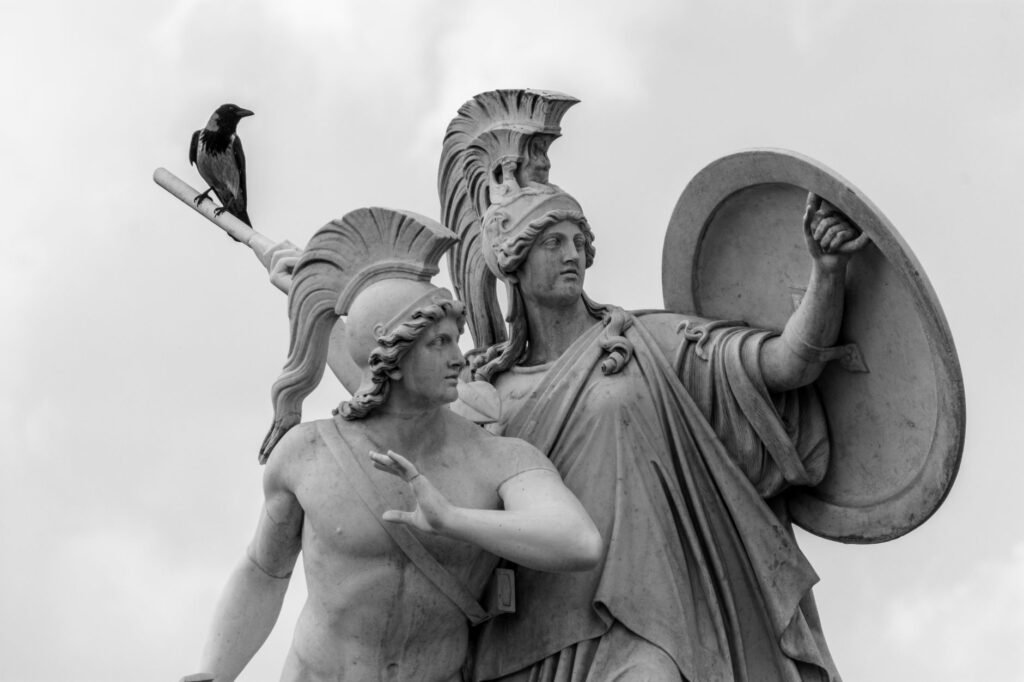
The owl’s association with Athena is ancient and strongly rooted in Greek language and symbolism. The goddess’s name, Athēnâ in Greek, is connected to Athens, though the precise historical origin of the name is disputed. The owl’s Greek cultural significance is reflected in the word glaux (γλαύξ), meaning “owl,” especially the little owl. Athena herself is sometimes called Glaukopis, often translated as “bright-eyed,” “owl-eyed,” or “gray-eyed.” The epithet likely suggests shining, penetrating eyes, but it also reinforced the visual link between the goddess and the owl.
The connection may have developed from several overlapping factors:
- the owl’s nocturnal vision and alertness
- its association with wisdom and quiet observation
- its presence around the Acropolis and the city of Athens
- its prominence on Athenian coinage and civic imagery
Ancient Greek culture did not always distinguish sharply between metaphor, divine symbol, and sacred animal. As a result, Athena’s owl could represent both the goddess’s qualities and her protection over the city.
Historical Context
Athena was one of the most important deities in the Greek pantheon. She was widely worshipped across the Greek world, but Athens was her primary cult center and the city most closely tied to her identity. The owl emerged within this urban, religious, and political environment.
In archaic and classical Greece, animals often carried symbolic meanings connected to gods. The owl’s nocturnal gaze and stillness made it a natural emblem for careful judgment and hidden knowledge. In a city like Athens, which valued deliberation, public speech, and military strategy, Athena’s owl fit remarkably well as a civic symbol.
The owl also gained special importance in the fifth century BCE, when Athenian power expanded and the city’s silver tetradrachms, stamped with Athena and her owl, circulated widely. These coins became among the most recognizable in the ancient Mediterranean. Their imagery linked religion, economy, and political identity.
Main Characteristics
Athena’s owl is usually understood through a combination of zoological observation and symbolic meaning. The real bird most often identified with the goddess is the little owl, a small species native to the Mediterranean.
Common characteristics associated with Athena’s owl
- Nocturnal vision: able to see and move effectively at night
- Alertness: seemingly watchful and attentive
- Stillness: often perceived as calm and controlled
- Silent flight: a trait that contributed to its mysterious reputation
- Bright eyes: visually linked with Athena’s epithets
- Small size: especially in the case of the little owl, which was common in Greece
In iconography, the owl is typically shown in profile, with large round eyes and a compact body. On coins, it often appears standing beside or near the goddess, or as the reverse type of Athenian currency.
Family and Genealogy
Athena’s owl does not belong to a mythological genealogy in the same way as gods or heroes. It is not generally described as having parents, children, or spouses in ancient myth.
However, in symbolic terms, it is closely “related” to Athena herself. Ancient sources present the bird as her companion, attribute, or emblem. In that sense, its identity is defined not by family descent but by association.
Some traditions also mention other birds and animals linked to Athena, but the owl remained the most durable and widely recognized.
Symbols
Athena’s owl is associated with several symbols that reinforce the goddess’s character and role.
| Symbol | Meaning | Connection to Athena’s owl |
|---|---|---|
| Owl | Wisdom, vigilance, knowledge | Primary emblem of Athena |
| Olive tree | Peace, prosperity, civic continuity | Sacred to Athena and Athens |
| Aegis | Divine protection, authority | Part of Athena’s iconography |
| Helmet | Warfare and strategy | Represents her martial aspect |
| Spear | Tactical power and defense | Linked to her role as protectress |
| Gorgon’s head (Gorgoneion) | Terror, apotropaic protection | Often appears with Athena’s imagery |
The owl’s association with wisdom became especially influential in later tradition. In popular imagination, the bird came to stand for intelligence in a broad sense, though ancient Greek meanings were more specific and context-dependent. Athena’s wisdom was practical and civic as well as intellectual: it included strategy, craftsmanship, law, and prudent action.
Sacred Animals
The owl is the most important sacred animal of Athena, but the goddess is linked to other animals as well.
Associated animals
- Owl: the principal sacred animal and emblem of wisdom
- Snake: sometimes appears in Athena-related imagery; may represent protection, chthonic forces, or guardianship
- Horse: relevant in myths connected with technology, invention, and competition, though not as a primary sacred animal
- Various birds: in some local traditions, other birds may appear in Athena’s sphere, but none rival the owl in importance
The owl’s significance is especially strong because it appears both in mythic symbolism and in everyday civic material, such as coinage. This made it visible to ordinary people far beyond temple precincts.
Sacred Plants
The sacred plant most closely associated with Athena is the olive tree, not the owl. Still, the owl belongs to the wider symbolic world of Athena and Athens, where the olive tree had extraordinary significance.
Olive tree and owl in Athenian symbolism
- The olive tree represented peace, fertility, endurance, and economic value.
- Athena was said to have bestowed the olive on Athens in a famous contest with Poseidon.
- The owl, as Athena’s bird, shared in the city’s religious and civic identity.
- On Athenian coinage, the owl frequently appears alongside olive branches or olive oil-related imagery.
The owl itself is not usually linked to a specific sacred plant in the manner of some other deities. Its importance lies more in its relationship to Athena and the olive-centered identity of her city.
Sacred Places
Athena’s owl is connected most strongly with Athens and the Acropolis.
Major places linked to Athena’s owl
| Place | Importance |
|---|---|
| Athens | Main city associated with Athena and her owl |
| Acropolis | Sacred high ground and cult center of Athena |
| Parthenon | Major temple of Athena on the Acropolis; associated with civic and religious imagery |
| Athens’ Agora | Public center where coinage, civic symbols, and daily life intersected |
| Attica | Region under Athena’s cultural and political patronage |
The owl may have been especially associated with the Acropolis because owls lived around the rocky heights of the city. Ancient Athenians could encounter them in a setting that physically reinforced the sacred bond between goddess, city, and bird.
Powers and Attributes
Athena’s owl does not possess independent divine powers. Its significance comes from what it represents in relation to Athena.
Attributes symbolized by Athena’s owl
- Wisdom
- Strategic intelligence
- Watchfulness
- Night vision
- Good judgment
- Protection
- Civic awareness
Athena herself ruled over many domains:
- wisdom and intelligence
- military strategy rather than brute force
- craft, weaving, and skilled labor
- cities and civic institutions
- lawful order and disciplined thought
The owl reflects these domains through its reputation as a careful, observant bird. In later interpretations, the owl became a generalized emblem of learning, but in the Greek world its meaning remained tied to practical intelligence and divine favor.
Main Myths
Unlike some gods and heroes, Athena’s owl does not feature in a single dominant mythic cycle. Its importance comes more from recurring symbolic associations than from a large body of stories about the bird itself.
The contest for Athens
The best-known mythic background for Athena’s symbolic authority is her contest with Poseidon for patronage of Athens. In this tradition, each deity offered a gift to the city. Poseidon created a salt spring or struck the ground with his trident, while Athena offered the olive tree. The Athenians favored Athena’s gift, and she became the city’s patron goddess.
Although the owl is not central to this myth in surviving versions, the story explains why Athena became so closely bound to Athens and why her symbols, including the owl, gained civic significance.
The owl as a sign of Athena’s favor
In later tradition, the appearance of an owl could be taken as a favorable omen or as evidence of Athena’s presence. The bird’s watchfulness and calm demeanor made it a fitting sign for a goddess associated with foresight and wise counsel.
The owl in war and strategy
Athena was also a war goddess, but unlike Ares she represented disciplined strategy rather than battlefield frenzy. The owl’s silent observation and nocturnal precision suited this aspect of her identity. Ancient audiences could interpret the bird as a symbol of tactical intelligence and restrained power.
Relationship with Other Mythological Figures
Athena’s owl is defined primarily through Athena, but it also stands in relation to other gods and figures in the Greek mythological system.
Key relationships
- Zeus: Athena’s father in most traditions; as Zeus’s daughter, she occupies a high divine position
- Poseidon: rival of Athena in the contest for Athens
- Hephaestus: associated with craftsmanship and invention, sometimes compared with Athena’s skilled domains
- Ares: contrasts with Athena as he represents violent war, while she represents strategy
- Nike: victory is often allied with Athena’s success and wisdom
- Athenians: the human community most closely linked to Athena and her owl
The owl itself often functions as an extension of Athena’s authority rather than as a character in its own right. In artistic and civic contexts, it mediates between the goddess and the people of Athens.
Worship and Cult
Athena was worshipped throughout the Greek world, and her cult in Athens was especially elaborate. The owl was not usually the object of worship on its own, but it formed part of her sacred imagery and religious atmosphere.
Forms of worship connected to Athena
- temple offerings
- dedications of votive objects
- festivals honoring Athena
- civic processions
- sacrifices in her sanctuaries
- artistic representations on pottery, sculpture, and coinage
Festivals
The most important Athenian festival was the Panathenaia, held in honor of Athena. It included processions, competitions, sacrifices, and the presentation of a new peplos, or ceremonial robe, to the goddess. While the owl is not the central ritual object of the festival, it belongs to the broader symbolic world of Athena’s worship.
Ritual significance
The owl likely had apotropaic value, meaning it could protect against harm or signify divine oversight. In a culture where signs and omens were taken seriously, the appearance of Athena’s owl may have been interpreted as meaningful, especially in political or military contexts.
Ancient Sources
Athena and her owl are known through many ancient authors and material remains. The bird is not always discussed directly, but its image and significance appear widely.
Important ancient sources
- Homer – Athena is repeatedly described with epithets that emphasize brightness and sharp-eyed perception.
- Hesiod – presents Athena within the broader divine hierarchy.
- Pindar – reflects Greek reverence for Athena and civic symbols.
- Aristophanes – alludes to Athenian identity, coins, and common symbols in comic contexts.
- Apollodorus – preserves mythic summaries, including stories about Athena.
- Pausanias – describes temples, cult images, and local traditions in Greece.
- Ovid – though Roman, he retells Greek myths in a way that influenced later reception.
- Aristotle and later natural writers – contribute to ancient observations about owls as animals.
Material evidence
The most direct ancient evidence for Athena’s owl comes from:
- Athenian coinage, especially the silver tetradrachm
- vase painting
- sculptures and reliefs
- inscriptions and dedications
- architectural decoration
These sources are crucial because they show how the owl functioned in lived religion and civic identity, not only in literary myth.
Roman Equivalent
There is no exact Roman equivalent to Athena’s owl because the Roman goddess Minerva, while closely corresponding to Athena, did not generate an equally dominant owl-centered civic symbol in Roman culture.
Still, Minerva inherited many of Athena’s traits:
- wisdom
- strategy
- crafts
- learning
- protection of cities and skilled work
The owl did become associated with Minerva in Roman and later European tradition, but the strongest and earliest symbolic association is Greek and specifically Athenian. In Roman art and later Western iconography, the owl often serves as a generic emblem of Minerva and of wisdom more broadly.
Influence on Modern Culture
Athena’s owl remains a powerful symbol in modern culture, especially in education, publishing, finance, and logo design.
Modern uses and influences
- Academic symbolism: owls are widely used to represent scholarship and learning.
- University emblems: many institutions use owls or Athena-inspired imagery.
- Publishing and libraries: the owl suggests knowledge and vigilance.
- Numismatics: collectors and historians study Athenian owl coins as major artifacts of classical history.
- Art and design: classical references to Athena’s owl continue in sculpture, illustration, and branding.
- Popular culture: the owl appears in films, novels, games, and fantasy imagery as a sign of wisdom or magic.
Modern depictions often simplify the ancient symbolism, treating the owl as a universal “wise bird.” The historical Greek meaning was more specific: it belonged to the religious and civic world of Athens and to the goddess’s broader identity as protector of ordered knowledge.
Curiosities
Here are some lesser-known facts about Athena’s owl:
- The owl on ancient Athenian coins is one of the most famous images in numismatic history.
- The Athenian tetradrachm was so widely recognized that it circulated far beyond Greece.
- The Greek word glaux can refer specifically to the little owl, the species most often linked with Athena.
- Athena’s association with the owl may have been strengthened by the fact that owls were common around the Acropolis.
- In ancient Greek thought, animals could be omens, divine signs, and symbolic companions at the same time.
- The owl’s meaning changed over time: from a local sacred emblem to a more universal sign of wisdom.
- Some ancient authors and later commentators connected Athena’s epithet Glaukopis with the owl, while others emphasized the brightness of her eyes rather than the bird itself.
- The owl is one of the rare mythological animal symbols that became a major civic logo as well as a religious one.
Frequently Asked Questions
1. What is Athena’s owl?
Athena’s owl is the bird symbol associated with the Greek goddess Athena, especially the little owl. It represents wisdom, watchfulness, and protection.
2. Why is the owl linked to Athena?
The owl was linked to Athena because of its night vision, alertness, and calm behavior. These traits suited Athena’s role as goddess of wisdom and strategy.
3. Was Athena’s owl an actual animal or only a symbol?
It was both. The symbol is based on a real owl species, most likely the little owl, but it also carried religious and civic meanings in Greek culture.
4. What did Athena’s owl mean in ancient Greece?
It symbolized intelligence, prudent judgment, and divine favor. In Athens, it also represented the city’s identity and prosperity.
5. Where was Athena’s owl most important?
It was most important in Athens, especially in connection with the Acropolis, the Parthenon, and Athenian coinage.
6. Did Athena’s owl appear in myths?
It appears more as a symbol than as a mythological character. Its importance comes from its association with Athena and from its role in civic and religious imagery.
7. Is the owl still used as a symbol today?
Yes. The owl remains a common symbol of wisdom, learning, and scholarship, often inspired by classical associations with Athena and Minerva.
8. Which ancient coin shows Athena’s owl?
The famous Athenian silver tetradrachm shows Athena on one side and an owl on the other, making it one of the most recognizable coins of antiquity.
Conclusion
Athena’s owl is one of the most enduring symbols from the ancient world. Rooted in Greek religion, Athenian civic identity, and classical art, it came to embody wisdom, vigilance, and disciplined intelligence. Although the owl is a real bird, its cultural meaning far exceeded natural history. In Athens, it became a sacred emblem of the city’s patron goddess and a visual sign of collective identity.
Through coinage, literature, and artistic tradition, Athena’s owl traveled far beyond the ancient Greek world. It remains a powerful image in modern education, design, and popular culture, still evoking the enduring legacy of Athena, the goddess of wisdom and strategy.

Orin Vale has spent the better part of two decades tracing the threads that connect the world’s oldest stories — from the halls of Asgard to the banks of the Nile, from Olympus to the jungles of the Maya. What began as a childhood fascination with flood myths and trickster gods grew into years of independent study across comparative mythology and ancient religion, always chasing the same question: what did these stories mean to the people who first told them? Orin writes for readers who want more than trivia — the ones looking for the beliefs, fears, and truths that myths were built to carry.