Cat Sìth
The Cat Sìth is a figure from Celtic folklore, especially associated with the Gaelic traditions of Scotland and Ireland. Often described as a large black cat with a white spot on its chest, the Cat Sìth occupies a distinctive place in folk belief as a supernatural being that blurs the boundary between domestic animal, fairy creature, and omen. In Scottish tradition, it is best known as an eerie presence linked to death, funerary customs, and the Otherworld. Over time, the Cat Sìth has become one of the most recognizable creatures in Celtic myth and later fantasy literature, partly because it combines a familiar animal with a disturbing supernatural aura.
Unlike gods or heroes from major classical mythologies, the Cat Sìth belongs primarily to folklore and oral tradition. That means its stories vary by region and period, and many surviving accounts come from later collectors rather than from a single ancient text. Even so, the creature is important for understanding how Gaelic-speaking communities explained misfortune, death, and the uncanny presence of animals in everyday life.
Origin and Meaning
The name Cat Sìth comes from Scottish Gaelic. It is usually analyzed as:
- cat: “cat”
- sìth or sìdhe: a word related to the fairies, the Otherworld, or supernatural beings
The term is often rendered in English as “fairy cat” or “cat of the fairy mound”. The spelling varies in modern usage, and related forms appear in Irish Gaelic tradition. In older discussions, the creature is sometimes connected with the broader family of fairy beings known as the Aos Sí in Irish tradition or the Sìth in Scottish Gaelic tradition.
The name reflects an important feature of Gaelic folklore: the supernatural world is often described not as separate from nature, but as existing beside it. A cat, already regarded in many cultures as mysterious and independent, becomes in this setting a vehicle for fairylike power.
Historical Context
The Cat Sìth belongs to the wider world of Gaelic folklore, especially in the Highlands and Islands of Scotland, and in related Irish traditions. Belief in fairies, supernatural animals, omens, and the restless dead was deeply embedded in premodern rural life. People often interpreted unusual events—unexpected sounds, strange animal behavior, illness, death, or luck—as signs of unseen forces.
Several historical factors helped shape the creature’s reputation:
- Oral storytelling traditions preserved supernatural motifs across generations.
- Christian influence did not erase older beliefs but often reinterpreted them through moral or funerary frameworks.
- Domestic cat life in rural households made cats both familiar and uncanny.
- Funerary customs created a setting in which supernatural explanations for death and vigilance around the dead were especially powerful.
The Cat Sìth is most commonly associated with Scottish Highlands folklore, though similar fairy-cat motifs appear elsewhere in Celtic and northern European traditions. Its stories were not part of a formal religion in the way gods were worshipped in antiquity; instead, they belong to local belief systems, household traditions, and seasonal custom.
Main Characteristics
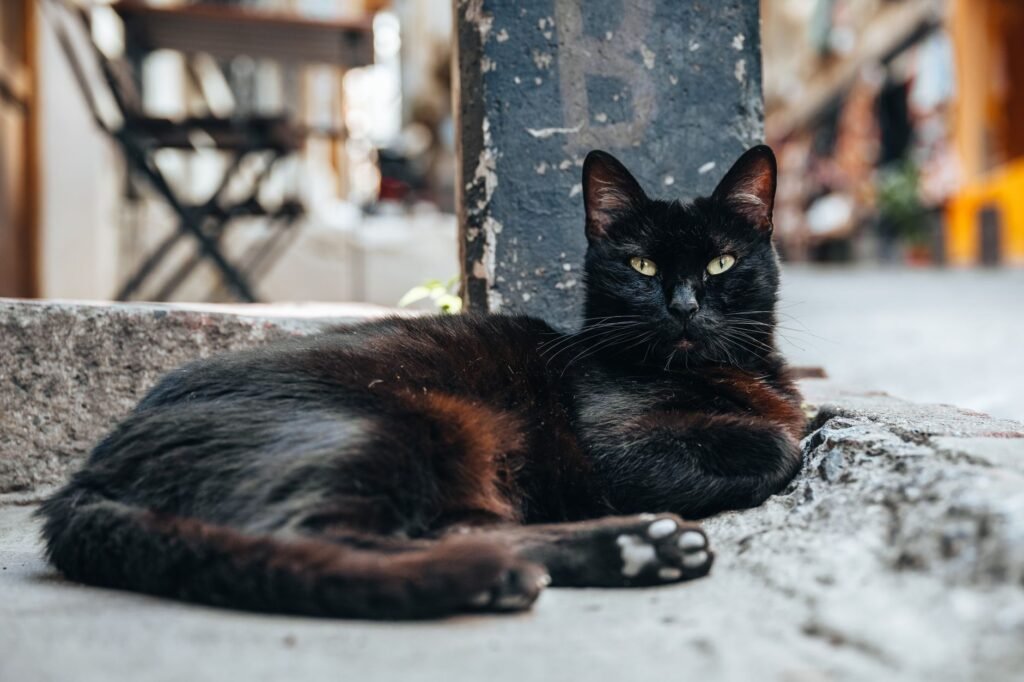
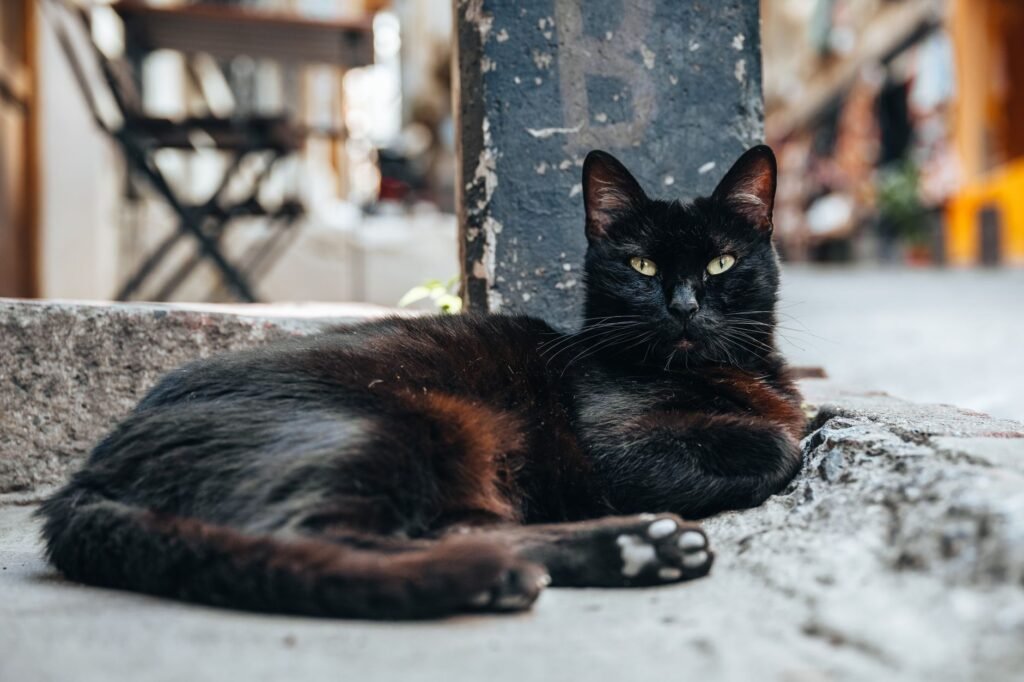
The Cat Sìth is usually described as a large black cat, often with a white mark on the chest. Accounts vary, but the most common identifying features include:
- Size larger than an ordinary domestic cat
- Black fur, sometimes glossy or unnaturally dark
- A single white patch on the breast
- A silent, watchful, or uncanny manner
- An association with the supernatural, especially the fairies or the dead
In some stories, the Cat Sìth is not merely a cat-like animal but a shape-shifting fairy being. In other versions, it is a specific kind of enchanted cat. Folklore sources do not always distinguish clearly between a supernatural cat, a witch’s familiar, and a fairy creature. This ambiguity is part of its power.
A few recurring traits stand out:
| Trait | Typical portrayal |
|---|---|
| Appearance | Large black cat, often with a white chest mark |
| Nature | Supernatural, fairy-linked, or ghostly |
| Behavior | Silent, watchful, sometimes harmful |
| Reputation | Ominous, especially around death |
| Function | Omen, guardian of the dead, or wandering fairy creature |
The creature is usually not a benevolent household cat. Instead, it appears as a liminal being, connected with thresholds: life and death, home and wilderness, human and fairy worlds.
Family and Genealogy
Unlike divine figures with detailed genealogies, the Cat Sìth does not have a stable family tree in surviving tradition. Folklore generally treats it as a type of being rather than a single named individual with parents, spouse, or descendants.
That said, some traditions place the Cat Sìth within a broader network of supernatural kinship:
- It may be considered a fairy creature and thus related in a loose sense to the Aos Sí.
- In some stories, it behaves like a witch’s familiar or an enchanted animal.
- In later folklore, it can overlap with other spectral or fairy animals, though these are not always identical.
Because the tradition is fragmentary, it is safer to speak of associations rather than formal genealogy. The Cat Sìth belongs to a family of beings defined more by nature and function than by ancestry.
Symbols
The Cat Sìth is associated with several symbolic elements, especially in Scottish folklore.
Common Symbols
- Black fur: often linked with mystery, night, hidden power, or the Otherworld
- White chest patch: a distinctive mark in many descriptions
- Threshholds and hearths: cats are often associated with domestic spaces, but the Cat Sìth appears where the boundary between home and supernatural danger becomes unstable
- Death and mourning: especially through the funerary custom of the cat’s pass over the corpse
- Fairy power: the “sìth” element in the name connects it to the world of the fairies
The white mark on the chest is especially notable because it distinguishes the creature from a normal black cat and may serve as a visual sign of its supernatural identity. In folklore, unusual markings often signal beings that are not fully ordinary.
Sacred Animals
Strictly speaking, the Cat Sìth is not “sacred” in the sense of a deity’s holy animal in a formal cult. However, it is directly associated with the cat as an animal, and cats have long carried symbolic weight in folklore worldwide.
The Cat as a Symbolic Animal
In the context of Cat Sìth traditions, cats symbolize:
- Independence
- Night vision and hidden knowledge
- Ambiguity between domesticity and wildness
- Protection of the home, in some wider folk beliefs
- Unpredictability and mystery
The Cat Sìth intensifies these features by placing the cat within a supernatural framework. It is not simply a cat, but a cat transformed into a folkloric sign.
Sacred Plants
No specific plant is universally or consistently associated with the Cat Sìth in the historical record. Unlike some mythological figures tied to trees, herbs, or ritual plants, the Cat Sìth is primarily connected with animals, death customs, and fairy belief.
However, in broader Gaelic and Celtic folklore, certain plants were used in protective or ritual contexts, especially around thresholds, houses, and the dead. These may appear in stories involving the supernatural more generally, but they are not exclusive to the Cat Sìth.
Because of this, any claim that a specific plant was sacred to the Cat Sìth should be treated cautiously unless supported by a particular local tradition.
Sacred Places
The Cat Sìth is not tied to a single temple, shrine, or canonical sacred site. Its geography is folkloric rather than institutional. Still, certain kinds of places are repeatedly associated with it.
Typical Settings in Tradition
- Crofts and rural homes
- Fireplaces and hearths
- Burying places and funeral houses
- Roadsides at night
- Fairy mounds and liminal landscapes
- The Highlands and islands of Scotland
The fairy mound, or the place of the sìth, is especially important in Gaelic tradition. Such mounds were believed to be entrances to the Otherworld and were associated with supernatural beings. While the Cat Sìth is not always explicitly said to live there, the name itself points to that broader setting.
The creature also appears in domestic spaces, particularly around deathbeds and wakes. This dual location—Otherworld and household—helps explain its folkloric force.
Powers and Attributes
The Cat Sìth is not a god with a fixed portfolio, but it is credited with several supernatural functions.
Commonly Attributed Powers
- Sensing or taking souls
- Foretelling or accompanying death
- Appearing at funerals and wakes
- Bringing blessings or misfortune, depending on the story
- Moving between the human world and the fairy world
- Possibly shape-shifting, in some traditions
The most famous tradition says that if a Cat Sìth passed over a corpse before burial, it could steal the soul of the dead person. This belief led to precautions during funerals. One well-known custom is that people would engage in noisy games or distractions around the body to keep the Cat Sìth away before burial. Whether this was practiced widely or recorded only in certain local accounts is difficult to determine, but it is one of the best-known associations of the creature.
The Cat Sìth is therefore both feared and respected as a being that operates near the boundary of life and death.
Main Myths
The Cat Sìth does not have a single canonical myth cycle. Instead, it appears in a set of recurring folk narratives.
The Soul-Stealing Cat
The best-known story concerns the dead. According to tradition, if the Cat Sìth reached a corpse before burial and crossed over it, the soul of the deceased could be taken away. This made the creature a danger to the dead and a concern for mourners.
This story explains certain wake practices and demonstrates a common folkloric principle: the dead are vulnerable before proper rites are complete, and supernatural beings can interfere with their passage.
The Halloween or Samhain Connection
In some later popular retellings, the Cat Sìth is connected with Samhain or Halloween, when the boundary between worlds was believed to be thin. While this association is common in modern summaries, specific historical evidence can vary. It is best understood as part of the broader seasonal imagination surrounding fairy beings and spirits.
Fairy Cat or Enchanted Being
Other stories present the Cat Sìth as a fairy creature in feline form. In such tales, it may appear briefly, vanish suddenly, or behave in ways that make it impossible to classify as a normal animal. These stories emphasize uncertainty rather than plot.
The Bargain with Household Rules
Some folkloric accounts suggest that people could avoid trouble by following ritual precautions, such as keeping watch over the dead or observing taboos. This reflects a common feature of folk belief: supernatural danger can sometimes be managed through correct behavior.
Relationship with Other Mythological Figures
The Cat Sìth’s closest relationships are with fairies, the dead, and occasionally witchcraft traditions.
With the Fairies
The strongest association is with the sìth or fairy world. The Cat Sìth is often treated as a fairy creature or an animal belonging to fairy society. This places it among many Celtic beings that are neither fully divine nor fully mortal.
With the Dead
Its role in funerary customs links it to spirits, souls, and the passage after death. In this context, it functions less like a companion of the dead and more like a dangerous intervening force.
With Domestic Cats
Because it is modeled on a familiar animal, the Cat Sìth also stands in relation to ordinary household cats. Folklore often magnifies the natural qualities of cats—quiet movement, night activity, independence—into signs of supernatural power.
With Witchcraft
In some later interpretive traditions, black cats are linked with witches or magic. However, this is not identical to the core Gaelic Cat Sìth tradition. Where such links appear, they are usually the result of later folklore blending rather than a single original narrative.
Worship and Cult
There is no evidence of formal worship of the Cat Sìth in the way one would speak of temples, priests, or a cult in the classical religious sense. The creature belongs to folklore rather than organized religion.
Folkloric Practices
What does appear are protective customs and behavioral rituals, especially around death:
- Watching over the corpse
- Keeping noise or movement in the house
- Avoiding actions believed to attract harmful supernatural beings
- Observing local taboos connected with funerals and mourning
These practices were not worship of the Cat Sìth, but rather attempts to prevent it from causing harm.
Seasonal and Household Belief
The Cat Sìth fits into a world where people routinely managed unseen forces through custom and caution. It is best understood as part of a practical folk cosmology, not as an object of devotion.
Ancient Sources
There are no classical Greek or Roman authors who write about the Cat Sìth, since it belongs to much later Gaelic folklore, not Mediterranean antiquity. Therefore, sources must be sought in folklore collections, antiquarian writings, and ethnographic records rather than in Homer, Hesiod, or Ovid.
Important types of sources include:
- Scottish folklore collections
- Gaelic oral tradition recorded by antiquarians
- Local accounts of funeral customs
- Studies of Celtic belief and fairy lore
Because many surviving references were collected after the period when the beliefs were fully active, scholars often note that details may reflect editorial shaping, local variation, or later literary influence. For that reason, the Cat Sìth should be approached as a figure of folk tradition, not a neatly documented ancient deity.
Roman Equivalent
There is no direct Roman equivalent to the Cat Sìth. Roman religion did have protective spirits, household deities, and beliefs about omens and animals, but none corresponds exactly to this fairy cat of Gaelic tradition.
If a loose parallel is needed, one might compare it to:
- Lemures or restless spirits, in terms of death-related anxiety
- Household protective beings, in terms of domestic supernatural presence
- Ominous animals, in terms of divinatory symbolism
These comparisons are only approximate. The Cat Sìth is rooted in a distinct Celtic worldview and should not be reduced to a Roman analogue.
Influence on Modern Culture
The Cat Sìth has become increasingly visible in modern fantasy, folklore studies, and popular media. Its striking image—a black fairy cat associated with death—makes it easy to adapt for contemporary audiences.
Literature
Modern fantasy and folklore-inspired fiction often uses the Cat Sìth as:
- A magical cat
- A guardian of the dead
- A fairy companion
- A shape-shifting entity
Authors interested in Celtic mythology frequently draw on the name because it sounds ancient and evokes a clearly folkloric atmosphere.
Games
The Cat Sìth appears in role-playing games, collectible card games, and fantasy settings, often as a monster, spirit, or magical familiar. Game designers are attracted to the creature’s clear visual identity and flexible mythic function.
Television and Film
While not always a central figure, the Cat Sìth or Cat Sith motif appears in fantasy adaptations, animation, and supernatural storytelling. It is sometimes merged with broader “black cat” symbolism or with generic fairy creatures.
Art and Popular Culture
Artists and illustrators often represent the Cat Sìth as:
- A giant black cat with glowing eyes
- A fairy-like cat with otherworldly features
- A shadowy animal standing at a graveyard or threshold
The creature’s influence in modern culture is closely tied to the rise of interest in Celtic legend, Halloween imagery, and fantasy aesthetics.
Curiosities
- The Cat Sìth is often described as large enough to rival a dog in size, though this detail varies by source.
- The white chest marking is one of its most characteristic visual features.
- The creature is sometimes linked to funeral wakes, making it one of the few folklore beings specifically associated with the treatment of the dead.
- In modern retellings, it is frequently mistaken for a generic black cat, but traditional accounts emphasize its supernatural nature.
- The name is Gaelic, but the creature has been popularized far beyond Gaelic-speaking regions through fantasy literature and internet culture.
- Some stories frame it as dangerous, while others suggest it is merely uncanny; this variation reflects the flexibility of oral tradition.
- The Cat Sìth is a good example of how ordinary animals could become powerful symbols in folk belief.
Frequently Asked Questions
What is the Cat Sìth?
The Cat Sìth is a supernatural cat from Gaelic folklore, especially Scottish tradition. It is usually described as a large black cat with a white chest patch and is often linked to fairies and death.
Is the Cat Sìth evil?
Not always in a moral sense, but it is often portrayed as dangerous or ominous. Its best-known role is as a creature that may steal the soul of the dead if it reaches a corpse before burial.
Where did the Cat Sìth come from?
It comes from Scottish and related Irish Gaelic folklore. It belongs to oral tradition rather than a single written myth or ancient religious text.
Is the Cat Sìth the same as a witch’s familiar?
Not exactly. In some later interpretations the two ideas overlap, but the Cat Sìth is primarily a fairy cat or supernatural being from Gaelic folklore.
Why is the Cat Sìth associated with funerals?
Folklore says it could cross over a corpse and take the soul. This belief made funerary vigilance important and linked the creature strongly with death customs.
Does the Cat Sìth appear in ancient mythology?
Not in classical Greek or Roman mythology. It belongs to later Gaelic folk tradition, which was transmitted orally and recorded by folklorists and antiquarians.
What does the white patch on its chest mean?
Traditions vary, but the white patch is a common identifying mark that distinguishes the Cat Sìth from an ordinary black cat and may signal its supernatural nature.
Is the Cat Sìth still culturally important today?
Yes. It remains an influential figure in modern fantasy, folklore studies, and popular depictions of Celtic myth, especially in contexts involving black cats, fairies, and Halloween imagery.
Conclusion
The Cat Sìth is one of the most distinctive beings in Gaelic folklore. Neither fully animal nor fully fairy, it represents the way traditional Celtic communities understood the porous boundary between the everyday world and the supernatural. Its connection with death, funerals, and the fairy realm gives it a lasting power that goes beyond simple ghost-story entertainment.
Although it lacks the formal worship and detailed genealogy of a classical deity, the Cat Sìth is no less significant as a cultural figure. It preserves older beliefs about omens, the dead, and the hidden life of animals, while also continuing to inspire modern literature and popular culture. As a result, the Cat Sìth remains an enduring symbol of the mysterious and uncanny side of the natural world.

Orin Vale has spent the better part of two decades tracing the threads that connect the world’s oldest stories — from the halls of Asgard to the banks of the Nile, from Olympus to the jungles of the Maya. What began as a childhood fascination with flood myths and trickster gods grew into years of independent study across comparative mythology and ancient religion, always chasing the same question: what did these stories mean to the people who first told them? Orin writes for readers who want more than trivia — the ones looking for the beliefs, fears, and truths that myths were built to carry.