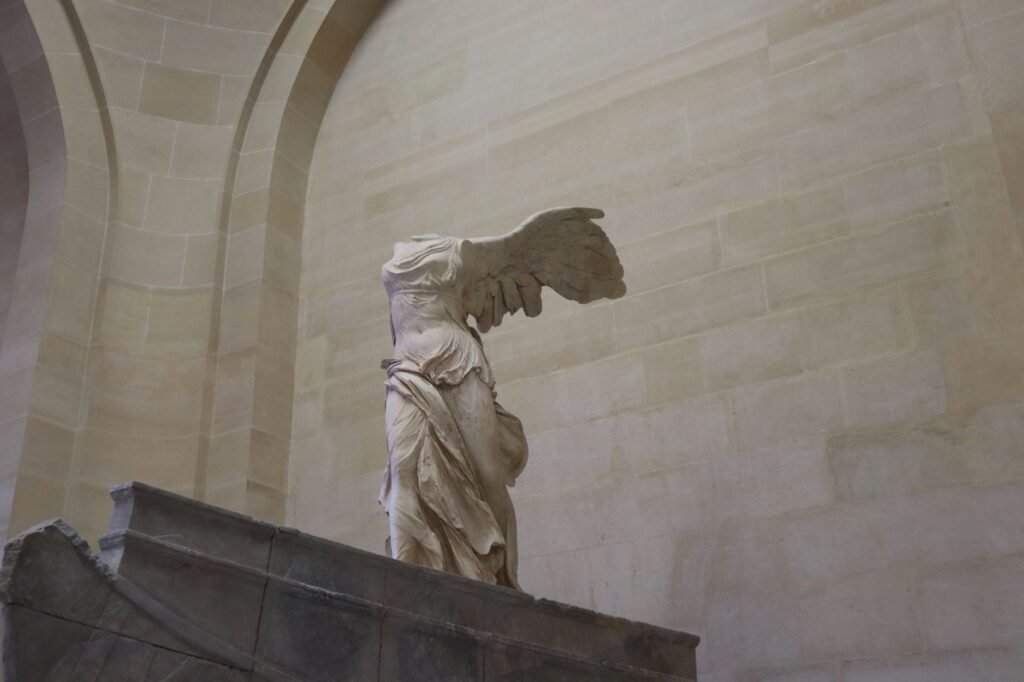
Nike’s Wings
Nike’s wings are among the most recognizable visual elements in Greek mythology and classical art. As the attribute of Nike, the Greek goddess of victory, wings symbolize speed, triumph, divine favor, and the sudden, fleeting nature of success. In ancient art, they help identify Nike immediately: she is not usually depicted as an enthroned Olympian, but as a swift, dynamic figure moving through battlefields, ritual scenes, and victory celebrations. Her wings also distinguish her from other female deities and highlight her unique role as a personification of victory itself.
Although Nike appears in many contexts across Greek and later Roman culture, her wings are especially important because they express the idea that victory arrives quickly, can depart just as fast, and belongs to the gods as much as to human effort. In literature, sculpture, vase painting, and coinage, Nike’s wings became a lasting emblem of triumph that continues to influence modern art, design, and political symbolism.
Origin and Meaning

The name Nike comes from the ancient Greek word νίκη (níkē), meaning victory. In Greek religion and poetry, Nike is both a goddess and an embodiment of victorious outcome. Her wings are not merely decorative; they are a visual extension of her nature.
The association of Nike with wings is rooted in Greek artistic tradition, where winged figures often represent beings who move between divine and human realms. Wings suggest:
- swiftness
- transcendence
- messenger-like mobility
- the temporary and changeable nature of fortune
- divine intervention in human affairs
The concept is older than the famous modern sports brand that later adopted her name and emblem. In antiquity, the winged Nike served as an icon of military success, athletic achievement, and civic glory.
Historical Context
Nike belongs to the broader world of Greek religion, where gods and divine personifications were not always sharply separated. She could function as a minor deity in her own right or as an aspect of Zeus, Athena, or other major figures associated with triumph.
Her prominence grew in the Archaic and Classical periods, when Greek city-states increasingly used divine imagery to celebrate military victories and public achievements. Winged victory became a powerful motif in:
- temple sculpture
- athletic prizes
- state coinage
- dedicatory monuments
- funerary and commemorative art
Nike’s wings were especially useful in visual culture because they made victory appear active and alive. Rather than presenting triumph as a static badge, artists showed Nike in motion, arriving to crown the victor, offering a wreath, or hovering above an important event.
In the Hellenistic period, the goddess continued to appear in more dramatic and elaborate forms, while in Roman times the image of winged Victory became even more widespread in public art and imperial propaganda.
Main Characteristics
Nike is generally portrayed as a youthful, graceful female figure with wings attached to her back. Her image varies depending on artistic style and medium, but several traits recur consistently.
Common visual features
- Wings: usually large and feathered, often spread or in motion
- Youthful body: a slender, athletic female form
- Dynamic posture: running, flying, leaning forward, or descending
- Victory symbols: wreaths, ribbons, palm branches, or trophies
- Light drapery: a flowing garment that emphasizes movement
Nike is not normally shown as a warrior with armor. Instead, she appears as the divine presence that confirms and rewards victory. Her wings are central to this role because they signal that she is not bound by ordinary human limits.
Artistic meanings of the wings
Nike’s wings communicate several layers of meaning at once:
| Meaning | Explanation |
|---|---|
| Speed | Victory comes suddenly and decisively |
| Mobility | Nike can appear wherever triumph occurs |
| Divine presence | She belongs to the realm of gods |
| Ephemerality | Success is glorious but can be temporary |
| Superiority | Flight places her above human conflict |
In many works of art, the wings also balance the figure visually, making her appear lighter and more elevated than surrounding mortals or deities.
Family and Genealogy
The genealogy of Nike varies across ancient sources, as often happens with divine personifications in Greek myth.
Most common traditions
The most widespread tradition identifies Nike as the daughter of the Titan Pallas and the oceanid Styx. In this account, she is one of several siblings associated with divine force:
- Kratos — strength or power
- Bia — force or violence
- Zelus — zeal or rivalry
- Nike — victory
This family line emphasizes abstract qualities that serve Zeus in the cosmic order.
Association with Zeus
Nike is also closely linked with Zeus. In some traditions, she lives near him or accompanies him as an emblem of his authority. Her presence reinforces the idea that victory is granted by divine power. She is not usually described as Zeus’s wife or daughter in the same simple way that other goddesses are tied into stable family narratives; rather, her role is functional and symbolic.
Association with Athena
Nike is also strongly associated with Athena, especially in her aspect as patron of strategy, civic order, and war craft. In Athens, the cult of Athena Nike united these divinities in a way that blurred strict genealogical categories. Here, Nike is less a family member than an attribute or companion of Athena.
Symbols
Nike’s wings are the most distinctive symbol connected with her, but they are part of a broader set of victory imagery.
Major symbols
- Wings: speed, transcendence, divine arrival
- Wreath or crown: the reward of victory
- Palm branch: triumph and celebration
- Ribbon or fillet: ceremonial honor
- Trophy: military success
- Torch: sometimes associated with ritual and celebration
- Altar or libation: sacrificial acknowledgment of divine favor
Meaning of the wings
The wings are not only identification markers. They also help express the unstable character of victory. In Greek thought, success is something that must be seized and honored before it passes. Wings visually suggest that Nike can come and go quickly, underscoring the fleeting nature of human achievement.
Colors
Ancient sources do not provide a fixed sacred color scheme for Nike’s wings. However, in later artistic tradition, white and gold are often used to suggest purity, brightness, and glory. These are artistic conventions rather than established ancient doctrines.
Sacred Animals
Nike is not strongly defined by a single sacred animal in the way that some major Olympian gods are. Still, ancient and later art sometimes connects her with animals associated with victory, speed, or divine power.
Associated animals and meanings
| Animal | Symbolic meaning |
|---|---|
| Horse | speed, competition, military power |
| Eagle | Zeus, height, divine authority |
| Lion | strength and dominance |
| Dove | later symbolic associations with peace or triumph, though not a core ancient emblem of Nike |
The eagle is particularly significant because of Nike’s association with Zeus. In visual language, both eagle and wings reinforce the idea of elevated divine force. Horses are also relevant in athletic and martial contexts, especially where victory in racing or combat is emphasized.
Sacred Plants
Nike is commonly connected with plants used in Greek victory rituals and public honors, though not all associations are exclusive to her.
Important plants
- Laurel: victory, honor, and poetic triumph
- Olive: peace and athletic reward, especially in panhellenic contexts
- Palm: triumph and festive celebration
Laurel and victory
The laurel wreath is one of the most enduring symbols of victory in the ancient Mediterranean. While laurel is more specifically tied to Apollo in some traditions, it also became a general marker of triumph. Nike often appears offering or wearing wreaths made from victorious foliage.
The use of plants in Nike’s imagery reflects the ancient belief that victory deserved visible, ceremonial recognition. A plant gathered from nature and transformed into a symbolic crown turned triumph into something both sacred and public.
Sacred Places
Nike did not have a single universal sanctuary comparable to the great panhellenic shrines of Zeus or Apollo. However, she was worshipped and honored in places where victory was politically and religiously important.
Major places associated with Nike
Athens
The most famous sanctuary linked with Nike is the Temple of Athena Nike on the Acropolis of Athens. This site is crucial for understanding Nike’s cult and imagery. Although dedicated primarily to Athena in her aspect as protector and victorious goddess, Nike was deeply integrated into the sanctuary’s religious meaning.
The temple commemorated Athenian strength and divine support, especially during and after the conflicts of the classical period. Its location on the Acropolis made it a visible symbol of civic power.
Samothrace
One of the most celebrated artworks of the ancient world, the Winged Victory of Samothrace, was found on the island of Samothrace. The island itself was an important religious center, especially associated with the Mysteries of the Great Gods. The statue is not a temple site in the same way as Athens, but it shows the importance of Nike’s image in monumental sacred settings.
Battle and victory monuments
Nike’s image also appears at sites tied to military commemorations. In these contexts, her wings emphasized the divine ratification of human success.
Powers and Attributes
Nike is a divine personification of victory, but in Greek religion this term includes more than military triumph.
Areas of influence
- Battle victory
- Athletic success
- Ritual and civic triumph
- Political legitimacy
- Public celebration
- Divine approval
Nike does not usually function as a creator goddess or a ruler of nature. Her power is specific and focused: she brings success, crowns the deserving, and marks outcomes as divinely sanctioned.
The significance of flight
Her wings symbolize not only movement but also authority from above. In Greek visual thought, what comes from the sky often carries divine significance. Nike’s flight marks her as a being who bridges heaven and earth, transferring victory from the gods to mortals.
Relationship to fortune and chance
Nike is sometimes discussed alongside concepts such as tyche (fortune) and dynamis (power). While these are not the same, the overlap shows that victory in antiquity was understood as a combination of skill, fate, and divine favor.
Main Myths
Nike is less central to mythic storytelling than many Olympian gods, but she appears in important episodes and symbolic narratives.
Nike and Zeus
In the mythic imagination, Nike is frequently connected with Zeus’s supremacy. She often accompanies him as a sign that his rule is victorious and secure. In some traditions, Zeus receives aid from the family of Styx, including Nike, during the struggle against the Titans. This reinforces her role as a supporter of cosmic order.
Nike and Athena
Nike’s most enduring mythic and cultic association is with Athena. Athena herself is linked to strategic warfare and city protection, while Nike represents the resulting triumph. In art, Nike sometimes stands in Athena’s hand or beside her, suggesting that victory is the reward of wisdom and discipline.
The Winged Victory of Samothrace
The famous Hellenistic sculpture known as the Winged Victory of Samothrace does not preserve a specific myth in narrative form, but it powerfully embodies Nike’s mythic identity. The statue suggests a victorious arrival, perhaps after a naval success, though the original dedication and precise event remain uncertain. Because the evidence is incomplete, modern interpretations differ.
Nike and competitions
In athletic and civic festivals, Nike appears as the divine force that crowns winners. These scenes are not always mythological in a narrative sense, but they are culturally central: they dramatize the idea that the gods witness and reward excellence.
Relationship with Other Mythological Figures
Nike’s relationships are defined more by function than by family drama, though both aspects matter.
Zeus
Nike is one of Zeus’s closest divine companions in art and myth. She represents the success of his order. When depicted near Zeus, she reinforces his authority over gods and mortals.
Athena
Her strongest cultic partner is Athena. Together, Athena and Nike unite wisdom, strategy, civic protection, and victory. The pairing is especially important in Athens.
Hermes
Nike’s wings sometimes create a visual comparison with Hermes, the winged messenger god. However, Hermes represents movement, communication, and boundary-crossing, while Nike represents victory. Their shared winged iconography does not mean they are equivalent.
Eros and other winged beings
Nike belongs to a broader visual world of winged divine figures, including Eros, Thanatos, and the Nike/Victory personifications of later antiquity. Unlike Eros, whose wings relate to desire, Nike’s wings are tied to public success and honor.
Worship and Cult
Nike was honored in ritual and civic contexts, especially where victory needed to be recognized and secured.
Forms of worship
- prayers before battle
- dedications after military victory
- offerings in athletic sanctuaries
- public monuments celebrating success
- festivals linked to city patron deities
Athena Nike in Athens
The cult of Athena Nike is one of the clearest examples of Nike’s religious significance. The Athenians honored the goddess in her victorious aspect, seeking protection and triumph in war. The sanctuary on the Acropolis likely served both devotional and political purposes.
Offerings
Offerings to Nike and related victory deities could include:
- wreaths
- libations
- small dedications
- inscriptions
- votive gifts after battle or competition
Because Nike represents success, dedications were often acts of thanksgiving rather than petitions alone.
Public function
Nike’s cult also functioned as propaganda in the ancient sense: it made victory visible, communal, and sacred. A city that honored Nike announced that its success was not accidental but divinely affirmed.
Ancient Sources
Nike appears in a range of classical sources, though usually as part of broader theological or artistic contexts rather than as the sole subject.
Literary sources
- Hesiod, especially in the Theogony, for divine genealogy and the family of Styx
- Homer, where victory and divine support are central themes, even when Nike herself is not always foregrounded
- Pindar, whose victory odes are especially important for understanding the religious meaning of triumph
- Aeschylus, Sophocles, and Euripides, where victory language and divine favor appear in dramatic contexts
- Apollodorus, for later mythographic summaries
Geographical and antiquarian sources
- Pausanias, who describes sanctuaries, statues, and cult practices
- Strabo, in broader discussions of sacred geography and civic cult
Artistic evidence
Because Nike is so strongly associated with visual culture, sculpture, vase painting, reliefs, and coinage are as important as literary texts. Some of the clearest evidence for her wings comes from art rather than from extended mythic narratives.
Roman Equivalent
The Roman equivalent of Nike is Victoria. Like Nike, Victoria was a personification of victory and was frequently shown with wings.
Differences and continuities
Roman Victoria retained many Greek features:
- wings
- wreaths
- palm branches
- triumphal associations
However, Victoria became especially prominent in the Roman state ideology of military success and imperial rule. She appears on coins, monuments, and in civic iconography as a symbol of Rome’s expansion and endurance.
The Roman adaptation strengthened the political meaning of winged victory. In this context, the wings of Victoria represented not only divine speed but also the far-reaching power of empire.
Influence on Modern Culture
Nike’s wings have had a lasting influence on modern culture, far beyond classical studies.
Art and sculpture
The Winged Victory of Samothrace remains one of the most famous sculptures in the world. Its image has inspired artists, museums, fashion, and design. The sense of forward motion created by the wings and drapery continues to be admired as a masterpiece of Hellenistic art.
National and political symbolism
Winged victory has often been used in:
- war memorials
- state monuments
- medals
- civic emblems
- commemorations of peace and triumph
The image can function in both military and non-military contexts, depending on the cultural setting.
Branding and commercial design
Nike’s wings are indirectly influential through the modern sports brand Nike, which takes its name from the goddess. Although the company’s famous swoosh is not a direct depiction of wings, its identity relies on the same association with speed, success, and performance.
Literature, film, and games
Nike appears in:
- retellings of Greek myth
- fantasy literature
- role-playing and video games
- films and television series about antiquity
Her winged form makes her instantly adaptable to modern visual storytelling. She often represents the reward for heroic struggle or the personification of achievement.
Curiosities
- Nike is one of the few Greek divine figures whose most important feature, her wings, is also her clearest identifier in art.
- The famous Winged Victory of Samothrace is missing both head and arms, yet remains one of the most recognizable ancient statues in the world.
- Nike is frequently shown bringing victory rather than fighting for it.
- In some ancient artworks, she appears so small relative to the gods she serves that her wings become the main sign of her identity.
- The cult of Athena Nike shows how Greek religion could merge distinct divine functions into a single sacred complex.
- Nike’s image helped shape later Western ideas of victory as something that can be celebrated through art, wreaths, monuments, and public ceremony.
Frequently Asked Questions
What do Nike’s wings symbolize?
Nike’s wings symbolize speed, divine arrival, transcendence, and the fleeting nature of victory. They show that success comes from the gods and can appear suddenly.
Is Nike the same as Athena?
No. Nike is a separate goddess or divine personification of victory, though she is closely associated with Athena and sometimes worshipped alongside her as Athena Nike.
Why is Nike usually depicted with wings?
The wings visually express her ability to move quickly between the divine and human worlds. They also help distinguish her from other female deities in art.
Does Nike appear in ancient myths?
Yes, but she is not usually the center of long narrative myths. She appears more often as a supporting divine presence, especially in relation to Zeus, Athena, and victory scenes.
What is the most famous image of Nike?
The most famous image is the Winged Victory of Samothrace, a celebrated Hellenistic sculpture in the Louvre.
Who is the Roman equivalent of Nike?
The Roman equivalent is Victoria, a winged personification of victory.
Was Nike worshipped as a goddess?
Yes. Nike was honored in Greek religion, especially in connection with military and civic victories, and through her association with Athena Nike in Athens.
Why is Nike important today?
Nike remains important because her image of winged victory continues to influence art, architecture, symbols of achievement, and modern branding.
Conclusion
Nike’s wings are one of the most enduring symbols of victory in world culture. In ancient Greece, they identified the goddess Nike as the divine power behind triumph in war, athletics, and civic life. More than a decorative feature, the wings conveyed speed, transcendence, and the fragile brilliance of success. Through sculpture, literature, worship, and later Roman adaptation as Victoria, Nike’s image became a lasting emblem of achievement and divine favor.
From the Acropolis of Athens to the Winged Victory of Samothrace, and from ancient coinage to modern branding, Nike’s wings have carried a powerful idea across centuries: victory is not only won, but also bestowed, celebrated, and remembered.

Orin Vale has spent the better part of two decades tracing the threads that connect the world’s oldest stories — from the halls of Asgard to the banks of the Nile, from Olympus to the jungles of the Maya. What began as a childhood fascination with flood myths and trickster gods grew into years of independent study across comparative mythology and ancient religion, always chasing the same question: what did these stories mean to the people who first told them? Orin writes for readers who want more than trivia — the ones looking for the beliefs, fears, and truths that myths were built to carry.