Introduction
Ops is the Roman goddess of abundance, agricultural wealth, and the productive power of the earth. In Roman religion, she was closely associated with fertility, harvest, prosperity, and the material plenty needed for communal survival. Although later Roman writers often connected her with the Greek goddess Rhea, Ops had a distinct place in Roman religious life, especially in relation to Saturn and the seasonal cycle of sowing and reaping.
Her importance lies not only in myth but also in the practical values of Roman society. As a deity of stored grain, earth’s bounty, and civic prosperity, Ops reflects the central role of agriculture in ancient Italy and the religious idea that wealth was a sacred gift requiring proper ritual respect. Her festival, the Opiconsivia or Opalia, was linked to the safe preservation of the harvest and the stability of the Roman community.
Origin and Meaning
The name Ops is generally connected with the Latin noun ops, meaning “help,” “means,” “resources,” or “wealth.” In this sense, the goddess personified abundance and the material supports of life. The same root appears in words such as opes (“resources, power, riches”) and in the Roman title Opulentia (“wealth, abundance”).
Ancient and modern scholars have noted that Ops was primarily an Italic and Roman deity rather than a direct borrowing from Greece. However, Roman religion often interpreted local gods through Greek parallels, and Ops was later identified with Rhea, the mother of the Olympians. This identification should be understood as a later interpretive equivalence rather than a simple replacement.
Historical Context
Ops belongs to the religious world of early Rome and central Italy, where the success of the harvest was vital to survival. Before Rome became a Mediterranean empire, its economy depended heavily on farming, storage, and the proper management of grain. A goddess of abundance was therefore not symbolic ornamentation but a religious expression of real economic dependence.
Her cult was integrated into the wider Roman system of state religion, in which gods were honored through festivals, sacrifices, and priestly observance to secure prosperity for the city. Ops was especially linked with Saturn, a god of sowing and the agricultural cycle. Their association suggests a balance between the forces of planting, growth, and preservation.
By the late Republic and Empire, Roman religion increasingly absorbed Greek interpretations. Writers such as Varro, Macrobius, and others helped preserve knowledge of Ops, though often through antiquarian discussion rather than active popular worship. Like many older Roman deities, her cult became more obscure over time but remained important in religious memory and scholarly tradition.
Main Characteristics
Ops is usually described as a matronly fertility and abundance goddess. She is not primarily a war deity, a sky goddess, or a moral lawgiver. Instead, her identity centers on nourishment, prosperity, and the earth’s productive capacity.
Core traits
- Abundance and plenty: she embodies stored resources and the success of the harvest.
- Agricultural fertility: her power extends to crops, grain, and the rhythms of the rural year.
- Protection of wealth: she is associated with secure reserves, not merely immediate consumption.
- Maternal imagery: in Roman interpretation, she often appears as a nurturing and sustaining figure.
Unlike some more dramatic deities of myth, Ops is fundamentally a stability goddess. Her significance is cumulative and practical: she represents what allows households, cities, and states to endure.
Family and Genealogy
Ancient sources and later interpretations provide a fairly consistent but not entirely uniform picture of Ops’ divine relationships.
Commonly attested relationships
| Relationship | Figure | Notes |
|---|---|---|
| Spouse | Saturn | Most commonly paired with Ops in Roman tradition |
| Greek equivalent | Rhea | Used in later interpretive or comparative accounts |
| Children | Jupiter, Juno, Neptune, Pluto, Ceres, Vesta | In Roman mythographic tradition, these correspond to the chief Olympian and major Roman/Greek deities |
The pairing of Ops and Saturn reflects a mythological logic in which the powers of sowing and stored abundance belong together. In some traditions, the children of Saturn and Ops are the major gods who later rule the world after Saturn’s overthrow. This genealogy is part of the broader Roman reception of Greek myth, especially the Titans and Olympians cycle.
It is important to note that genealogies vary by source. Roman authors did not always present a single standardized version, and some accounts emphasize interpretation rather than strict narrative consistency.
Symbols
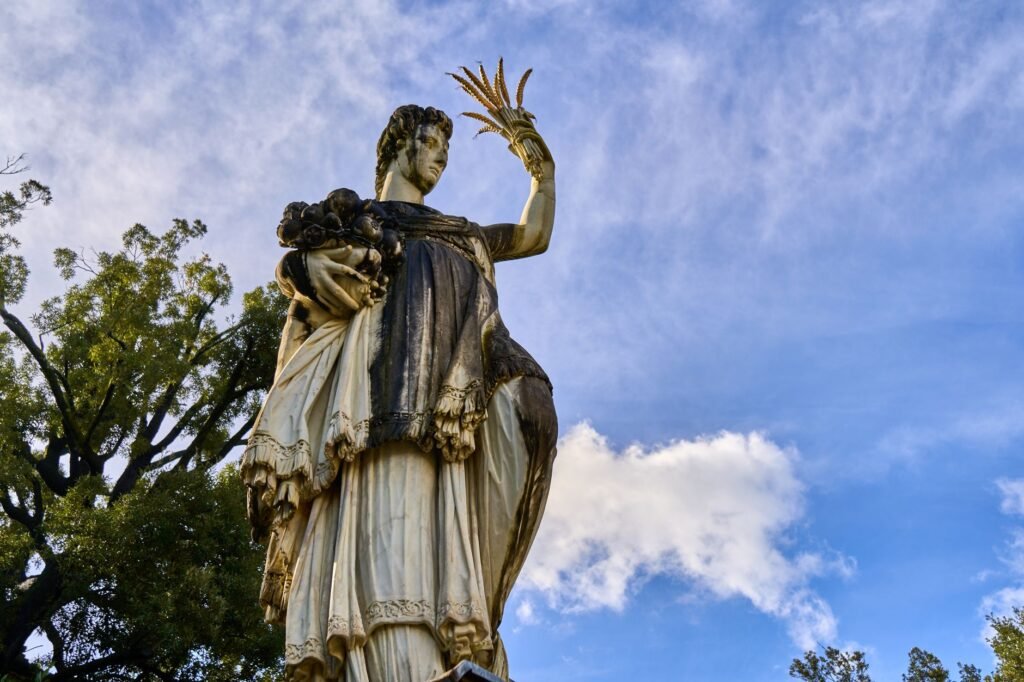
Ops is associated with symbols of agricultural wealth, fertility, and stored abundance. Unlike deities with strongly fixed iconography, her visual representation is less uniform in surviving ancient art and more strongly known through literary and ritual references.
Common symbols
- Cornucopia: the horn of plenty, a general symbol of abundance
- Sheaves of grain: representing harvest and agricultural prosperity
- Fruit and produce: markers of earth’s generosity
- Sitting or enthroned posture: suggesting stability and fecundity
- Veiled or matronly appearance: consistent with Roman depictions of dignified female divinities
The cornucopia is especially important, though it is also shared with other fertility and abundance deities. When associated with Ops, it expresses not simple luxury but the sacred availability of necessary resources.
Sacred Animals
Ancient sources do not preserve a strongly fixed set of sacred animals for Ops in the way that some Greek gods have well-defined animal associations. Nevertheless, certain animals fit her agricultural and fertility sphere.
Animals associated by symbolism
- Oxen: connected to farming, plowing, and productive labor
- Sheep and goats: linked to pastoral wealth and household resources
- Bees: occasionally relevant in broader fertility symbolism, though not uniquely tied to Ops
- Horses: less central, but related to wealth and status in Roman life
Because Ops is primarily a goddess of resources rather than a zoomorphic deity, animals should be understood as symbolic companions rather than exclusive sacred creatures.
Sacred Plants
Plants associated with Ops reflect her role in grain, fruitfulness, and agricultural abundance.
Key plants
- Wheat and grain: the most important crop-symbols for Roman agriculture
- Barley: another staple crop tied to sustenance
- Vines and grapes: in the broader context of fertility and seasonal plenty
- Olive: a general Mediterranean symbol of productivity and endurance
- Fruit-bearing trees: especially as emblems of harvest abundance
Grain is most closely connected with Ops because Roman food security depended on cereals. Her worship reflects the basic truth that the fertility of the land was not merely economic but religiously meaningful.
Sacred Places
Ops was not tied to one universally dominant sanctuary in the way that some major gods were. Still, the goddess had important places of worship in Rome, and her cultic presence was linked to significant sacred spaces.
Notable locations
| Place | Significance |
|---|---|
| Rome, on the Capitoline and in other temple contexts | Ops was honored in Roman religious life and state ritual |
| Regia | Some Roman festival activity and ritual traditions involving Ops were connected with priestly or state religious spaces |
| Temple of Saturn area | Because of her close association with Saturn, her cult was often understood in relation to his sacred precinct |
| Curia and state ritual settings | Festivals such as Opiconsivia were part of civic religion rather than private household worship alone |
The precise topography of Ops’ cult is less clearly preserved than that of some other Roman deities. This partly reflects the antiquity of her worship and the fragmentary survival of Roman religious records.
Powers and Attributes
Ops’ authority belongs to the sphere of fertility, harvest, stored abundance, and prosperity. She is not a goddess of battle, prophecy, or the underworld, though her power supports the entire civic order by ensuring survival and wealth.
Major domains
- Agricultural fertility
- Harvest success
- Storage and preservation of grain
- Material prosperity
- Household and civic abundance
- Earth’s productive power
In Roman thought, stored grain was not merely economic surplus; it was a sacred reserve that protected communities against hunger. Ops therefore represents the transition from field to granary, from seasonal growth to durable wealth. This makes her especially significant in societies where famine risk was real.
Main Myths
Ops does not possess a large independent myth cycle comparable to that of Jupiter, Venus, or Ceres. Most of her mythological importance comes through her role in the broader divine genealogy and in stories about Saturn and the gods.
Birth and family tradition
In Roman mythographic tradition, Ops is the wife of Saturn and the mother of the principal gods. Saturn, fearing the loss of power, devours his children as they are born. Ops is then associated with the concealment or saving of the youngest child, Jupiter, who later defeats Saturn. This narrative mirrors the Greek story of Rhea and Cronus.
Because Roman authors often adapted Greek myth, versions differ in detail. The central pattern, however, is stable: Ops functions as the mother who preserves the future of the divine order.
Agricultural and cultic associations
Another “mythic” dimension of Ops lies in her ritual meaning. She is not a goddess of adventure or transformation so much as of seasonal continuity. The symbolic story surrounding her is that abundance comes through proper cycles, careful storage, and divine favor.
Relationship with Other Mythological Figures
Ops’ most important relationship is with Saturn. Their pairing connects sowing, harvest, preservation, and the rhythms of time.
Key relationships
- Saturn: husband and agricultural counterpart; often a divine couple of fertility and time
- Rhea: Greek analogue in interpretive tradition
- Jupiter: son in Roman mythographic genealogy; associated with the rise of the new divine order
- Ceres: another major Roman grain goddess, with whom Ops shares agricultural territory but not identity
- Tellus/Terra: earth goddess figures that overlap with abundance and fertility
- Consus: an ancient Roman god of stored grain and hidden resources, often considered relevant to the same ritual world
Distinctions from Ceres and Tellus
Ops should not be reduced to Ceres. Ceres is more specifically the goddess of grain and agriculture in a broader sense, while Ops is often more directly associated with stored abundance, prosperity, and the secure resources of the community. Likewise, she is not simply Tellus, the earth, though all three belong to overlapping fertility traditions.
This overlap reflects the nature of Roman religion, where divine functions could intersect without being fully identical.
Worship and Cult
Ops was honored through official Roman rites that connected divine favor with agricultural prosperity. Her worship was largely public and civic, though it certainly had relevance for households, farmers, and landowners.
Festivals
The most important festivals associated with Ops were:
- Opiconsivia: celebrated on 19 August in honor of Ops Consiva, a form linked to stored grain and the completion of the harvest
- Opalia: usually associated with 14 December, a festival connected to Ops and her relation to Saturn
These observances reflect two moments in the agricultural cycle:
- the gathering and securing of abundance
- the winter period in which stored resources sustain the community
Ritual features
Ancient descriptions suggest that some rituals connected with Ops involved:
- offerings of produce or grain
- reverent observance by priests
- association with the Regia or other sacred civic spaces
- restrictions that emphasize the goddess’s hidden or inwardly protected nature
Ops was sometimes called Ops Consiva, a form linked to the storing or sowing of grain in concealed places. This suggests a ritual emphasis on the protected and preserved character of resources.
Cultic meaning
Her worship underscores the Roman belief that prosperity must be ritually secured. Plenty was not taken for granted; it required divine maintenance, correct observance, and gratitude.
Ancient Sources
Knowledge of Ops comes from a range of Roman literary and antiquarian sources rather than a single canonical myth.
Important ancient references
- Varro: valuable for Roman religion, antiquarian explanation, and festival lore
- Ovid: useful for Roman religious and mythological interpretation, especially in discussions of festivals
- Macrobius: a major source for Roman religious antiquarianism and Saturnalia-related traditions
- Livy: occasionally relevant for the broader religious and civic context of Roman ritual
- Festus and Paul the Deacon’s epitome: preserve lexical and antiquarian information
- Augustine: though critical of pagan religion, he preserves important references to Roman gods and cults
- Hyginus and mythographic traditions: contribute to genealogical and comparative accounts
Because Ops is an ancient Italic deity, some of the most informative evidence is indirect. Much of what is known comes from later Roman authors explaining older practices.
Roman Equivalent
Ops is sometimes identified with the Greek Rhea, mother of Zeus and consort of Cronus. This is the standard Roman interpretive equivalent, especially in mythographic contexts.
However, the equivalence should be treated carefully:
- Rhea is a figure from Greek myth with a Titan genealogy.
- Ops is a Roman and Italic goddess of abundance and resources.
- The Romans often merged them because of functional similarity and family roles.
The Roman adaptation preserves the maternal and generative aspect but emphasizes the agricultural and economic meaning of the goddess more strongly than the Greek tradition does in many contexts.
Influence on Modern Culture
Ops is less prominent in modern popular culture than major gods such as Jupiter, Venus, or Mars, but she remains significant in the study of Roman religion and myth.
Areas of modern influence
- Classical scholarship: Ops appears in studies of Roman agriculture, festival systems, and divine pairings
- Literature and historical fiction: Roman pantheons often include her as part of the Saturnian family
- Educational media: she is sometimes used to illustrate how Romans linked religion to agriculture
- Games and fantasy worldbuilding: Roman gods of harvest and prosperity occasionally appear in adaptations inspired by classical mythology
- Art and symbolic imagery: the cornucopia and harvest motifs associated with Ops continue to shape visual representations of abundance
Her significance in modern culture is often indirect, through the survival of Roman concepts of prosperity, harvest, and the sacred role of economic stability.
Curiosities
Lesser-known facts about Ops
- Ops was one of the Roman deities associated with hidden or stored wealth, not just visible bounty.
- Her festival Opiconsivia had a special connection with the storage of grain rather than only its harvest.
- The goddess’s name is etymologically related to the Latin idea of resources or means, which gives her a broader meaning than simple fertility.
- Ops was closely linked to Saturn, whose own festival, the Saturnalia, became one of Rome’s most famous celebrations.
- In Roman religion, the line between goddess of the earth, goddess of grain, and goddess of wealth was often fluid; Ops stands at this intersection.
- Later Roman writers sometimes treated older agricultural deities as if they were fully equivalent to Greek figures, even when the original Roman cult was more distinctive.
Frequently Asked Questions
1. Who was Ops in Roman mythology?
Ops was the Roman goddess of abundance, harvest, fertility, and stored wealth. She played an important role in Roman agricultural religion.
2. Is Ops the same as Rhea?
Not exactly. Roman authors often identified Ops with the Greek Rhea, but Ops was originally a Roman and Italic goddess with her own agricultural character.
3. What was Ops the goddess of?
She was associated with abundance, grain storage, prosperity, fertility, and the resources needed for survival.
4. Who was Ops married to?
Ops was most commonly described as the wife of Saturn.
5. What are the festivals of Ops?
The main festivals associated with her are Opiconsivia in August and Opalia in December.
6. What symbols are linked to Ops?
Common symbols include the cornucopia, grain, fruits, and other signs of harvest abundance.
7. Did Ops have a major myth of her own?
She does not have a large independent myth cycle, but she appears prominently in traditions about Saturn and the birth of the gods.
8. Why was Ops important to the Romans?
She represented the sacred side of agricultural prosperity, especially the secure storage of resources that protected the Roman community from hunger.
Conclusion
Ops occupies a distinctive place in Roman mythology as a goddess of abundance, agricultural fertility, and stored wealth. Her importance reflects the practical realities of ancient Roman life, where harvests, grain reserves, and productive land were essential to survival and state stability. Though later interpreted through Greek parallels, she remained an unmistakably Roman figure in her emphasis on resources, preservation, and civic prosperity.
As a companion of Saturn and a guardian of abundance, Ops embodies a core Roman idea: that prosperity depends not only on growth, but also on careful stewardship. Her legacy survives in the study of Roman religion, in the symbolism of plenty, and in the broader cultural memory of the ancient world’s sacred relationship between earth, wealth, and survival.

Orin Vale has spent the better part of two decades tracing the threads that connect the world’s oldest stories — from the halls of Asgard to the banks of the Nile, from Olympus to the jungles of the Maya. What began as a childhood fascination with flood myths and trickster gods grew into years of independent study across comparative mythology and ancient religion, always chasing the same question: what did these stories mean to the people who first told them? Orin writes for readers who want more than trivia — the ones looking for the beliefs, fears, and truths that myths were built to carry.