Introduction
Psyche is a figure from Greek mythology whose story has had extraordinary influence on literature, philosophy, art, and psychology. In the best-known version of the myth, Psyche is a mortal woman of exceptional beauty who becomes the beloved of Eros (Cupid in Roman tradition) and eventually attains immortality. Her tale is one of longing, trial, loss, trust, and transformation, and it remains one of the most enduring narratives of love and the soul in the ancient world.
Beyond mythology, the name psyche became a major term in later Western thought. In Greek, the word means both “soul” and “breath of life,” and over time it came to stand for the inner self, the life principle, and the human mind in philosophical and psychological traditions. Psyche is therefore important not only as a mythological heroine but also as a concept that shaped religious, literary, and intellectual history.
Origin and Meaning
The Greek word ψυχή (psychē) originally referred to the breath of life and, by extension, the soul or life force that departs from the body at death. In early Greek usage, the term could denote the vital principle rather than the modern idea of psychology. Later Greek philosophy expanded the meaning to include the immaterial essence of a person, and that broader sense strongly influenced both ancient and modern thought.
As a mythological figure, Psyche appears in the Greco-Roman tradition as a personification or embodiment of the soul. Her story is most fully preserved in Apuleius’s Metamorphoses (The Golden Ass), a Latin novel from the 2nd century CE. While the literary version is Roman, the name and conceptual background are Greek.
Historical Context
Psyche belongs to the cultural world of the ancient Mediterranean, where myths often explained natural phenomena, social values, and spiritual ideas. Her story combines several elements that were important in classical antiquity:
- Beauty as divine power and danger
- Marriage and female virtue
- Initiation through hardship
- The soul’s longing for divine union
- Transformation and immortality
The myth was shaped by long-standing Greek ideas about the soul and by later Hellenistic and Roman literary culture. Unlike major Olympian deities, Psyche is not primarily a goddess with a public cult in the archaic Greek religious sense. Instead, she is a literary and symbolic figure whose story gained prominence through later retellings.
In philosophical traditions, especially among Platonists, the soul’s journey toward truth and divine reality was a central theme. Psyche’s myth can be read in light of such concerns, although different ancient and modern interpreters have offered different meanings.
Main Characteristics
Psyche is generally portrayed as:
- Extraordinarily beautiful
- Mortal, not originally divine
- Curious and emotionally vulnerable
- Persistent and resilient
- Capable of growth through suffering
In the narrative tradition, her beauty is so great that it rivals that of Aphrodite/Venus, which provokes conflict. Yet her defining quality is not merely beauty. Psyche is also marked by trial, endurance, and eventual elevation. Her story typically emphasizes the soul’s movement from ignorance to knowledge, from separation to reunion, and from mortality to immortality.
Because Psyche is often interpreted allegorically, her most important characteristic is symbolic: she represents the human soul itself, especially the soul tested by desire, doubt, and discipline.
Family and Genealogy
Family details vary by source, since Psyche is not a central figure in the earliest surviving Greek mythic genealogies. In Apuleius’s account, she is a mortal princess with:
- Father: unnamed in the literary tradition, but often described as a king
- Mother: unnamed in the literary tradition
- Sisters: two elder sisters, whose envy plays a major role in the story
- Husband: Eros (Cupid), god of love
- Child: Voluptas or Hedone in Latin and Greek traditions, meaning “Pleasure” or “Delight”
This genealogical pattern is important because it reflects the allegorical structure of the myth: the soul (Psyche) united with love (Eros) produces pleasure or bliss. However, the exact names and emphases vary between authors and later interpreters.
Symbols
Psyche is associated with symbols that express transformation, soul, and immortality.
| Symbol | Meaning |
|---|---|
| Butterfly | A later and widespread symbol of the soul and metamorphosis |
| Wings | Spiritual ascent, freedom, or the soul’s movement |
| Lamp | Knowledge, revelation, and the danger of forbidden sight |
| Jar or casket | The descent into danger and the boundaries of mortal experience |
| Flowers | Beauty, fragility, and renewal |
The butterfly became especially important in later art because the Greek word psychē could also evoke the butterfly’s light, changing form. This connection strengthened the association between Psyche and the soul’s immortality.
Sacred Animals
Psyche is not tied to a broad animal cult in the way that some deities are, but certain animals became strongly associated with her in art and interpretation:
- Butterfly: The most important symbolic animal, representing the soul and transformation.
- Pigeon or dove: Sometimes associated with love and tenderness in broader classical imagery, though not uniquely hers.
- Bee: Occasionally linked in later symbolic traditions to soul, sweetness, and spiritual order, but not a primary ancient attribute.
Unlike major Olympian gods, Psyche does not have a fixed sacred animal tradition across all sources. The butterfly is the clearest and most enduring association.
Sacred Plants
Classical sources do not establish a strong and exclusive plant cult for Psyche. However, later artistic and symbolic traditions often connect her with plants linked to love, beauty, and transformation:
- Roses: Associated with love and beauty, especially in relation to Eros and Venus
- Myrtle: A plant of love and ritual purification in the ancient world
- Poppy: In some later symbolic interpretations, associated with sleep, dreams, and altered awareness
- Flowers in general: Emblems of delicate beauty and renewal
These associations are interpretive rather than strictly canonical. They reflect broader Greco-Roman symbolism rather than a formal cult of Psyche.
Sacred Places
Psyche is not known for ancient temples or major sanctuaries comparable to those of Olympian gods. Her “places” are primarily narrative landscapes and symbolic spaces in the myth.
Key Locations in the Myth
- The royal palace: Where Psyche lives before her trials and where her hidden union with Eros begins
- The mountain: Where she is abandoned and later receives instructions from the oracle or divine voice
- Venus’s realm: The environment of testing, labor, and hostility
- The underworld: The final and most dangerous site of her quest, where she seeks a beauty box from Persephone/Proserpina
Symbolic Significance
These locations represent stages of spiritual development:
- Palace: Innocence and hidden union
- Mountain: Separation and revelation
- Underworld: Death-like descent and endurance
- Olympian reunion: Immortality and restoration
Powers and Attributes
Psyche is not typically described as a goddess with independent cosmic powers. Her importance lies in what she represents and what she experiences.
Primary Domains
- The soul
- Beauty and desire
- Initiation through ordeal
- Transformation and rebirth
- Union between mortal and divine
Attributes in the Mythic Tradition
Psyche’s “powers” are not magical in the usual divine sense. Instead, she demonstrates:
- Resilience under hardship
- Capacity for trust and distrust
- Desire for knowledge
- Endurance in the face of tasks
- Readiness for immortality after purification
In philosophical readings, Psyche also becomes a figure for the soul’s struggle toward divine truth.
Main Myths
The story of Psyche is best known through Apuleius, but it draws on older mythic and symbolic themes.
The Beauty of Psyche
Psyche is so beautiful that people begin to honor her like Venus/Aphrodite. This arouses the goddess’s jealousy. In some versions, her beauty causes men to forget marriage and worship her instead of Venus, intensifying divine anger.
The Oracle and the Hidden Marriage
To resolve the problem, Psyche’s parents consult an oracle. She is told that she must be left on a mountain to meet a fearful bridegroom. There she is carried off by a gentle wind and brought to a magical palace, where an invisible husband visits her at night. He warns her not to look upon him.
The Sisters’ Deception
Psyche’s envious sisters persuade her to distrust her husband. They suggest that he may be a monster. Urged by curiosity and fear, Psyche uses a lamp to look at him while he sleeps. She discovers that he is the beautiful god Eros/Cupid. A drop of hot oil wakes him, and he flees.
The Trials of Psyche
Psyche then wanders in search of Eros and must submit to Venus’s hostile demands. In Apuleius’s version, Venus assigns her several seemingly impossible tasks, including:
- Sorting a great heap of mixed grains
- Obtaining golden wool from dangerous sheep
- Fetching water from a perilous source
- Descending to the underworld to retrieve a beauty box from Persephone/Proserpina
In each task, Psyche receives help from animals, voices, or divine intermediaries. These aids suggest that perseverance, not brute force, leads to success.
The Descent into the Underworld
Psyche’s descent is one of the most memorable episodes. She is instructed not to open the box she receives. However, her curiosity leads her to open it, and she falls into a death-like sleep. Eros later revives her.
Union and Immortality
After reconciliation, Eros pleads her case, and Zeus/Jupiter grants Psyche immortality. Their union becomes permanent, and Psyche gives birth to a child named Delight or Pleasure.
Interpretive Meaning
The myth has often been read as an allegory of:
- The soul’s fall into error
- The danger of curiosity without trust
- The necessity of suffering before wisdom
- The soul’s eventual union with divine love
Relationship with Other Mythological Figures
Psyche’s story is defined by her relationships.
Eros / Cupid
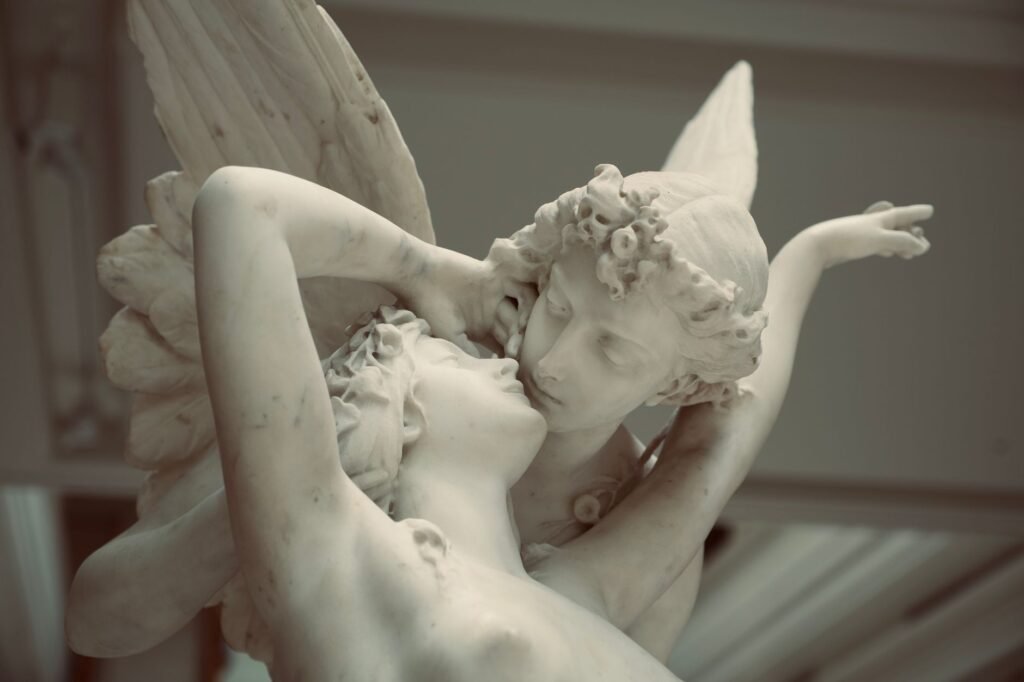
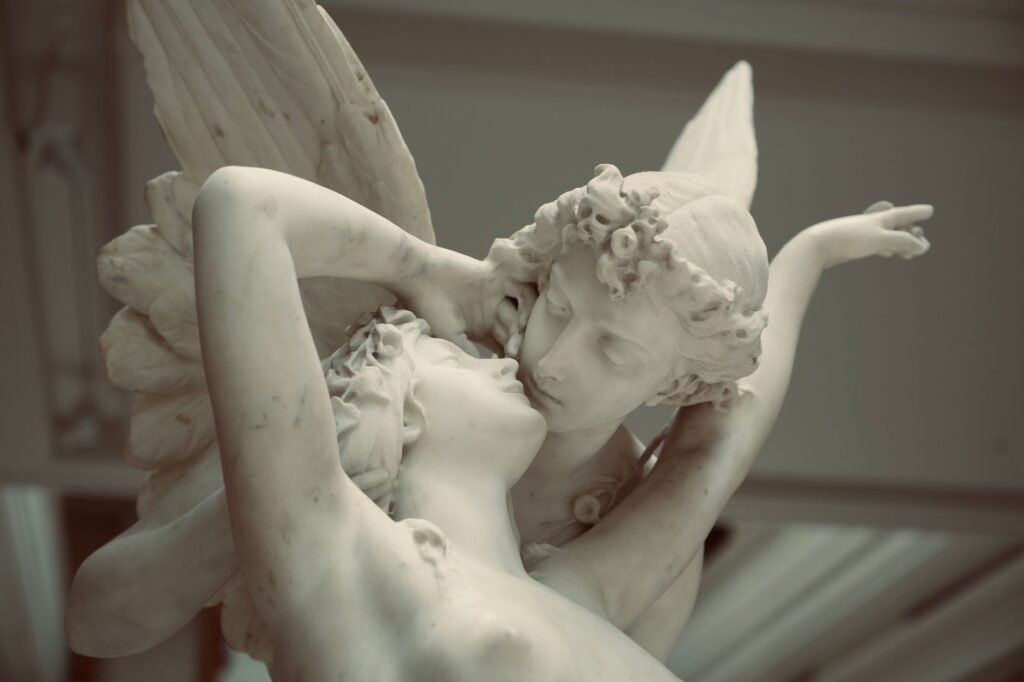
Eros is her husband and divine lover. Their relationship is central to the myth. At first, it is concealed; later, it becomes a model of union between love and soul. In artistic and literary traditions, they are often depicted together as a pair.
Aphrodite / Venus
Venus is Psyche’s chief antagonist in the Apuleian narrative. Her jealousy drives the trials. This conflict is not simply personal; it reflects tension between divine beauty, desire, and mortal excellence.
Her Sisters
Psyche’s sisters function as narrative foils. Their envy and skepticism contribute to her crisis. They represent the destructive power of distrust and social comparison.
Zeus / Jupiter
The supreme god resolves the conflict by granting Psyche immortality and sanctioning the marriage. This intervention elevates the story from romance to divine legitimation.
Persephone / Proserpina
The queen of the underworld appears in the final task, giving Psyche a beauty box. Her role connects Psyche’s story to death, descent, and return.
Worship and Cult
Unlike Athena, Hera, or Demeter, Psyche was not the center of a major pan-Hellenic cult in the ancient world. Her religious significance is more literary, philosophical, and symbolic than ritual.
Evidence for Cult
The evidence for direct worship of Psyche is limited and should be treated cautiously. Some later sources and interpretations suggest that she may have been honored in localized or informal ways, but she does not appear as a major cult deity in surviving archaic records.
Ritual and Symbolic Use
Psyche’s image and story became important in:
- Mystery-style interpretations of the soul
- Philosophical allegory
- Later artistic and moralizing literature
- Funerary symbolism, especially the butterfly as the soul
Because the surviving evidence is uneven, it is more accurate to say that Psyche influenced religious imagination rather than served as a major object of ancient public worship.
Ancient Sources
The most important ancient source for Psyche is:
- Apuleius, Metamorphoses (Books 4–6) — the fullest and most influential literary version of the myth
Other relevant ancient authors and traditions include:
- Pausanias — useful for Greek religious and local traditions, though not the main source for Psyche’s narrative
- Hyginus — later mythographic material, though accounts vary in completeness
- Platonist and philosophical writers — for the conceptual background of psyche as soul
- Later Latin and Greek mythographers — who preserve fragments or adaptations of the tale
It is important to note that Homer and Hesiod do not provide the well-known Psyche narrative found in Apuleius. The figure is rooted in the Greek word for soul, but the fully developed myth is preserved much later.
Roman Equivalent
Psyche does not have a direct Roman “equivalent” in the way that Zeus corresponds to Jupiter or Aphrodite to Venus. Rather, the Roman literary tradition adapts and preserves her as a figure named Psyche, while her lover Eros is often rendered as Cupid and Aphrodite as Venus.
In Roman culture, especially in Apuleius, Psyche becomes part of a Latin narrative that blends Greek myth, Roman literary style, and philosophical symbolism. Her story is therefore not a simple translation but a creative Roman reworking of Greek concepts.
Influence on Modern Culture
Psyche has had a major impact on modern literature, visual art, and psychological language.
Literature
The myth has inspired:
- Poetic retellings
- Symbolist and Romantic interpretations
- Fairy-tale adaptations
- Feminist and psychological readings
Writers have often focused on the themes of female agency, desire, curiosity, and initiation.
Art
Artists from the Renaissance onward frequently depicted:
- Psyche and Cupid sleeping
- Psyche discovering Cupid’s identity
- Psyche receiving help in her tasks
- The apotheosis of Psyche
The pair became especially popular in neoclassical and academic art.
Psychology
The word psychology derives from psyche plus logos (“study” or “discourse”). Although modern psychology is a scientific discipline distinct from ancient myth, the term preserves the ancient association of psyche with the inner life, consciousness, and soul.
Film, Television, and Games
Psyche and Eros/Cupid appear in adaptations and retellings across modern media, often as symbols of romantic conflict or the soul’s journey. The myth also influences fantasy storytelling, especially narratives involving trials, divine lovers, and forbidden knowledge.
Curiosities
- Psyche is one of the rare mythological figures whose name became a major term in both religion and science, through the words “soul” and “psychology.”
- The butterfly’s association with Psyche helped make it a long-lasting symbol of the soul in European art.
- Her story is often treated as a fairy tale within a novel, because Apuleius’s version contains many motifs familiar from folk narrative.
- The tasks imposed by Venus resemble initiation ordeals found in many cultures.
- Psyche is one of the clearest examples of a mythic figure whose meaning expanded dramatically in later philosophy and literature.
- In some interpretations, the myth is read as a story about trust versus curiosity, while others emphasize the soul’s maturation or female coming-of-age.
- The title Metamorphoses is especially fitting, since Psyche’s narrative is a story of transformation on multiple levels.
Frequently Asked Questions
Who was Psyche in Greek mythology?
Psyche was a mortal woman of exceptional beauty who became the beloved wife of Eros. Her myth is best known from Apuleius and symbolizes the soul’s journey toward divine union.
What does the name Psyche mean?
The Greek word psychē means “soul,” “breath of life,” or “spirit.” It later became central to philosophical and psychological vocabulary.
Is Psyche a goddess?
In the best-known myth, Psyche is not originally a goddess. She is a mortal who becomes immortal at the end of her story.
What is Psyche’s symbol?
Her main symbol is the butterfly, which represents the soul and transformation. She is also associated with a lamp, wings, and flowers.
Who was Psyche’s husband?
Psyche’s husband was Eros in Greek tradition, known as Cupid in Roman tradition.
Did Psyche have children?
Yes. In Apuleius’s version, she and Eros have a daughter named Voluptas or Hedone, meaning “Pleasure” or “Delight.”
Why is Psyche important today?
Psyche is important because she links mythology, philosophy, and psychology. Her story continues to shape ideas about love, the soul, and personal transformation.
Conclusion
Psyche is one of the most influential figures in classical mythology, not because she was a major goddess of public cult, but because her story captures enduring questions about the human condition. She represents the soul’s vulnerability and strength, the risks of curiosity, the trials of love, and the possibility of transformation through suffering.
From ancient literature to modern psychology, the name Psyche has remained powerful because it unites myth and concept. As a heroine, she is the soul in narrative form; as a symbol, she is a lasting image of inward life, desire, and immortality.

Orin Vale has spent the better part of two decades tracing the threads that connect the world’s oldest stories — from the halls of Asgard to the banks of the Nile, from Olympus to the jungles of the Maya. What began as a childhood fascination with flood myths and trickster gods grew into years of independent study across comparative mythology and ancient religion, always chasing the same question: what did these stories mean to the people who first told them? Orin writes for readers who want more than trivia — the ones looking for the beliefs, fears, and truths that myths were built to carry.