Introduction
The Twelve Labors of Heracles are among the most famous episodes in Greek mythology. They tell how Heracles, the greatest of Greek heroic figures, was required to perform a series of extraordinary tasks as penance for a violent madness that led him to kill members of his own family. The labors combine monster-slaying, wilderness exploration, and acts of endurance, and they became a defining model of heroic achievement in the ancient world.
The story is important for several reasons. In mythology, it establishes Heracles as a hero whose strength is matched by suffering and labor. In cultural history, it reflects Greek ideas about divine punishment, purification, kingship, and the limits of human endurance. In later literature and art, the Twelve Labors became a universal symbol of almost impossible tasks completed through courage and ingenuity.
Origin and Meaning
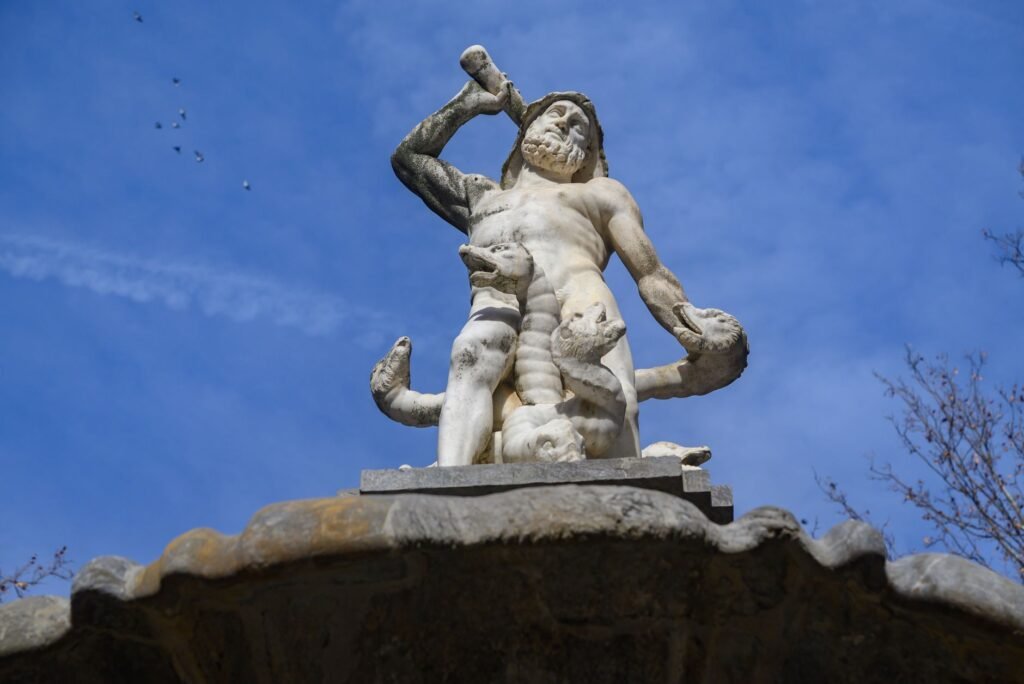
The name Heracles comes from Greek Hēraklēs (Ἡρακλῆς), commonly understood as meaning “glory of Hera” or “fame through Hera.” The irony of this name is central to his myth, since Hera is his principal divine persecutor.
The word labor in English translates the Greek idea of ponos or athlos: hard work, toil, and contest. The Twelve Labors are therefore not merely adventures; they are imposed trials of purification and service. In Greek tradition, they are often described as dodekathlos (“twelve tasks” or “twelve labors”), though ancient sources do not always present the same list in the same order.
The concept developed in the context of Greek heroic myth, where a hero’s worth could be tested through dangerous feats. Heracles’ labors probably crystallized over time from older local stories, temple traditions, and oral epic narratives. By the Classical period, the cycle had become one of the best-known mythic sequences in Greek culture.
Historical Context
The Twelve Labors belong to the broader world of Greek religion and heroic legend, especially the tradition of heroes who mediate between mortals and gods. Heracles was not a god in origin, but a hero whose extraordinary strength and suffering gave him a unique place in the religious imagination of the Greeks.
Several historical and cultural elements help explain the myths:
- Hero cult: Heracles was worshipped as a hero in many Greek cities.
- Purification through suffering: The labors function as punishment and cleansing after the killing of his wife and children, which in many traditions was brought about by Hera-induced madness.
- Monstrous frontiers: Many labors take place at the edges of the known world, reflecting Greek fascination with the wild, untamed, and foreign.
- Civilizing heroism: Heracles often removes dangers that threaten communities—beasts, bandits, monsters, and chaos.
The number twelve may reflect later systematization. Ancient sources do not all agree on the sequence, and some variants replace one task with another. For example, the cleansing of the Augean stables is sometimes not counted in the same way in early lists, and there are traditions in which different episodes receive greater or lesser emphasis.
Main Characteristics
The Twelve Labors are identified by several major characteristics:
- They are imposed by a superior power. Heracles performs them under the authority of King Eurystheus, usually at the command of Apollo through the Delphic oracle.
- They are intentionally difficult or impossible. Each labor requires exceptional strength, cunning, or endurance.
- They involve monsters and symbols of disorder. The tasks often feature lions, serpents, dogs, boars, birds, and other dangerous creatures.
- They move from the local to the cosmic. Heracles begins with a beast in the Peloponnese and eventually reaches the underworld and distant lands.
- They combine force and intelligence. Heracles is not only physically powerful; he also solves problems creatively.
The labors are not simply a list of feats. Together, they create a mythic biography in which a suffering hero overcomes chaos and gains immortality through trial.
Family and Genealogy
Heracles’ genealogy is central to his myth.
Parents
- Father: Zeus, king of the gods, in the most common tradition.
- Mother: Alcmene, a mortal woman of noble lineage.
Spouses and Children
Different sources give different accounts of Heracles’ marriages and offspring.
- Megara is commonly named as his first wife in Greek tradition; several children are associated with this marriage.
- Deianira is often described as a later wife, and her role is central to the story of Heracles’ death.
- Some traditions also mention Hebe, the goddess of youth, as his divine wife after his apotheosis.
Heracles had many children in mythology, and numerous Greek aristocratic families claimed descent from him. These descendants are often called Heracleidae.
Relatives and Conflicts
Heracles’ family relations are shaped by conflict:
- Hera, Zeus’s wife, is the divine enemy who opposes him from birth.
- Eurystheus, a distant cousin in many genealogies, becomes the king who assigns the labors.
- Iphicles, Heracles’ mortal half-brother, appears in some traditions as a close companion or contrast to him.
The family dimension of the myth is important because the labors begin after Heracles is driven into guilt and exile by the murder of his own children, an act later interpreted as caused by divine madness.
Symbols
Heracles is associated with several powerful symbols. In the context of the Twelve Labors, the most important are:
| Symbol | Meaning |
|---|---|
| Lion skin | Victory over the Nemean Lion; invulnerability and heroic identity |
| Club | Strength, simplicity, and direct force |
| Bow and arrows | Distant power, hunting skill, and deadly precision |
| Quiver | Martial readiness |
| Olive or wild laurel in some depictions | Victory, purification, or divine favor |
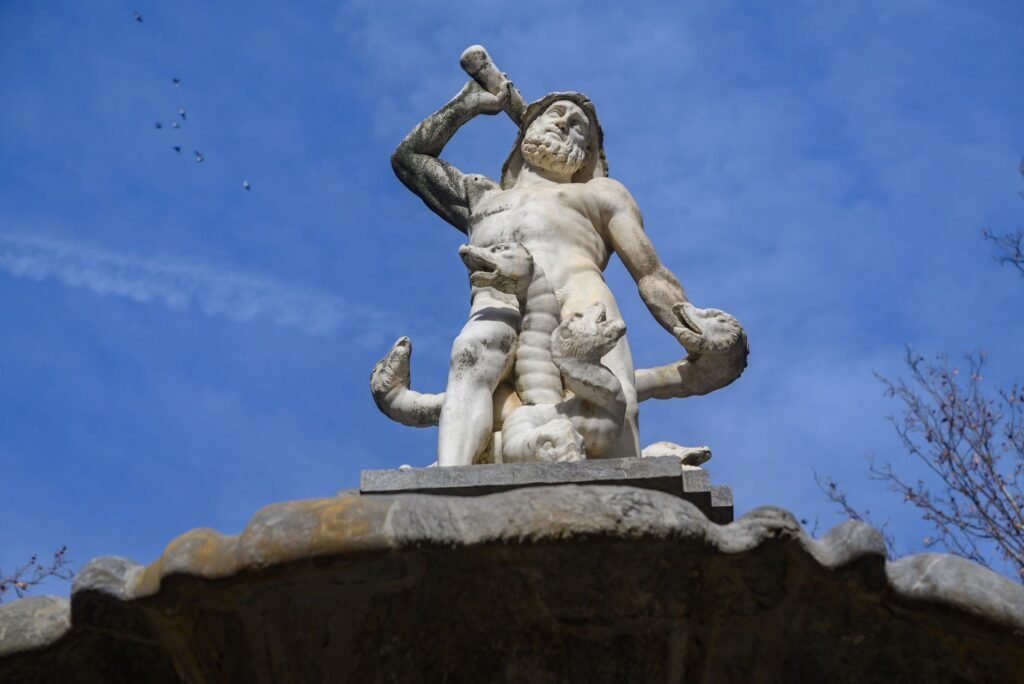
The Nemean lion skin became Heracles’ most famous emblem. In art, he is often shown wearing it as a hooded cloak. The skin signifies that he has tamed a creature impossible to wound with ordinary weapons and has transformed raw violence into heroic status.
Sacred Animals
Heracles is linked to several animals, especially those encountered during the labors.
The Lion
The Nemean Lion is the most famous sacred or symbolic animal associated with him. It represents untamed force and immunity to weapons.
The Hydra
The multi-headed Lernaean Hydra symbolizes regenerative danger and the persistence of chaos.
The Boar
The Erymanthian Boar and the Calydonian Boar in related myths represent destructive wildness.
The Cattle
The cattle of Geryon and Augeas symbolize wealth, labor, and the management of civilization’s resources.
Birds and Serpents
The Stymphalian birds and the snake-like dragon guarding the golden apples of the Hesperides show Heracles confronting creatures that threaten or guard the boundaries between order and disorder.
These animals are not “sacred” in the same way as animals of a mystery cult, but they are mythically significant and often appear in Heraclean iconography.
Sacred Plants
Heracles is not strongly associated with one dominant sacred plant in the way some deities are, but certain plants and vegetal symbols recur in his myth.
Olive
The olive tree appears in Greek heroic and athletic culture and is sometimes linked with Heracles in art and later interpretation.
Poplar
In some literary traditions, the poplar is associated with his time in the underworld or with symbolic wreaths.
Laurel and Wild Vegetation
Because Heracles often operates in wild landscapes, he is frequently connected to untamed nature rather than a single sacred plant. The gardens of the Hesperides, however, introduce the theme of extraordinary fertility and divine fruitfulness.
Sacred Places
The labors are connected to a wide geography across Greece and beyond.
Key Locations
| Place | Connection |
|---|---|
| Nemea | Site of the Nemean Lion |
| Lerna | Home of the Hydra |
| Erymanthus | Region of the boar hunt |
| Stymphalus | Lake of the Stymphalian birds |
| Crete | Location of the Cretan Bull |
| Thrace | Land of Diomedes’ man-eating horses |
| The Amazons’ lands | Place of the girdle of Hippolyta |
| Erytheia / far west | Site of Geryon’s cattle in many traditions |
| The Underworld | Venue of the descent for Cerberus |
| Olympia | Strong later association with Heracles, games, and cult |
Sanctuaries and Heroic Sites
Heracles was honored widely in sanctuaries, gymnasia, and local cult places. Some regions claimed particular connections to specific labors. His broad geographical presence helped make him a pan-Hellenic hero, not tied to one city alone.
Powers and Attributes
Heracles is not a god of a narrow domain. Rather, he is a hero of strength, endurance, and overcoming. The Twelve Labors emphasize a cluster of attributes:
- Physical power
- Martial courage
- Resilience under punishment
- Skill in hunting and combat
- Ingenuity in problem-solving
- Protection of human communities
Heracles also has a transitional status between mortal and divine. In later tradition, he is eventually received among the gods after death. This makes the labors a path toward transformation: by enduring suffering and performing impossible deeds, he moves toward immortality.
Main Myths
The Twelve Labors are usually explained as the result of a chain of events beginning with tragedy.
The Madness and the Oracle
In many versions, Hera causes Heracles to fall into madness, during which he kills his wife and children. Overcome by guilt, he seeks purification. The Delphic oracle instructs him to serve Eurystheus for a set period and complete a series of labors.
The Labors Themselves
The standard list includes the following:
| # | Labor | Brief description |
|---|---|---|
| 1 | Nemean Lion | Kill the invulnerable lion and bring back its skin |
| 2 | Lernaean Hydra | Slay the multi-headed serpent in the marshes of Lerna |
| 3 | Ceryneian Hind | Capture the sacred hind of Artemis alive |
| 4 | Erymanthian Boar | Capture the giant boar alive |
| 5 | Augean Stables | Clean the stables in a single day, often by redirecting rivers |
| 6 | Stymphalian Birds | Drive away or kill the dangerous birds of Lake Stymphalus |
| 7 | Cretan Bull | Bring back the bull from Crete |
| 8 | Mares of Diomedes | Tame or seize the man-eating horses of Diomedes |
| 9 | Girdle of Hippolyta | Obtain the belt of the Amazon queen |
| 10 | Cattle of Geryon | Bring the cattle from the far west |
| 11 | Apples of the Hesperides | Obtain the golden apples from the divine garden |
| 12 | Cerberus | Bring the three-headed dog of the Underworld to Eurystheus |
Important Variants
Ancient authors do not always give identical lists or explanations. In some traditions, Heracles performs more than twelve feats, while the final canon of twelve appears to be a later organizing framework. The Augean stables labor is especially variable in how it is counted. Some sources and later retellings also give different versions of the Amazon episode, the route to Geryon, or the means by which the apples are obtained.
Narrative and Symbolic Meaning of the Labors
The labors can be read as a sequence of symbolic victories:
- Wild beast mastery: Nemean Lion, Erymanthian Boar
- Poison and regeneration: Hydra
- Sacred capture rather than destruction: Ceryneian Hind, Cretan Bull
- Sanitation and civil order: Augean Stables
- Control of nature through cleverness: Stymphalian Birds
- Encounter with foreign lands and peoples: Amazons, Geryon
- Descent into death: Cerberus
Together, they trace a movement from local violence to cosmic struggle.
Relationship with Other Mythological Figures
Heracles interacts with many major figures of Greek myth.
Gods
- Zeus is his father and ultimate protector.
- Hera is his most persistent adversary.
- Athena often assists him in later iconography and some literary versions.
- Apollo is associated with the oracle that imposes the labors.
- Artemis is involved in the capture of the Ceryneian Hind.
- Poseidon and Hermes appear in various related episodes.
Mortals and Semi-Divine Figures
- Eurystheus serves as the weak king who commands Heracles.
- Omphale appears in later episodes after the labors, where Heracles is paradoxically compelled into servitude.
- Hippolyta of the Amazons figures in a labor that has many variants.
- Diomedes, Geryon, and Augeas are among the mortal or monstrous opponents.
Monsters
Heracles’ most enduring relationships are with monsters: lion, hydra, boar, birds, bulls, serpents, dogs, and giant cattle-thieves. His mythology repeatedly frames him as the one who confronts chaos where others cannot.
Worship and Cult
Heracles was widely worshipped in the ancient Greek world, though the labors themselves were not rituals. His cult had several important aspects:
- Hero cult and sacrifice: In many places, Heracles received offerings as a hero or, later, as a god.
- Gymnasia and athletic culture: He was especially linked to physical training and athletic achievement.
- Purification and protection: Some communities treated him as a guardian against danger.
- Festivals and local honors: Various cities celebrated Heracles with processions, athletic contests, or sacrifices, though practices differed regionally.
In cult, Heracles could appear as both a distant hero and a present protector. His mythic trials gave moral weight to his worship: he was not merely powerful, but proven.
Ancient Sources
The labors are preserved across a wide range of ancient literature, art, and commentary.
Key Literary Sources
- Homer mentions Heracles in the Iliad and Odyssey as a legendary figure of immense strength.
- Hesiod refers to Heracles in early epic contexts, though not as a fully standardized labor cycle.
- Apollodorus, in the Bibliotheca, is one of the most useful surviving sources for a structured account of the Twelve Labors.
- Pindar alludes to Heracles in a heroic and praise-poetic register.
- Euripides and Sophocles preserve dramatic traditions involving Heracles and his suffering.
- Diodorus Siculus offers historical-mythographic summaries.
- Pausanias records local traditions and cult details.
- Ovid, in the Metamorphoses and related works, adapts Heracles for Roman audiences.
Artistic Evidence
Greek vase painting, sculpture, and temple decoration also preserve Heraclean scenes. Visual art is important because it sometimes shows variants not identical to literary accounts.
Roman Equivalent
Heracles was adopted into Roman culture as Hercules. The Roman adaptation retained the hero’s strength, labor, and divine status, while fitting him into Roman religious and moral frameworks.
In Rome, Hercules became associated with:
- strength and discipline
- commercial prosperity
- protective power
- military virtue in some interpretations
Roman literature and art often reworked the labors as examples of endurance and conquest. The figure of Hercules became especially prominent in later European tradition, where he often represents the archetype of the strongman hero.
Influence on Modern Culture
The Twelve Labors of Heracles remain highly influential.
Literature
Writers have repeatedly retold the labors as epic adventure, symbolic psychology, or children’s mythology. Heracles appears as a model of heroic trial in poetry, novels, and retellings of classical myth.
Art
Painters and sculptors from antiquity to the modern period have depicted individual labors, especially the Nemean Lion, the Hydra, and Cerberus. The visual contrast between human and monster gives the cycle enduring artistic appeal.
Cinema and Television
Film and television frequently adapt Heracles/Hercules as a sword-and-sandal hero. These versions often simplify the labor cycle while retaining its basic structure.
Games
Video games and tabletop games use the Twelve Labors as a template for quests, bosses, and achievement structures. The idea of a hero completing a sequence of escalating challenges is directly inspired by the myth.
Popular Culture
The labors have become shorthand for an almost impossible series of tasks. The phrase “Herculean task” in English comes directly from this tradition.
Curiosities
- The Nemean Lion is often described as having skin that could not be penetrated by weapons, which is why Heracles resorts to strangling or overwhelming it.
- Heracles sometimes uses different methods in different sources to complete the same labor, showing that Greek myth was not fixed in a single canonical form.
- The Augean stables are famous not only as a cleaning task but also as an example of using engineering and river-diversion, not brute force alone.
- The Cerberus labor is one of the few that involves a journey into the Underworld and back.
- Heracles’ labor list may have been shaped by later editors or mythographers who wanted to impose order on a much older and less uniform body of stories.
- In some versions, the Apples of the Hesperides are obtained with the help of Atlas, showing Heracles relying on diplomacy and substitution rather than force.
- Heracles’ strength was so central to his image that later tradition often used him to symbolize human endurance against overwhelming odds.
- The labors appear frequently on Greek pottery, which helped standardize their visual recognition even when texts varied.
Frequently Asked Questions
1. Why did Heracles have to perform the Twelve Labors?
In the most common tradition, he had to do so as penance after killing his wife and children in a state of madness, often attributed to Hera’s hostility. The Delphic oracle instructed him to serve Eurystheus and complete the tasks.
2. Were the Twelve Labors always exactly twelve?
Not necessarily. Ancient sources vary, and the idea of a fixed set of twelve appears to be a later standardization of older myths and heroic episodes.
3. Which labor was the hardest?
Ancient sources do not agree on a single “hardest” labor. Modern readers often consider the Hydra, Cerberus, or Apples of the Hesperides among the most difficult because they combine danger, cleverness, and supernatural elements.
4. Did Heracles complete all the labors alone?
Usually he performs them himself, but some versions include help from gods, allies, or chance. For example, Athena or other figures may assist in certain episodes, and the exact role of helpers varies by source.
5. Why is the Nemean Lion so important?
The lion is the first labor in many versions and provides Heracles with his iconic lion skin. It establishes his identity as a hero who defeats a nearly invulnerable monster.
6. Is Heracles the same as Hercules?
Heracles is the Greek name; Hercules is the Roman form. They refer to the same mythic figure, though Roman tradition reshaped him in distinctive ways.
7. What do the labors symbolize?
They symbolize endurance, purification, mastery over chaos, and the transformation of suffering into glory. They also reflect the Greek heroic ideal of achieving fame through struggle.
Conclusion
The Twelve Labors of Heracles are one of the most enduring mythic cycles in world culture. They combine violence and discipline, suffering and achievement, the human and the divine. Through these labors, Heracles becomes more than a strongman: he becomes the hero who confronts disorder in every form, from wild beasts to monstrous guardians and the underworld itself.
Their lasting power lies in their versatility. Ancient Greeks could read them as heroic tales, moral exempla, or religious narratives of purification. Later cultures have seen in them a pattern of trial and triumph that remains instantly recognizable. As a result, the Twelve Labors continue to define Heracles—and the very idea of a herculean task—in the modern imagination.

Orin Vale has spent the better part of two decades tracing the threads that connect the world’s oldest stories — from the halls of Asgard to the banks of the Nile, from Olympus to the jungles of the Maya. What began as a childhood fascination with flood myths and trickster gods grew into years of independent study across comparative mythology and ancient religion, always chasing the same question: what did these stories mean to the people who first told them? Orin writes for readers who want more than trivia — the ones looking for the beliefs, fears, and truths that myths were built to carry.