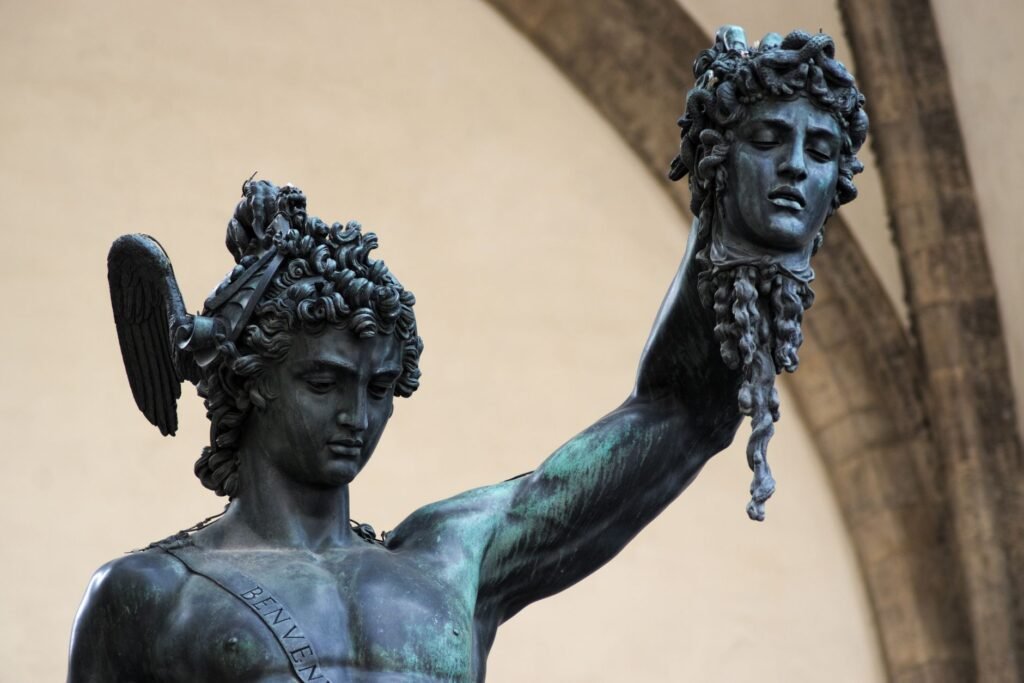
Perseus and Medusa
Introduction
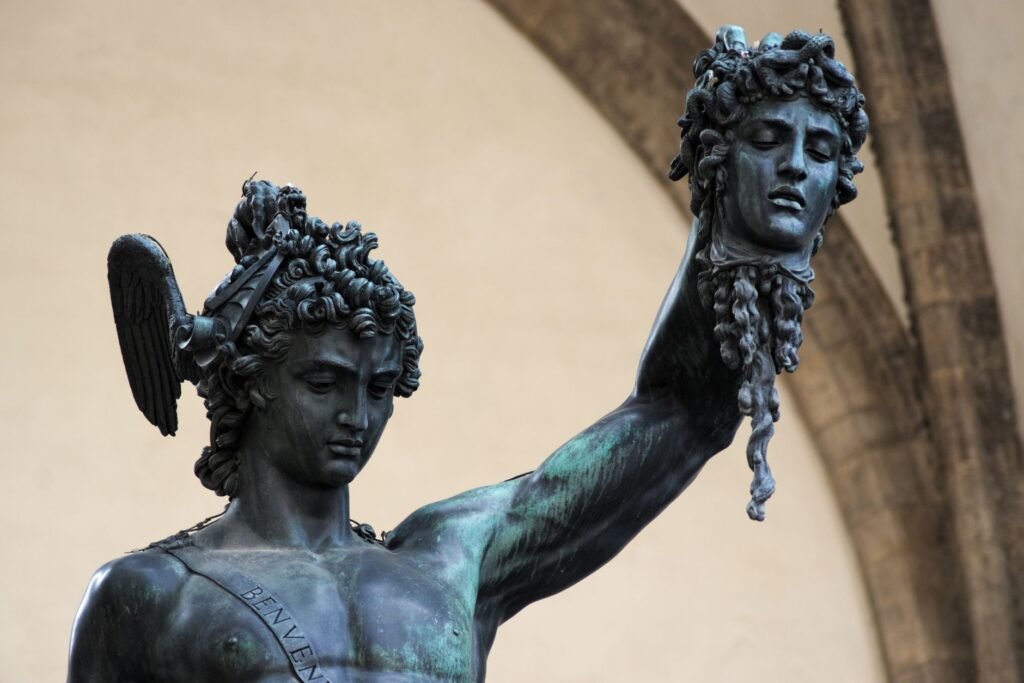
The story of Perseus and Medusa is one of the best-known episodes in Greek mythology. It combines adventure, divine intervention, heroic endurance, and a dramatic encounter with one of the most fearsome figures in ancient myth. Perseus, a heroic son of Zeus, is sent on a seemingly impossible mission: to bring back the head of Medusa, the only mortal Gorgon. With the help of the gods and a set of magical gifts, he succeeds.
This myth has had lasting importance in literature, visual art, religion, and popular culture. It has also become a rich symbol for themes such as peril, transformation, heroism, gaze, and the power of intelligence over brute force. Because the story survives in multiple ancient versions, it offers an excellent example of how Greek myth developed across generations of storytellers.
Origin and Meaning
Etymology of the names
The name Perseus is ancient Greek in origin, but its precise etymology is uncertain. Ancient and modern scholars have proposed different explanations, and no single derivation is universally accepted.
Medusa comes from the Greek Médousa (Μέδουσα), generally understood as “guardian” or “ruler,” from a verb meaning “to protect” or “to rule.” This etymology is often associated with her original role as a terrifying but meaningful mythic figure.
Historical origin
Perseus and Medusa belong to the mythic traditions of archaic Greece. The story was already known in early epic and genealogical poetry, and it later became fixed in classical literature through authors such as Hesiod, Apollodorus, and Ovid.
Medusa herself appears to have older roots than the later heroic narrative suggests. Scholars have often noted that she may preserve traces of an ancient apotropaic or protective deity whose image frightened away evil. The familiar tale of Perseus beheading her is therefore not just an isolated adventure, but part of a broader transformation of older religious imagery into heroic myth.
Historical Context
Greek myth and heroic narrative
The myth of Perseus belongs to the heroic age of Greek legend, a semi-divine past populated by kings, monsters, gods, and culture heroes. These stories were central to Greek identity, helping explain the origins of royal families, sanctuaries, city foundations, and ritual practices.
Perseus is one of the great Greek heroes alongside Heracles, Theseus, Jason, and Bellerophon. His story reflects several major mythological patterns:
- the hero born under divine circumstances
- the threatened child who survives despite danger
- the quest or impossible task
- the assistance of divine gifts
- victory over a monstrous adversary
- the founding of dynasties through heroic descent
Religious and cultural background
The Medusa story also reflects the Greek world’s concern with dangerous boundaries: life and death, human and divine, civilized and wild, visible and invisible. Medusa’s gaze, which turns living beings to stone, represents a terrifying power that must be managed rather than confronted directly. Perseus’ use of reflection instead of direct sight is one of the myth’s most famous features.
In art and ritual, Medusa’s face became an apotropaic image—something meant to ward off evil. This helps explain why her image appears on shields, temples, mosaics, and protective objects throughout the ancient Mediterranean.
Main Characteristics
Perseus
Perseus is usually presented as:
- a heroic son of Zeus and the mortal woman Danaë
- clever, brave, and resourceful rather than purely brute-force powerful
- favored by divine helpers
- an ancestor of major heroic and royal lines
He is often depicted carrying:
- the harpe or curved sword
- the kibisis, a bag or pouch for Medusa’s head
- winged sandals
- the cap of invisibility or helmet of Hades
- sometimes the reflective shield provided by Athena
Medusa
Medusa is one of the three Gorgons, usually described as the only mortal one. In later literary tradition she is a monster with:
- snakes for hair
- a terrifying face
- a gaze that turns onlookers to stone
- sometimes wings, tusks, or a protruding tongue in artistic representations
However, older and more varied traditions sometimes present the Gorgons more broadly and do not always emphasize the later monstrous female form in the same way. The famous image of Medusa as a snake-haired monster is therefore a developed mythic and artistic tradition, not necessarily a single fixed original form.
Family and Genealogy
Perseus’ family
Perseus is the son of:
- Zeus, king of the gods
- Danaë, daughter of King Acrisius of Argos
According to the myth, Acrisius had been warned by prophecy that his daughter’s son would kill him. To prevent this, he imprisoned Danaë, but Zeus reached her in the form of a shower of gold. After Perseus was born, Acrisius placed mother and child in a chest and cast them into the sea.
Perseus later becomes the husband of:
- Andromeda, whom he rescues from a sea monster
Children attributed to Perseus and Andromeda include, in various traditions:
- Perses
- Alcaeus
- Heleus
- Mestor
- Sthenelus
- Electryon
These descendants are important because they connect Perseus to major heroic lines, especially the Heraclid and Persid genealogies in later Greek tradition.
Medusa’ genealogy
Medusa’s family is more complex and varies by source. The most common ancient account names her parents as:
- Phorcys
- Ceto
These are sea deities or primeval divinities. Medusa is one of the three Gorgon sisters:
- Stheno
- Euryale
- Medusa
In some traditions, Medusa is not simply a monster but was once beautiful before being transformed. This version is most strongly associated with later Roman literature, especially Ovid.
Children of Medusa
Although Medusa is slain, she is also said to be the mother of two famous offspring conceived with Poseidon:
- Pegasus, the winged horse
- Chrysaor, a warrior or mythical figure whose name means “golden sword”
These children emerge from her body at the moment of death in many accounts. Their birth reinforces the myth’s paradoxical structure: death produces life, and monstrosity gives rise to wonder.
Symbols
The Perseus and Medusa myth is rich in symbols that have remained influential for centuries.
| Symbol | Meaning |
|---|---|
| Medusa’s head | Protective power, fear, death, apotropaic force |
| Reflective shield | Indirect vision, intelligence, strategy |
| Winged sandals | Speed, divine assistance, mobility between worlds |
| Cap of invisibility | Concealment, divine favor, liminal power |
| Harpe or curved sword | Heroic action, decisive violence |
| Stone | Petrification, death, the transformation of living flesh into fixed matter |
| Blood of Medusa | Ambivalent creative and destructive power |
The gaze
One of the strongest symbolic elements is the gaze. Medusa kills through sight, while Perseus survives by avoiding direct visual contact. The myth therefore dramatizes a conflict between looking and not looking, knowledge and danger, confrontation and mediation.
The head as a trophy
The severed head of Medusa becomes an object of power. In Greek and Roman art, the Gorgon head often appears as a decorative and protective emblem, showing that what is terrifying can also be domesticated into a symbol of defense.
Sacred Animals
The Perseus and Medusa cycle is not centered on a large cult of sacred animals, but several animals are closely connected to the myth.
Key associated animals
- Horse: Pegasus is the most important animal connected to Medusa.
- Snake: Medusa’s serpentine hair symbolizes danger, chthonic power, and transformation.
- Sea creatures: The parents of Medusa and the monster threatened Andromeda are linked to the sea, emphasizing the myth’s maritime associations.
- Birds and winged beings: Perseus’ winged sandals and Pegasus connect the story to flight and divine movement.
The snake is especially significant because it links Medusa to both protection and threat. In Greek art, snake imagery often carried chthonic or regenerative associations as well as a frightening dimension.
Sacred Plants
There are no universally recognized sacred plants directly and uniquely associated with Perseus and Medusa in the way that olive is associated with Athena or laurel with Apollo. However, some vegetal and natural motifs appear in artistic and literary treatments of the myth.
Associated natural motifs
- Reeds and coastal vegetation may appear in scenes of Perseus’ journey.
- Coral is sometimes poetically linked to the myth of Medusa, because ancient writers explained its formation as arising from Medusa’s blood or from contact with her power.
- Flowers and garlands may be used in later artistic depictions of heroic triumph, though these are not specific cult plants.
The myth’s plant associations are therefore indirect and largely literary or symbolic rather than cultic.
Sacred Places
Regions linked to Perseus
Perseus is associated with several important Greek and Mediterranean locations:
- Argos: connected with his birth and the prophecy involving Acrisius
- Seriphus: the island where Perseus and Danaë arrive and where King Polydectes sends Perseus on the quest
- Aethiopia: the realm of Andromeda in many versions, where Perseus rescues her
- Tiryns and Mycenae: later linked to his descendants and to the heroic royal genealogy
- Joppa: in later local traditions associated with the rescue of Andromeda, especially in the eastern Mediterranean
Medusa and the Gorgons
The Gorgons are usually placed at the edge of the world, in a remote and liminal region. Ancient sources vary on their location, but they are often imagined as dwelling:
- in the far west or near Ocean
- among lands beyond ordinary human civilization
- in a terrifying, inaccessible territory
This remoteness reflects the mythic function of monsters as beings inhabiting the boundary between the known world and the unknown.
Powers and Attributes
Perseus’ heroic qualities
Perseus does not possess innate magical power in the same way a god might, but he benefits from divine support and exceptional fortune. His key attributes are:
- courage
- intelligence
- obedience to divine counsel
- adaptability
- endurance
- strategic thinking
His success depends on tools and guidance from the gods, especially Athena and Hermes. This makes him a particularly Greek kind of hero: not just strong, but clever and favored by divine order.
Medusa’s powers
Medusa’s defining power is her petrifying gaze. In the later tradition, anyone who looks directly at her face turns to stone. This power marks her as a being of terrible liminality.
Other associated qualities include:
- monstrous appearance
- chthonic or underworld associations
- the ability to inspire awe and terror
- posthumous power through her head, which remains dangerous and useful after death
Main Myths
The birth of Perseus
The myth begins with a prophecy. Acrisius, king of Argos, is told that he will die at the hands of his daughter’s son. To prevent this, he confines Danaë. Zeus visits her, Perseus is born, and the king later tries to dispose of them by casting them into the sea in a chest. They survive and reach Seriphus.
The impossible task
Perseus becomes involved in the main quest through King Polydectes of Seriphus, who wishes to remove him. In many versions, Polydectes demands gifts from his nobles, and Perseus, lacking a suitable offering, promises to bring the head of Medusa. The request is effectively a death sentence.
Divine assistance
Athena and Hermes help Perseus. The typical elements of the quest include:
- the Graeae, whom Perseus outwits in order to obtain information
- the Nymphs, who provide magical items in some versions
- Athena’s polished shield
- Hermes’ sword or advice
- the helmet of Hades, which grants invisibility
The exact sequence varies among sources, but the overall pattern is stable: Perseus succeeds through divine aid and cunning.
The slaying of Medusa
Perseus approaches the sleeping Gorgons without looking directly at them. He uses the shield as a mirror and decapitates Medusa with a single strike. This is the central dramatic moment of the myth.
From Medusa’s severed body emerge:
- Pegasus
- Chrysaor
Perseus places Medusa’s head in his pouch and uses its power later as a weapon.
Rescue of Andromeda
On his return journey, Perseus encounters Andromeda, chained as a sacrifice to a sea monster. He kills the monster and marries her. This episode creates another major heroic pattern: the monster-slayer as rescuer and future dynastic founder.
The fulfillment of prophecy
Perseus eventually causes the death of Acrisius, fulfilling the oracle despite his own innocence in the matter. Different traditions give different details, but the key point remains that fate cannot be escaped. This ending is typical of Greek myth, where prophecy often determines the outcome even when it is resisted.
Relationship with Other Mythological Figures
Athena
Athena is one of Perseus’ most important divine allies. She is associated with wisdom, strategy, and reflected vision. Her role in the Medusa episode is especially significant because she provides the reflective shield and later incorporates the Gorgon head into her own iconography.
Hermes
Hermes assists Perseus as messenger and guide. His involvement emphasizes travel, mediation, and cleverness.
Zeus
Zeus is Perseus’ divine father and the source of his heroic status. His intervention in Danaë’s story initiates the entire mythic chain.
Danaë
Danaë is central to the family narrative. Her confinement, divine visitation, and survival establish Perseus’ legitimacy and divine lineage.
Medusa
Medusa is both opponent and victim. In ancient tradition she is usually a monster to be slain, but some later versions invite sympathy by presenting her as transformed from beauty to monstrosity. This variation has made her one of the most reinterpreted figures in classical myth.
Andromeda
Andromeda is Perseus’ rescued bride. Her story has often been linked with themes of sacrifice, vulnerability, and dynastic marriage.
Polydectes
Polydectes functions as a rival or antagonist. He drives the quest for Medusa’s head and is later punished when Perseus returns.
Worship and Cult
Hero cult and religious memory
Perseus was not worshiped as a god in the same way as Zeus or Athena, but he could receive hero cult in some local traditions. Hero cult honored legendary figures at tombs or shrines as powerful ancestors or protectors.
Medusa, by contrast, was not the focus of widespread worship in historical Greece. However, her image had strong apotropaic value. The Gorgon head appears on temples, armor, coins, and household objects as a protective device.
Ritual significance
There is no single universal cult of Perseus and Medusa, but their imagery was used in ways that may have served ritual protection:
- Gorgon masks or heads on shields and buildings
- protective amulets
- temple decoration designed to repel evil
- heroic genealogies tied to local identity
This means the myth mattered not only as story but also as visual and symbolic protection.
Ancient Sources
Several ancient authors preserve key versions of the myth.
Major sources
- Hesiod, especially the Theogony, for the Gorgons, their genealogy, and the birth of Pegasus and Chrysaor
- Homer, who alludes to Gorgon imagery and the power of terror associated with her image
- Apollodorus, Bibliotheca, for a systematic prose account of Perseus’ quest
- Pausanias, for local traditions, monuments, and cultic references
- Ovid, Metamorphoses, for a highly influential Roman retelling, especially the transformation of Medusa and the broader narrative of Perseus
- Pindar, who references heroic genealogies and mythic exploits
- Euripides and later tragedians, indirectly through mythic allusions, although the full Perseus-Medusa tale is not preserved in a complete surviving tragedy
Variation among sources
Ancient versions differ on several points:
- the role of the Graeae
- which divine gifts Perseus receives
- whether Medusa was always monstrous or was transformed
- the location of the Gorgons
- the precise circumstances of Acrisius’ death
These differences are normal in Greek mythology and should not be treated as contradictions that invalidate the myth. Instead, they show the flexibility of traditional storytelling.
Roman Equivalent
There is no exact Roman equivalent to Perseus, because he is fundamentally a Greek hero. However, Roman authors adopted and adapted his story, especially through Ovid.
In Roman literature, Perseus remains Perseus, but the myth is reframed with greater emphasis on transformation, eloquence, and artistic spectacle. Medusa likewise remains Medusa, though Roman interpretation often makes her story more psychologically complex, especially in Ovid’s version.
The Roman world also transformed the Gorgon head into a widely used decorative motif in architecture, mosaics, jewelry, and military imagery.
Influence on Modern Culture
The myth of Perseus and Medusa remains highly visible in modern culture.
Literature and scholarship
Writers and poets continue to revisit the myth because it offers layered themes:
- the nature of monstrosity
- the ethics of heroism
- the politics of the gaze
- the relationship between beauty and violence
- the tension between fate and choice
Modern classical scholarship has also examined Medusa as a figure of ritual, gender, iconography, and reception.
Visual art
The story has inspired artists from antiquity to the present. Famous visual treatments include:
- Greek vase painting
- Roman mosaics
- Renaissance and Baroque paintings
- neoclassical sculpture
- modern and contemporary reinterpretations of Medusa as both monster and victim
Film, television, and games
Perseus and Medusa appear frequently in:
- fantasy films
- adventure stories
- animated adaptations of Greek myth
- role-playing games
- video games
- comics and graphic novels
The image of the Gorgon is especially adaptable in modern fantasy because it combines danger, magic, and striking visual identity.
Popular symbolism
Today Medusa’s head often functions as a general symbol of:
- danger
- female rage or power, depending on interpretation
- protective force
- ancient mystery
- the transformation of fear into art
Curiosities
- Medusa is the only mortal Gorgon in the best-known ancient version.
- The famous phrase “don’t look directly at her” is a modern summary of a much older mythic pattern involving reflected vision.
- Perseus is one of the rare Greek heroes whose most famous victory depends heavily on tools and guidance, not just strength.
- The blood of Medusa had contradictory powers in ancient tradition: it could be deadly, but it was also associated with life and cure in some later accounts.
- Athena’s use of the Gorgon head in her own iconography shows how a monster’s image could be turned into a protective divine symbol.
- In some ancient local traditions, the story of Perseus and Andromeda was linked to specific coastal landscapes and monuments.
- The myth helped explain the origin of Pegasus, one of the most enduring creatures in Greek mythology.
Frequently Asked Questions
Who was Perseus in Greek mythology?
Perseus was a Greek hero, son of Zeus and Danaë, best known for killing Medusa and rescuing Andromeda.
Who was Medusa?
Medusa was one of the Gorgons. In the most familiar version, she had snakes for hair and could turn people to stone with her gaze.
Why did Perseus kill Medusa?
In the myth, Perseus was sent to bring back Medusa’s head, often as part of a deadly challenge set by King Polydectes. The task was meant to be impossible.
How did Perseus defeat Medusa?
He used divine gifts, especially Athena’s reflective shield, to avoid looking directly at Medusa. This allowed him to approach safely and cut off her head.
What was born from Medusa’s blood?
In the traditional account, Pegasus and Chrysaor emerged from Medusa’s body after she was slain.
Was Medusa always a monster?
Not necessarily in every tradition. Some later accounts, especially Roman ones, suggest she was once beautiful before being transformed. Earlier sources focus more on her monstrous nature.
Why is Medusa’s head so famous in art?
Because it became an apotropaic symbol, meaning it was believed to ward off evil. Artists and builders used it as a protective image.
Is Perseus worshiped as a god?
No. He was honored in some places as a heroic ancestor or local hero, but he was not a major Olympian god.
Conclusion
The myth of Perseus and Medusa remains one of the most enduring narratives from Greek mythology because it combines adventure, terror, divine aid, and symbolic depth. Perseus represents the heroic triumph of intelligence and courage, while Medusa embodies the ambiguous power of the monstrous, the sacred, and the protective. Their story has been retold for over two millennia because it speaks to universal themes: fate, danger, the limits of vision, and the transformation of fear into meaning.
As both a literary tradition and a cultural symbol, Perseus and Medusa continue to shape how the ancient world is imagined. Their myth survives not only in texts but also in art, architecture, psychology, and modern storytelling, making it one of the most influential episodes in the whole of classical mythology.

Orin Vale has spent the better part of two decades tracing the threads that connect the world’s oldest stories — from the halls of Asgard to the banks of the Nile, from Olympus to the jungles of the Maya. What began as a childhood fascination with flood myths and trickster gods grew into years of independent study across comparative mythology and ancient religion, always chasing the same question: what did these stories mean to the people who first told them? Orin writes for readers who want more than trivia — the ones looking for the beliefs, fears, and truths that myths were built to carry.