Trident of Neptune
Introduction
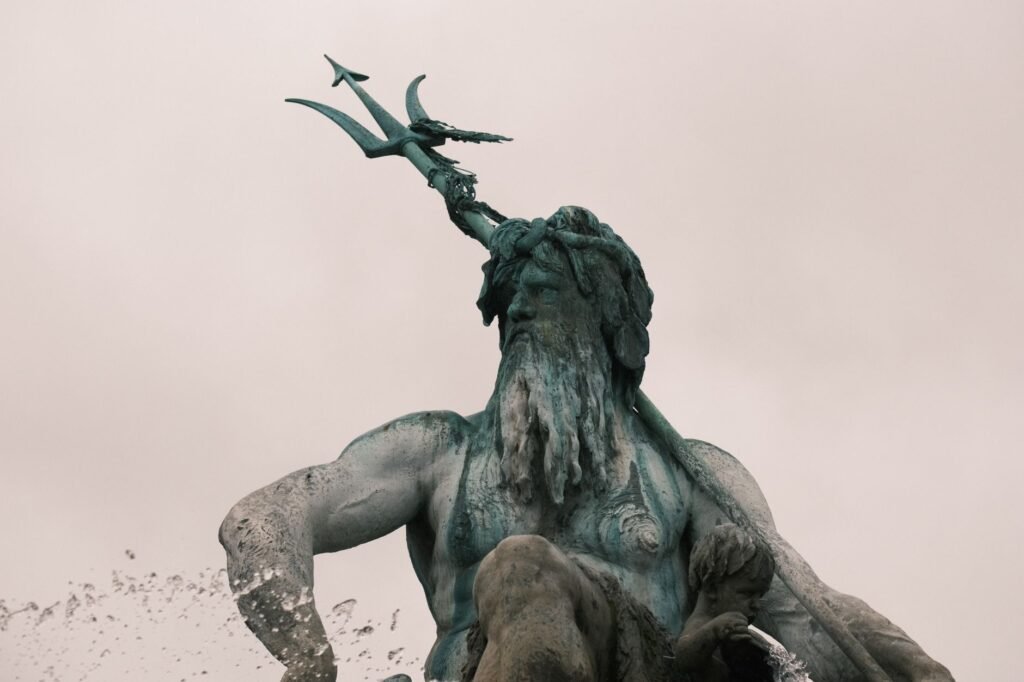
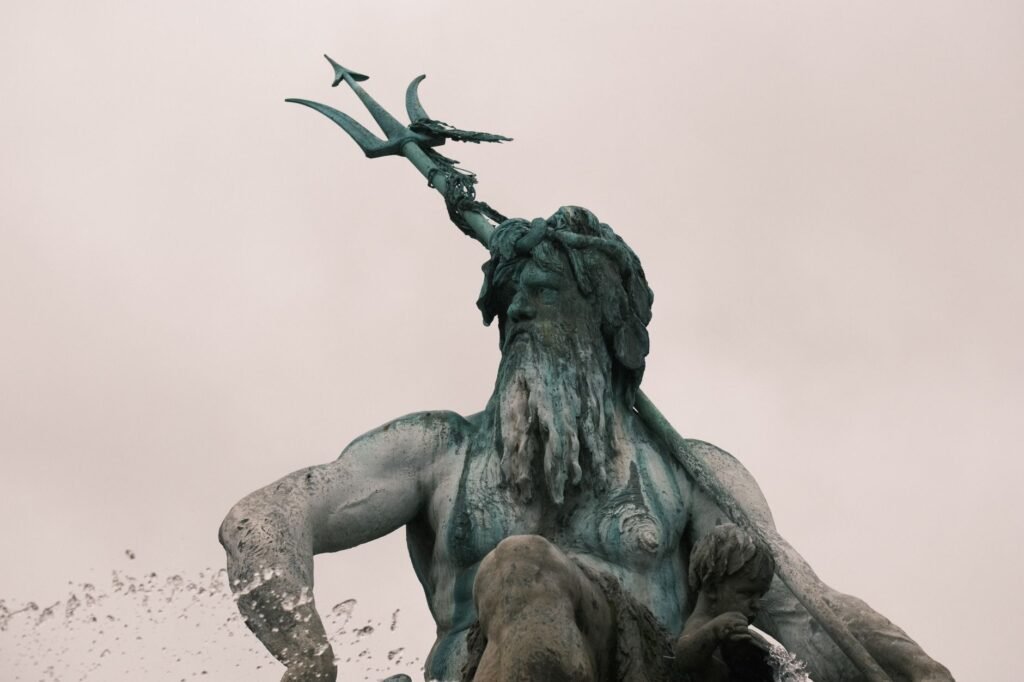
The Trident of Neptune is one of the most recognizable symbols in Greco-Roman mythology. As the emblem and weapon of Neptune, the Roman god of the sea, earthquakes, and horses, the trident represents divine authority over the waters and the forces associated with them. In ancient art and later Western culture, it became a shorthand image for oceanic power, maritime sovereignty, and tempestuous natural force.
Although best known through Roman tradition, the trident’s roots lie in broader ancient Mediterranean religious and artistic traditions. Its image appears in myths, sculpture, coinage, mosaics, literature, and modern popular culture. Because of Neptune’s close identification with the Greek god Poseidon, the trident also carries significance across both Greek and Roman contexts, even though the Roman name and cult developed distinct local features.
Origin and Meaning
The word trident comes from the Latin tridens or tridentis, meaning “three-toothed” or “three-pronged.” The term directly describes the object’s shape: a three-pronged spear or fork. In classical iconography, the trident is usually shown as a long staff with three points, though artistic depictions vary in shape, size, and ornamentation.
The association of the trident with Neptune is ancient, but its precise origin is not always stated explicitly in surviving sources. In Greek myth, Poseidon is already linked to a three-pronged implement, and Roman religion inherited and adapted that imagery. The trident likely developed from the practical world of fishing tools, harpoons, or spear-like implements used around the Mediterranean, later transformed into a divine symbol.
In symbolic terms, the three prongs have often been interpreted in different ways:
- as a sign of dominion over sea, storms, and earthquakes;
- as a marker of threefold power or completeness;
- as a visual device emphasizing aggressive, penetrating force.
These interpretations are not always ancient explanations; some are later symbolic readings. What is clear is that the trident became inseparable from Neptune’s visual identity.
Historical Context
Neptune was one of the major gods of the Roman pantheon, closely identified with maritime power and the watery world. In early Roman religion, Neptune seems to have had a more limited role than in later literature, and his cult was not originally as central as that of Jupiter, Mars, or Quirinus. Over time, especially under Greek influence, Neptune became increasingly associated with the sea and with Poseidon’s mythic profile.
The trident emerged as Neptune’s defining attribute in art and storytelling. In a maritime civilization such as Rome, whose prosperity depended heavily on trade, naval power, and coastal control, the sea was both vital and dangerous. Neptune’s trident therefore symbolized not only divine rule but also the unpredictable force of nature that could aid or destroy human enterprise.
In the wider ancient world, sea gods often possessed weapons or emblems of authority. The trident fit this pattern well, providing a visual expression of control over the waves, marine creatures, and violent storms. In Roman imperial iconography, the trident could also evoke naval dominance and the reach of Roman power across the Mediterranean.
Main Characteristics
The Trident of Neptune is usually described as a three-pronged spear, often long enough to be used with both hands in artistic representations. Although ancient artists did not always standardize its appearance, it commonly appears as a slender staff with a pointed central spear and two side prongs.
Identifying features
- Three points: the defining feature of the weapon.
- Long shaft: usually depicted as a staff or spear-like rod.
- Association with water: often shown in scenes with the sea, waves, horses, dolphins, or marine creatures.
- Divine status: it is not merely a tool, but a sign of godly authority.
The trident is both a weapon and a symbol. As a weapon, it is associated with Neptune’s power to strike, control, or stir the sea. As a symbol, it identifies the god in sculpture, pottery, mosaics, and later decorative art. Unlike swords or shields, the trident is not typically used in realistic battle scenes; its meaning is primarily mythological and ceremonial.
Family and Genealogy
Strictly speaking, the trident itself does not have a family or genealogy. However, because it belongs to Neptune, it is useful to summarize the god’s family relationships as they appear in Roman and related Greek traditions.
Neptune is the Roman equivalent of Poseidon, one of the three major brothers among the Olympian gods. In the standard Greek mythological genealogy, Poseidon is the son of Cronus and Rhea, and the brother of Zeus and Hades. Roman tradition generally adapted these relationships.
Neptune’s divine relationships
| Relationship | Name | Notes |
|---|---|---|
| Father | Cronus / Saturn | In Greek myth, Neptune’s counterpart Poseidon is one of Saturn’s children |
| Mother | Rhea / Ops | Mother of the major Olympian gods |
| Brothers | Jupiter / Zeus, Pluto / Hades | The three brothers divide dominion over sky, sea, and underworld |
| Spouse | Salacia | Roman sea goddess associated with salt water |
| Spouse counterpart | Amphitrite | Greek wife of Poseidon; often used in Roman artistic contexts as well |
| Children | Varies by source | Different traditions name different offspring, including Triton and various heroes or horses |
Ancient sources do not always agree on Neptune’s genealogy or offspring, and Roman authors frequently blend Roman and Greek traditions. The trident itself is not given a genealogy, but it functions as a hereditary marker of Neptune’s divine office, much like Jupiter’s thunderbolt or Pluto’s cap.
Symbols
The trident is the primary symbol of Neptune, but it appears alongside other associated emblems and visual markers.
Common symbols associated with Neptune and the trident
- Waves and the sea: signifying his realm.
- Dolphins: often used in marine iconography.
- Horses: linked to Neptune’s mythic association with horses and chariot imagery.
- Sea monsters and fish: reinforcing his dominion over aquatic life.
- Chariots drawn by sea creatures: common in artistic representations.
- Corals, shells, and maritime ornaments: especially in later art.
The trident itself may be shown plain or embellished. In some depictions it functions like a royal scepter of the sea, while in others it resembles a practical spear. Its three-pronged form made it visually distinctive and easy to identify at a glance.
Sacred Animals
Several animals are closely associated with Neptune and the imagery of his trident.
Horses
Horses are among Neptune’s most famous sacred animals. In myth, he is not only a sea god but also associated with horse breeding and equine power. This association is unusual but well established in ancient tradition.
Dolphins
Dolphins often accompany Neptune in art, symbolizing the sea’s benevolent and intelligent side. They are among the most common marine animals in Roman visual culture.
Bulls
In some traditions, bulls are associated with Poseidon/Neptune because of their strength, fertility, and raw power. These associations vary by region and source.
Fish and marine creatures
Fish, sea monsters, and other aquatic beings may appear near Neptune in mosaics and sculptural reliefs. They emphasize his control over the marine environment.
The trident’s symbolic connection to these animals lies in Neptune’s sovereignty: the weapon marks him as the ruler of the creatures and forces of the sea.
Sacred Plants
Unlike some gods, Neptune is not strongly associated with a specific plant in the surviving classical tradition. However, certain plants appear in broader maritime and ritual contexts.
Sea plants and coastal vegetation
- Seaweed and aquatic plants may appear in marine decorative art.
- Reeds and shoreline vegetation can symbolize coastal liminal spaces.
- Olive and laurel are not specifically Neptune’s plants, but may appear in Roman religious or artistic settings connected to divine honor.
It is important to note that no single plant is universally or securely identified as Neptune’s sacred plant in the way that olive is linked to Athena or laurel to Apollo. Any plant associations are therefore secondary and context-dependent.
Sacred Places
Neptune was honored in various places associated with water, coastal life, and Roman public religion.
Notable cultic and symbolic locations
- The Circus Flaminius in Rome: site of the Basilica Neptuni or related memorial associations in some traditions; Neptune was honored in the area through public and religious memory.
- The Temple of Neptune in Rome: ancient sources refer to cultic spaces dedicated to Neptune, though details vary.
- Harbors and coastal sanctuaries: as a sea god, Neptune was naturally venerated in maritime regions.
- Promontories and seashores: places of sacrifice or prayer before voyages.
- Rivers and springs: in some cases, Neptune’s domain extends beyond the open sea to freshwater and inland waters.
Because Roman religion was highly local and practical, Neptune could be honored wherever sea travel, fishing, or water safety mattered. The trident, as his emblem, often appeared in these contexts as a visual token of divine presence.
Powers and Attributes
Neptune’s powers derive from his place among the major gods of the Mediterranean world. Through the trident, those powers are made visible and dramatic.
Main domains
- The sea: his principal realm.
- Earthquakes: especially in Greek tradition, where Poseidon is known as “Earth-Shaker.”
- Horses: an important and somewhat enigmatic aspect of his identity.
- Storms and waters: including dangerous currents, tides, and flooding.
- Navigation and maritime safety: especially in practical Roman religion.
The trident as a sign of power
The trident signifies Neptune’s ability to:
- command the sea;
- raise or calm waves;
- strike the earth or water;
- assert divine authority over marine space;
- threaten ships, sailors, and coastal settlements.
In some myths, the trident is also the instrument by which Neptune creates springs or alters landscapes. Such stories reinforce the idea that the weapon is not merely defensive or offensive but creative as well.
Main Myths
Several important myths involve Neptune and his trident, though traditions vary between Greek and Roman sources.
Contest for Athens
One of the most famous myths involving Neptune’s counterpart, Poseidon, concerns the contest with Athena for patronage of Athens. In the Greek version, Poseidon strikes the ground with his trident and produces either a saltwater spring or a horse, depending on the source. Athena offers the olive tree, and the city chooses her gift.
This story is highly significant because it demonstrates the trident as an instrument of miraculous power, not simply violence.
Creation of springs and landscapes
In some myths, Neptune uses the trident to cause water to emerge from the earth or to reshape the land. These acts underline his dual connection to the sea and subterranean waters.
Punishment and storms
Neptune may use his trident to cause storms or upheaval when offended. In epic poetry, the god often appears as a force of marine instability, sending waves against ships or opposing human actions.
Association with horses
Some traditions connect Neptune to the creation of the first horse or to the origin of horse breeding. These stories are not uniform, but they show the breadth of his influence. The trident in such contexts signals authority over both sea and land animals.
Neptune in imperial and civic imagery
In Roman visual culture, Neptune and his trident sometimes appear in scenes celebrating victory at sea, abundance from trade, or cosmic order. While these are not myths in the narrow sense, they reflect the god’s role in public ideology.
Relationship with Other Mythological Figures
Neptune’s trident helps define his relationships with gods, heroes, and mortals.
Jupiter and Pluto
In the standard mythological division of the cosmos, Jupiter rules the sky, Neptune the sea, and Pluto the underworld. The trident thus marks Neptune’s share in the cosmic order.
Minerva / Athena
Neptune’s rivalry with Athena in the Athenian foundation myth is one of the most enduring divine conflicts in classical tradition. The trident’s blow becomes a symbol of failed competition or contested patronage.
Amphitrite and Salacia
As Neptune’s consort, Amphitrite in Greek tradition and Salacia in Roman tradition are linked to the sea’s fertility and continuity. Artistic scenes may place Neptune’s trident beside these figures as a marker of marital and divine status.
Triton and marine retinues
Marine beings such as Triton, sea nymphs, and other attendant figures frequently appear with Neptune. Their presence reinforces his role as ruler of a watery court.
Heroes and sailors
Mortals who travel by sea, found cities, or challenge divine authority may encounter Neptune’s trident indirectly through storms, omens, or miracles. The trident marks the boundary between human control and divine power.
Worship and Cult
Neptune had a recognized cult in Rome, though his worship differed from that of some other major gods. The trident, while not itself an object of worship, functioned as a divine insignia in cult images and public representations.
Ritual and offerings
Offerings to Neptune would have been appropriate for:
- safe sea travel;
- favorable winds and calm waters;
- fishing and maritime trade;
- protection from floods or storms.
Sacrifices and prayers could include livestock, incense, libations, and vows, depending on local practice and occasion.
Festivals
Neptune was associated with the Neptunalia, a Roman festival traditionally held in July. Ancient descriptions suggest a concern with water and heat, and the festival may have involved ritual activity connected to securing or conserving water in the summer season. Details are limited and not fully certain.
Cultic practice
Neptune’s cult was practical and public rather than esoteric. Sailors, traders, and communities dependent on the sea would invoke him as needed. His trident, in this sense, was not a fetish object but a visual sign of divine jurisdiction.
Ancient Sources
The trident of Neptune is best understood through the literary and artistic tradition that surrounds Poseidon and Neptune. Key ancient sources include:
- Homer, especially the Iliad and Odyssey, where Poseidon appears as a powerful sea god;
- Hesiod, especially the Theogony, for divine genealogy;
- Apollodorus, whose Library preserves mythographic summaries;
- Pausanias, whose Description of Greece records cultic and local traditions;
- Ovid, especially the Metamorphoses, which includes mythic transformations and divine actions;
- Virgil, particularly the Aeneid, where Neptune calms the sea and intervenes in epic narrative.
What the sources show
The sources do not always explain the trident in the same way. Some focus on Neptune’s authority over the sea, while others emphasize his power in mythic action. Artistic evidence is also crucial, since the trident often appears more clearly in visual culture than in detailed literary description.
Roman Equivalent
Neptune is the Roman equivalent of the Greek Poseidon, but the relation is not exact identity in every respect. Roman religion adapted Greek mythology while preserving some local features.
Differences and overlaps
| Aspect | Greek Poseidon | Roman Neptune |
|---|---|---|
| Main identity | Sea god, earthquake god | Sea god, associated with water and marine power |
| Consort | Amphitrite | Salacia in Roman tradition, though Amphitrite also appears in Roman art |
| Symbol | Trident | Trident |
| Cultural emphasis | Mythological and cultic across Greek world | Strongly linked to Roman maritime ideology and public religion |
The trident is one of the clearest examples of continuity between the Greek and Roman forms of the god. It bridges mythology, art, and religious practice across both traditions.
Influence on Modern Culture
The Trident of Neptune remains a powerful cultural image in modern times. It appears in literature, art, branding, and entertainment as a symbol of sea power and command.
In literature and visual art
Artists and writers have long used the trident to represent:
- the ocean;
- tempestuous power;
- authority over nature;
- classical antiquity.
Renaissance and Neoclassical art often revived Neptune with his trident, especially in fountains, palace decoration, and allegorical paintings.
In cinema, television, and games
Modern fantasy, historical films, and games frequently adapt the trident as a weapon for sea gods, kings, or aquatic beings. Even when Neptune himself is absent, the trident remains a visual shorthand for marine divinity.
In public symbolism
The trident can also appear in logos, civic emblems, naval imagery, and sports branding. Its association with strength and the sea makes it widely adaptable. In some cases, however, its meaning is purely decorative and not explicitly mythological.
Curiosities
- The trident is more strongly associated with Poseidon in Greek usage, but the Roman world made it equally recognizable as Neptune’s emblem.
- Neptune’s trident is one of the few divine weapons in classical mythology that also resembles a practical tool, which may have helped it become so visually enduring.
- In some ancient stories, the trident can create or reveal water, making it a symbol of both destruction and provision.
- Neptune was also linked to horses, an association that surprises many modern readers because it seems unrelated to the sea.
- Artistic depictions of Neptune sometimes vary so much that the trident is the most reliable way to identify him.
- The trident’s three prongs have inspired many later symbolic interpretations, but not all of these can be traced securely to ancient sources.
Frequently Asked Questions
1. What is the Trident of Neptune?
The Trident of Neptune is the three-pronged weapon and symbol associated with Neptune, the Roman god of the sea. It represents his authority over water, storms, and related natural forces.
2. Is the Trident of Neptune the same as Poseidon’s trident?
Yes, in most classical and artistic contexts the two are essentially the same symbol. Neptune is the Roman counterpart of the Greek Poseidon, and both are represented with a trident.
3. What does the trident symbolize?
It symbolizes divine power, control over the sea, storms, and sometimes earthquakes. It also functions as an identifying sign of Neptune in art and myth.
4. Did ancient Romans really worship the trident itself?
No. The trident was not worshiped as a separate sacred object. It was an emblem and attribute of Neptune, used in art and religious symbolism.
5. Why does Neptune have a trident instead of another weapon?
Ancient sources do not always explain this directly. The trident’s three-pronged shape made it an effective and distinctive symbol of marine power, and it may have developed from real fishing or spear tools.
6. Is Neptune only a sea god?
Not entirely. In both Roman and Greek tradition, Neptune/Poseidon is also linked to earthquakes and horses, in addition to the sea.
7. Where can the trident be seen in ancient art?
It appears in statues, reliefs, mosaics, coins, pottery, and frescoes, usually as a key attribute identifying Neptune or Poseidon.
8. Does the Trident of Neptune appear in modern culture?
Yes. It is widely used in modern literature, film, games, logos, and decorative art as a symbol of sea power and classical mythology.
Conclusion
The Trident of Neptune is far more than a mythological weapon. It is a durable symbol of authority, natural force, and the ancient human effort to understand and represent the sea. Rooted in classical religion and mythology, the trident became inseparable from Neptune’s identity in Roman culture and from Poseidon’s in Greek tradition.
Its continuing presence in art, literature, and popular culture shows how strongly the ancient image has endured. As both a weapon and an emblem, the trident remains one of the most powerful visual expressions of the relationship between divinity, the sea, and the imagination of the ancient Mediterranean world.

Orin Vale has spent the better part of two decades tracing the threads that connect the world’s oldest stories — from the halls of Asgard to the banks of the Nile, from Olympus to the jungles of the Maya. What began as a childhood fascination with flood myths and trickster gods grew into years of independent study across comparative mythology and ancient religion, always chasing the same question: what did these stories mean to the people who first told them? Orin writes for readers who want more than trivia — the ones looking for the beliefs, fears, and truths that myths were built to carry.