Introduction
The shen ring is one of the most recognizable symbols in ancient Egyptian art and religion. In Egyptian mythology and iconography, it represents eternity, protection, and completeness. The symbol appears as a circular loop with a short tangent line or horizontal base, forming a closed ring that seems to “hold” what it surrounds. Because of this visual form, it became closely associated with ideas of wholeness, divine protection, and the unbroken cycle of time.
The question “what is the shen ring in Egyptian mythology” is best answered by noting that it is not a god or goddess, but a symbol with sacred power. It appears in temple reliefs, royal regalia, amulets, and divine depictions, especially in connection with deities who protect kings and uphold cosmic order. In ancient Egyptian religion, symbols were not merely decorative; they were thought to participate in the power of the forces they represented. The shen ring is therefore important not only as an artistic motif, but also as a religious sign of divine preservation.
Origin and Meaning

The term shen is derived from the ancient Egyptian word usually transliterated as šn or shen, which is associated with the idea of encircle, enclose, or surround. The concept behind the symbol is the enclosing of something in a protective ring. This idea is central to its meaning: what is within the ring is safeguarded, stabilized, and made enduring.
The shen ring is related to Egyptian notions of:
- eternity
- protection
- completeness
- the encircling power of divine authority
In some contexts, the shen ring is linked with the cartouche, the oval frame used around royal names. The cartouche is usually considered an expanded and stylized form of the shen ring, though scholars distinguish between the two. The cartouche has a loop at one end and a straight line at the other, while the shen ring is a more complete circular or oval loop. Both shapes communicate protection and permanence.
The exact historical moment when the shen ring first appeared is difficult to define precisely, since it belongs to very early Egyptian symbolic language and may have developed over time. It is clearly attested in pharaonic art from early periods onward and continued throughout Egyptian history.
Historical Context
Ancient Egyptian civilization placed enormous emphasis on order, continuity, and divine protection. The world, as the Egyptians understood it, had to be maintained through ritual, kingship, and correct relations between gods and humans. Symbols such as the shen ring helped express these ideas visually and ritually.
The shen ring appears in a broad religious environment that included:
- the belief in ma’at, the principle of cosmic order, truth, and balance
- the sacral role of the pharaoh
- the protective powers of gods and goddesses
- funerary beliefs about eternal life
- temple art that visually encoded divine authority
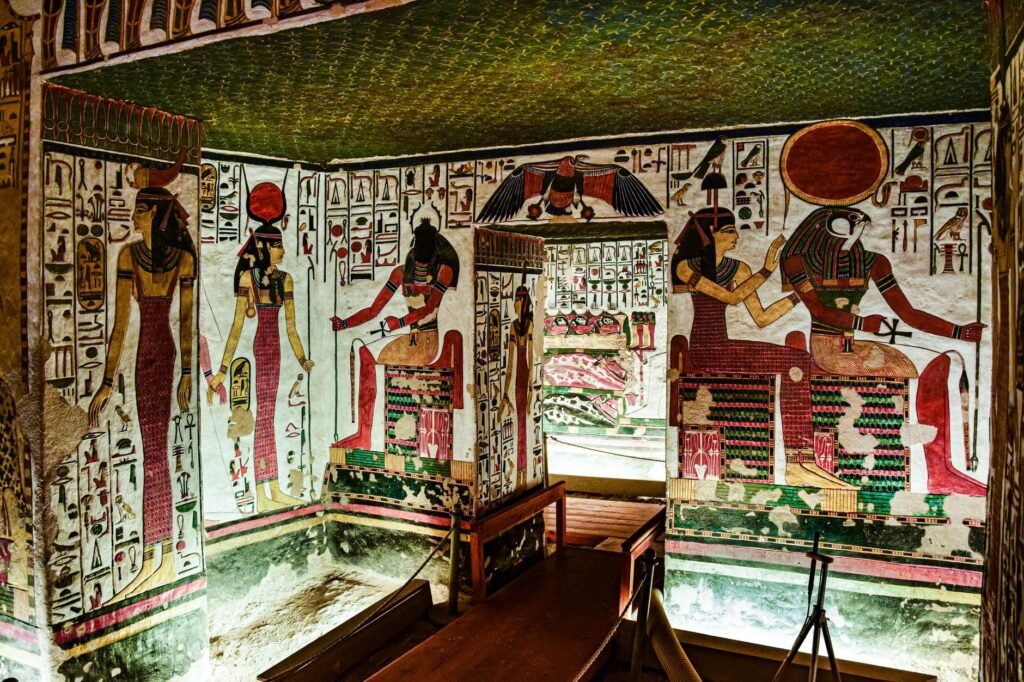
Because the Egyptians valued permanence, the ring’s closed shape was especially suitable for representing the endlessness of divine protection and the cyclical nature of existence. The symbol could be shown held by gods, inscribed on objects, or placed in contexts associated with royal power and the afterlife.
Its use was not limited to one period. The shen ring remained meaningful across long stretches of Egyptian history, though its exact artistic style and frequency could vary by dynasty and context.
Main Characteristics
The shen ring is usually depicted as a looped circle. In many examples, it appears as a ring resting on a horizontal base, sometimes with a stylized knot or binding at the bottom. The shape suggests an object that has been tied into a protective enclosure.
Key features of the shen ring
- Closed form: the enclosure symbolizes completeness and continuity.
- Protective function: it marks out a space guarded by divine power.
- Association with eternity: the loop has no beginning or end.
- Connection to royalty and deities: frequently shown in sacred or royal contexts.
- Flexible iconography: it may appear alone, held in a hand, or integrated into other symbols.
In Egyptian art, symbols often operated at several levels at once. The shen ring could function as a literal object, a visual emblem, and a theological statement. Its shape also made it suitable for integration into the broader symbolic system of ancient Egyptian writing and art.
Family and Genealogy
Unlike mythological beings, the shen ring does not have a family tree, parents, spouses, or children. It is not a deity and therefore does not belong to genealogy in the usual mythological sense.
However, it is often associated with divine relationships through the gods and goddesses who hold or present it. In these representations, the symbol is granted meaning through its use by major figures of the pantheon, especially:
- Ra and other solar deities
- Horus, in relation to kingship
- Isis, in relation to protection and magical power
- Hathor and Nephthys, who may appear in funerary and protective contexts
- Anubis, in funerary ritual scenes
The shen ring’s “relationships” are therefore symbolic rather than genealogical.
Symbols
The shen ring itself is a symbol, but it also appears alongside other related signs that deepen its meaning.
Common symbolic associations
| Symbol or concept | Meaning | Relation to the shen ring |
|---|---|---|
| Ma’at | Order, truth, balance | The ring supports cosmic stability |
| Cartouche | Royal name enclosed and protected | A related protective enclosure |
| Ankh | Life | Together with the shen, it can suggest eternal life |
| Was scepter | Power and dominion | Often paired with divine authority |
| Solar disk | Solar divinity and eternal cycle | Complements shen’s associations with eternity |
In some contexts, the shen ring is closely paired with the ankh or presented by a god or goddess as a gift of life and permanence. Such combinations are especially common in scenes where the king receives divine favor.
The closed loop of the shen ring makes it a powerful visual expression of limitless duration. Since ancient Egyptian religion frequently expressed abstract concepts through image and form, the ring’s geometry carried theological significance.
Sacred Animals
The shen ring is not an animal-associated deity, so it does not have a single sacred animal in the same way that some gods do. Still, it may appear in the company of animals that symbolize divine protection or royal power.
Animals commonly associated with Egyptian sacred art and related symbolism include:
- Hawk/falcon: linked with Horus and kingship
- Cobra: associated with protection and royal authority
- Lion: strength, guardianship, solar power
- Jackal: funerary protection through Anubis
These animals are not “sacred animals of the shen ring” in a direct sense. Rather, they appear in the same religious visual world and may reinforce the symbol’s meaning when shown with it.
Sacred Plants
No specific sacred plant is uniquely associated with the shen ring. Egyptian sacred plants tended to be linked more directly with particular gods, funerary beliefs, or cosmic symbolism.
Nevertheless, plants frequently present in Egyptian religious iconography can indirectly enrich the meanings of protective and eternal symbols:
- Lotus: rebirth, emergence, the sun, renewal
- Papyrus: Lower Egypt, vitality, growth
- Date palm: endurance, abundance, time
- Sycamore fig: protection, nourishment, divine shelter
Because the shen ring expresses continuity and eternity, plants associated with renewal and life are thematically compatible with it. However, no ancient source establishes a unique botanical association as a standard feature of the symbol.
Sacred Places
The shen ring is not tied to a single sanctuary, city, or mountain. Instead, it appears in many sacred settings throughout Egypt.
Important contexts where it appears
- Temples: on reliefs, divine scenes, and ritual depictions
- Tombs: as a sign of protection and eternal life
- Royal monuments: especially where the king receives blessing or sanction
- Amulets and funerary objects: to safeguard the deceased
- Administrative and ceremonial objects: when royal authority is emphasized
Some of the most important religious centers of Egypt—such as Thebes, Heliopolis, Abydos, Memphis, and Dendera—preserve iconography in which shen-related meanings appear, though the symbol is not exclusive to any one location.
The universality of the shen ring is part of its significance. Rather than belonging to one cult center, it functioned across Egyptian religious geography.
Powers and Attributes
The shen ring’s primary powers are symbolic rather than personal. In ancient Egyptian thought, symbols could participate in the reality they represented. The shen ring therefore conveyed real protective and metaphysical force.
Core attributes
- Protection: surrounding and guarding the enclosed subject
- Eternity: no beginning or end
- Wholeness: completion and unity
- Royal legitimacy: divine sanction of kingship
- Stability: preservation against disorder and decay
- Sacral enclosure: creating a bounded, protected space
The symbol could be applied to humans, gods, names, or objects. When placed around a royal name, it protected the identity and power of the king. In funerary contexts, it could suggest the deceased’s safe passage into everlasting life.
Main Myths
The shen ring is not the subject of a single major myth cycle in the way that Osiris, Isis, or Horus are. Instead, it appears within the broader mythological framework of divine order and protection.
Mythic themes associated with the shen ring
Divine protection of kings
The ring often appears in scenes where a god or goddess grants stability and protection to the pharaoh. This reflects the Egyptian belief that kingship was maintained by divine support.
Eternity and the afterlife
The shen ring’s circular form made it suitable for funerary symbolism. It expresses the hope that the deceased may endure beyond death in a protected, unbroken state.
Encirclement and cosmic order
Because the symbol means “to encircle,” it resonates with the Egyptian idea that order must surround and contain chaos. This is a central mythic concern in Egyptian religion.
It is important to note that the shen ring is best understood as a supporting symbol in myths, not as the hero or central figure of a mythological narrative.
Relationship with Other Mythological Figures
The shen ring interacts with Egyptian mythology through its use by major divine figures.
Common associations
| Figure | Relationship with the shen ring |
|---|---|
| Ra | Associated with eternity, solar continuity, and cosmic order |
| Horus | Linked with kingship and divine protection of the pharaoh |
| Isis | Connected to magical protection and safeguarding |
| Anubis | Appears in funerary settings where protection of the dead is important |
| Thoth | Relevant through sacred order, writing, and the protection of divine names |
| Ma’at | Conceptual partner in maintaining order and balance |
In some depictions, deities may present the shen ring to the king, or the king may be shown under divine protection that implies the ring’s meaning even when it is not explicitly held. These relationships vary by context and artistic period.
Worship and Cult
The shen ring was not worshipped as a god, so it did not have its own cult center or ritual clergy. Instead, it functioned within the worship of gods, the sacred nature of kingship, and funerary practice.
Forms of use
- Temple imagery: on walls, pillars, and ritual scenes
- Amulets: worn or placed with the dead for protection
- Funerary equipment: to support eternal life
- Royal iconography: affirming the divine status of the king
- Inscriptions and decorative arts: marking sacred enclosure and continuity
The practical ritual value of the shen ring lay in its symbolic power. Egyptians believed that correctly used signs could help secure divine favor and protection. Thus, the shen ring may be understood as part of the ritual language of ancient Egypt rather than as an object of worship on its own.
Ancient Sources
No single ancient text is devoted solely to the shen ring, and many of the surviving references are visual rather than literary. This is typical for Egyptian religion, where iconography often carries meaning that complements written texts.
Primary evidence and sources
- Temple reliefs and tomb paintings from various periods
- Inscriptions in royal and religious settings
- Funerary texts, where protective and eternal motifs are prominent
- Amuletic contexts, preserved archaeologically
When discussing Egyptian symbols in Greek and Roman literature, modern readers sometimes look to authors such as Herodotus, Plutarch, or later classical writers for descriptions of Egyptian religion. However, these authors do not provide a focused account of the shen ring itself. The most reliable evidence remains Egyptian material culture and inscriptions.
Because the shen ring is a symbol rather than a mythological character, it is not usually found in the narrative traditions of Homer, Hesiod, Apollodorus, Pausanias, or Ovid, who are primarily relevant to Greek and Roman mythology rather than Egyptian symbolism.
Roman Equivalent
There is no exact Roman equivalent to the shen ring. Roman religion used its own symbols of protection and eternity, but none matches the shen ring perfectly.
That said, some Roman concepts overlap partly with it:
- Aureus or imperial symbolism: for authority and legitimacy
- Corona: as a sign of honor or sacred power
- Eternality motifs: such as victory, endurance, and divine sanction
- Protective amulets: used in household and funerary contexts
In Greco-Roman Egypt, Egyptian symbols could continue to be used alongside Roman forms, but the shen ring remained recognizably Egyptian in meaning and visual identity.
Influence on Modern Culture
The shen ring has attracted attention in modern studies of ancient Egypt and appears in museums, educational materials, and symbolic design. Its elegant shape and clear meaning make it popular in contemporary interpretations of Egyptian art.
Areas of modern influence
- Museum displays and Egyptology
- Books and documentaries on ancient Egypt
- Decorative art and jewelry inspired by Egyptian motifs
- Graphic design and tattoo art
- Historical fiction and fantasy settings featuring Egyptian imagery
In modern culture, the shen ring is sometimes confused with the cartouche or used as a generic “Egyptian symbol of eternity.” While that broad idea is close to its ancient meaning, careful interpretation should distinguish between different Egyptian signs.
Popular culture occasionally uses Egyptian symbols without precision, but scholarly and museum contexts generally identify the shen ring as a sign of protection and endless duration.
Curiosities
- The shen ring’s circular shape is one reason it was associated with eternity: a circle has no visible beginning or end.
- It is related to the cartouche, but the two are not identical.
- The symbol was meaningful in both royal and funerary contexts.
- In some artistic scenes, the shen ring is held by a deity as if it were a divine gift.
- Its power comes less from a spoken myth and more from the Egyptian belief that images themselves could act.
- The symbol remained relevant through long periods of Egyptian history, showing the durability of Egyptian religious imagery.
- Because it is visually simple, the shen ring is one of the easiest Egyptian symbols for modern audiences to recognize.
Frequently Asked Questions
What is the shen ring in Egyptian mythology?
The shen ring is an ancient Egyptian symbol of eternity, protection, and wholeness. It is not a god or goddess, but a sacred emblem used in religious and royal art.
What does the shen ring look like?
It is usually shown as a closed loop or circle, sometimes resting on a short base or attached to a line. Its enclosed shape represents protection and continuity.
Is the shen ring the same as a cartouche?
Not exactly. The cartouche is related to the shen ring and may have developed from it, but the cartouche specifically frames royal names, while the shen ring has broader symbolic uses.
What does the shen ring symbolize?
It symbolizes eternity, divine protection, completeness, and sacred enclosure. It is often associated with kingship and the afterlife.
Which gods are associated with the shen ring?
It appears in connection with several gods and goddesses, especially Ra, Horus, Isis, Anubis, and other protective deities. The associations vary by scene and period.
Was the shen ring worshipped?
No. It was not worshipped as a deity. It was a symbol used in worship, royal iconography, and funerary practice.
Is there a myth about the shen ring?
There is no single myth centered on it. Instead, the shen ring appears in many myths and ritual scenes as a symbol of divine protection and eternal order.
Why is the shen ring important?
It helps explain how ancient Egyptians used visual symbols to express complex religious ideas such as eternity, order, and divine legitimacy.
Conclusion
The shen ring is a central symbol of ancient Egyptian religious thought. In answer to the question what is the shen ring in Egyptian mythology, it can be described as a protective emblem of eternity and completeness, widely used in temple art, funerary contexts, and royal imagery. Although it is not a god or a mythic character, it plays an important role in the visual language of Egyptian belief.
Its enduring significance comes from the way it joins form and meaning: a simple enclosed ring becomes a powerful statement about continuity, divine safeguarding, and the endless life desired by both kings and the dead. As a result, the shen ring remains one of the most meaningful and enduring symbols of ancient Egypt.

Orin Vale has spent the better part of two decades tracing the threads that connect the world’s oldest stories — from the halls of Asgard to the banks of the Nile, from Olympus to the jungles of the Maya. What began as a childhood fascination with flood myths and trickster gods grew into years of independent study across comparative mythology and ancient religion, always chasing the same question: what did these stories mean to the people who first told them? Orin writes for readers who want more than trivia — the ones looking for the beliefs, fears, and truths that myths were built to carry.