Who Is Geb in Egyptian Mythology?
Introduction
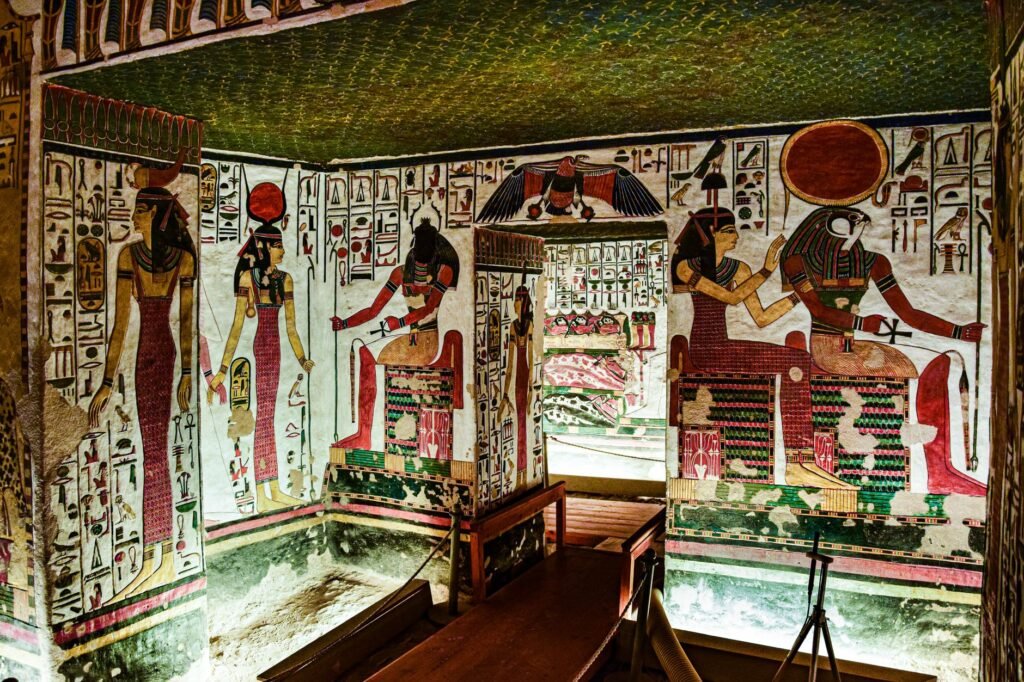
Geb is one of the most important gods in ancient Egyptian mythology. He is best known as the earth god, a divine figure associated with the land of Egypt, fertility, vegetation, and the physical world beneath the sky. In many myths, Geb appears as the son of the air god Shu and the sky goddess Tefnut, the husband of Nut, and the father of major deities such as Osiris, Isis, Set, and Nephthys.
Because the ancient Egyptians viewed the cosmos as a sacred and ordered system, Geb was not merely a symbolic personification of the earth. He was part of the divine family that explained creation, kingship, death, and rebirth. His role links mythology, religion, agriculture, and political ideology, making him a central figure in Egyptian thought.
Origin and Meaning
The name Geb is the modern scholarly transcription of the ancient Egyptian divine name, usually written with the consonants gb. The exact vocalization is uncertain, because ancient Egyptian writing did not record vowels in the same way modern languages do.
The meaning of the name is commonly connected with the earth itself. In Egyptological scholarship, Geb is identified as the earth deity and often described as the “lord of the earth.” His name appears in religious texts, funerary literature, and royal inscriptions.
Different periods and sources preserved different spellings and epithets, but the basic concept remains consistent: Geb is the divine embodiment of the land. His name became one of the standard ways ancient Egyptians referred to the earth as a living, sacred force.
Historical Context
Geb belongs to the oldest layers of Egyptian religion. His worship and mythological role are attested from the Old Kingdom onward, and references continue through the Middle Kingdom, New Kingdom, and later periods. He was never the sole focus of a major nationwide cult like Amun, Re, or Osiris, but he was deeply embedded in Egyptian cosmology.
Ancient Egyptian religion did not separate nature, politics, and theology the way modern systems often do. The earth was not just soil; it was the foundation of life, agriculture, burial, and divine legitimacy. Geb, as earth god, was therefore connected to:
- the fertility of the land
- the growth of crops
- the burial of the dead
- the transfer of royal power
- the cosmic order of heaven and earth
In creation myths, Geb and Nut were separated by Shu, forming the basic structure of the world: sky above, earth below, and air in between. This separation became a standard cosmological image in Egyptian religion.
Main Characteristics
Geb is usually represented as a male deity lying beneath the sky goddess Nut. In artistic and textual traditions, he often appears reclining on the ground, sometimes with the body painted green or covered with vegetation, emphasizing fertility and the living earth.
Key characteristics of Geb
- Earth god: He personifies the ground and the land of Egypt.
- Fertility deity: He is associated with plant growth and agricultural abundance.
- Chthonic figure: As an underworld-linked deity, he is connected with burial and the dead.
- Cosmic role: He is one of the gods who define the structure of the universe.
- Royal significance: Pharaohs were sometimes said to inherit the throne of Geb.
Geb is often shown with a goose, which is one of his sacred symbols and may reflect an ancient association with the “Great Cackler,” a creator figure in some traditions. However, not all representations are consistent across all periods.
Family and Genealogy
Geb’s family is one of the most important divine lineages in Egyptian mythology.
Parents
In the standard Heliopolitan cosmogony, Geb is the son of:
- Shu, the god of air
- Tefnut, the goddess of moisture
These two are often part of the Ennead, the nine-deity family centered at Heliopolis.
Spouse
Geb’s principal consort is:
- Nut, the sky goddess
According to the myth, Geb and Nut were originally locked in an embrace. Shu separated them so that the cosmos could exist in ordered form. Their separation created the space between earth and sky.
Children
Geb and Nut are the parents of four major gods:
- Osiris
- Isis
- Set
- Nephthys
In some traditions, Horus the Elder is also included among their descendants or associated with this divine family, though genealogies vary by source and cult center.
Genealogical significance
Geb’s family forms the basis of a major mythological cycle involving:
- kingship and succession
- murder and restoration
- fertility and drought
- order and disorder
This genealogy is not just family history in a human sense; it is a theological explanation of how the cosmos and divine authority function.
Symbols
Geb is associated with several symbolic elements that express his identity as an earth deity.
| Symbol | Meaning |
|---|---|
| Earth / ground | His primary domain and embodiment |
| Goose | Traditional sacred animal and divine emblem |
| Green vegetation | Fertility, growth, and renewal |
| Reclining male figure | Earth lying beneath the sky |
| Cornice-like or layered earth imagery | Stability and support of the world |
| Crook and flail in some royal contexts | Links to kingship and rule, though not exclusive to Geb |
Color symbolism
Geb is sometimes connected with green, the color of plant life and regeneration. In Egyptian symbolism, green often represented fertility, rebirth, and vitality. Because the earth produces crops and supports life, this color fits his role well.
Iconographic role
Ancient artists often used Geb to express the idea that the earth is alive and divine. His position beneath Nut in cosmological scenes made him instantly recognizable in religious art.
Sacred Animals
The animal most closely connected with Geb is the goose.
The goose
The goose appears in various Egyptian mythological contexts, and Geb is sometimes associated with the “Great Cackler,” a creator image linked to the primordial moment of creation. In some interpretations, the goose reflects Geb’s voice or presence in creation myths.
Other possible animal associations
Ancient Egyptian religion was flexible and locally varied, so Geb was not limited to one fixed sacred animal in every tradition. However, the goose remains his most recognizable symbolic animal.
Sacred Plants
Geb’s association with the earth naturally links him to plants, especially those representing growth and fertility.
Important plant associations
- Barley and grain: Symbols of agricultural abundance
- Vegetation in general: Emblems of the living earth
- Green plants: Signs of rebirth and renewal
No single plant is universally exclusive to Geb in the way that certain plants belong strongly to other deities in Egyptian religion. Instead, his plant symbolism is broad and agricultural, tied to the productive power of the soil.
Sacred Places
Geb was worshipped across Egypt, but he did not have one universally dominant cult center that defined him alone. His significance was cosmological rather than regional.
Important associations and places
- Heliopolis: A major center of solar and creation theology, where Geb was part of the Ennead.
- Memphis region: In some theological traditions, earth and kingship themes linked Geb to the broader Memphite religious landscape.
- Burial grounds and necropolises: Because he was associated with the earth and the dead, Geb was symbolically present wherever burial took place.
Sacred landscape
In Egyptian thought, the whole land of Egypt could be seen as belonging to Geb. The fertile fields, riverbanks, and burial earth all fell within his domain. Unlike gods associated with a single temple city, Geb’s sacred geography was tied to the world itself.
Powers and Attributes
Geb’s powers are rooted in his function as earth deity and cosmic stabilizer.
Main domains
- The earth and land
- Fertility and agriculture
- Stability and support
- Burial and the dead
- Royal succession
- Cosmic balance
Attributes
Geb was believed to:
- support the body of the world
- receive the dead into the earth
- oversee fertility and crop growth
- witness the legitimacy of kings
- participate in divine succession myths
In funerary texts, the earth is often imagined as a divine power that accepts the deceased. Since the dead were buried in the ground, Geb had a role in transition, rest, and renewal.
Main Myths
Geb appears in several major Egyptian myths, especially those connected with creation and royal legitimacy.
The separation of Geb and Nut
One of the best-known myths tells how Shu separated Geb from Nut. In the beginning, the two were joined in a close embrace, but this prevented the world from being formed properly. Shu lifted Nut above Geb, creating the cosmic arrangement of sky over earth.
This story explains:
- why the sky arches above the earth
- how space and order came into being
- why the world has a layered structure
The Ennead and divine succession
In Heliopolitan theology, Geb is part of the divine family that legitimizes the structure of rule. He is associated with the transfer of authority to Osiris and later to Horus. This makes him a witness and authority figure in the divine succession of kingship.
The contest of Osiris and Set
Geb plays an important role in the cycle of Osiris, Set, and Horus. After the conflict between Osiris and Set, and later between Horus and Set, Geb is sometimes described as making judgments or decisions about inheritance and kingship. In some versions, he supports the claims of Horus or acts as an adjudicator.
Because sources vary, his exact role is not identical in every account. However, he consistently appears as a divine ancestor whose authority helps determine rightful rule.
Geb and the dead
In funerary literature, the earth god’s role extends to the burial of the deceased. Since the dead are placed in Geb’s domain, he is connected to the protection, containment, and transformation of the body after death.
Relationship with Other Mythological Figures
Geb’s mythological importance is closely tied to his relationships with other gods.
With Nut
Nut is Geb’s most significant divine partner. Their separation is one of the foundational images of Egyptian cosmology. Despite being separated, they remain emotionally and symbolically linked as earth and sky.
With Shu and Tefnut
Shu and Tefnut are Geb’s parents, and Shu is also the god who separates Geb from Nut. This family relationship reflects the movement from primordial moisture and air into an ordered cosmos.
With Osiris
Osiris is Geb’s son and one of the most important gods in Egyptian religion. As a god of fertility, death, and resurrection, Osiris inherits and transforms some aspects of Geb’s earth-related symbolism.
With Set
Set, another child of Geb and Nut, is the disruptive force in the family cycle. His rivalry with Osiris and conflict with Horus create much of the mythological drama in which Geb participates indirectly or as an authority figure.
With Horus
Horus becomes the heir to kingship in many traditions. Geb’s authority in succession myths helps validate Horus’s position as the rightful ruler.
With the pharaoh
The king could be described as the heir of Geb or as one who rules under Geb’s authority. This relationship strengthened the ideology that kingship is anchored in the earth and the divine order.
Worship and Cult
Geb was not primarily known for a large, highly centralized cult like some other Egyptian gods, but he was certainly revered in religious practice.
Forms of worship
Worship of Geb would have included:
- prayers and offerings in temple contexts
- references in funerary rituals
- recitations in cosmological and royal texts
- symbolic acknowledgment in agricultural and burial settings
Offerings
Although details vary by place and period, offerings to earth-related deities in Egypt commonly included:
- grain
- bread
- beer
- libations
- incense
Because Geb was associated with fertility and the land, agricultural offerings were especially appropriate.
Ritual role
Geb appears more often as a theological presence than as a deity with a narrowly defined public festival calendar. His importance is therefore visible in texts and iconography as much as in direct temple cult.
Ancient Sources
Geb is known from a wide range of ancient Egyptian sources. Since Egyptian religion evolved over thousands of years, his image comes from multiple textual traditions rather than one fixed canon.
Major ancient sources and evidence
- Pyramid Texts: Early royal funerary inscriptions containing references to Geb and cosmic order.
- Coffin Texts: Middle Kingdom funerary spells that expand his role in the afterlife.
- Book of the Dead: Later funerary literature with references to earth, burial, and divine judgment.
- Temple inscriptions: Later religious texts that preserve mythological and theological roles.
- Mythological compositions from Heliopolis and related traditions.
Greek and Roman writers
Greek and Roman authors such as Plutarch discussed Egyptian gods in interpretive works, though their accounts must be used carefully because they often reflect Greco-Roman understanding rather than pure Egyptian tradition.
Important point: there is no direct equivalent to Geb in the way Homer or Hesiod describe Greek gods, because Egyptian sources differ in genre and purpose. Most knowledge of Geb comes from native Egyptian religious texts and iconography.
Roman Equivalent
Geb does not have a perfect Roman equivalent. Roman religion included earth-related deities such as Tellus and Terra Mater, which can be compared with Geb in function, but the correspondence is only approximate.
Comparison with Roman deities
| Egyptian deity | Approximate Roman counterpart | Similarity |
|---|---|---|
| Geb | Tellus / Terra Mater | Earth and fertility |
| Nut | Caelus / sky deities | Sky and cosmic canopy |
However, these are comparative analogies, not exact identifications. Roman religion and Egyptian religion developed independently, and each deity belonged to a different theological system.
Influence on Modern Culture
Geb is less famous in modern global culture than Osiris, Isis, or Anubis, but he still appears in scholarship, popular media, and artistic adaptation.
Modern influence
- Egyptology and museum displays: Geb appears in educational materials on Egyptian cosmology.
- Fiction and fantasy: Modern novels, games, and animated works sometimes include Geb as part of Egyptian pantheons.
- Internet and pop culture: He is often referenced in summaries of Egyptian gods and creation myths.
- Art and illustration: Artists depicting Nut arched over Geb continue a visual tradition rooted in ancient iconography.
In many modern adaptations, Geb may be simplified as “the earth god,” but serious treatments recognize his broader role in kingship, succession, and the afterlife.
Curiosities
1. Geb is one of the oldest divine earth figures in Egyptian religion
His presence in early funerary texts shows that he was not a late invention but part of foundational Egyptian theology.
2. He is often shown with Nut above him
This visual pairing is one of the most recognizable images in Egyptian cosmology.
3. Geb’s laughter could be linked to earthquakes in some interpretations
Some later explanatory traditions connected the earth god’s activity with the shaking of the ground, though these ideas are not uniformly attested and should be treated cautiously.
4. He is both a creator figure and a burial figure
This combination reflects a deep Egyptian idea: the earth gives life and also receives the dead.
5. His family resembles a mythic political dynasty
The divine family of Geb, Nut, Osiris, Isis, Set, and Nephthys mirrors the Egyptian concern with inheritance, succession, and legitimacy.
6. He is more visible in texts than in large temple cults
This makes him especially important for understanding Egyptian cosmology rather than simply temple religion.
Frequently Asked Questions
Who is Geb in Egyptian mythology?
Geb is the Egyptian god of the earth. He represents the land, fertility, vegetation, burial, and the physical world beneath the sky.
Who are Geb’s parents?
In the standard Heliopolitan tradition, Geb is the son of Shu and Tefnut.
Who is Geb married to?
Geb’s principal wife is Nut, the sky goddess.
Who are Geb’s children?
His children are usually given as Osiris, Isis, Set, and Nephthys. Some traditions vary in details, but this is the most common genealogy.
What animal is associated with Geb?
The goose is his best-known sacred animal and symbol.
Is Geb a creator god?
Geb is not usually the supreme creator in Egyptian religion, but he is part of the earliest divine generation in some creation traditions and plays a crucial role in ordering the cosmos.
What is Geb’s role in the afterlife?
Because he is the earth god, Geb is connected with burial and the reception of the dead into the ground. His domain includes the earth where bodies are interred.
Does Geb have a Roman equivalent?
There is no exact Roman equivalent, but he is often compared with Tellus or Terra Mater, the Roman earth deities.
Conclusion
Geb is a major figure in Egyptian mythology and one of the central gods in the ancient Egyptian understanding of the cosmos. As the earth god, he embodies the land itself, supports fertility and agriculture, receives the dead, and helps define the structure of the world beneath the sky.
His importance is not limited to natural symbolism. Geb is also part of the divine family that explains kingship, inheritance, and cosmic order. Through his relationship with Nut, Shu, Osiris, Set, Isis, and Nephthys, he stands at the center of some of the most enduring myths in Egyptian religion.
Although he was not always the focus of a single major cult, Geb remained fundamental to Egyptian theology from the earliest periods onward. His legacy survives in ancient texts, temple imagery, modern scholarship, and contemporary retellings of Egyptian myth.

Orin Vale has spent the better part of two decades tracing the threads that connect the world’s oldest stories — from the halls of Asgard to the banks of the Nile, from Olympus to the jungles of the Maya. What began as a childhood fascination with flood myths and trickster gods grew into years of independent study across comparative mythology and ancient religion, always chasing the same question: what did these stories mean to the people who first told them? Orin writes for readers who want more than trivia — the ones looking for the beliefs, fears, and truths that myths were built to carry.