What Is a Cartouche in Egyptian Mythology?
Introduction
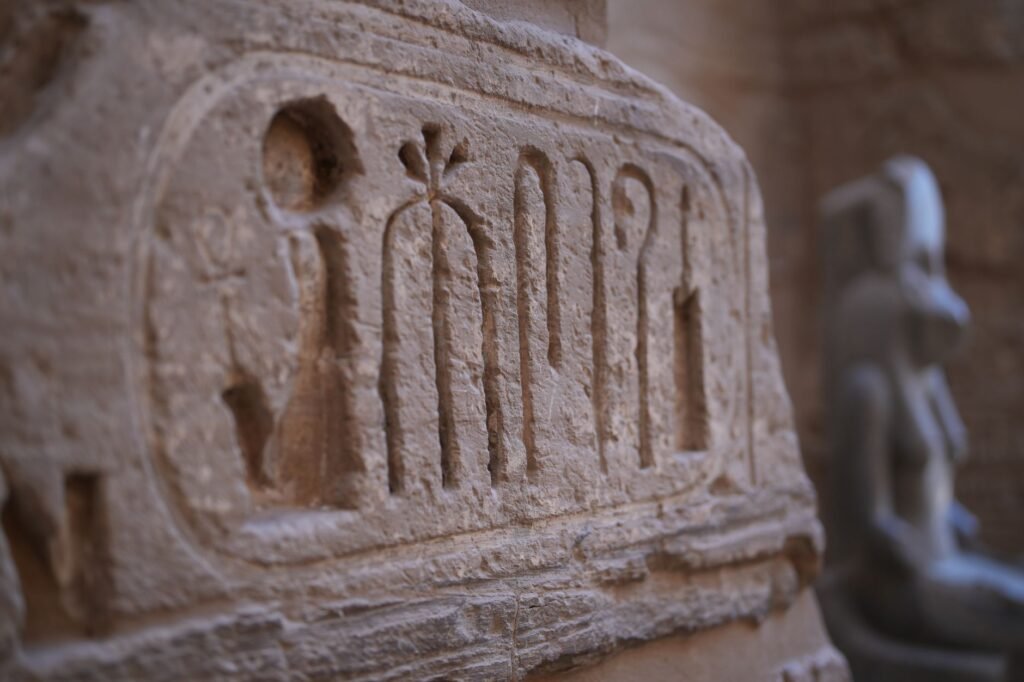
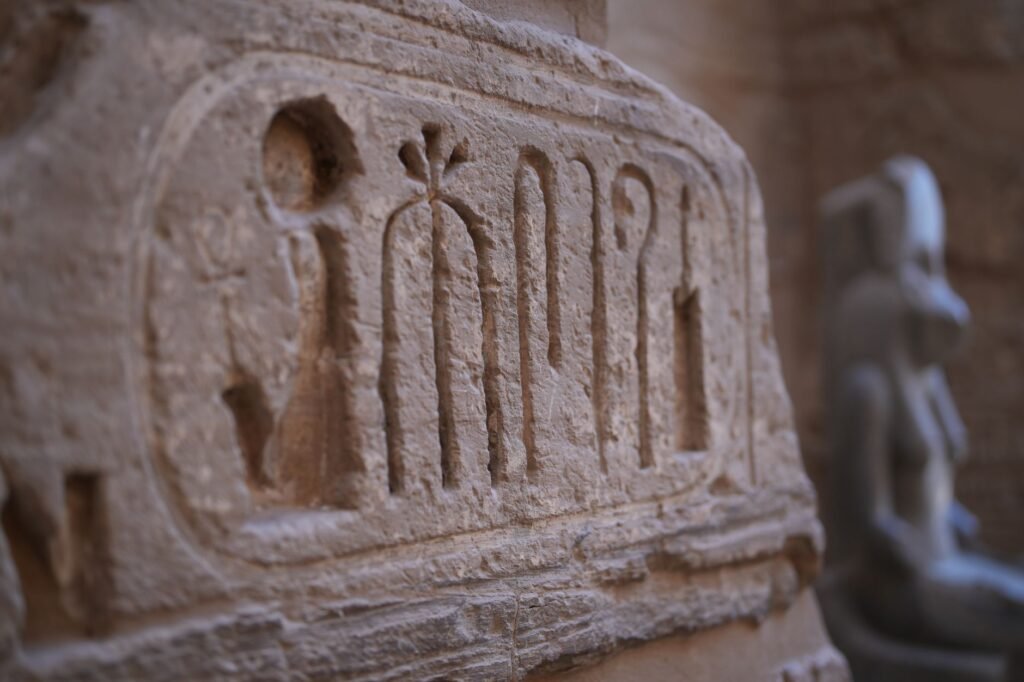
A cartouche in ancient Egyptian culture is not a mythological being, but a special oval-shaped frame used in hieroglyphic writing to enclose the names of kings and, in some cases, queens or royal figures. Because it is so closely associated with royal identity, divine kingship, and the religious symbolism of names in ancient Egypt, the cartouche often appears in discussions of Egyptian mythology, religion, and funerary belief.
In modern popular culture, the word cartouche is sometimes treated as if it were a mysterious emblem or magical object. Historically, however, it was a graphic convention of writing and royal representation, not a god, goddess, or mythical creature. Its importance lies in how Egyptians understood the power of names, legitimacy, protection, and eternity.
Origin and Meaning
The word cartouche comes from French. Egyptologists adopted it after French soldiers in the Napoleonic period thought the oval sign resembled a cartridge case. The ancient Egyptians did not use this term.
In Egyptian writing, the cartouche is called a shen-ring in broader symbolic terms because of its association with the Egyptian shen symbol, a circular loop representing eternal protection and completeness. The cartouche itself is essentially an elongated oval with a horizontal line at one end, enclosing a royal name written in hieroglyphs.
Etymological and historical notes
- Modern term: cartouche
- Language of origin: French
- Ancient Egyptian concept: royal name enclosed within a protective oval
- Related symbol: the shen ring, a loop signifying eternity and protection
The cartouche developed from earlier royal name encirclement systems. By the end of the Old Kingdom and more clearly in the Middle Kingdom, it became a standard way to present royal titulary. It visually emphasized that the enclosed name belonged to the king’s identity as a sovereign and sacred person.
Historical Context
The cartouche is part of the broader system of Egyptian royal ideology. Ancient Egyptian kings were not merely political rulers; they were seen as divinely sanctioned mediators between gods and humans. Their names were therefore sacred and politically significant.
Egyptian kings typically had several official names, including:
- the Horus name
- the Nebty or “Two Ladies” name
- the Golden Horus name
- the throne name
- the birth name
The cartouche usually enclosed the throne name and birth name. These names were central to royal identity and were used in inscriptions, monuments, and funerary contexts.
Why the cartouche mattered
The cartouche served several functions:
- Identification — It marked a name as royal.
- Protection — It symbolically protected the king’s name.
- Eternity — It linked the king to everlasting remembrance.
- Legitimacy — It reinforced dynastic authority.
- Religious meaning — It reflected the sacred power of names in Egyptian belief.
Ancient Egyptians believed that a person’s name was essential to their existence after death. Erasing a name could diminish or destroy memory, while preserving a name helped sustain the deceased in the afterlife. The cartouche thus had a profound funerary and theological significance.
Main Characteristics
The cartouche is not a mythological character, but it has several identifiable characteristics that explain its symbolic importance.
Visual features
- Shape: elongated oval with a line at one end
- Contents: hieroglyphic royal name
- Use: primarily for kings, sometimes queens or royal heirs
- Placement: on temple walls, tombs, stelae, statues, coffins, amulets, papyri, and official monuments
Symbolic features
The cartouche represented:
- the enclosing of sacred royal identity
- the protection of the king’s name
- the order and boundary of kingship
- the permanence of royal memory
In practical terms, the cartouche made royal names easy to identify in inscriptions. In symbolic terms, it served as a visual sign that the name belonged to someone who stood at the center of Egypt’s divine and political order.
Distinguishing traits
| Feature | Description |
|---|---|
| Shape | Oval loop with a line at one end |
| Function | Encloses royal names in hieroglyphs |
| Symbolic value | Protection, eternity, legitimacy |
| Associated figure | Pharaoh or royal person |
| Common setting | Tombs, temples, statues, amulets |
Family and Genealogy
Because a cartouche is not a deity or living being, it does not have a family or genealogy in the mythological sense. However, it is closely tied to royal lineage and the concept of dynastic succession.
Genealogical significance in royal contexts
The cartouche helped distinguish one royal name from another and could therefore appear in contexts that emphasized:
- inheritance of the throne
- dynastic continuity
- royal ancestry
- the legitimacy of a ruler’s line
In this sense, the cartouche is connected not to a divine family tree but to historical kingship. It identifies the individual whose name is enclosed, rather than existing as a separate mythological entity.
Symbols
The cartouche itself is a symbol, but it is also connected to other Egyptian symbolic forms.
Key related symbols
- Shen ring: a loop of protection and eternity
- Ankh: life
- Djed pillar: stability and endurance
- Was scepter: power and dominion
- Uraeus: royal authority and divine protection
The cartouche’s oval form visually echoes the idea of a protective boundary. This boundary was not simply decorative. In Egyptian thought, names carried power, and enclosing the name could help shield it from harm.
Meaning of the oval
The oval shape is often interpreted as representing:
- an enclosing boundary
- a protected space
- continuity
- the cyclical and eternal character of royal remembrance
Some scholars and popular accounts connect the cartouche directly to the shen ring, while others emphasize that the cartouche is a specialized written form related to royal titulary rather than a direct copy of the protective ring symbol. The relationship is clear, but the precise historical development is discussed differently in scholarly literature.
Sacred Animals
There are no sacred animals uniquely associated with the cartouche itself, because it is a written symbol rather than a divine being or cult object with an animal cult.
However, cartouches often appear alongside symbols of royal power that were associated with sacred animals or animal deities, such as:
- the cobra of the uraeus, linked to divine protection
- the falcon, associated with Horus and kingship
- the lion, associated with strength and royal power
- the bull, linked to vigor and rulership
These associations arise from the broader royal and religious setting in which cartouches were used, not from the cartouche as an independent symbol with its own animal sacredness.
Sacred Plants
There are no sacred plants specifically tied to the cartouche. Still, the cartouche appears in inscriptions and temple decoration that may include sacred plant symbolism in general Egyptian art, such as:
- the papyrus
- the lotus
- the persea tree in some religious contexts
These plants were associated with life, regeneration, Lower and Upper Egypt, and divine order. They sometimes appear near royal names, but they are not intrinsic to the cartouche itself.
Sacred Places
The cartouche is not linked to a single sanctuary, mountain, or city. Instead, it was used throughout Egypt wherever royal names were inscribed.
Important contexts for cartouches
- Temples — royal names carved on walls and pylons
- Tombs — especially in royal burials and elite funerary contexts
- Statues — as identification and protection
- Stelae — commemorative and religious inscriptions
- Papyri — especially in funerary texts and administrative documents
- Obelisks and monuments — as markers of royal presence
Major sites where cartouches are common
Cartouches appear at many famous Egyptian sites, including:
- Thebes
- Luxor
- Karnak
- Abydos
- Saqqara
- Giza
- Valley of the Kings
- Memphis
Because the cartouche was a standard feature of royal inscriptions, it is found across the full span of pharaonic Egyptian civilization.
Powers and Attributes
Strictly speaking, a cartouche has no supernatural powers of its own. Its power comes from its role in Egyptian religious thought.
Symbolic functions
- Protecting the royal name
- Preserving identity in life and after death
- Marking divine kingship
- Supporting royal memory
- Linking the king to cosmic order
In Egyptian belief, a person’s name was deeply connected to their being. For rulers, this was especially important because the king embodied the state, the gods’ favor, and the stability of the world. The cartouche helped inscribe that identity into stone, metal, and ritual memory.
Attributes often associated with cartouches
| Attribute | Meaning |
|---|---|
| Protection | Shields the royal name from harm |
| Eternity | Preserves memory across time |
| Authority | Signals legitimate kingship |
| Sacredness | Marks a name as ritually important |
| Identity | Distinguishes the ruler in inscriptions |
Main Myths
The cartouche is not central to a single myth in the way that Osiris, Isis, or Horus are. Still, it is connected to several major Egyptian religious ideas and stories.
The power of names
One of the most important beliefs in ancient Egypt was that names had enduring power. To know and preserve a name was to preserve the person. This idea appears in funerary religion and royal ideology throughout Egyptian history.
The cartouche contributed to this by enclosing the king’s name in a protective visual frame. In effect, it helped ritualize memory.
Royal survival after death
The king’s survival in the afterlife depended on many factors: proper burial, ritual offerings, divine favor, and the preservation of names and images. Cartouches found in tombs and funerary contexts supported this afterlife identity.
Destruction and erasure
When rulers were later attacked politically or religiously, their names were sometimes damaged or erased from monuments. This was not simply vandalism in the modern sense. In Egyptian terms, erasing a name could threaten posthumous existence and memory. The cartouche, therefore, became part of the struggle over historical legitimacy.
Notable caution
Unlike myths involving gods and monsters, cartouche-related stories are mostly about ritual practice, kingship, and memory, rather than narrative legend. Its “mythology” is symbolic rather than story-driven.
Relationship with Other Mythological Figures
The cartouche interacts indirectly with many Egyptian deities and divine concepts because it belongs to the world of kingship.
Connections with major deities
- Horus: the king was often identified with Horus alive on earth
- Ra: royal power was linked to solar authority
- Osiris: kings sought association with Osiris in death
- Isis: protective magic and dynastic legitimacy were often associated with her
- Thoth: as god of writing and knowledge, Thoth is relevant to hieroglyphic inscriptions
Political and divine relationships
The cartouche reflects the belief that the king stood in a special relationship to the gods. It was not a divine figure itself, but it helped express the king’s semi-divine role.
Conflicts and erasure
When later rulers condemned earlier ones, they sometimes tried to remove their names from monuments. This could be understood as a posthumous attack on identity and legitimacy. Such actions are especially discussed in relation to rulers whose memory was politically controversial.
Worship and Cult
The cartouche was not worshipped as a deity. There were no temples dedicated to it, no priesthood, and no independent festivals for it. However, it had a ritual and ceremonial function.
Use in religious practice
Cartouches appeared in:
- temple inscriptions honoring kings
- royal funerary equipment
- amulets placed for protection
- texts intended to secure remembrance
- magical and religious contexts where names were important
Ritual importance
A royal name in a cartouche could be:
- carved on temple walls during dedication ceremonies
- inscribed on funerary objects
- repeated in offering formulas
- included in protective spells or blessings
Offerings and ceremonies
While offerings were made to gods and deceased kings, the cartouche itself was not the recipient of offerings. Instead, it functioned as a sign that the royal name had entered a sacred and ritually protected space.
Ancient Sources
Because the cartouche is a feature of Egyptian script and royal titulary, it is documented mainly in primary Egyptian inscriptions, not in Greek literary sources.
Primary Egyptian evidence
Important evidence comes from:
- temple inscriptions
- tomb inscriptions
- royal monuments
- sarcophagi
- papyri
- stelae
- funerary texts
Classical authors
Classical Greek and Roman writers such as Herodotus, Diodorus Siculus, Plutarch, and Strabo discussed Egyptian religion, kingship, and customs, but they did not provide a technical explanation of the cartouche as Egyptologists understand it today. Their works are useful for general background, not for the cartouche as a specific hieroglyphic format.
Modern interpretation
The scholarly understanding of cartouches is based primarily on:
- epigraphic study of Egyptian inscriptions
- the decipherment of hieroglyphs
- comparative analysis of royal titulary
The cartouche became much better understood after the decipherment of hieroglyphs in the 19th century.
Roman Equivalent
There is no true Roman equivalent to the Egyptian cartouche.
That said, some Roman practices are loosely comparable in function:
- imperial names inscribed on monuments
- honorific titles in official inscriptions
- laurel wreath symbolism for victory and authority
- commemorative naming of rulers in public spaces
However, these are only partial parallels. The Egyptian cartouche is unique in its combination of hieroglyphic form, royal ideology, and magical protection of the name. Rome did not have an exact equivalent oval frame for enclosing imperial names as a standard sacred sign.
Influence on Modern Culture
The cartouche is widely recognized today, often more in visual design and popular fiction than in accurate historical understanding.
In modern archaeology and education
- It is a standard term in Egyptology.
- It appears in museum labels and textbooks.
- It is used to identify royal names on monuments and artifacts.
In art and design
Cartouche-inspired shapes are used in:
- decorative motifs
- jewelry
- graphic design
- themed architecture
- museum branding and educational materials
In literature, film, and games
Popular media sometimes uses cartouches as:
- mysterious labels on ancient artifacts
- magical seals
- plot devices for hidden royal identities
These portrayals may be imaginative but are often simplified. The cartouche is sometimes mistakenly presented as a talisman or symbol with independent supernatural power. In reality, its significance lies in royal identity, inscription, and religious memory.
Common modern misconception
A frequent error is to treat the cartouche as if it were a mythological object comparable to a sacred relic. Historically, it was a written enclosure for a name, though one with profound symbolic and religious meaning.
Curiosities
Interesting facts about cartouches
- The modern word cartouche is not ancient Egyptian.
- A cartouche usually encloses two of the king’s names, not all five royal names.
- The cartouche was especially important because Egyptians believed the preservation of the name helped secure eternal life.
- The shape resembles a rope loop or protective boundary in symbolic interpretation.
- Some nonroyal individuals in later periods could be named in ways that visually echoed royal forms, but the standard use remained royal.
- Cartouches are one of the first Egyptian symbols many people learn to recognize because they make royal names visually distinct.
- The famous Rosetta Stone includes royal names in cartouches, which helped scholars identify repeated name patterns during the decipherment of hieroglyphs.
Frequently Asked Questions
1. What is a cartouche in Egyptian mythology?
A cartouche is an oval frame in ancient Egyptian writing that encloses a royal name, usually the name of a pharaoh. It is not a god or mythological creature, but a symbol strongly connected to royal and religious belief.
2. Why did Egyptians use cartouches?
They used cartouches to mark royal names, protect them symbolically, and emphasize the sacred status of kingship. The enclosed name was believed to be preserved for eternity.
3. Did the ancient Egyptians call it a cartouche?
No. The word cartouche is a modern French term adopted by Egyptologists. Ancient Egyptians had their own concept of the royal name enclosed in a protective form.
4. Are cartouches magical?
Not in the sense of being magical objects with independent powers. Their importance was religious and symbolic: they protected names and helped preserve identity, especially for kings in life and after death.
5. Which names are written inside a cartouche?
Typically the throne name and birth name of a pharaoh are written inside cartouches. Other royal names are usually written in different forms.
6. Can cartouches be found outside tombs?
Yes. Cartouches appear widely on temples, statues, stelae, amulets, papyri, and many royal monuments across ancient Egypt.
7. Is a cartouche the same as the shen ring?
They are related but not identical. The shen ring is a broader symbol of eternity and protection, while the cartouche is a royal name frame that developed from similar symbolic ideas.
8. Why are cartouches important to Egyptology?
They help scholars identify royal names, reconstruct dynasties, and understand ancient Egyptian ideas about kingship, language, and the afterlife.
Conclusion
A cartouche in Egyptian mythology is best understood not as a mythical being but as a sacred royal name enclosure with deep religious and cultural significance. It reflects one of the most distinctive features of ancient Egyptian civilization: the belief that names were powerful, memory was essential, and kingship was divinely ordered.
By enclosing the pharaoh’s name in a protective oval, the cartouche marked that name as worthy of preservation, legitimacy, and eternal remembrance. It appeared everywhere in Egyptian monumental art and remains one of the most recognizable symbols of ancient Egypt today. Its enduring legacy lies in the way it connects writing, religion, kingship, and the afterlife into a single visual form.

Orin Vale has spent the better part of two decades tracing the threads that connect the world’s oldest stories — from the halls of Asgard to the banks of the Nile, from Olympus to the jungles of the Maya. What began as a childhood fascination with flood myths and trickster gods grew into years of independent study across comparative mythology and ancient religion, always chasing the same question: what did these stories mean to the people who first told them? Orin writes for readers who want more than trivia — the ones looking for the beliefs, fears, and truths that myths were built to carry.