Diana
Introduction
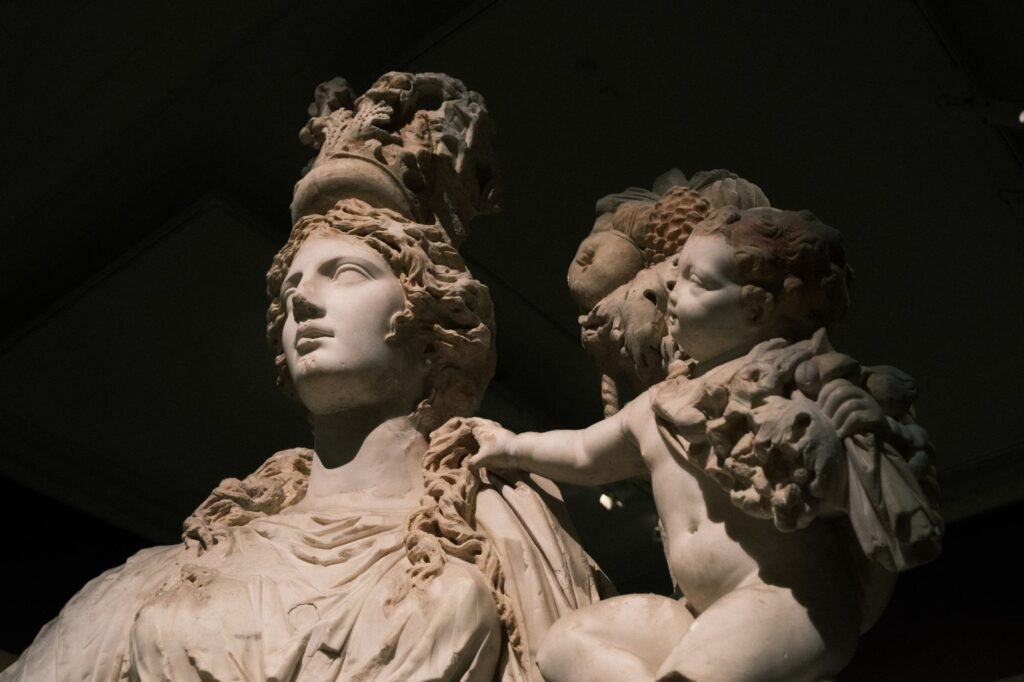
Diana is one of the most enduring figures in Greco-Roman religion and mythology. In the Roman tradition, she was a major goddess associated with the moon, the hunt, wild nature, childbirth, and female independence. She was closely identified with the Greek goddess Artemis, though Roman Diana also developed distinct local and cultic characteristics of her own.
As a divine figure, Diana occupied an important place in ancient religion and later Western cultural memory. She appears in classical literature, sacred cult, visual art, and modern adaptations ranging from painting and sculpture to film, literature, and video games. Her image has often symbolized purity, autonomy, wilderness, and the power of the female divine.
Origin and Meaning
The name Diana is generally understood as a Latin form connected to the Indo-European root dyeu-, meaning “bright” or “sky.” This same root appears in the names of related sky and daylight deities, including Zeus and the Roman god Jupiter. The etymology suggests an ancient association with luminosity, and by extension with the moon and celestial brightness.
In Roman religion, Diana was not simply a borrowed Greek goddess, although she became strongly associated with Artemis. Some scholars emphasize that Diana likely had an earlier Italian and Latin religious background, especially as a woodland and fertility deity linked to the countryside, hunting, and women’s health. Over time, her identity merged with Greek influence, especially in literary and artistic contexts.
Historical Context
Diana belongs to the religious world of ancient Italy and the Roman state. She was worshipped in republican and imperial Rome, as well as in local sanctuaries across Italy. Her cult reflects a mixture of native Italic traditions and Hellenic influence.
A key center of worship was the sanctuary of Diana Nemorensis at Lake Nemi near Aricia in Latium. This cult was ancient and unusual, associated with sacred kingship, ritual continuity, and a priest known as the Rex Nemorensis. According to Roman sources, the priesthood was obtained through violence, a striking feature that made this sanctuary famous in antiquity and in later scholarship.
Diana also had civic and public significance. On the Aventine Hill in Rome, she was honored in a temple traditionally associated with the Latin League, highlighting her role not only as a wilderness deity but also as a goddess of communal and political identity. Her festivals and cult practices connected her to the calendar, the agricultural year, and rites for women and children.
In Greek-influenced literature, Diana was increasingly aligned with Artemis, the goddess of the hunt, virginity, and the moon. This identification shaped later Western perceptions of Diana, especially in Renaissance and post-Renaissance art.
Main Characteristics
Diana is typically portrayed as a youthful, powerful, and independent goddess. Her principal characteristics include:
- Virginity and chastity: Like Artemis, Diana is often described as a sworn virgin who resists marriage and male control.
- Hunting: She is associated with bows, arrows, forests, and wild animals.
- Moonlight: In later tradition, she becomes a lunar goddess, especially linked with the night sky.
- Wild nature: Diana governs uncultivated landscapes, mountains, woods, and the boundaries between civilization and wilderness.
- Female protection: She is connected to childbirth, the safety of young women, and transitions in female life.
- Retributive power: In myths, she punishes transgression swiftly, especially violations of her sacred space or dignity.
Diana’s iconography usually emphasizes movement, alertness, and self-sufficiency. She is often depicted with a short tunic suitable for hunting, a bow, a quiver of arrows, and sometimes a stag or hounds. In artistic traditions, the crescent moon or star imagery may also appear, especially in her lunar aspect.
Typical attributes at a glance
| Attribute | Meaning |
|---|---|
| Bow and arrows | Hunting, swift punishment, divine precision |
| Crescent moon | Lunar association, night, cyclical renewal |
| Stag or deer | Wild nature, grace, sacred animal |
| Hounds | Tracking, hunt, protective force |
| Short tunic | Mobility, virgin huntress iconography |
| Forests and groves | Wilderness, liminal sacred space |
Family and Genealogy
Diana’s genealogy differs depending on whether one follows Roman, Greek, or later literary traditions.
In Roman and Greek-based genealogy
In the standard Greco-Roman account, Diana is the daughter of Jupiter and Latona (Greek Leto), and twin sister of Apollo. This tradition is especially prominent in literary sources influenced by Greek myth.
In Roman religious tradition
The picture is more complex. As an Italian goddess, Diana may have had earlier local cultic roots that were not originally framed within the Jupiter-Latona-Apollo family. Roman religion frequently absorbed and systematized older deities by aligning them with Olympian-style genealogies.
Relationships
Diana is commonly linked with several important figures:
- Apollo: Twin brother in the dominant classical tradition; associated with light, prophecy, music, and healing.
- Actaeon: A mortal hunter transformed into a stag and killed by his own hounds after seeing Diana bathing.
- Callisto: A companion of Diana who was seduced or violated by Jupiter, depending on the version.
- Orion: In some traditions, a giant hunter and companion or rival, who dies through Diana’s agency or by other divine means.
- Egeria: A nymph or divine figure sometimes connected to Diana’s cult and sacred landscape, especially in Roman local tradition.
Because ancient sources vary, Diana’s relationships should be understood as mythic traditions rather than fixed biography.
Symbols
Diana’s symbols reflect her domains of hunting, chastity, lunar power, and nature.
Common symbols
- Bow and arrows: Her most recognizable hunting tools.
- Crescent moon: Sign of her lunar identity.
- Stag: Sacred or emblematic animal, especially in myths and art.
- Hunting dog: Companion of the hunt.
- Torch: Sometimes associated with night, childbirth, and guidance.
- Forest and grove: Not a portable symbol, but one of her primary sacred environments.
Symbolic meanings
- The bow suggests distance, discipline, and divine judgment.
- The moon represents cycles, femininity, and light in darkness.
- The stag evokes wildness, agility, and the untamed world.
- The torch can symbolize illumination, birth, and ritual passage.
Sacred Animals
Diana is associated with several animals, especially those connected with the wild or the hunt.
Stag or deer
The stag is the most famous animal associated with Diana. It appears in art, myth, and cult symbolism. The deer represents the untamed forest and, in some contexts, the goddess’s own presence in nature.
Hunting dogs
Dogs are important in her huntress identity. They symbolize tracking, loyalty, and the pursuit of prey. In myths such as that of Actaeon, hounds can also serve as instruments of divine punishment.
Other associated animals
- Boars and hares may appear in broader hunting contexts.
- Wild animals of the forest generally fall under her protection or domain.
- In some traditions, she-bears or female animals can be linked with her protective powers over young life and maternal processes, though this is more prominent in Greek Artemis traditions.
Sacred Plants
Diana’s sacred flora is tied to forests, groves, and liminal woodland spaces.
Oak
The oak is often associated with sacred groves and divine strength in Roman and Italic religion. It can be linked to Diana through woodland sanctity, though not uniquely to her.
Cypress and laurel
These trees appear in broader classical sacred symbolism. Laurel is more closely tied to Apollo, but in shared Greco-Roman settings the two siblings’ cults sometimes echo each other in ritual language and artistic presentation.
Forest plants and herbs
Diana’s cult does not center on one exclusive sacred plant in the way that some deities are linked with a specific tree or flower. Instead, her botanical identity is rooted in woodland vegetation, wild herbs, and the uncultivated natural world.
Sacred Places
Diana’s cult was strongly connected to sacred landscapes, especially groves, lakes, and hills.
Lake Nemi and the Sanctuary of Diana Nemorensis
The most famous sanctuary of Diana was at Lake Nemi in Latium, south of Rome. This sanctuary, set in a wooded landscape, was one of the most important and enigmatic cult centers in Roman religion.
Its chief features included:
- a sacred grove
- a lake setting
- a priestly office known for ritual combat or succession through force
- long-standing associations with fertility, women, and protection
The site inspired much later archaeological and historical interest.
The Aventine Temple in Rome
A temple to Diana on the Aventine Hill was traditionally associated with Latin identity and political alliance. This location linked Diana to the urban and civic religion of Rome rather than only to the countryside.
Groves and wilderness sites
Across Italy and the wider Roman world, Diana was honored in:
- groves
- springs
- forest sanctuaries
- rural shrines
- liminal places between settlement and wilderness
Her sacred geography reflects her role as a goddess of thresholds, boundaries, and the natural world outside the city.
Powers and Attributes
Diana’s powers are broad and multi-layered. She is not only a huntress but also a guardian of life transitions and a divine force in the natural order.
Major domains
- Hunting and archery
- Wild animals and forests
- Moon and night
- Virginity and chastity
- Childbirth and female protection
- Liminal spaces and boundaries
- Divine punishment and protection
Functional significance
Diana’s attributes are especially important because they combine independence and control. She moves freely in the wilderness, yet she also governs it. She is associated with freedom from marriage, yet also with the safeguarding of women’s lives. She can nurture and protect, but also wound and punish.
This duality is central to her mythic identity.
Main Myths
Diana appears in many classical myths, especially in Roman poetry and later Greco-Roman retellings.
Actaeon
One of the best-known myths concerns Actaeon, a hunter who accidentally sees Diana bathing. In retribution, Diana transforms him into a stag, and he is torn apart by his own hounds.
This story highlights several recurring themes:
- the inviolability of the goddess
- the danger of male intrusion
- punishment for transgressing sacred boundaries
- the power of transformation
Different authors shape the episode differently, but the essential pattern remains consistent.
Callisto
In a widely circulated myth, Callisto, a follower or companion of Diana, becomes pregnant after being seduced or violated by Jupiter. When the pregnancy is discovered, she is expelled from Diana’s company. Later traditions connect Callisto with the constellations Ursa Major and Ursa Minor.
This myth emphasizes:
- the strictness of Diana’s virgin circle
- the vulnerability of mortal women to divine power
- the tension between chastity, innocence, and contamination in mythic narrative
Orion
The giant hunter Orion is linked to Diana in multiple, sometimes contradictory traditions. In some stories, he is a companion or possible romantic interest; in others, Diana kills him, or he dies through other divine agency. Ancient sources disagree, and no single version is authoritative.
The myth of Orion reinforces Diana’s association with hunting, danger, and the limits placed on mortal male ambition.
Niobe
In the story of Niobe, Diana and Apollo punish Niobe for boasting that she has more children than their mother, Latona. Diana kills Niobe’s daughters while Apollo kills her sons, or the division may vary in some accounts.
This myth underscores:
- the honor due to the divine
- the consequences of arrogance
- the cooperation of the divine twins in vengeance
Iphigenia
In some Greek traditions later adopted into Roman literary culture, Iphigenia is connected to Artemis/Diana. The goddess is said to require or accept the substitution of a deer for the sacrifice of the girl. The details vary, but the story ties Diana to sacrifice, divine intervention, and the preservation of life.
Heroic and local myths
Diana also appears in local Italian legends, cult stories, and etiological myths explaining ritual customs. These are often more regional and less standardized than the famous literary tales.
Relationship with Other Mythological Figures
Diana’s mythic network is extensive.
With Apollo
Apollo is her twin brother in the dominant classical tradition. Their pairing reflects complementary divine roles:
- Diana: the moon, hunt, wilderness, female protection
- Apollo: the sun or light, prophecy, music, healing
In Roman art and literature, they often appear as a balanced divine pair.
With Jupiter
Jupiter is her father in the classical genealogy. He is also the source of several myths in which Diana’s companions are harmed or violated, indirectly provoking her actions. This relationship illustrates the complex hierarchy of divine power in Roman myth.
With Latona
Latona, Diana’s mother, is central to myths of divine protection and vengeance, especially in stories of Niobe. Diana’s devotion to her mother is often emphasized.
With mortals
Diana’s relationship with mortals is often marked by distance. She may protect women and children, but she is not easily approachable. Myths frequently warn against:
- spying on her
- offending her followers
- violating the purity of her sacred space
- boasting against divine authority
With other deities
Diana can be compared with:
- Minerva, in her virgin, independent aspect
- Hecate, in lunar and liminal associations
- Bona Dea, in female-centered Roman religious contexts
- Juno Lucina, in childbirth-related functions
These similarities do not make them identical, but they reveal overlapping domains in ancient religion.
Worship and Cult
Diana’s worship varied from place to place and over time.
Ritual life
Her cult likely included:
- offerings at groves and temples
- prayers for safe childbirth
- hunting-related dedications
- seasonal rites
- communal festivals
At Lake Nemi, the cult was especially distinctive and may have preserved very ancient ritual forms.
The Rex Nemorensis
The priest of Diana at Nemi, the Rex Nemorensis, was linked with one of the most famous ritual traditions in Roman religion. Ancient writers describe a successor who obtained the office by killing the current priest. The meaning of this custom has been much discussed, and modern scholars treat the surviving descriptions cautiously, since they come through literary sources rather than direct ritual manuals.
Festivals
Diana was celebrated on dates associated with the founding of her temples and with communal religious observance. The best-known festival in Rome was the Nemoralia on 13 August, also called the festival of torches. It was particularly associated with the sanctuary at Nemi and with women, slaves, and the protection of the vulnerable.
Worshippers
Her worship appealed to:
- hunters
- women
- rural communities
- those seeking protection in childbirth
- people connected to sacred groves and local shrines
Diana’s cult was accessible to both elite and non-elite worshippers, reflecting the broad reach of Roman religion.
Ancient Sources
Diana is known from a wide range of ancient literary and visual sources.
Major classical authors
- Homer: Although Diana is not central in Homeric epic, the Greek Artemis tradition forms part of the background to later identification.
- Hesiod: Early Greek genealogical traditions help frame the divine family later associated with Diana.
- Callimachus: The Hymn to Artemis is crucial for understanding Greek Artemis, which strongly influenced Diana’s later literary image.
- Apollodorus: Provides mythographical summaries relevant to Diana/Artemis traditions.
- Ovid: Especially important for Roman literary treatments, including Metamorphoses, which contains the Actaeon and Callisto myths.
- Virgil: References Diana in the Aeneid and other works, especially in Roman religious and mythic contexts.
- Pausanias: Valuable for Greek cult and mythic parallels.
- Strabo, Livy, and Varro: Important for Roman religion, local cults, and historical context.
Important caution
Ancient sources do not always agree. Diana’s character, genealogy, and myths vary depending on whether the author is writing as a Roman antiquarian, Greek mythographer, Augustan poet, or later commentator.
Roman Equivalent
Diana is the Roman goddess most commonly identified with the Greek Artemis. This equivalence is central to classical studies, but it is not a simple one-to-one substitution.
Similarities with Artemis
Both goddesses are associated with:
- virginity
- hunting
- wild nature
- moonlight
- protection of women
- punishment of transgression
Distinctively Roman features
Roman Diana also retained or developed characteristics that were especially important in Italic religion:
- stronger connection to Latium
- role in civic and communal cult
- association with the Aventine
- local sanctuary at Nemi
- links to slaves and the marginalized in some festival contexts
Thus, Diana is best understood as both a Roman goddess in her own right and a Roman counterpart to Artemis.
Influence on Modern Culture
Diana has had a long afterlife in Western culture.
Literature and art
Renaissance and neoclassical artists frequently depicted Diana as:
- a huntress
- a lunar maiden
- a symbol of chastity and purity
- an emblem of aristocratic elegance and natural freedom
Writers from the early modern period onward used Diana as a metaphor for independent female power, unattainable beauty, or chastity. She appears in poetry, operatic libretti, and symbolic allegory.
Cinema, television, and games
Modern entertainment media often draw on Diana’s image, especially in forms influenced by the broader Artemis-Diana tradition:
- as a goddess of the moon
- as a huntress or warrior figure
- as a symbol of female strength
- as a name or archetype for characters in fantasy and science fiction
Popular culture
The name Diana itself has become culturally resonant. It evokes dignity, grace, autonomy, and classical heritage. The goddess also continues to shape discussions of femininity, wilderness, and mythic symbolism in modern reinterpretations.
Curiosities
- Diana’s sanctuary at Nemi fascinated ancient writers and later scholars because of the ritual role of the Rex Nemorensis.
- The festival Nemoralia was associated with torchlight and may have been especially significant for women.
- In Roman literature, Diana is often more severe and remote than some other deities, reinforcing her role as a guardian of sacred boundaries.
- Although she is widely seen as a moon goddess, that lunar identity becomes more prominent in later syncretic tradition than in some early Roman forms.
- The myth of Actaeon became one of the most famous artistic subjects associated with Diana.
- Her association with chastity does not mean passivity; in myth she is one of the most active and formidable goddesses in the classical pantheon.
Frequently Asked Questions
1. Who was Diana in Roman mythology?
Diana was a major Roman goddess associated with the hunt, the moon, wilderness, virginity, and the protection of women and children.
2. Is Diana the same as Artemis?
Diana is the Roman counterpart of the Greek goddess Artemis. They are closely identified, though Diana also has distinct Roman religious features.
3. What are Diana’s main symbols?
Her main symbols include the bow and arrows, the crescent moon, the stag, and hunting dogs.
4. Where was Diana worshipped?
She was worshipped in many places, especially at the sanctuary of Lake Nemi and at her temple on the Aventine Hill in Rome.
5. What is the story of Actaeon?
Actaeon was a hunter who saw Diana bathing. She transformed him into a stag, and he was killed by his own hounds.
6. Was Diana only a virgin goddess?
Virginity is one of her defining traits, but Diana also had broader functions, including protection in childbirth and guardianship over nature.
7. What is the Nemoralia?
The Nemoralia was a festival associated with Diana, especially her cult at Nemi. It involved torches and was connected to women and communal worship.
8. Why is Diana important today?
Diana remains important because she represents a powerful mythic image of independence, nature, and female divine authority, and she continues to inspire art and literature.
Conclusion
Diana is one of the most significant goddesses of the ancient Mediterranean world. As a Roman deity with deep Italian roots and strong Greek parallels, she embodies the meeting point of local religion, imperial culture, and literary mythology. Her domains of hunting, moonlight, wilderness, and female protection made her a figure of both beauty and power.
Her myths, especially those of Actaeon, Callisto, and Niobe, reveal enduring ancient concerns with boundaries, purity, and divine justice. Her sanctuaries, particularly Lake Nemi, testify to the depth and antiquity of her cult. Through centuries of art, literature, and reinterpretation, Diana has remained a compelling symbol of autonomy, sacred nature, and the enduring force of the feminine divine.

Orin Vale has spent the better part of two decades tracing the threads that connect the world’s oldest stories — from the halls of Asgard to the banks of the Nile, from Olympus to the jungles of the Maya. What began as a childhood fascination with flood myths and trickster gods grew into years of independent study across comparative mythology and ancient religion, always chasing the same question: what did these stories mean to the people who first told them? Orin writes for readers who want more than trivia — the ones looking for the beliefs, fears, and truths that myths were built to carry.