Pluto (Roman god)
Introduction
Pluto is the Roman god of the underworld, the dead, and the wealth hidden beneath the earth. In Roman religion and later classical tradition, he is one of the most important figures associated with death, burial, subterranean riches, and the final resting place of souls. He is often identified with the Greek god Hades, although Roman religious practice and literary usage gave Pluto distinct emphases and names.
Pluto occupies a central place in ancient Mediterranean mythology because he represents both the inevitability of death and the hidden abundance of the earth. He was not only a ruler of the dead but also a divine power linked to precious metals, fertile soil, and the unseen forces beneath the surface. For this reason, ancient authors sometimes treated him with awe, caution, or euphemistic respect.
Origin and Meaning
The name Pluto comes from the Greek Ploutōn (Πλούτων), meaning “the wealthy one” or “the rich one,” derived from ploutos (“wealth”). The name reflects a major religious idea: wealth comes from below the earth, where metals, minerals, and fertile humus are found, and where the dead are also received.
In Greek tradition, the older name Hades referred both to the god and to the underworld itself. Over time, Ploutōn became a more respectful and positive title, especially in mystery cults and later literature. The Romans adopted this name as Pluto, alongside other underworld titles such as Dis Pater and Orcus, depending on context and author.
The shift in naming is significant. Rather than emphasizing terror alone, the title “Pluto” highlights hidden abundance, subterranean power, and the god’s role as lord of what lies beneath the visible world.
Historical Context
Pluto emerged from a long tradition of Indo-European and Mediterranean underworld divinities. In Greek religion, the underworld was both a place and a divine realm governed by a powerful deity. Roman religion borrowed heavily from Greek mythology, but it also maintained older native ideas about the dead, ancestral spirits, and chthonic powers.
In the Roman world, death was not treated in isolation from civic religion. Burial customs, funerary rites, household memory of the dead, and festivals for ancestors all formed part of the broader religious landscape. Pluto belonged to this world of chthonic religion, meaning worship connected to the earth, the underworld, and the dead.
His importance increased in literature, philosophy, and mystery religions. In particular:
- Mystery cults often presented the afterlife in more hopeful terms.
- Orphic and Eleusinian traditions connected underworld figures to initiatory knowledge and divine renewal.
- Roman poets and mythographers used Pluto as a majestic ruler of the dead rather than a mere monster of death.
Although Pluto was not among the most publicly celebrated gods in everyday civic ritual, he remained a major religious and literary presence throughout classical antiquity.
Main Characteristics
Pluto is typically described as a stern, powerful, and incorruptible ruler. He is not usually portrayed as evil in the ancient sense. Instead, he is severe, remote, and inevitable.
Core traits
- Lord of the underworld
- Receiver of the dead
- Guardian of subterranean wealth
- Distant and solemn ruler
- Associated with fate, finality, and hidden abundance
Unlike gods of war or weather, Pluto’s power is quiet and absolute. He governs the realm from which no mortal normally returns. Ancient authors often avoided speaking his name directly, preferring epithets or titles that expressed respect and caution.
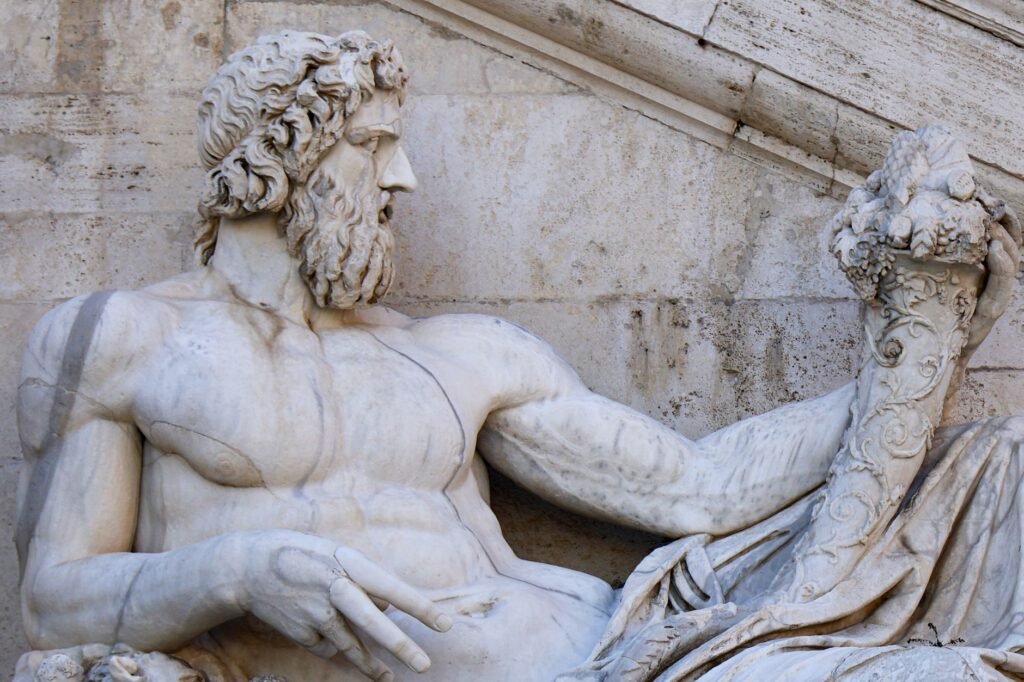
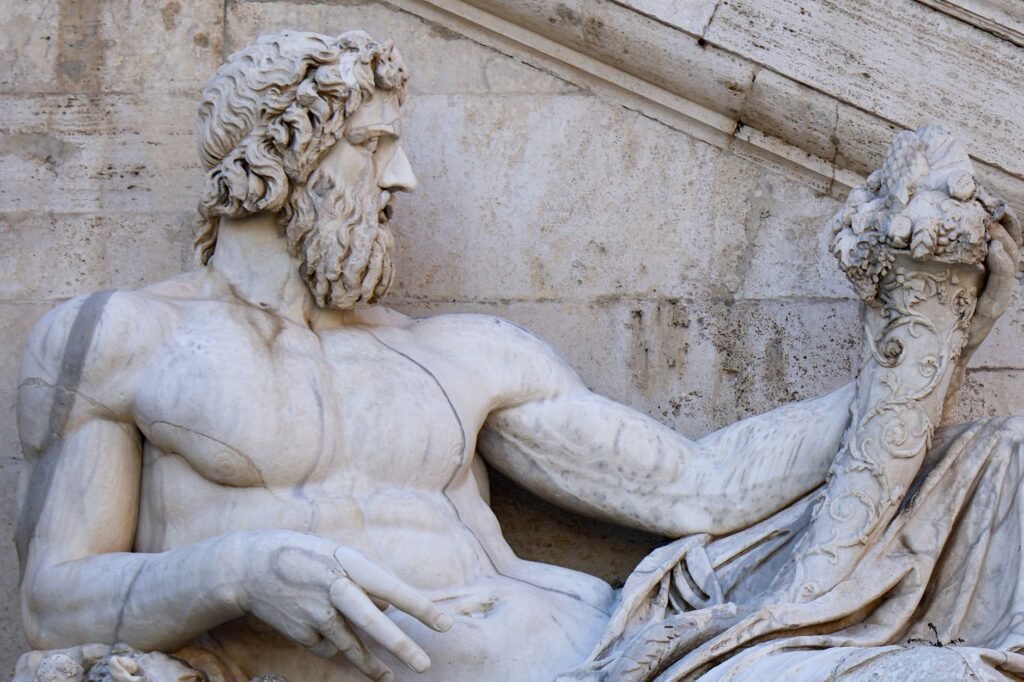
In artistic representation, Pluto is often shown as:
- a mature, bearded man
- seated on a throne
- holding a scepter
- accompanied by Cerberus, the three-headed dog
- sometimes carrying the cornucopia, symbol of wealth and fertility
This mixture of darkness and abundance defines Pluto’s identity better than any single image.
Family and Genealogy
Pluto’s genealogy varies somewhat across traditions, but the most common classical account presents him as one of the sons of Saturn and Ops in Roman tradition, corresponding to Cronus and Rhea in Greek mythology. He was therefore a brother of:
- Jupiter (Zeus)
- Neptune (Poseidon)
- Juno (Hera)
- Ceres (Demeter)
- Vesta (Hestia)
After the overthrow of Saturn, the three brothers divided the cosmos:
- Jupiter received the sky
- Neptune received the sea
- Pluto received the underworld
Spouse
Pluto’s chief consort is Proserpina in Roman tradition, the Roman equivalent of Persephone. Their marriage is central to his mythology and to ancient ideas about seasonal death and return.
Children
Classical sources do not present a stable or universally accepted list of children for Pluto. Unlike some Olympian gods, he is not commonly associated with a large divine family in Roman myth. Different traditions may give him occasional offspring or symbolic associations, but these are not consistent across sources.
Relationships
Pluto’s most famous relationship is with Proserpina, but he is also linked to the broader divine family of Jupiter and the Olympians through the cosmic division of power. His role is less that of a father figure in myth and more that of an isolated sovereign.
Symbols
Pluto’s symbols reflect both death and wealth.
| Symbol | Meaning |
|---|---|
| Scepter | Sovereignty over the underworld |
| Cornucopia | Earth’s hidden riches and abundance |
| Key | Control over the gates of death and subterranean realms |
| Throne | Kingship and permanence |
| Cerberus | Guarding the boundary between life and death |
| Dark cloak or crown | Majesty, secrecy, and chthonic power |
Common iconographic elements
- Cornucopia: especially important because it links Pluto to prosperity and fertility beneath the earth.
- Key: sometimes associated with the opening and closing of the underworld.
- Ebony, black stones, or dark imagery: commonly associated with his realm in later art and literature, though not always as formal sacred symbols.
- Crown or diadem: marks him as king.
The symbolism is notable for its dual nature. Pluto is not simply a destroyer; he also represents the concealed source of life’s material wealth.
Sacred Animals
The most famous animal associated with Pluto is Cerberus, the three-headed guard dog of the underworld. Cerberus prevents the dead from leaving and the living from entering unlawfully.
Associated animals
- Cerberus: guardian of the underworld gate
- Snakes: common chthonic symbols in Roman and Greek religion; associated with the earth and the dead
- Black sheep or black bulls: often linked to underworld sacrifices in ancient ritual contexts
- Horses: in some traditions, linked to underworld journeys and chthonic sacrifice
Cerberus is the most enduring animal companion of Pluto in art and literature. The creature symbolizes vigilance, boundary enforcement, and the inescapability of death.
Sacred Plants
Unlike gods strongly associated with specific trees or agricultural plants, Pluto has a more limited and context-dependent plant symbolism.
Plants and related vegetation
- Cypress: commonly linked to death and funerary settings in the Greco-Roman world
- Narcissus: associated in myth with the underworld through Proserpina’s abduction scene in some traditions
- Pomegranate: not Pluto’s plant alone, but deeply connected to Proserpina and underworld mythology
- Funerary wreaths and grave plants: such as myrtle or other memorial greenery, depending on local customs
The pomegranate is especially important because it links Pluto to the myth of Proserpina and to the seasonal cycle of descent and return. However, the plant is more closely associated with Proserpina than with Pluto himself.
Sacred Places
Pluto was connected to many underworld entrances, tombs, and sacred sites associated with the dead. Since the underworld was not a geographical place on the surface, his cultic landscape consisted of entrances, caves, sanctuaries, and necropoleis.
Important locations
| Place | Significance |
|---|---|
| The underworld (Orcus/Inferi) | Pluto’s cosmic realm |
| Eleusis | Important mystery center linked to Demeter and Persephone/Proserpina traditions |
| Enna in Sicily | In many versions of the Proserpina myth, the site of her abduction |
| Lake Avernus | In Roman tradition, a gateway to the underworld |
| Caves and chasms | Common symbolic entrances to chthonic realms |
| Necropoleis and tomb precincts | Places of funerary association and underworld worship |
Cultic geography
The Romans often treated certain places as threshold spaces where the boundary between living and dead could be symbolically crossed. Such sites were associated with rituals, warnings, and the presence of underworld deities, including Pluto, Dis Pater, and Orcus.
Powers and Attributes
Pluto’s powers are broad but centered on the subterranean world.
Main domains
- Rule over the dead
- Custody of souls in the underworld
- Control of burial and the final boundary of life
- Association with buried wealth, minerals, and treasure
- Power over hidden, earth-born abundance
- Participation in the cosmic order established after the division of the world
Functional roles
Pluto is both a judge-like ruler and a guardian. He does not typically act as a tempter or deceiver. Instead, he maintains order in the realm of the dead. In literary accounts, he receives souls, enforces boundaries, and preserves the separation between mortality and immortality.
In philosophical and allegorical contexts, Pluto could symbolize:
- material wealth hidden beneath the earth
- death as a necessary stage in cosmic order
- the hidden and invisible realities underlying visible life
Main Myths
Pluto appears in several major myths, though he is most famous for the abduction of Proserpina.
The abduction of Proserpina
This is Pluto’s best-known myth. In the standard version, he sees Proserpina gathering flowers and abducts her to the underworld to become his wife. Her mother, Ceres, searches desperately for her, and the world suffers famine as a result. Eventually, an arrangement is reached allowing Proserpina to spend part of the year above ground and part below.
This myth explains seasonal change in many later interpretations, though ancient versions vary in how explicitly they connect the story to agricultural cycles.
The division of the cosmos
After the defeat of Saturn, the three brothers—Jupiter, Neptune, and Pluto—divide rule over heaven, sea, and underworld. This myth establishes Pluto as a legitimate sovereign rather than a rebel or usurper.
Heracles and Cerberus
In the labor of Heracles, the hero descends to the underworld and brings back Cerberus. Pluto appears in some versions as the ruler who permits or resists this feat. The story emphasizes that even a hero must respect Pluto’s domain.
Orpheus and Eurydice
Although Pluto is not always the main focus, he and Proserpina are the rulers before whom Orpheus pleads for Eurydice’s release. Their role here reinforces their function as solemn judges of the dead.
Mythic pattern
Across these stories, Pluto represents:
- irreversible transition
- lawful authority over death
- the possibility of limited return, but only under strict conditions
- the hidden continuity between death and fertility
Relationship with Other Mythological Figures
Pluto’s relationships with other figures are largely defined by hierarchy, kinship, and boundary crossing.
With Proserpina
His relationship with Proserpina is the most significant. In some traditions, the union is portrayed as forceful and involuntary at first; in later receptions, it can be read more symbolically as a sacred marriage between death and renewal. Ancient sources differ in tone, and modern interpretations should not flatten the myth into a single moral reading.
With Jupiter
Jupiter is Pluto’s brother and cosmic counterpart. The division of the world between them establishes a balance of divine authority. Jupiter governs the skies and the living order of the world; Pluto governs what lies beneath it.
With Neptune
Neptune, another brother, shares in the cosmic distribution of power. Together the three brothers represent the three great regions of the universe.
With Ceres
Ceres is both sister-in-law and mother of Proserpina. Her grief and search define Pluto’s most famous myth and create a lasting conflict between fertility above ground and rule below it.
With Mercury
Mercury frequently serves as a divine messenger and psychopomp, escorting souls to the underworld. He therefore acts as an intermediary between Pluto’s realm and the upper world.
With heroes
Heracles, Orpheus, Aeneas, and other mythic figures enter Pluto’s sphere in narrative episodes involving descent, rescue, or revelation. These stories reinforce the idea that Pluto’s realm can be approached, but only at great cost and under divine conditions.
Worship and Cult
Pluto was worshipped in a chthonic manner rather than through the most common public Olympian ceremonies. His cult varied by region, and much of the evidence comes from literary, epigraphic, and archaeological sources rather than from a single standardized priesthood.
Cultic characteristics
- offerings to the dead and underworld powers
- sacrifices of dark animals in some contexts
- libations poured into the earth
- rites at tombs, caves, and boundary places
- respect expressed through euphemism and avoidance of direct naming
Festivals and observances
Pluto is not usually associated with a large independent public festival in the way that some other gods are. Instead, he appears in broader funerary and chthonic contexts, including festivals for the dead and rites connected to agricultural renewal.
In Roman religion, underworld deities were sometimes invoked during ritual occasions related to the dead, especially those requiring purification or offerings to ancestors.
Mystery religion context
Pluto and Proserpina were especially significant in mystery traditions. These cults tended to emphasize:
- initiation
- the soul’s fate after death
- sacred knowledge
- the promise of a more favorable afterlife
The Eleusinian mysteries are the most famous Greek example of this broader religious atmosphere, though the precise role of Pluto in any local cult could differ.
Ancient Sources
Knowledge of Pluto comes from a wide range of ancient texts. Different authors emphasize different aspects of his character.
Major sources
- Homer: The Iliad and Odyssey refer to Hades and the underworld world-view that later shaped Pluto’s identity.
- Hesiod: The Theogony preserves the divine genealogy and cosmic division among the brothers.
- Homeric Hymn to Demeter: essential for the Proserpina/Persephone myth.
- Apollodorus: the Bibliotheca summarizes myths involving Pluto, Proserpina, Heracles, and other figures.
- Ovid: the Metamorphoses offers a famous literary version of the abduction of Proserpina.
- Virgil: the Aeneid portrays the underworld, its rulers, and the journey of Aeneas.
- Pausanias: valuable for local cult and travel-based observations.
- Cicero and Varro: provide Roman religious and philosophical perspectives.
- Plutarch: important for interpretive, moral, and religious discussion.
Source criticism
Ancient sources do not always agree on names, genealogies, or mythic details. For example, some texts speak more readily of Hades, others of Plouton/Pluto, and Roman writers may blend Greek and native Italic traditions. A careful reading requires attention to genre, date, and local tradition.
Roman Equivalent
Pluto is the Roman form of the Greek Ploutōn/Hades, but the Roman religious landscape was not a simple copy of Greek myth. Roman authors also connected him with Dis Pater, a Roman underworld god associated with wealth and the dead, and sometimes with Orcus, a darker figure linked especially to punishment and the fearful side of death.
Distinctions in Roman usage
| Name | Typical emphasis |
|---|---|
| Pluto | Wealth, underworld kingship, Greek influence |
| Dis Pater | Riches beneath the earth, chthonic power |
| Orcus | The punitive or fearsome aspect of death and the underworld |
In practice, these figures sometimes overlap in Roman literature. However, Pluto often carries a more dignified and even benevolent undertone than Orcus, and a more mythological, Hellenized character than Dis Pater.
Influence on Modern Culture
Pluto has had a substantial afterlife in modern literature, art, and popular culture. His mythic profile remains recognizable because he combines kingship, death, and hidden treasure.
Literature and art
- Renaissance and Baroque artists frequently depicted the abduction of Proserpina.
- Poets and dramatists have used Pluto as a symbol of death, power, and the underworld.
- Modern retellings of Greek and Roman myth often preserve his role as ruler of the dead.
Film, television, and games
Pluto appears in many modern fantasy, animation, and role-playing contexts, usually as a god of the underworld or a guardian of the dead. Adaptations often simplify his role, but the core imagery remains consistent: darkness, authority, and subterranean wealth.
Popular culture
The name “Pluto” has also been widely used outside mythology because of its association with remoteness, coldness, and distance. The planet Pluto, named in 1930, reflects this mythic symbolism, though the astronomical body is not part of Roman religion itself.
Modern portrayals sometimes recast Pluto as:
- a tragic ruler
- a stern judge
- a protective husband
- a dark but not necessarily evil deity
These interpretations draw on ancient themes while adapting them for contemporary storytelling.
Curiosities
- The title Pluto originally highlights wealth, not just death.
- In some ancient contexts, speaking the name of the underworld ruler directly was considered impolite or ominous.
- Pluto is one of the clearest examples of a god whose domain is both feared and respected.
- The cornucopia is unusual for an underworld god, but it makes sense in his case because the earth hides both the dead and mineral wealth.
- Ancient writers often blurred the boundaries between Pluto, Hades, Dis Pater, and Orcus, depending on religious and literary needs.
- The myth of Proserpina gave later artists one of the most visually dramatic stories in classical mythology: abduction, grief, descent, and partial return.
- Pluto is one of the few major gods whose realm is defined by permanence and threshold, rather than by active intervention in daily human affairs.
Frequently Asked Questions
1. Who was Pluto in Roman mythology?
Pluto was the Roman god of the underworld, the dead, and subterranean wealth. He is usually identified with the Greek god Hades.
2. Why is Pluto associated with wealth?
His name comes from a Greek word meaning “rich,” because precious metals, gems, and fertile earth are found underground.
3. Is Pluto the same as Hades?
In most classical contexts, yes, Pluto is the Roman counterpart of Hades or a respectful title for the same deity. However, Roman authors sometimes also linked him to Dis Pater or Orcus.
4. Who was Pluto’s wife?
His wife was Proserpina, the Roman equivalent of Persephone. Their myth is one of the best-known stories in classical tradition.
5. What symbols are linked to Pluto?
Common symbols include the scepter, key, throne, cornucopia, and Cerberus.
6. Was Pluto worshipped like other Roman gods?
Yes, but mainly in chthonic and funerary contexts rather than as a major public civic deity with a large separate festival.
7. What is Pluto’s most famous myth?
The abduction of Proserpina is his most famous myth and is central to later interpretations of seasonal change and the cycle of life and death.
8. How did Pluto influence modern culture?
Pluto appears widely in literature, visual art, film, games, and fantasy storytelling as a ruler of the dead or a mysterious underworld deity.
Conclusion
Pluto is one of the most enduring figures in Roman mythology because he embodies a profound ancient understanding of death, hidden wealth, and the invisible order beneath the world. As ruler of the underworld, he stands at the boundary between life and death, surface and depth, loss and abundance. His myths, especially the story of Proserpina, gave later cultures a powerful symbolic language for seasonal change, mourning, and renewal.
In Roman religion and classical literature, Pluto was never merely a god of terror. He was a sovereign of necessity, a guardian of what lies beneath, and a reminder that the earth conceals both endings and riches. His legacy continues in art, language, and popular imagination, where the figure of Pluto remains one of antiquity’s most compelling and complex divine rulers.

Orin Vale has spent the better part of two decades tracing the threads that connect the world’s oldest stories — from the halls of Asgard to the banks of the Nile, from Olympus to the jungles of the Maya. What began as a childhood fascination with flood myths and trickster gods grew into years of independent study across comparative mythology and ancient religion, always chasing the same question: what did these stories mean to the people who first told them? Orin writes for readers who want more than trivia — the ones looking for the beliefs, fears, and truths that myths were built to carry.