Medusa
Introduction
Medusa is one of the most famous figures in Greek mythology. Best known as the Gorgon whose gaze turns living beings to stone, she has remained a powerful symbol in literature, art, psychology, and popular culture for more than two millennia. Although often treated simply as a monster, Medusa is a complex mythic figure whose image changed significantly over time. In ancient sources, she is associated with death, danger, and the boundary between human and divine worlds. In later traditions, she also became linked to beauty, victimhood, divine punishment, and transformation.
Medusa matters not only because of her role in the Perseus myth, but also because she reflects broader Greek ideas about monstrosity, female power, fear, and sacred taboo. Her story has been retold by poets, painters, sculptors, and modern creators in ways that reveal changing cultural values.
Origin and Meaning
The name Medusa comes from the Greek Μέδουσα (Médousa), usually explained as the feminine form of the verb medein, meaning “to protect,” “to rule,” or “to be mindful of.” The exact etymology is not certain, and scholars have proposed different interpretations. In mythological and artistic contexts, the name may imply both guardianship and danger.
In Greek myth, Medusa is one of the Gorgons. The word Gorgon is often connected to notions of dread or the terrifying, though its precise linguistic origin is also debated. Ancient Greek tradition most commonly presents Medusa as the only mortal Gorgon, unlike her immortal sisters. This distinction is central to her mythic role, since it allows Perseus to kill her.
Medusa’s image may also preserve traces of pre-Greek or archaic religious symbolism. Some scholars have suggested that the Gorgon face functioned originally as an apotropaic image, meaning a symbol intended to ward off evil. While this theory cannot be proven in every detail, it helps explain why Medusa appears in ancient art not only as a threat, but also as a protective emblem.
Historical Context
Medusa belongs to the mythological world of archaic and classical Greece, but her image appears across a long historical span. She is present in early epic, temple sculpture, vase painting, and later literary retellings. Her myth reflects ancient Greek concerns about chaos, civilization, death, and the dangerous power of the supernatural.
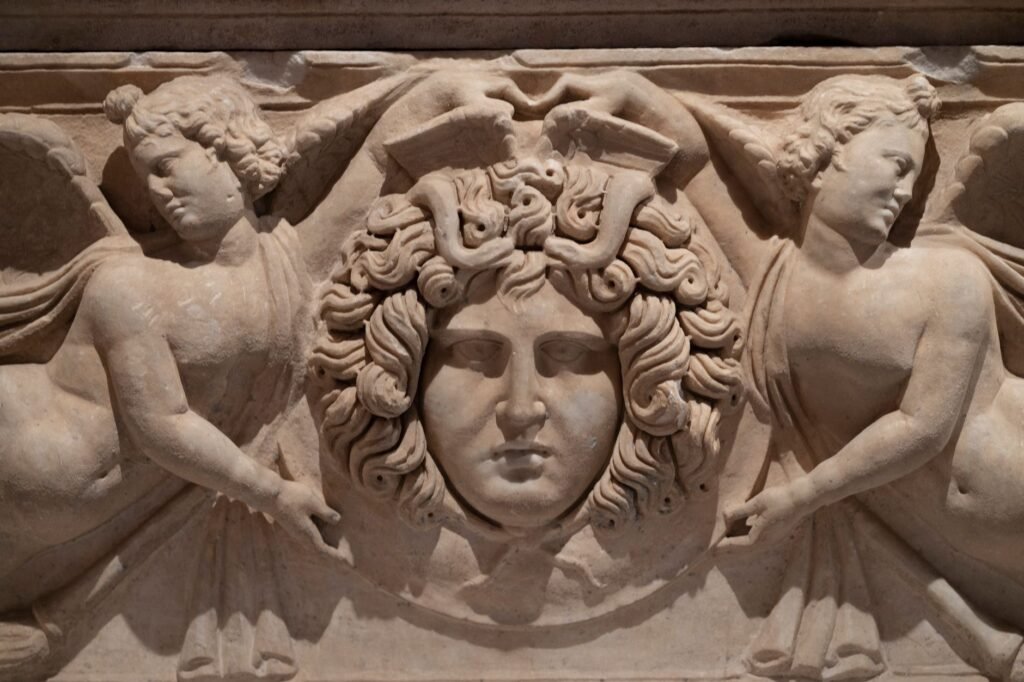
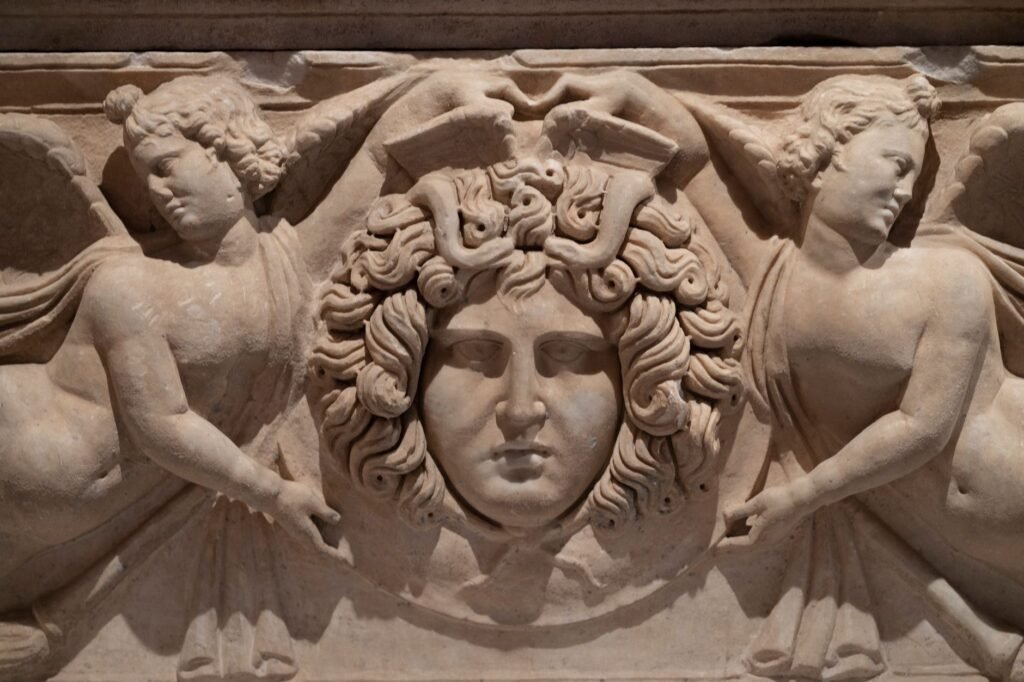
In early Greek art, Gorgon imagery appears on shields, temples, and other objects associated with protection. The so-called Gorgoneion, a frontal mask-like face, was used as an apotropaic device. It could be placed on armor, buildings, or vessels to repel harmful forces. This suggests that Medusa was not simply a monster in the ancient imagination; she could also serve as a protective boundary figure.
By the time of the classical authors, Medusa had become part of a more developed heroic narrative. Perseus, aided by divine tools and advice, beheads her and uses her head as a weapon. Later Roman poets, especially Ovid, added new layers to the story by emphasizing transformation and, in some versions, Medusa’s earlier beauty and her violation by Poseidon in Athena’s temple. These later accounts strongly influenced modern readings of the myth.
Main Characteristics
Medusa is usually described as one of the three Gorgon sisters. Her most famous features include:
- Snakes for hair
- A terrifying face
- The power to turn viewers to stone
- A monstrous, sometimes winged, appearance
- In some sources, a deadly or overwhelming gaze
Different ancient traditions do not always agree on her exact form. Some early artistic depictions show the Gorgon as a grimacing, almost mask-like being with large eyes, a protruding tongue, tusks, or a broad face. Later literary descriptions increasingly humanize her, especially in Roman poetry.
The most widely known version of Medusa is the one in which she is a monster slain by Perseus. However, this is only one part of her mythic identity. In some traditions, her severed head retains its deadly power even after death. In others, blood from her body has special properties. These variations are important because they show that Medusa’s story was never fixed in a single canonical form.
Family and Genealogy
Medusa’s genealogy varies by source. The most common ancient tradition identifies her as the daughter of Phorcys and Ceto, two primordial sea deities. This makes her part of a family of monstrous or liminal beings linked to the sea and the underworld.
She is usually described as one of three Gorgon sisters:
- Stheno
- Euryale
- Medusa
Only Medusa is mortal in most versions. Her sisters are immortal and survive her death.
Children
After Medusa is killed, two beings are said to emerge from her body:
- Pegasus, the winged horse
- Chrysaor, often described as a warrior or a figure of golden sword
In Hesiod’s Theogony, these children are born from Medusa’s blood when Perseus cuts off her head. Other traditions vary in how they describe their birth. Some say they sprang from her blood at the moment of death, while others place their emergence in different circumstances.
Relationships
The most famous relationship in Medusa’s myth is with Poseidon. In one influential tradition, especially in Ovid, Poseidon lies with Medusa in Athena’s temple, after which Athena punishes Medusa by transforming her hair into snakes. However, this version is not found in all earlier sources. Some Greek authors do not clearly present Medusa as a victim of sexual violence; instead, they emphasize her monstrous nature from the outset. The differences between these traditions are significant and should not be ignored.
Symbols
Medusa’s symbolism is rich and multilayered. Her image has been used as both a sign of terror and a protective emblem.
| Symbol | Meaning |
|---|---|
| Snakes | Danger, chthonic power, transformation, liminality |
| Gaze | Fatal knowledge, petrification, the power of recognition and fear |
| Severed head | Victory over chaos, magical potency, surviving power after death |
| Frontal face | Confrontation, warding off evil, apotropaic force |
| Wings in some depictions | Supernatural mobility, monstrous otherworldliness |
The snake is especially important. In Greek and wider Mediterranean symbolism, snakes can represent death, rebirth, hidden wisdom, or underworld associations. In Medusa’s case, they intensify her role as a being who stands at the boundary between life and death.
The gaze is equally central. To look at Medusa is to be frozen, which makes vision itself dangerous. This is one reason her myth has long been interpreted as a meditation on sight, power, and the limits of human perception.
Sacred Animals
Strictly speaking, Medusa was not the object of a formal animal cult in the way some deities were. However, several animals are strongly associated with her iconography and myth.
Snakes
Snakes are Medusa’s defining animal symbol. They appear in her hair or around her body in later imagery. Their significance includes:
- Chthonic or underworld associations
- Danger and poison
- Renewal through shedding skin
- Protective and apotropaic power
Horses
The horse enters Medusa’s myth through Pegasus, her child. Pegasus is not Medusa’s sacred animal in a cultic sense, but he is a direct result of her story and helped shape her mythic legacy.
Boars and other fierce animals
In some ancient artistic traditions, the Gorgon face appears among motifs associated with ferocity and defense, though not tied to a single sacred animal. The broader emphasis is on predatory or threatening force rather than a formal sacred-animal system.
Sacred Plants
There is no well-established ancient plant cult specifically dedicated to Medusa. However, certain plants are symbolically associated with her through Greek myth and later interpretation.
Olive
The olive is important because of Medusa’s connection with Athena, whose sacred tree is the olive. The temple setting of the Poseidon–Medusa episode in later tradition creates an indirect symbolic link, though the olive itself is not Medusa’s own plant.
Gorgoneion-related protective plants in later folklore
In later magical and folkloric traditions, plant imagery sometimes appears alongside Medusa-like figures in protective contexts. These associations are not consistent in ancient sources and should be treated cautiously. No single sacred plant can be confidently identified as belonging to Medusa.
Sacred Places
Medusa is associated with several mythic and artistic locations, though she was not worshipped in a centralized cult with a single major sanctuary.
Libya
Some ancient traditions place the Gorgons in Libya, an edge-of-the-world region in Greek geographic imagination. This reflects the ancient tendency to locate monsters at the margins of the known world.
The western limits of the world
Medusa and the Gorgons are often associated with the far west or remote western regions, beyond ordinary human space. These locations symbolized danger, otherness, and the unknown.
Athena’s temple
In Ovid’s version, Medusa is violated in Athena’s temple. This place becomes central to later moral and literary interpretations of the myth. It is a sacred space violated by divine and sexual conflict, making the episode especially important in modern retellings.
Artistic and civic spaces
The Gorgon face was widely used in temples, shields, mosaics, and architecture. In that sense, Medusa became a protective presence in many public spaces. Her image could be found where warding-off danger was a practical or symbolic concern.
Powers and Attributes
Medusa’s primary power is petrification: anyone who looks directly at her can be turned into stone. This power makes her a figure of absolute visual danger.
Her major attributes include:
- Fatal gaze
- Monstrous appearance
- Chthonic association
- Apotropaic function
- Posthumous magical potency
In some versions, Medusa’s blood has special powers. Ancient writers report that blood from one side of her body could be deadly, while blood from the other side might be healing. This theme appears in later medical and mythic traditions, though details vary between sources.
Medusa also functions as a boundary figure. She marks the line between:
- Human and monstrous
- Life and death
- The seen and the unseen
- Civilization and wilderness
Main Myths
The Perseus myth
The best-known myth involving Medusa is her encounter with Perseus. King Polydectes sends Perseus to bring back Medusa’s head, expecting him to fail. With divine help from Athena and Hermes, Perseus receives tools that allow him to approach her safely. These often include:
- A polished shield or mirror-like surface
- A sword or sickle
- Winged sandals
- A bag to carry the head
- A helmet of invisibility in some traditions
Perseus uses reflection to avoid looking directly at Medusa. He beheads her while she is asleep in many versions. From her blood or body emerge Pegasus and Chrysaor. Perseus then uses her severed head as a weapon, turning enemies to stone.
The origin of the Gorgon face
Another mythic layer concerns the Gorgoneion itself. Medusa’s face becomes a symbol placed on objects to repel harm. In this sense, her monstrous image is transformed into a protective sign. This paradox is one of the most distinctive features of her legacy: what terrifies can also defend.
Medusa before monstrosity
Later traditions, especially Roman ones, tell a different story about Medusa’s past. In Ovid’s Metamorphoses, she was once beautiful, and Poseidon’s assault in Athena’s temple leads to her transformation. This version has had enormous influence in modern literature and feminist interpretation. However, it should be noted that earlier Greek sources do not always present the story this way.
Relationship with Other Mythological Figures
Athena
Athena is one of the most important figures in Medusa’s story. She aids Perseus and, in later accounts, transforms Medusa’s hair into snakes or otherwise curses her. The relationship is often read as a conflict between divine order and transgressive power, though interpretations differ depending on the source.
Perseus
Perseus is Medusa’s slayer and the hero most directly connected to her myth. Without Medusa, Perseus would not have achieved fame through this labor. Their relationship is not one of dialogue or mutual interaction in the surviving mythic narrative, but of heroic confrontation.
Poseidon
Poseidon is connected to Medusa in later traditions through the episode in Athena’s temple. This relationship is among the most debated parts of the myth because different sources describe it differently, and because later readers have interpreted it through the lens of violence, punishment, and divine politics.
Her sisters: Stheno and Euryale
Medusa’s immortal sisters are often mentioned as mourners or avengers. Their presence emphasizes that Medusa belongs to a family of monstrous beings rather than standing entirely alone.
Other mythic figures
Medusa’s severed head interacts with many figures in the Perseus cycle, including Andromeda, Atlas, and the suitors or enemies Perseus encounters. In these stories, Medusa continues to act even after death.
Worship and Cult
Medusa was not worshipped as a major Olympian deity with a standard cult across the Greek world. However, her image was widely used in a religious and protective context.
Apotropaic use
The Gorgon face was employed on:
- Shields
- Temple pediments
- Roof tiles
- Coins
- Armor
- Household objects
This use was protective rather than devotional. The image was meant to frighten away evil, not to honor Medusa as a goddess.
Ritual and belief
Direct evidence for rituals dedicated specifically to Medusa is limited. Most ancient references concern her image rather than a formal cult. This does not mean she had no religious significance; rather, her significance was often embedded in broader systems of magical protection and sacred imagery.
Ancient Sources
Medusa appears in several major ancient texts, but details differ from one author to another.
| Author | Work | Contribution |
|---|---|---|
| Homer | Iliad, Odyssey | Early references to the Gorgon image and underworld associations |
| Hesiod | Theogony | Genealogy of the Gorgons, Perseus, Pegasus, and Chrysaor |
| Pseudo-Apollodorus | Bibliotheca | Systematic summary of the Perseus and Medusa myth |
| Pausanias | Description of Greece | Notes on local traditions, art, and cultic representations |
| Ovid | Metamorphoses | Influential Roman retelling, especially the beauty-and-transformation version |
Homer
Homer mentions the Gorgon in contexts of terror and divine imagery, but not in the fully developed later narrative form. These early references show that the Gorgon image was already culturally significant.
Hesiod
Hesiod provides one of the most important genealogical accounts in the Theogony. His version is central for understanding Medusa as part of the primordial mythic family.
Pseudo-Apollodorus
The Bibliotheca offers a concise mythographic summary, useful for reconstructing the standard Greek narrative of Perseus and Medusa.
Ovid
Ovid’s Metamorphoses is one of the most influential literary versions of the myth. It strongly shaped later European interpretations, especially the idea of Medusa as a transformed woman rather than an inherently monstrous being.
Roman Equivalent
Medusa does not have a direct Roman equivalent in the way some Greek gods were matched with Roman gods. Instead, she was adopted into Roman myth and art largely without translation into a different deity.
In Roman culture, Medusa remained Medusa, though her image was widely used in decorative and protective art. Roman writers, especially Ovid, gave her a major literary afterlife. Her presence in Roman mosaics, architecture, and personal objects shows that she was valued not as a goddess in the Roman pantheon, but as a potent mythic and symbolic figure.
Influence on Modern Culture
Medusa has had an extraordinary impact on modern culture. She appears in:
- Literature
- Painting and sculpture
- Film and television
- Comics and graphic novels
- Video games
- Fashion and branding
- Feminist reinterpretations
- Psychological and psychoanalytic writing
Literature
Modern authors have reimagined Medusa as victim, monster, antihero, or symbol of female rage. Retellings often focus on her perspective rather than Perseus’s.
Visual art
From Renaissance painting to contemporary sculpture, Medusa’s head and gaze have inspired artists interested in beauty, horror, and transformation. Her image is especially strong in Baroque and Neoclassical art.
Popular culture
Medusa appears in fantasy stories, monster films, and games as a recognizable archetype. She is often simplified into a snake-haired villain, but more nuanced adaptations draw on her tragic and symbolic complexity.
Feminist interpretation
In modern scholarship and activism, Medusa has been read as a figure of silenced power, violated womanhood, or resistance to patriarchal narratives. These interpretations are modern and should not be projected uncritically onto all ancient sources, but they have shaped contemporary cultural reception.
Curiosities
- The Gorgoneion was one of the most common protective motifs in Greek art.
- Medusa is the only Gorgon who is usually mortal.
- Pegasus and Chrysaor are said to have emerged from her body after her death.
- Some ancient images show the Gorgon as more bestial than human, while later art makes her more beautiful and tragic.
- The myth of Medusa influenced both medical and magical traditions in antiquity and later eras.
- Her image can be found on ancient armor, suggesting that terror itself could be used as protection.
- The head of Medusa remained powerful even after death, which makes her one of mythology’s clearest examples of posthumous agency.
Frequently Asked Questions
1. Who was Medusa in Greek mythology?
Medusa was a Gorgon, a monstrous figure whose gaze turned people to stone. She is best known for being slain by Perseus.
2. Was Medusa always a monster?
Not in all traditions. Some ancient sources present her as monstrous from the beginning, while later Roman tradition, especially Ovid, describes her as once beautiful and then transformed.
3. Why did Medusa have snakes for hair?
Different sources explain this differently. In Ovid’s version, Athena transforms Medusa after Poseidon’s assault in the goddess’s temple. Other traditions do not give the same explanation and simply present Medusa as a monstrous being.
4. What are Medusa’s children?
In the most famous ancient tradition, her children are Pegasus and Chrysaor, who are born from her body after her death.
5. Why was Medusa’s image used on shields and buildings?
Her image functioned as an apotropaic symbol, meaning it was believed to ward off evil and protect the people or place where it appeared.
6. Did the ancient Greeks worship Medusa as a goddess?
There is no strong evidence for a widespread cult of Medusa as a goddess. Her image was used symbolically and protectively, but she was not a major Olympian deity.
7. What is the most famous story about Medusa?
The most famous story is the one in which Perseus beheads Medusa with help from Athena and Hermes, then uses her head as a weapon.
8. Why is Medusa still important today?
Medusa remains important because she represents enduring themes such as fear, transformation, power, violence, and the reinterpretation of myth through changing cultural values.
Conclusion
Medusa is far more than a simple monster from a heroic tale. She is a mythic figure whose meanings changed across time, from archaic protective symbol to fearsome Gorgon, from defeated enemy to tragic or violated woman in later retellings. Her story reveals how ancient societies understood danger, sacred space, vision, and the power of images.
Through Greek and Roman literature, art, and religious symbolism, Medusa became one of the most enduring figures in world mythology. Her face continues to fascinate because it embodies a profound contradiction: it terrifies, but it also protects; it marks death, but it also generates new life; and it remains one of the most recognizable symbols in the entire classical tradition.

Orin Vale has spent the better part of two decades tracing the threads that connect the world’s oldest stories — from the halls of Asgard to the banks of the Nile, from Olympus to the jungles of the Maya. What began as a childhood fascination with flood myths and trickster gods grew into years of independent study across comparative mythology and ancient religion, always chasing the same question: what did these stories mean to the people who first told them? Orin writes for readers who want more than trivia — the ones looking for the beliefs, fears, and truths that myths were built to carry.