Introduction
The story of Oedipus and the Sphinx is one of the most famous episodes in Greek mythology. It combines riddle-solving, royal legitimacy, divine punishment, and tragic irony, making it central to both ancient literature and later Western storytelling. The encounter is most familiar from the myth in which Oedipus answers the Sphinx’s riddle, saves Thebes, and is rewarded with kingship and marriage to Jocasta, only to discover later that his success is bound up with a disastrous destiny.
Unlike many Greek myths that evolved through many local variations, the Oedipus-Sphinx episode is relatively well defined in the surviving literary tradition. It appears in tragedy, epic summaries, mythographic handbooks, vase painting, and later Roman adaptations. The tale is significant not only as a myth of intelligence versus monstrous danger, but also as a meditation on fate, identity, and the limits of human knowledge.
Origin and Meaning
The name Oedipus is traditionally explained from Greek as Oidípous (Οἰδίπους), often interpreted in antiquity as meaning “swollen foot” or “he who has swollen feet”, referring to the injuries inflicted on the infant when his ankles were pierced and bound. This etymology is consistent with the mythic explanation of his childhood abandonment, though modern scholars note that the exact linguistic origin remains debated.
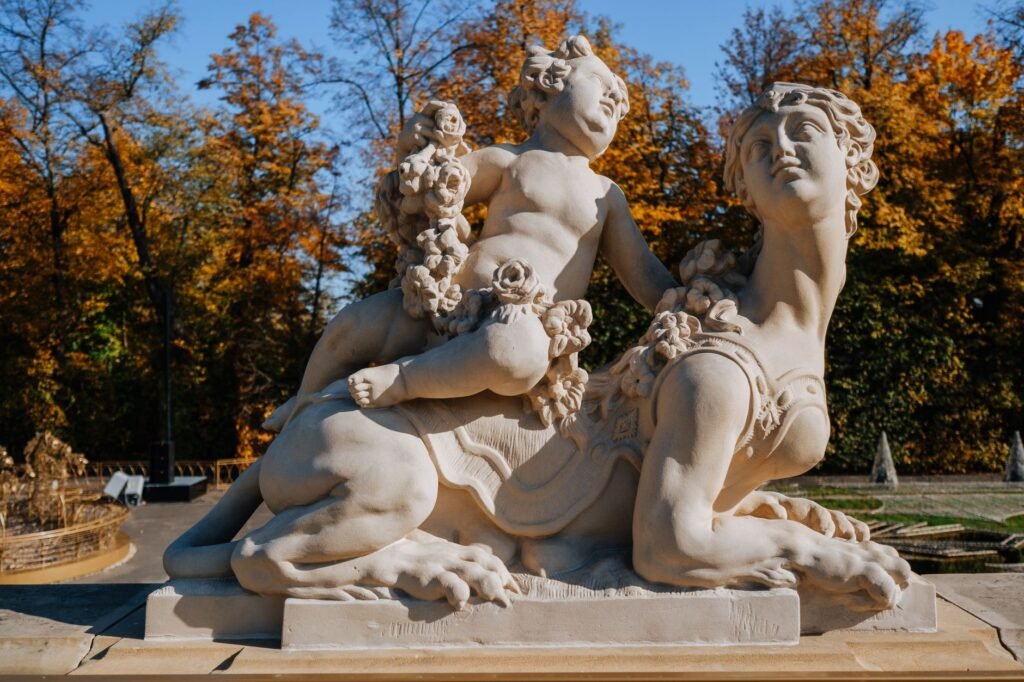
The Sphinx in Greek myth is a monstrous being with a lion’s body, a woman’s head, and sometimes wings. The word sphinx itself is Greek (sphinx, σφίγξ), though the creature has clear Eastern Mediterranean and Near Eastern parallels. In Greek culture, the Sphinx became associated especially with the Theban cycle and the riddle posed to travelers near Thebes.
Historically, the myth of Oedipus and the Sphinx likely developed from older storytelling traditions about a guardian monster and a clever hero. By the classical period, it had become one of the most recognizable mythic confrontations in Greek literature.
Historical Context
The Oedipus and the Sphinx story belongs to the broader Theban myth cycle, a group of legends centered on Thebes, one of the major cities of ancient Greece. The myth reflects several important cultural themes:
- Kingship and legitimacy: the ruler who saves the city gains authority.
- Intelligence as heroic power: victory comes from wit rather than physical strength.
- Divine punishment and fate: the hero’s triumph does not prevent eventual catastrophe.
- The city and the outsider: Oedipus arrives as a stranger and becomes ruler through a test of knowledge.
In historical terms, Thebes was one of the most important political and cultural centers in Greek imagination. Myths about its origins and crises were used by poets and tragedians to explore the fragility of civic order. The Sphinx episode, placed before the tragic recognition of Oedipus’s identity, creates a dramatic contrast between apparent salvation and hidden doom.
The story also fits ancient Greek ideas about miasma or ritual pollution, since the later revelation that Oedipus killed his father and married his mother transforms the savior-king into a source of contamination for the city.
Main Characteristics
The central figures of the myth are sharply defined in the literary tradition.
Oedipus
Oedipus is usually portrayed as:
- intelligent and decisive
- courageous under pressure
- a stranger seeking his destiny
- a king whose success is inseparable from tragic ignorance
In the Sphinx episode, he is not yet the blind and suffering figure of later tragedy. Instead, he appears as a capable problem-solver whose answer to the riddle demonstrates human intelligence at its peak.
The Sphinx
The Sphinx is typically described as:
- a hybrid monster, part woman and part lion
- a destroyer of Theban life
- a questioner who kills those who fail to answer
- an embodiment of threat, mystery, and death
In Greek myth, the Sphinx is not merely an animal-like monster. She is an intellectual challenge as well as a physical one. Her power lies in asking a question that exposes human ignorance.
The Riddle
The best-known feature of the myth is the Sphinx’s riddle. In its standard form, she asks:
What creature walks on four feet in the morning, two at noon, and three in the evening?
Oedipus answers:
The human being.
This response is often interpreted symbolically as a description of the human life cycle: infancy, adulthood, and old age. The answer also expresses the centrality of human self-knowledge in Greek thought.
Family and Genealogy
Because the topic is specifically Oedipus and the Sphinx, family relationships are relevant mainly through Oedipus’s broader myth.
Oedipus’s Family
According to the common mythic tradition, Oedipus is the son of:
- Laius, king of Thebes
- Jocasta (also called Epicaste in some traditions), queen of Thebes
His children, depending on the source, are usually named as:
- Eteocles
- Polyneices
- Antigone
- Ismene
These children are not part of the Sphinx episode itself, but they are essential to Oedipus’s later tragic story.
The Sphinx’s Parentage
The parentage of the Sphinx varies across Greek sources and mythic traditions. Ancient authors sometimes identify her as the child of Typhon and Echidna, a common monster lineage in Greek myth. Other traditions differ, and some local or literary versions do not emphasize her genealogy.
Relationships in the Myth
| Figure | Relationship to Oedipus and the Sphinx myth |
|---|---|
| Laius | Oedipus’s father; earlier victim of prophecy and key to the curse on Thebes |
| Jocasta | Oedipus’s mother and later wife |
| Creon | Relative of Jocasta; briefly governs or negotiates in Theban stories |
| The Sphinx | Monster who blocks access to Thebes and tests Oedipus |
| Theban citizens | Victims of the Sphinx’s devastation and beneficiaries of Oedipus’s victory |
Symbols
The Oedipus and the Sphinx myth is rich in symbolic meaning.
Common Symbols
| Symbol | Meaning |
|---|---|
| The riddle | The challenge of human knowledge and interpretation |
| The crossroads | Fate, choice, and unknowable destiny |
| The lion body of the Sphinx | Dangerous strength and predatory power |
| The female head | Enigmatic intelligence and seduction |
| Swollen feet / bound feet | Oedipus’s hidden identity and broken origin |
| The city gate or approach to Thebes | The threshold between civilization and chaos |
Interpretive Significance
The riddle has often been read as symbolizing:
- the stages of human life
- the instability of identity
- the tension between reason and fate
- the need for interpretive intelligence
The Sphinx herself can symbolize the destructive side of mystery: a question that cannot be answered destroys those who fail. Oedipus symbolizes the human capacity to answer, but also the danger of knowing too much too late.
Sacred Animals
No animals are sacred to Oedipus in a religious sense, since he is a mortal hero rather than a god. However, animal imagery is highly important in the myth.
The Lion
The Sphinx’s lion body gives the creature martial and predatory significance. In Greek visual art, the lion often suggests power, danger, and royal force. The lion element makes the Sphinx a creature of liminality: part human, part beast.
The Bird-Like or Winged Form
In some artistic traditions, the Sphinx has wings. Wings may imply:
- otherworldly motion
- supernatural status
- proximity to divine or demonic powers
The Human Being as Symbolic Animal
The riddle’s answer turns the human being into the central symbolic “animal” of the myth. Human life, unlike the fixed nature of beasts, is presented as changing and vulnerable across time.
Sacred Plants
There is no widely established sacred plant specifically associated with Oedipus and the Sphinx in the way that some gods or cult heroes have plant associations. However, plants appear indirectly in Theban myth and Greek ritual settings.
Possible Symbolic Associations
- Olive: broadly associated with Greek civic life, wisdom, and peace.
- Laurel: commonly linked with victory and purification.
- Funerary vegetation: in tragic contexts, plant imagery may evoke death, mourning, and the fragility of human life.
Because no canonical plant belongs uniquely to the Oedipus-Sphinx episode, any plant association should be treated as contextual rather than sacred in a strict sense.
Sacred Places
The central place in the myth is Thebes, the city threatened by the Sphinx.
Thebes
Thebes in Boeotia is the most important location connected to the myth. In the story:
- the Sphinx sits near the city
- she devours those who cannot answer her riddle
- Oedipus arrives as a stranger and frees the city
The exact location of the Sphinx in the earliest traditions is not always detailed. Later retellings often place her on a rocky height or at the city’s approach.
Broader Theban Landscape
The myth is part of a larger cycle involving:
- the gates of Thebes
- the royal palace
- later burial places of Theban heroes and victims
- the region of Boeotia, where Theban identity was rooted
No Formal Sanctuary
Unlike a god with dedicated sanctuaries, Oedipus and the Sphinx are not generally associated with a formal cult center. Their importance lies more in narrative and literary memory than in public worship.
Powers and Attributes
Because Oedipus and the Sphinx are figures in myth rather than deities, their “powers” should be understood as narrative functions.
Oedipus’s Attributes
Oedipus is associated with:
- intelligence
- interpretive skill
- courage in crisis
- royal authority
- tragic blindness in a symbolic sense, later literal blindness in some traditions
His power is not magical. It is the power of correct reasoning under threat.
The Sphinx’s Attributes
The Sphinx is associated with:
- enigma
- death for the unworthy or ignorant
- surveillance and challenge
- liminal guardianship
- destructive intelligence
She acts as a gatekeeper. Her role is to test those who seek passage, and failure means death.
Thematic Power
The encounter dramatizes a contest between two forms of force:
- The Sphinx’s lethal question
- Oedipus’s human answer
The myth suggests that intellect can defeat violence, but only partially. The victory resolves one crisis while setting the stage for another.
Main Myths
The Sphinx Terrorizes Thebes
The best-known story begins with Thebes suffering under the Sphinx. She blocks the road and kills those who fail to solve her riddle. Ancient accounts differ slightly on the details, but the core narrative is stable: the city is under siege by a monster whose threat is intellectual and physical.
Oedipus Arrives as a Stranger
Oedipus comes to Thebes after a series of earlier events, including his abandonment in infancy and his later flight from Corinth after hearing a prophecy. The background varies somewhat across sources, but by the time he encounters the Sphinx, he is a traveler without full knowledge of his origins.
The Riddle
The Sphinx asks her famous riddle. Oedipus answers that the creature is a human being:
- as an infant, it crawls on four limbs
- as an adult, it walks on two
- in old age, it uses a staff as a third support
This answer frees Thebes and destroys the Sphinx.
The Reward
As reward for saving the city, Oedipus receives the throne of Thebes and marries Jocasta, the widow of Laius. This development is crucial to the tragic structure of the myth because it turns the hero’s success into the condition for later disaster.
The Tragic Irony
The most important feature of the story is irony. Oedipus solves a riddle about human nature but does not know his own identity. He understands the Sphinx’s question yet remains blind to his own past. This tension is one of the reasons the myth became central to tragedy and psychoanalytic interpretation in modern times.
Relationship with Other Mythological Figures
Jocasta
Jocasta is Oedipus’s wife and mother in the standard myth. Her relationship to the Sphinx episode is indirect but crucial, since the defeat of the monster leads to Oedipus’s marriage to her.
Laius
Laius, Oedipus’s father, is linked to the background of the myth. Some traditions connect his earlier actions to the curse on Thebes. His death at the hands of Oedipus precedes the Sphinx episode in the usual mythic timeline.
Creon
Creon is a Theban nobleman whose role varies across sources. He may act as a political stabilizer in the aftermath of the Sphinx’s defeat and later becomes central in the political conflicts following Oedipus’s downfall.
Tiresias
Tiresias is not part of the Sphinx confrontation itself, but he is essential in the broader Oedipus cycle. As a blind seer, he stands in contrast to Oedipus’s later blindness and insight. The myth places different forms of knowledge in tension.
The Sphinx in Wider Myth
The Greek Sphinx should not be confused with the Egyptian sphinx, although the Greek image may have been influenced by Near Eastern and Egyptian art. In Greek myth, the Sphinx is a unique monster associated especially with Thebes.
Worship and Cult
There is no strong evidence of a major cult of Oedipus and the Sphinx as objects of worship in the same way as gods or major heroes. However, myth and ritual sometimes overlap in Greek culture.
Heroic Memory
Oedipus could be treated as a heroic figure in later local traditions, especially in literary and civic contexts. His myth was remembered in connection with Thebes and its identity.
Ritual and Tragedy
The story was especially influential in theater, where myth functioned as a vehicle for civic reflection. Tragedians used the Oedipus cycle to explore questions of guilt, ignorance, divine law, and leadership.
Offerings and Artistic Commemoration
Rather than formal worship, the myth was preserved through:
- dramatic performances
- vase painting
- poetic retellings
- local storytelling
- later philosophical and psychological interpretation
Ancient Sources
Several ancient authors mention or develop the story of Oedipus and the Sphinx.
Major Sources
| Author | Work | Relevance |
|---|---|---|
| Homer | Odyssey | Early references to Oedipus and Theban traditions, though not the full Sphinx story |
| Hesiod | Fragmentary traditions | Early mythic background for Theban lore |
| Pindar | Odes | References to Theban heroic material |
| Aeschylus | Theban tragedies and related fragments | Part of the dramatic tradition surrounding Oedipus |
| Sophocles | Oedipus Rex | The most famous literary treatment of the broader Oedipus story |
| Euripides | Phoenissae | Important for Theban narrative context |
| Apollodorus | Bibliotheca | Mythographic summary of the Oedipus cycle |
| Pausanias | Description of Greece | Valuable for local traditions and geographical references |
| Ovid | Metamorphoses | Roman literary adaptation of Greek myth |
Notes on Variation
Different ancient sources emphasize different aspects:
- some focus on the riddle
- some on the curse on Thebes
- some on Oedipus’s lineage and abandonment
- some on the aftermath of the Sphinx’s defeat
The exact wording of the riddle is most consistently preserved in later retellings, but the story’s core remains stable.
Roman Equivalent
There is no exact Roman deity or hero who corresponds directly to Oedipus and the Sphinx as a pair. However, Roman literature adopted and adapted the Greek myth extensively.
Roman Reception
Roman authors, especially Ovid, retold Greek myths with literary sophistication. In Roman culture, the story of Oedipus and the Sphinx remained a powerful example of:
- intelligence under pressure
- fate revealed through irony
- the dangers of hidden identity
The Sphinx itself was also known in Roman art and literature, often as a symbol of mystery or learned challenge.
Influence on Modern Culture
The myth of Oedipus and the Sphinx has had enormous influence on modern literature, psychology, visual art, and popular culture.
Literature and Philosophy
The story influenced:
- Renaissance and neoclassical drama
- Romantic and Symbolist poetry
- modern philosophical reflections on knowledge and destiny
The Oedipus myth became especially famous through Sigmund Freud, whose “Oedipus complex” drew on the broader myth, not specifically on the Sphinx episode. Still, the Sphinx scene remains one of the most recognizable parts of the story.
Visual Art
Artists have frequently depicted:
- Oedipus answering the Sphinx
- the Sphinx confronting the traveler
- the moment of triumph at Thebes
The image often emphasizes the contrast between the human figure and the monstrous hybrid creature.
Film, Television, and Games
The motif appears in:
- historical and mythological films
- television adaptations of Greek myths
- puzzle-based video games
- fantasy narratives featuring guardian monsters and riddles
Cultural Legacy
The phrase “riddle of the Sphinx” has entered common speech to mean a question that is difficult or impossible to solve. Oedipus himself has become a symbol of tragic self-discovery.
Curiosities
- The Sphinx in Greek myth is not the same as the Great Sphinx of Giza, though the names are related through later Greek associations with Egypt.
- The famous riddle is one of the best-known in world literature and has been adapted in countless forms.
- The myth is among the earliest examples of a monster defeated by intelligence rather than weapons.
- Some ancient versions vary in how much emphasis they place on the Sphinx compared with other parts of Oedipus’s story.
- The scene was a popular subject in Greek vase painting, especially because it visually represents a contest of minds.
- In later interpretation, Oedipus’s answer is often praised, but the myth’s deeper irony is that he understands humanity in general while remaining ignorant of himself.
Frequently Asked Questions
What is the riddle of the Sphinx in the Oedipus myth?
The Sphinx asks what creature walks on four feet in the morning, two at noon, and three in the evening. Oedipus answers that it is a human being.
Why did the Sphinx attack Thebes?
In the myth, the Sphinx punishes Thebes by killing those who cannot solve her riddle. Ancient sources present this as a divine or monstrous affliction, though the precise cause varies by tradition.
What happened after Oedipus solved the riddle?
Oedipus freed Thebes from the Sphinx and was rewarded with the throne and marriage to Jocasta. This victory later becomes part of the tragic structure of his life.
Is the Sphinx in Greek myth the same as the Egyptian sphinx?
No. The Greek Sphinx is a specific mythological monster associated with Thebes, while the Egyptian sphinx is a separate artistic and religious figure, though there may have been cross-cultural influence.
What does the riddle symbolize?
The riddle is often interpreted as symbolizing the stages of human life, the fragility of human existence, and the power of reasoning to uncover truth.
Is Oedipus considered a hero?
Yes, in the mythic sense. He is a hero who saves a city and performs a remarkable feat of intelligence, though his life is also marked by tragic destiny.
Which ancient author tells the story most famously?
Sophocles is the best-known ancient author connected with the Oedipus cycle, especially in Oedipus Rex, though the Sphinx episode is also summarized by mythographers such as Apollodorus.
Why is the story still important today?
It remains important because it explores universal themes: identity, fate, knowledge, leadership, and the consequences of human ignorance.
Conclusion
The myth of Oedipus and the Sphinx occupies a central place in classical tradition because it combines a memorable puzzle with profound tragic meaning. It presents a hero who saves a city through intelligence, yet cannot save himself from destiny. The Sphinx represents the danger of unanswered questions, while Oedipus represents the power—and limitation—of human reason.
As a story of riddle-solving, kingship, and hidden truth, it has remained influential for more than two millennia. Its endurance in literature, art, and modern thought reflects the myth’s unusual depth: it is both an ancient monster tale and a lasting meditation on what it means to know oneself.

Orin Vale has spent the better part of two decades tracing the threads that connect the world’s oldest stories — from the halls of Asgard to the banks of the Nile, from Olympus to the jungles of the Maya. What began as a childhood fascination with flood myths and trickster gods grew into years of independent study across comparative mythology and ancient religion, always chasing the same question: what did these stories mean to the people who first told them? Orin writes for readers who want more than trivia — the ones looking for the beliefs, fears, and truths that myths were built to carry.