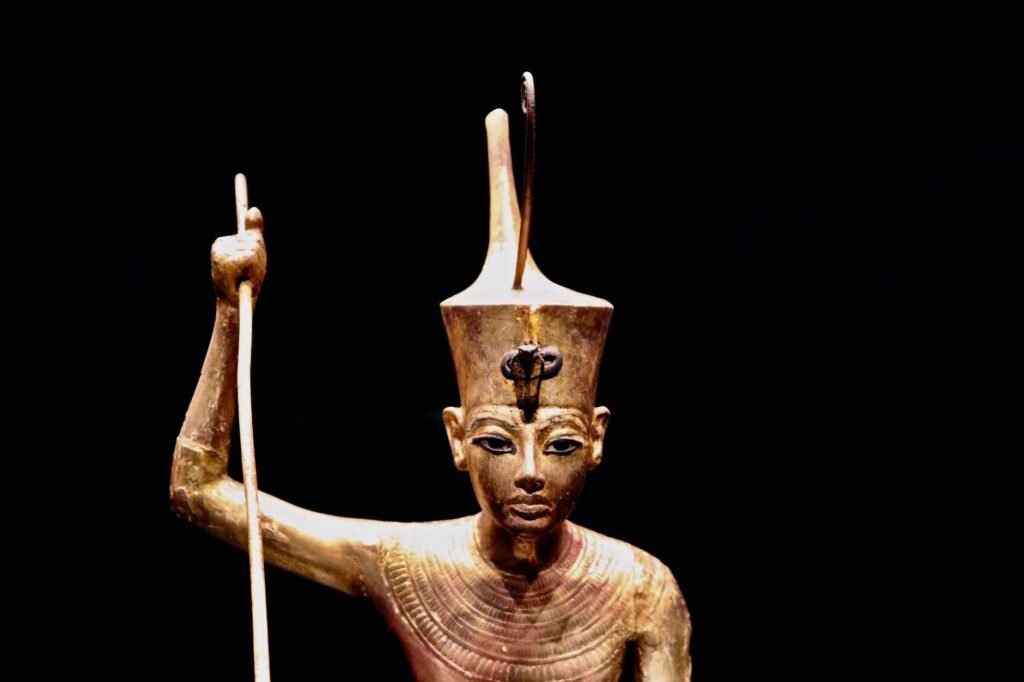
What Is the White Crown of Egypt in Egyptian Mythology?
Introduction

The White Crown of Egypt is one of the most recognizable symbols in ancient Egyptian iconography and mythology. Known in modern scholarship as the hedjet, it represented Upper Egypt, the southern part of the Nile Valley. More than a political emblem, the white crown carried deep religious meaning. It was associated with kingship, divine authority, sacred protection, and the unification of the Egyptian state.
In Egyptian mythology, crowns were not merely royal decorations. They signified a ruler’s legitimacy and cosmic role. The white crown, in particular, expressed the power of the king over Upper Egypt and appeared in scenes where gods and pharaohs were linked through sacred rulership. It also became one half of the composite double crown, a symbol of united Egypt.
Because the white crown appears in religious art, royal inscriptions, and mythological scenes across many centuries, it remains central to understanding how the ancient Egyptians viewed kingship, divine order, and the relationship between the ruler and the gods.
Origin and Meaning
The ancient Egyptian name of the white crown is generally given in modern sources as hedjet. The exact etymology of the term is not fully certain, but Egyptologists use it to refer to the tall, white, conical crown associated with Upper Egypt. Like many ancient Egyptian terms, its original pronunciation is reconstructed rather than directly known from living speech.
Historical origin
The white crown is attested from very early periods of Egyptian history and may have roots in pre-dynastic or early dynastic symbolism. Its appearance in royal and divine imagery suggests that it was already an established emblem by the time the Egyptian state was consolidating around the end of the fourth millennium BCE.
The crown became especially important as a marker of the king of Upper Egypt. When Egypt was unified, the white crown did not disappear. Instead, it was paired with the red crown of Lower Egypt to create the pschent, or double crown, representing the union of the Two Lands.
Meaning in mythology
In mythological and religious contexts, the white crown symbolized:
- sovereignty over Upper Egypt
- divine kingship
- purity and sacred authority
- continuity of the cosmic and political order
Its color and form helped distinguish it from other royal headdresses. White was often associated with ritual cleanliness, sanctity, and clarity. In royal ideology, these qualities reinforced the king’s sacred role as guardian of ma’at, the principle of truth, balance, and order.
Historical Context
The white crown must be understood within the broader history of ancient Egyptian state formation. Egypt developed as a dual kingdom composed of Upper Egypt in the south and Lower Egypt in the north. These regions had distinct regional traditions, symbols, and political centers before unification.
Upper Egypt and the king
The white crown was the emblem of the southern kingdom. Its association with Upper Egypt reflects the importance of regional identity in early Egyptian politics. When the pharaoh ruled the entire country, he was still shown wearing the white crown in contexts emphasizing his authority over the south or his universal sovereignty.
Religion and kingship
Ancient Egyptian religion did not separate politics from sacred power. The pharaoh was not simply a human monarch; he was the earthly representative of divine order. Crowns were therefore part of a religious vocabulary of kingship. The white crown appeared in temple reliefs, tomb decorations, and royal ceremonies as a visual statement that the ruler was divinely sanctioned.
Development over time
The white crown remained a meaningful symbol throughout Egyptian history, though its use changed with artistic styles, political developments, and religious emphasis. It appears in:
- early dynastic royal iconography
- Old Kingdom temple and tomb art
- Middle Kingdom and New Kingdom royal scenes
- later representations of kings, gods, and ritual authority
It is important to note that ancient Egyptian religion was not static. Different dynasties and cult centers emphasized different aspects of royal symbolism, and the white crown could therefore carry slightly different nuances depending on context.
Main Characteristics
The white crown has a distinct and simple shape, but its symbolism is rich.
Physical appearance
The crown is typically depicted as:
- tall and conical or bulb-shaped
- plain white in color
- without elaborate decoration
- closely fitted to the head
- sometimes shown with a flared base or subtle outline in art
Because actual crowns made of organic materials have not survived in clear archaeological examples, most knowledge comes from artistic representation rather than physical remains.
Identifying features
The white crown can be distinguished from other Egyptian crowns:
| Crown | Region or Meaning | Visual Features |
|---|---|---|
| White Crown (hedjet) | Upper Egypt | Tall, plain, white, conical |
| Red Crown (deshret) | Lower Egypt | Red, with a curled projection at the back |
| Double Crown (pschent) | United Egypt | Combination of white and red crowns |
| Atef Crown | Linked to Osiris | White crown with feathers, often ceremonial |
| Khepresh | War crown | Blue crown, often shown in military contexts |
Symbolic significance
Its plainness was significant. Unlike more ornate crowns, the white crown’s simplicity emphasized solemn authority rather than display. In mythological imagery, the crown often signifies that a person or deity has entered a sacred realm of governance.
Family and Genealogy
The white crown is not a deity and therefore does not have a family or genealogy in the literal sense. However, in Egyptian mythology, it is closely associated with divine and royal figures who are treated as symbolic relatives or holders of royal office.
Associated rulers and divine figures
The crown is especially linked to:
- the pharaoh, as ruler of Upper Egypt
- Horus, the sky god and divine prototype of kingship
- Osiris, in funerary and resurrection-related contexts
- Atum and Ra, in broader royal theology
- certain goddesses connected with royalty, such as Wadjet and Nekhbet
Symbolic relations
In mythic and political language, crowns often acted as markers of legitimacy rather than beings with descent. The white crown could be described as belonging to Upper Egypt, and by extension to the ruler chosen to govern it. In the ideology of the Two Lands, the white crown and red crown formed a pair, mirroring the dual nature of Egypt itself.
Symbols
The white crown is itself a major symbol, but it is often associated with other emblems that deepen its meaning.
Core symbols connected to the white crown
- White color: purity, sacredness, ritual order
- Tall conical shape: elevation, authority, and visibility
- Upper Egypt: geographic and political rule
- Kingship: divine right to govern
- Ma’at: cosmic and social order
Related royal emblems
The white crown could appear with or alongside:
- the uraeus cobra, symbol of royal protection
- the false beard, associated with divine kingship
- the crook and flail, emblems of rulership and authority
- the double crown, symbol of unified rule
- the was scepter, expressing power and dominion
The crown’s symbolism was not fixed in one simple meaning. In religious art, a crown could signal the ruler’s earthly office, his divine favor, or his role in maintaining cosmic balance.
Sacred Animals
The white crown itself is not an animal symbol, but Egyptian mythology often linked royal insignia with sacred animals through divine associations.
Animals connected indirectly to the white crown
- The cobra: Often represented by the uraeus on royal headgear. It symbolized protection and divine fire.
- The vulture: Associated with Nekhbet, the goddess of Upper Egypt, who protected the king and the southern land.
- The falcon: Linked with Horus, the kingly god whose authority was reflected in pharaonic regalia.
Symbolic significance
These animals are important because the white crown was more than a regional marker. It belonged within a sacred system of kingship. The vulture of Upper Egypt, in particular, is closely relevant because Nekhbet was one of the chief protective goddesses of the south and a companion to the white crown’s regional identity.
Sacred Plants
No specific sacred plant is uniquely and universally attached to the white crown in the same way that some deities are associated with particular flora. However, plants played symbolic roles in ancient Egyptian kingship and ritual.
Possible plant associations in royal symbolism
- Lotus: Often connected with Upper Egypt and renewal
- Papyrus: More closely linked with Lower Egypt, making it important in dual symbolism
- Reed and marsh plants: Frequently used in the visual language of the Two Lands
Importance of plants in context
Because the white crown represented Upper Egypt, it is sometimes discussed in contrast with papyrus symbolism from Lower Egypt. The pairing of lotus and papyrus, or southern and northern symbols, reinforced the idea of unity under the pharaoh.
It should be emphasized that these plant associations are broader royal symbols rather than exclusive attributes of the white crown itself.
Sacred Places
The white crown is tied to Upper Egypt, so its symbolic geography extends across the southern Nile Valley. It is not usually confined to one single temple or sanctuary.
Important regions connected to the white crown
- Upper Egypt: the crown’s primary sphere of meaning
- Hierakonpolis: an early political and religious center of southern Egypt
- Nekhen: the ancient name of Hierakonpolis, associated with early kingship
- Thebes: a major religious capital in later periods, especially linked to southern royal ideology
- Abydos: important in royal funerary cult and Osirian religion
Why these places matter
These sites are important because they reflect the historical emergence of kingship in Upper Egypt and the religious legitimacy of rulers. The white crown, as an emblem of the south, belongs to this landscape of early state formation and divine rule.
Powers and Attributes
Since the white crown is a symbol rather than a deity, it does not have independent magical powers. Its “powers” are symbolic and political, though in Egyptian thought symbols themselves could possess real effectiveness.
Main attributes
The white crown signified:
- authority over Upper Egypt
- legitimacy of rulership
- sacred protection of the king
- participation in divine order
- continuity of the monarchy
Functional role
In art and ritual, the crown indicated that the wearer was acting in a specific royal capacity. It could mark the pharaoh as:
- ruler of the south
- unified king of Egypt
- a divine or semi-divine figure
- an executor of ritual and justice
Mythological significance
In Egyptian mythology, the king was often shown as the successor of Horus and the opponent of chaos. The white crown therefore belonged to a wider ideological framework in which symbols of rule helped maintain the stability of the world.
Main Myths
There is no single myth centered exclusively on the white crown. Instead, it appears within several broader mythological and ideological traditions.
The unification of the Two Lands
One of the most important symbolic narratives in Egyptian state ideology is the unification of Upper and Lower Egypt. In this context, the white crown represents the southern land and its king. When combined with the red crown, it expresses the ideal of a united realm.
This unification was both historical and mythic. In royal art, the king is often shown bringing together opposites, proving his right to govern both lands.
Horus and the kingship myth
The crown appears in the broader mythological framework of Horus, who is the model of rightful kingship. Since the pharaoh is identified with Horus, royal insignia such as the white crown become part of the divine inheritance of rulership.
Osirian funerary ideology
In later religious thought, the king also has a relationship with Osiris, the dead and resurrected ruler. Crowns appear in funerary contexts as signs of restoration, renewal, and divine approval. The white crown may be shown in scenes where the deceased king is transformed into an eternal sovereign.
Important note on sources
Ancient Egyptian myths were not preserved in one canonical text. Instead, they survive through temple inscriptions, royal monuments, hymns, tomb scenes, and later literary traditions. As a result, the symbolic role of the white crown is reconstructed from many sources rather than from a single myth.
Relationship with Other Mythological Figures
The white crown is closely linked to several major divine and royal figures.
Horus
Horus is the most direct mythological partner of royal insignia. As the god of kingship and sky power, he embodies legitimate rule. The white crown may appear in scenes where the pharaoh is identified with Horus or where Horus confers authority on the king.
Osiris
Osiris is associated with death, renewal, and dynastic continuity. In funerary scenes, the crown can mark the deceased ruler’s transition into divine kingship. This connection reflects the Egyptian belief that kingship continued beyond death.
Nekhbet
Nekhbet, the vulture goddess of Upper Egypt, is one of the most important protective figures connected to the white crown. She symbolizes the southern land and often appears as a guardian of the king.
Wadjet
Wadjet is the cobra goddess of Lower Egypt. Though more directly associated with the red crown and the north, she becomes important in the combined symbolism of the double crown. The relationship between Wadjet and Nekhbet reflects the union of the Two Lands.
Re and other solar gods
Royal crowns also belong to solar ideology. The pharaoh, as the son or representative of the sun god, rules in a cosmic framework that links the crown to light, order, and renewal.
Worship and Cult
The white crown was not worshiped as a deity, but it was used in ritual, royal ceremony, and temple imagery.
Ritual use
The crown may have been worn or depicted in:
- coronation ceremonies
- temple rites
- festivals of kingship
- processions honoring the ruler
- funerary rituals for deceased kings
Offerings and ceremonial function
In temple art, the pharaoh wearing the white crown often presents offerings to gods. This demonstrates that the crown was part of a sacred performance of kingship. Through such acts, the king affirmed his role as mediator between gods and humans.
Artistic and liturgical presence
The white crown appears extensively in:
- wall reliefs
- stelae
- royal statues
- painted tomb scenes
- ceremonial scenes of dominion
Its use was less about private devotion and more about public, state-level religious expression.
Ancient Sources
There is no single ancient text dedicated to the white crown, but many sources provide evidence for its importance.
Egyptian sources
The main evidence comes from:
- royal iconography
- temple reliefs
- tomb paintings
- inscriptions
- liturgical and funerary texts
These sources show pharaohs and gods wearing the crown in contexts of legitimacy and sacred rule.
Greek and Roman authors
Classical writers discussed Egypt often, but they did not always distinguish crowns in the detailed way modern Egyptology does. Their accounts are valuable mainly as broader testimony about Egyptian religion and kingship.
Important authors include:
- Herodotus
- Diodorus Siculus
- Plutarch
- Strabo
These writers describe Egyptian customs, priestly traditions, and royal symbolism, though their accounts should be read critically because they often reflect outside observation rather than direct Egyptian theological explanation.
Modern scholarship
Understanding of the white crown today depends heavily on archaeology and Egyptological analysis rather than on one literary tradition. This is necessary because ancient Egyptian myth was expressed visually and ritually as much as textually.
Roman Equivalent
There is no exact Roman equivalent to the white crown of Egypt.
Roman rulers used crowns, laurel wreaths, and other insignia of authority, but these did not map directly onto the Egyptian royal system. When Egypt became part of the Roman Empire, the symbolism of the white crown continued in Egyptian visual tradition, but Roman political culture did not adopt it as a direct counterpart.
In comparative terms, one might say that the white crown functioned like a royal insignia, but not like a Roman institution. It remained specifically Egyptian in meaning.
Influence on Modern Culture
The white crown of Egypt continues to appear in modern culture, especially in depictions of ancient Egypt in books, films, museums, and digital media.
Common modern uses
- museum reconstructions of pharaonic regalia
- educational materials on Egyptian history
- historical novels set in ancient Egypt
- films and television programs featuring pharaohs
- video games and fantasy art inspired by Egyptian imagery
Cultural significance today
Modern audiences often recognize the crown as a sign of “Egyptianness,” even if they do not know its exact historical role. In that sense, it remains a visual shorthand for pharaonic authority and ancient religion.
At the same time, modern scholarship has helped correct popular simplifications. The white crown was not just a decorative hat; it was a deeply meaningful symbol of southern kingship and divine legitimacy.
Curiosities
- The white crown is one of the oldest royal symbols in Egyptian civilization.
- It is often shown in art, but no undisputed physical crown has survived from antiquity in a way that allows full reconstruction of its material form.
- The white crown and red crown together formed the double crown, one of the most important symbols of unified Egypt.
- The crown is linked more strongly to Upper Egypt than to any single god.
- In some depictions, gods as well as kings wear the white crown, showing that divine authority and royal authority were closely connected.
- Its plain design made it highly distinctive in Egyptian art.
- The crown’s symbolism continued long after the political realities of ancient Egypt changed.
Frequently Asked Questions
1. What is the white crown of Egypt in Egyptian mythology?
The white crown, or hedjet, was the crown of Upper Egypt. In mythology and royal ideology, it symbolized kingship, divine authority, and sacred rule.
2. Was the white crown worn by gods or only by pharaohs?
It was worn by pharaohs and also by some gods in Egyptian art, especially in scenes emphasizing divine kingship or regional authority.
3. What does the white crown symbolize?
It symbolizes Upper Egypt, royal legitimacy, divine authority, and the maintenance of ma’at, the Egyptian principle of order and balance.
4. Is the white crown the same as the double crown?
No. The white crown is only the crown of Upper Egypt. The double crown combines the white crown with the red crown of Lower Egypt.
5. Which god is most closely associated with the white crown?
The crown is closely associated with Horus in kingship theology and with Nekhbet, the vulture goddess of Upper Egypt, as a protective deity.
6. Did the ancient Egyptians leave written explanations of the white crown?
Not in a single dedicated text. Its meaning is known mostly from art, inscriptions, temple scenes, and royal symbolism rather than from one explanatory myth.
7. Is the white crown considered a religious object?
It was not a deity, but it had religious significance because it expressed the sacred nature of kingship and the pharaoh’s relationship to the gods.
8. Why is the white crown important today?
It is important because it helps historians and readers understand how the ancient Egyptians linked political power, religion, and cosmic order through royal symbols.
Conclusion
The white crown of Egypt is a major symbol of ancient Egyptian civilization and mythology. As the emblem of Upper Egypt, it represented southern kingship, divine legitimacy, and the sacred role of the pharaoh. Although simple in appearance, it carried powerful meanings tied to unity, order, and the relationship between human rule and divine authority.
In Egyptian mythology, the white crown belongs not to one story alone but to the broader religious world in which kingship was sacred. Its presence in art, ritual, and royal ideology reveals how ancient Egyptians understood power as something rooted in cosmic balance and divine support. For that reason, the white crown remains one of the clearest visual keys to the mythology and political theology of ancient Egypt.

Orin Vale has spent the better part of two decades tracing the threads that connect the world’s oldest stories — from the halls of Asgard to the banks of the Nile, from Olympus to the jungles of the Maya. What began as a childhood fascination with flood myths and trickster gods grew into years of independent study across comparative mythology and ancient religion, always chasing the same question: what did these stories mean to the people who first told them? Orin writes for readers who want more than trivia — the ones looking for the beliefs, fears, and truths that myths were built to carry.