Introduction
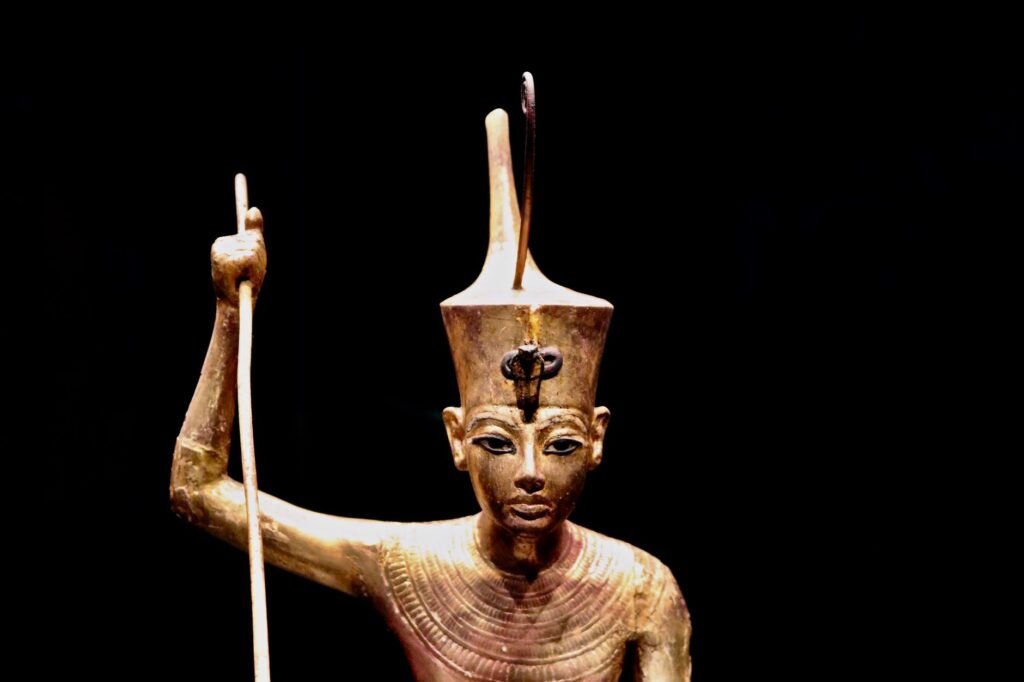
The red crown of Egypt is one of the most recognizable symbols in ancient Egyptian culture and royal iconography. In Egyptian mythology and political symbolism, it represents Lower Egypt—the northern part of the Nile Delta—and is closely associated with kingship, sovereignty, and the unified rule of Egypt. The crown is usually called the Deshret, a term linked to the color red and to the desert and the lowlands beyond the fertile river valley.
Unlike a mythological deity with a single narrative life story, the red crown is a sacred regalia object. It appears in temple scenes, royal inscriptions, and funerary art, where it signifies authority over Lower Egypt and, when paired with the white crown of Upper Egypt, the unity of the Two Lands. Because of this, the red crown is important not only as a royal emblem but also as a symbol of divine kingship, cosmic order, and state identity in ancient Egypt.
Origin and Meaning
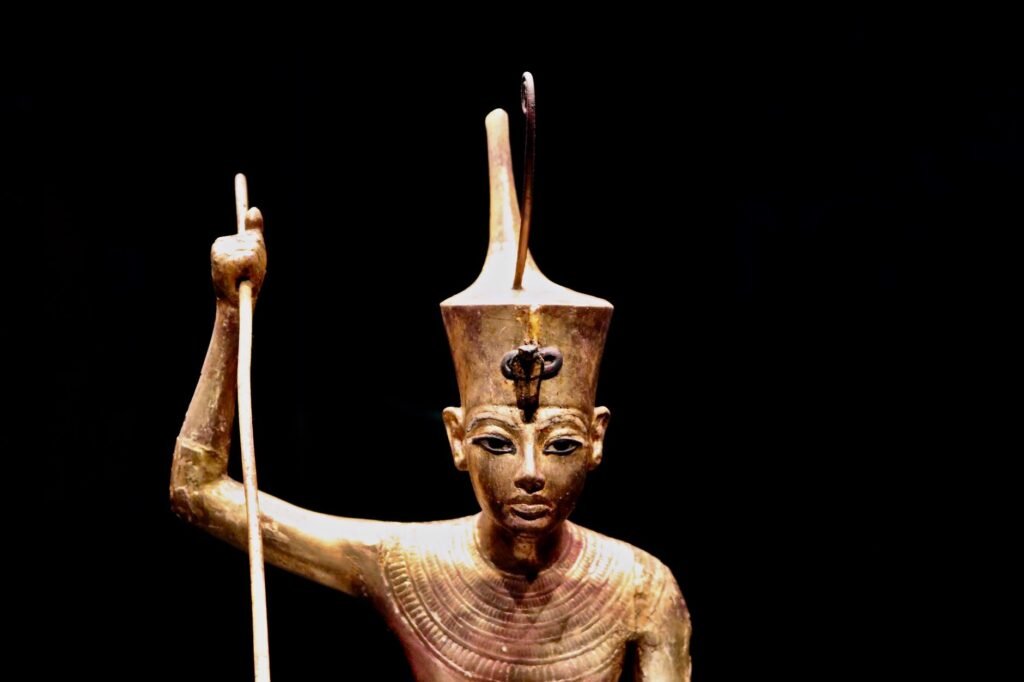
The most common modern term for the red crown is Deshret, a word related to the ancient Egyptian term for “red” and also associated with the red land of the desert. In ancient Egyptian thought, red could evoke several ideas at once: power, vitality, danger, chaos, and the arid outer regions of the Nile Valley. The crown’s color and shape therefore carried both political and religious meaning.
The red crown is historically connected to Lower Egypt, the Nile Delta region in the north. Ancient Egypt was often conceptualized as the union of two lands:
- Upper Egypt in the south, symbolized by the white crown (Hedjet)
- Lower Egypt in the north, symbolized by the red crown (Deshret)
The exact origin of the crown’s form is not fully known. As with many early Egyptian regalia, its earliest development likely predates surviving historical records. Scholars generally regard it as a long-established emblem that came to represent the Delta and its kingship by the early dynastic period.
Historical Context
The red crown became important during the formation of the Egyptian state, when rulers sought to present themselves as sovereigns of distinct regions that were later unified. In royal ideology, the crown was not merely decorative. It was a visible sign that the king ruled under divine sanction and maintained ma’at, the ideal of balance, order, and rightful governance.
Political significance
The crown symbolized:
- Authority over Lower Egypt
- The king’s role as ruler of a regional realm
- The eventual unity of Upper and Lower Egypt
- The state’s legitimacy and continuity
In many scenes, the pharaoh wears the red crown alone or combines it with the white crown to create the double crown (Pschent), which visually expresses the unification of the Two Lands. This composite crown became one of the most powerful symbols of Egyptian monarchy.
Religious context
The crown also appears in contexts where the king is shown interacting with gods. In those scenes, the crown helps define the pharaoh as the earthly representative of divine order. The object belongs to a wider system of symbols linking the ruler to deities, sacred geography, and the cycle of kingship.
Main Characteristics
The red crown has a distinctive, easily identifiable shape. While artistic conventions vary across periods, it generally features:
- A red base
- A tall, upward-curving projection at the back or side
- A spiral or coil-like element in some depictions
- In some artistic representations, a forward element or stylized structure at the front
Because ancient Egyptian art followed formal conventions, the crown’s appearance may differ depending on the period, medium, and artistic purpose. It is not a real surviving crown in the modern sense, but rather a symbolic and ceremonial representation.
Key identifying traits
| Feature | Description |
|---|---|
| Name | Deshret |
| Color | Red |
| Associated region | Lower Egypt |
| Symbolic role | Kingship, sovereignty, regional authority |
| Common pairing | White crown of Upper Egypt |
| Major composite form | Double crown (Pschent) |
The red crown is often shown with the uraeus, the rearing cobra emblem of royal protection, especially in later iconography where crowns are integrated into the complete royal image.
Family and Genealogy
The red crown is not a divine person and therefore does not have a genealogy in the mythological sense. It has no parents, children, or spouse. However, in symbolic and ideological terms, it belongs to the broader family of Egyptian royal regalia.
Related royal insignia
The red crown is conceptually related to:
- The white crown of Upper Egypt
- The double crown of unified Egypt
- The uraeus serpent
- The crook and flail
- The false beard associated with kingship
Together, these objects form the visual language of pharaonic authority. In religious texts and temple reliefs, these insignia can be understood as a kind of symbolic “genealogy” of kingship, with the red crown representing one part of the inherited political and sacred order.
Symbols
The red crown carries several overlapping symbolic meanings in Egyptian thought.
Core symbols and meanings
- Red color: associated with the desert, the east and west desert margins, vitality, and danger
- Lower Egypt: the northern Delta and its political identity
- Sovereignty: royal authority and legitimate rule
- Unity: especially when combined with the white crown
- Protection: in royal and divine contexts
The red crown and color symbolism
In ancient Egypt, red was not simply a single positive or negative sign. It could denote life and power, but also hostility and disorder. This duality is important. The crown’s red color marked the Delta, but it also connected symbolically with the dangerous forces that kingship was expected to control.
Common symbolic pairings
| Pairing | Meaning |
|---|---|
| Red crown + white crown | Unification of Egypt |
| Red crown + uraeus | Royal protection and authority |
| Crown + throne scenes | Legitimate kingship |
| Crown + gods | Divine approval of rule |
Sacred Animals
The red crown itself is not an animal symbol, but it is often linked to sacred animals through royal iconography and deity associations.
The cobra and the vulture
The most important animal symbols connected with Egyptian kingship are the:
- Uraeus cobra, associated with protection and royal power
- Vulture, especially in relation to Upper Egypt and goddesses such as Nekhbet
Because the red crown represents Lower Egypt, it is often seen in balance with symbols linked to Upper Egypt. The cobra, however, became widely associated with the king and could appear on the crown regardless of which regional emblem was shown.
Mythological associations
Lower Egypt was especially connected with Wadjet, the cobra goddess of the Delta. In this sense, the red crown can be understood as part of a broader sacred landscape in which animals embodied protective divine forces.
Sacred Plants
No specific plant is uniquely and universally tied to the red crown in Egyptian mythology. However, Egyptian kingship was often symbolically linked to the fertile land of the Nile and the plants of the Delta.
Indirect plant associations
Possible symbolic connections include:
- Papyrus, a plant strongly associated with Lower Egypt
- Lotus, often linked with renewal and sacred growth in broader Egyptian religion
- Reeds and marsh plants of the Delta region
Among these, papyrus is the most important for Lower Egypt. It frequently appears in pairings with lotus to symbolize the Two Lands or to mark regional identity in art and ritual. The red crown’s connection to Lower Egypt makes papyrus especially relevant as a cultural symbol, even if it is not part of the crown itself.
Sacred Places
The red crown is linked to sacred and political places in Lower Egypt, particularly the Nile Delta and royal centers associated with the north.
Key geographical associations
- Lower Egypt / the Delta: the primary region represented by the crown
- Memphis: a major political and religious center located near the border of Upper and Lower Egypt, often important in royal ideology
- Buto: a significant Delta cult center associated with Wadjet
- Naukratis and other Delta sites: later historical importance, though not specifically tied to the crown in early mythology
Symbolic geography
In Egyptian thought, geography was never merely physical. The crown stood for the Delta as a culturally meaningful space: fertile, marshy, and politically distinct from the southern valley. The red crown thus expressed a sacred geography in which kingship extended over contrasting but complementary regions.
Powers and Attributes
Since the red crown is a symbol rather than a deity, it does not “possess powers” in the way gods do. Nonetheless, in mythological and political terms it conveys several forms of authority and sacred function.
Attributes associated with the red crown
- Legitimacy: proof of rightful kingship over Lower Egypt
- Protection: especially in royal ritual and temple imagery
- Unification: when combined with the white crown
- Cosmic order: support for ma’at
- Regional identity: embodiment of the Delta’s role in the Egyptian state
Functional role in royal ideology
The crown helped present the king as:
- Ruler of a specific territory
- Heir to ancestral political traditions
- A mediator between gods and humans
- Protector of the land against chaos
In this sense, the red crown functioned almost like a sacred office made visible.
Main Myths
There are no surviving myths in which the red crown acts as a character. Instead, it appears within mythic and ideological narratives about kingship, unification, and divine order.
The unification of the Two Lands
One of the central myths of Egyptian royal ideology is the union of Upper and Lower Egypt. This is not always narrated as a single story in the same way as a Greek myth, but it is a foundational concept in Egyptian state religion. The red crown belongs to this framework as the emblem of Lower Egypt, whose union with Upper Egypt is represented by the double crown.
Royal validation by the gods
In temple and tomb scenes, gods may present the crown to the king or acknowledge him while he wears it. These scenes do not always refer to a single mythic episode, but they express a recurring theological idea: the king’s authority comes from the gods and is renewed through ritual.
Lower Egypt and divine protection
Because the red crown represents the Delta, it can also be connected to local divine protection, especially through Wadjet and the sacred centers of the north. This association supports the mythic image of the king as guardian of the entire country.
Relationship with Other Mythological Figures
The red crown is most clearly understood through its relationship with gods, goddesses, and royal symbols rather than through personal kinship.
Wadjet
Wadjet, the cobra goddess of Lower Egypt, is one of the most important divine figures associated with the red crown. She serves as a protector of kingship and a guardian of the Delta. Her emblematic role makes her closely linked to the crown representing her region.
Nekhbet
Nekhbet, the vulture goddess of Upper Egypt, is the counterpart to Wadjet. Together, the two goddesses symbolize the unity of Egypt. In royal ideology, Wadjet and Nekhbet often appear as paired protectors of the pharaoh.
The pharaoh
The king is the central human figure associated with the red crown. He wears it to display his rule over Lower Egypt and, when combined with the white crown, his mastery over the whole country.
Other divine connections
The crown can appear in scenes involving:
- Horus, the divine model of kingship
- Ra, in solar royal ideology
- Ptah, especially in state and Memphis-related contexts
- Amun, in later state religion
Worship and Cult
The red crown itself was not worshipped as a god, but it was a sacred royal object used within religious and state ceremonies.
Ritual use
The crown appears in:
- Temple reliefs
- Royal statuary
- Funerary objects
- Processional and ceremonial scenes
- Inscriptions celebrating coronation or kingship
Functions in cultic life
Its ritual significance included:
- Marking the king’s divine status
- Symbolizing rule over a sacred territory
- Supporting the ideology of coronation
- Reinforcing the sacred unity of Egypt
Offerings and festivals
There is no evidence of offerings made directly to the red crown itself. However, the crown is present in rituals performed for the king and the gods, especially at major state festivals and temple ceremonies where royal authority was reaffirmed.
Ancient Sources
Because the red crown is an Egyptian royal symbol, it is best documented in Egyptian primary sources, not in the classical Greek and Roman authors often cited for mythological subjects.
Main source categories
- Temple reliefs and inscriptions
- Royal titulary and regalia imagery
- Funerary art and coffin decoration
- Iconographic depictions of kings and gods
- Hieroglyphic and ceremonial texts
Later classical references
Classical authors such as Herodotus, Diodorus Siculus, and Plutarch discuss Egyptian religion, kingship, and customs in broad terms, but they do not provide a detailed “myth” of the red crown itself. Their writings are useful for understanding how outsiders interpreted Egyptian civilization, but they are not the principal source for the crown’s symbolism.
Modern Egyptological understanding
Most of what is known about the red crown comes from archaeological evidence and scholarly reconstruction rather than from a single textual account. Because of this, interpretations may vary slightly among Egyptologists, especially regarding its earliest form and development.
Roman Equivalent
The red crown does not have a true Roman mythological equivalent because it is a political-religious insignia rather than a deity. The closest Roman parallels are symbols of power and office, such as:
- The corona in general
- The laurel wreath as a sign of honor
- The diadem as a symbol of monarchy in the Hellenistic and Roman world
However, these are only partial analogies. The Egyptian red crown was tied to the sacred geography of Lower Egypt and to the ideology of the pharaoh, making it distinct from Roman regalia.
Influence on Modern Culture
The red crown continues to appear in modern depictions of ancient Egypt, especially in contexts involving pharaohs, gods, and archaeology.
In popular culture
It appears in:
- Museums and educational displays
- Films and documentaries about ancient Egypt
- Novels and historical fiction
- Video games set in ancient or mythic Egypt
- Graphic design and themed artwork
Symbolic use today
Modern artists and designers often use the red crown to signal:
- Ancient Egyptian royalty
- The Nile Delta or Lower Egypt
- A general image of pharaonic civilization
Because the crown is visually distinctive, it is frequently combined with the white crown to represent the “Egyptian pharaoh” in a single image, even when the historical context would call for a more precise regional distinction.
Curiosities
- The red crown is one of the two major crowns of Egyptian kingship, but it is usually less familiar to general audiences than the combined double crown.
- Its name, Deshret, is related to the word for red, but also to ideas of the desert and the outside world.
- The crown is strongly associated with Lower Egypt, which was ancient Egypt’s fertile northern region, not a desert.
- In Egyptian thought, red could be both protective and dangerous, reflecting the crown’s dual symbolic nature.
- The red crown is not known from surviving physical crowns in a museum sense; most knowledge of it comes from art and inscriptions.
- In some depictions, crown forms are stylized so much that details vary by artistic period.
- The pairing of the red and white crowns is one of the oldest visual expressions of political unity in world history.
- The goddess Wadjet is an especially important figure for understanding the crown’s regional meaning.
Frequently Asked Questions
What is the red crown of Egypt in Egyptian mythology?
The red crown of Egypt, called the Deshret, is the royal emblem of Lower Egypt. It symbolizes kingship, sovereignty, and the authority of the pharaoh over the northern Nile Delta region.
Was the red crown a real object?
Yes, it was a real type of ceremonial royal regalia, though no original crown has survived in the way modern crowns might. Its form is known mainly from ancient artwork, reliefs, and inscriptions.
What does the red color mean?
Red in Egyptian symbolism could represent power, life, danger, the desert, and the outer regions of the land. In the crown, it especially identifies Lower Egypt and its royal authority.
Which goddess is associated with the red crown?
The goddess Wadjet, a cobra deity of Lower Egypt, is strongly associated with the red crown. She represents protection and the sacred identity of the Delta.
How is the red crown different from the white crown?
The red crown represents Lower Egypt, while the white crown represents Upper Egypt. Together they form the double crown, symbolizing the unity of the Two Lands.
Did pharaohs always wear the red crown?
Not always. Pharaohs could be shown wearing the red crown, the white crown, the double crown, or other forms of headgear depending on the region, ritual, and symbolic message.
Is the red crown a god?
No. It is not a deity. It is a sacred symbol of rule and regional identity that plays an important role in mythological and royal imagery.
Why is the red crown important today?
It remains important because it helps modern readers and viewers understand ancient Egyptian ideas of kingship, political unity, and sacred symbolism.
Conclusion
The red crown of Egypt, or Deshret, is far more than an ornamental headpiece. In Egyptian mythology and royal ideology, it is a powerful emblem of Lower Egypt, divine kingship, and the balance between regional identities within the Egyptian state. Its meaning is rooted in geography, color symbolism, and the sacred role of the pharaoh as ruler under the protection of the gods.
Although it does not belong to a mythic “family” like a deity, the red crown is deeply embedded in Egypt’s religious and political imagination. It stands beside the white crown as one of the most enduring symbols of ancient civilization, and its legacy continues in scholarship, museums, and popular culture as a concise visual expression of pharaonic Egypt.

Orin Vale has spent the better part of two decades tracing the threads that connect the world’s oldest stories — from the halls of Asgard to the banks of the Nile, from Olympus to the jungles of the Maya. What began as a childhood fascination with flood myths and trickster gods grew into years of independent study across comparative mythology and ancient religion, always chasing the same question: what did these stories mean to the people who first told them? Orin writes for readers who want more than trivia — the ones looking for the beliefs, fears, and truths that myths were built to carry.