Introduction
The double crown of Egypt is one of the most recognizable symbols of ancient Egyptian kingship. In Egyptian mythology and royal ideology, it represented the rule of a pharaoh over both Upper Egypt and Lower Egypt, the two major regions of the ancient state. More than a decorative headpiece, the double crown expressed political unity, divine authority, and cosmic order.
In Egyptian art and inscriptions, it appears as a combined form of two older crowns: the white crown of Upper Egypt and the red crown of Lower Egypt. Together they formed the Pschent—a later Greek term for the combined crown—though in ancient Egyptian texts the concept was expressed through titles and symbols rather than a single fixed name. The double crown became a powerful emblem of the monarch as the one who unified the land and maintained ma’at, the Egyptian principle of truth, balance, and harmony.
Origin and Meaning
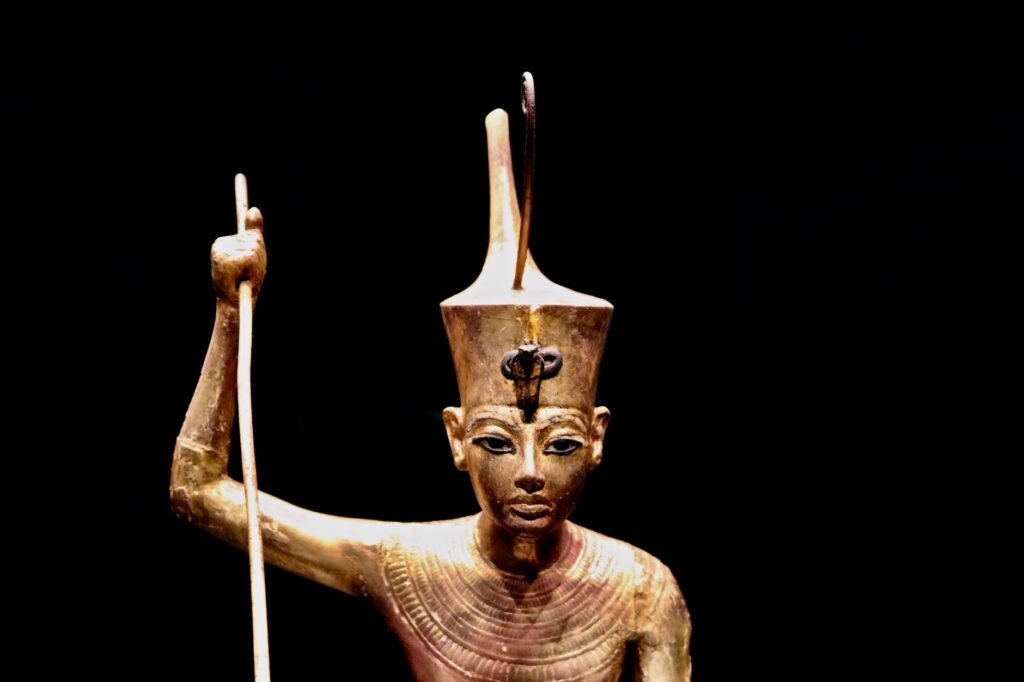
The double crown of Egypt originated from the political unification of the Nile Valley. Ancient Egypt traditionally recognized two lands:
- Upper Egypt, the southern region along the upper Nile
- Lower Egypt, the northern Nile Delta
Each land had its own royal symbolism:
- The white crown (hedjet) for Upper Egypt
- The red crown (deshret) for Lower Egypt
When these two regions were united under one ruler, the combined crown symbolized that union. The modern term “double crown” refers to this pairing. The Greek term Pschent is widely used in scholarship, but it is not an original Egyptian word.
The crown’s meaning was both political and religious. It signified that the pharaoh ruled over the two lands as a single sovereign, but it also implied that the king upheld the cosmic order of the world. In mythic terms, the unity of the two crowns mirrored the ideal unity of Egypt itself.
Historical Context
The symbolism of the double crown developed in the context of early state formation in ancient Egypt. By the early dynastic period, around the late fourth millennium BCE, the unified kingship of Egypt was already established in tradition and ideology. Whether unification was a single historical event or a longer process is debated by modern scholars, but later Egyptian tradition presented it as a foundational moment in national history.
The double crown became a standard royal emblem throughout much of pharaonic history. It appears in:
- Royal statuary
- Reliefs and temple decoration
- Seal impressions
- Ceremonial scenes
- Divine representations of the king
It was not merely a practical object worn every day. Like many Egyptian crowns, it was a ritual and ideological sign. Different crowns were used in different contexts, and many survive only in artistic depictions because they were likely made from perishable materials.
The double crown also helped define the pharaoh as a mediator between gods and humans. By wearing it, the king showed that he had authority over the whole territory of Egypt and responsibility for maintaining the proper relationship between the divine realm and the human world.
Main Characteristics
The double crown is usually shown as a composite headdress with distinct parts from each of the two regional crowns.
Key features
- White crown element: tall, conical form associated with Upper Egypt
- Red crown element: low, bowl-like base with a raised projection at the back associated with Lower Egypt
- Uraeus: the rearing cobra often placed at the front, symbolizing royal protection and divine power
- Occasional decorations: sometimes ribbons, feathers, or divine emblems are added in artistic representations
Identifying significance
The double crown was one of the clearest visual indicators of kingship in ancient Egyptian art. When a pharaoh wore it, viewers immediately understood several ideas at once:
- The ruler governed both halves of Egypt
- The king embodied political unity
- Royal power had divine sanction
- The monarch preserved cosmic balance
Although it is called a “crown,” it should be understood as a sacred insignia rather than a single standardized object worn in all settings. Egyptian rulers used multiple crowns and headdresses, each associated with a different ritual or political role.
Family and Genealogy
Strictly speaking, the double crown is not a deity with a family lineage, so questions of parents, spouses, or descendants do not apply in the usual mythological sense. However, within royal and divine symbolism, it belongs to a wider symbolic family of crowns and regalia.
Related royal emblems
- White crown (Hedjet): Upper Egypt
- Red crown (Deshret): Lower Egypt
- Atef crown: a more elaborate divine crown often linked to Osiris
- Khepresh: the blue “war crown” or ceremonial crown used in some periods
The double crown can be understood as the synthesis of the white and red crowns. In that sense, it “descends” from older regional symbols and represents their union. It is also connected to the divine and royal identities of the pharaoh, who in Egyptian thought was more than a human ruler.
Symbols
The symbolism of the double crown is central to its meaning in Egyptian mythology and state ideology.
Core symbolic meanings
| Symbol | Meaning |
|---|---|
| White crown | Upper Egypt, purity, southern kingship |
| Red crown | Lower Egypt, northern kingship, fertile delta |
| Combined crown | Unity of the Two Lands |
| Uraeus cobra | Protection, royal authority, divine fire |
| Pharaoh wearing the crown | Legitimate kingship, stability, cosmic order |
Colors and their meaning
The contrasting colors of the crown elements were not merely aesthetic. They encoded geography and authority:
- White often conveyed purity, sacredness, and the southern kingdom
- Red was associated with the north, but also with power and vitality
- Together, the colors expressed balance through duality
In Egyptian thought, duality was not contradiction but complementarity. The double crown made that principle visible.
Sacred Animals
The double crown itself is not associated with a single sacred animal in the way that some deities are, but it is closely linked to animals used in royal symbolism.
Important animal associations
- Cobra: The uraeus on the crown represented Wadjet, a protective goddess often shown as a serpent
- Vulture: Sometimes associated with Nekhbet, the goddess of Upper Egypt
- Bulls: Frequently used as royal symbols of strength and fertility
- Falcon: Associated with Horus, the divine sky king and model of pharaonic rule
The cobra is especially important because it often appears on the front of royal crowns, including the double crown, as a guardian against enemies. In some contexts, the cobra and vulture together symbolize the protection of both lands.
Sacred Plants
No sacred plant is uniquely and exclusively tied to the double crown itself, but Egyptian royal symbolism often included plants from the two lands, especially in scenes of unification.
Relevant plant symbols
- Papyrus: Associated with Lower Egypt and the marshy Delta
- Lotus: Often linked with Upper Egypt and rebirth
- Reeds and papyrus bundles: Frequently used in iconography of unification
In temple scenes, the binding of papyrus and lotus plants can represent the joining of Lower and Upper Egypt. This visual theme parallels the meaning of the double crown. The plants are therefore important not because they are part of the crown, but because they reinforce the same ideological message of unity.
Sacred Places
The double crown is connected to places central to Egyptian kingship, especially the capitals, cult centers, and symbolic sites of both regions.
Major associated locations
| Place | Significance |
|---|---|
| Hierakonpolis | Important early center of Upper Egyptian kingship |
| Buto | Major cult and political center in Lower Egypt |
| Memphis | Early capital and symbolic center of unified Egypt |
| Thebes | Later major religious and political center |
| Abydos | Strongly associated with kingship, burial, and Osiris |
Geographic symbolism
The concept of the double crown presupposes the sacred geography of Egypt itself. The Nile Valley was understood as two complementary halves. The king’s role was to unite and govern them. As a result, the crown is more than a regional insignia; it is a map of sovereignty.
Temples across Egypt depict pharaohs wearing the double crown when offering to gods, receiving legitimacy, or smiting enemies. These scenes placed the crown within sacred space and linked royal authority to divine approval.
Powers and Attributes
The double crown has no powers of its own in the sense of an independent deity. Its “powers” belong symbolically to the king who wears it.
Primary attributes
- Unification: symbolizes the joining of Upper and Lower Egypt
- Legitimacy: marks lawful kingship
- Protection: especially through the uraeus
- Sovereignty: indicates rule over the entire land
- Cosmic order: connects the ruler with ma’at
The crown served as a visual shorthand for the pharaoh’s responsibilities:
- Preserve national unity
- Defend Egypt from internal and external threats
- Support temple cults and the gods
- Maintain justice and order
- Perform rituals that ensured prosperity
In mythic terms, these attributes were not abstract. They were essential to the functioning of the universe as understood by the ancient Egyptians.
Main Myths
The double crown is not the central object of a single famous myth in the way that Osiris’ body or Horus’ eye may be. Instead, it belongs to a broad mythological framework about kingship, unification, and divine order.
The unification of the Two Lands
One of the most important mythic-historical narratives in Egypt is the unification of Upper and Lower Egypt under the first king. Later tradition often associated this with Narmer, though modern interpretations of early dynastic evidence can be complex. The double crown symbolizes the result of this unification.
Horus and Seth
Another important mythic background involves the conflict between Horus and Seth. This struggle is often read as a symbolic expression of order versus disorder, or legitimate kingship versus chaos. The pharaoh, as Horus’ earthly representative, wears the regalia of rule, including the double crown, as a sign that order has prevailed.
The king as divine intermediary
In many temple scenes, the king wearing the double crown offers to the gods, receives life from them, or smites enemies before them. These are not “myths” in the narrative sense, but ritual images expressing a mythic worldview: the ruler stands at the center of the relationship between Egypt and the divine.
Relationship with Other Mythological Figures
The double crown is deeply connected to several gods and goddess figures in Egyptian religion.
Key relationships
- Horus: The divine model of kingship; pharaohs were often identified with Horus
- Wadjet: Cobra goddess associated with Lower Egypt and protection
- Nekhbet: Vulture goddess associated with Upper Egypt
- Ra: Solar authority and kingship, often linked to royal legitimacy
- Osiris: Connected with royal succession, resurrection, and afterlife kingship
Symbolic role of the protective goddesses
Wadjet and Nekhbet are especially important because they are commonly shown as protectors of the king. Their presence emphasizes the twofold character of royal power:
- Wadjet protects Lower Egypt
- Nekhbet protects Upper Egypt
The double crown visually unites these divine protections in the person of the pharaoh.
The king as Horus
In Egyptian religious thought, the living king was frequently identified with Horus. The double crown is part of that identity, showing the king not as a private individual but as the visible manifestation of divine authority on earth.
Worship and Cult
The double crown was not worshipped as a god, but it was used in ritual, temple art, and royal ceremony.
Ritual uses
- Worn or represented during coronation-related acts
- Shown in temple reliefs during offerings to gods
- Depicted in victory scenes over Egypt’s enemies
- Associated with royal procession and state ceremony
Offerings and festivals
The crown itself was not offered sacrifices. Rather, it functioned within larger cultic frameworks where the king, wearing or symbolizing the crown, performed offerings to the gods. Festivals such as coronation celebrations and renewal ceremonies reinforced the king’s authority.
Political and religious function
The double crown affirmed that the pharaoh was not merely a political ruler. He was the one who maintained the temples, mediated with the gods, and preserved the rhythm of sacred time. The crown therefore had both liturgical and ideological significance.
Ancient Sources
Because the double crown is a symbol rather than a character, it does not appear in ancient literary sources in the same way as mythic figures do. However, it is abundantly represented in Egyptian art and royal inscriptions.
Egyptian evidence
Important evidence comes from:
- Early dynastic royal iconography
- Temple reliefs
- Statues of pharaohs
- Ceremonial scenes in tombs and temples
- Royal titulary and inscriptions
Classical authors
Classical Greek and Roman writers refer more broadly to Egyptian kingship and ceremonial customs than to the double crown specifically. Useful ancient authors for the wider context include:
- Herodotus: on Egyptian customs and rulers
- Diodorus Siculus: on Egyptian history and religion
- Plutarch: especially in discussions of Osiris and Egyptian religion
- Strabo: on Egypt’s geography and culture
These authors are valuable for context, but they do not provide a detailed technical description of the crown comparable to modern Egyptological analysis.
Scholarly caution
Modern understanding of the double crown depends largely on archaeology, art history, and epigraphy. Ancient sources should therefore be used carefully and in combination with material evidence.
Roman Equivalent
There is no exact Roman equivalent to the double crown of Egypt. Roman rulers used crowns, laurel wreaths, diadems, and other insignia of authority, but these did not carry the same specific symbolism of two-part territorial unity.
When Rome ruled Egypt, the double crown continued to appear in Egyptian-style royal and temple imagery, especially in representations of emperors adopting pharaonic forms. In that sense, Roman emperors in Egypt could be shown as pharaohs wearing traditional Egyptian regalia, including crowns associated with legitimate rule.
A closer Roman parallel in function, though not in meaning, would be the laurel wreath or imperial diadem, both of which signified authority and sovereignty. However, the double crown remained uniquely Egyptian in its symbolism of the Two Lands.
Influence on Modern Culture
The double crown remains a potent image in modern references to ancient Egypt. It appears in:
- Museum displays
- History textbooks
- Documentary films
- Reproductions of pharaonic regalia
- Popular fiction and video games
- Logos and graphic design inspired by Egypt
Its visual clarity makes it one of the most used symbols of ancient Egyptian civilization. Popular culture often presents it as the “crown of the pharaoh,” sometimes without explaining its specific political meaning.
Modern significance
The double crown is often used to represent:
- Ancient Egyptian monarchy
- National unity
- Divine kingship
- Archaeological heritage
In literature and entertainment, it can appear as a shorthand for mystery, power, or ancient legitimacy. Museums and educational institutions use it to explain how Egyptian rulers conceived of the state.
Curiosities
- The term Pschent is Greek, not Egyptian.
- The double crown is a symbolic composite, not always a literal surviving artifact.
- Egyptian art often shows crowns with symbolic detail rather than strict realism.
- The crown represents two lands that were ideologically united, even though Egypt’s political boundaries changed over time.
- The uraeus on the crown served as both a protective emblem and a marker of divine authority.
- In some depictions, the crown appears in the hands of a god or as part of ceremonial presentation, showing that kingship itself was sacred.
- The double crown reflects a broader Egyptian fascination with balance through duality: north and south, red and white, order and power.
Frequently Asked Questions
What is the double crown of Egypt in Egyptian mythology?
The double crown is the combined royal crown of ancient Egypt, symbolizing the ruler’s authority over both Upper and Lower Egypt. It represents unified kingship and divine legitimacy.
What are the two crowns that make up the double crown?
The double crown combines the white crown of Upper Egypt and the red crown of Lower Egypt.
Was the double crown worn by all pharaohs?
It is commonly associated with pharaohs in art and royal iconography, but not necessarily worn in everyday life. It was a ceremonial and symbolic regalia item.
Did the ancient Egyptians call it the double crown?
Not in the modern sense. “Double crown” and Pschent are later terms used by scholars. Ancient Egyptians expressed the idea through royal titles and iconography.
What did the uraeus on the crown mean?
The uraeus, a rearing cobra on the front of the crown, symbolized protection, royal power, and the presence of divine authority.
Is the double crown a god or goddess?
No. It is not a deity. It is a symbol of kingship, although it is closely connected to divine figures such as Horus, Wadjet, and Nekhbet.
Why is the double crown important in Egyptian history?
It is important because it visually represents the political unification of Egypt and the pharaoh’s role as ruler of both lands.
Where can the double crown be seen today?
It can be seen in ancient Egyptian statues, temple reliefs, museum collections, and reproductions in books and exhibitions about pharaonic Egypt.
Conclusion
The double crown of Egypt is one of the most enduring symbols of ancient Egyptian civilization. In mythology and political ideology alike, it represented the union of Upper and Lower Egypt, the legitimacy of the pharaoh, and the preservation of cosmic order. Although it is not a deity, it functions as a sacred emblem deeply embedded in Egyptian religious and royal thought.
Its meaning cannot be reduced to decoration. The double crown conveyed a complete worldview: a ruler chosen to govern two lands, protected by divine powers, and responsible for maintaining harmony in the world. For that reason, it remains a key symbol for understanding ancient Egyptian mythology, kingship, and cultural identity.

Orin Vale has spent the better part of two decades tracing the threads that connect the world’s oldest stories — from the halls of Asgard to the banks of the Nile, from Olympus to the jungles of the Maya. What began as a childhood fascination with flood myths and trickster gods grew into years of independent study across comparative mythology and ancient religion, always chasing the same question: what did these stories mean to the people who first told them? Orin writes for readers who want more than trivia — the ones looking for the beliefs, fears, and truths that myths were built to carry.