Who Is Seshat in Egyptian Mythology?
Introduction
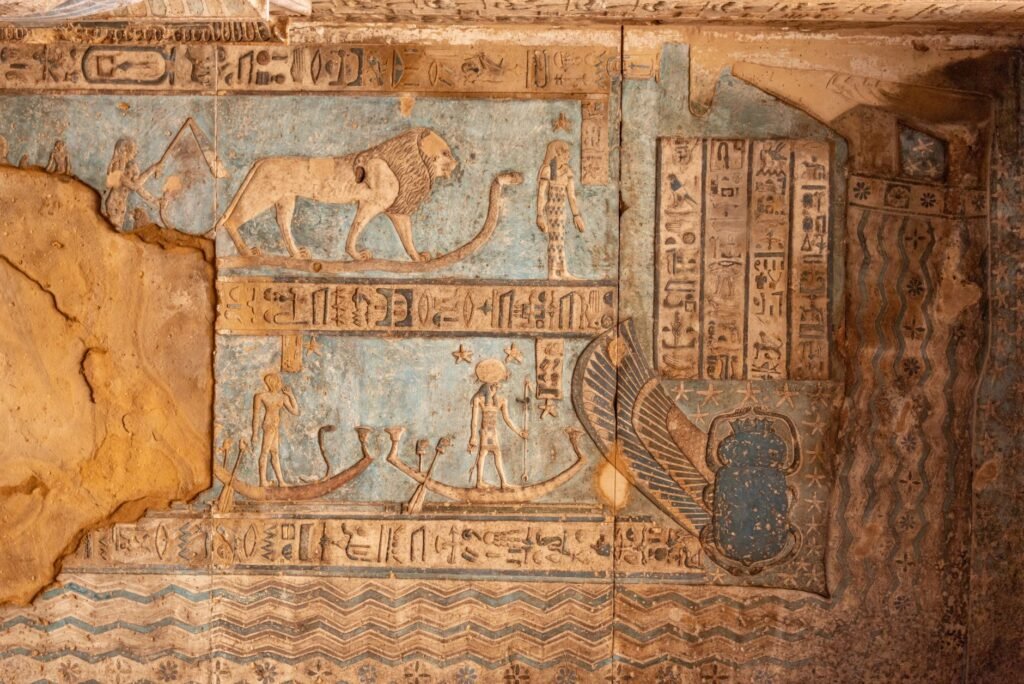
Seshat is one of the most distinctive deities in ancient Egyptian religion. She is primarily known as the goddess of writing, measurement, record-keeping, and knowledge, and she occupies an important place in the administrative and intellectual life of ancient Egypt. Although she is not as widely recognized today as Isis, Osiris, or Ra, Seshat was highly significant in Egyptian royal and temple culture, especially in contexts involving architecture, sacred knowledge, and the preservation of official records.
Unlike some Egyptian gods and goddesses whose roles became broad and widely celebrated in myth, Seshat remained a specialized divine figure. Her importance lies in the fact that she embodies the systems that made Egyptian civilization possible: calculation, documentation, surveying, and the orderly transmission of sacred and practical knowledge. For this reason, she is often described as a goddess of wisdom, but more precisely she is the divine patron of writing systems and measurement rather than abstract wisdom alone.
Origin and Meaning
The name Seshat is generally understood to derive from the Egyptian root sš, meaning “scribe” or “writing.” Her name is often translated as “She of the Writing” or “Female Scribe,” reflecting her close association with literacy, record-keeping, and written knowledge.
Ancient Egyptian language and orthography varied over long periods, and the precise nuances of divine names can be difficult to recover with certainty. However, Seshat’s name consistently points to her essential function: she is the goddess who writes, counts, measures, and records.
Her historical origin is difficult to trace in detail, as surviving sources do not provide a clear narrative of her creation. She appears in early Egyptian religious and royal contexts as an established deity, suggesting a long development rooted in the practical and ceremonial importance of scribal culture. Egypt’s bureaucracy depended on writing and measurement, and Seshat appears to have personified the sacred dimension of those activities.
Historical Context
Seshat belongs to the religious world of ancient Egypt, where divine powers were closely connected to kingship, temple ritual, agriculture, and the administration of the state. In a civilization that relied on calendars, land measurement, taxation, construction, and written archives, a goddess of recording and surveying was highly appropriate.
Her role is most visible in royal and temple settings. She is especially associated with:
- foundation rituals for temples
- the measurement of sacred ground
- recording the years of a king’s reign
- documenting royal achievements
- supporting scribes and scholarly activity
Seshat was not a domestic goddess or a fertility deity in the usual sense. Instead, she belongs to the sphere of intellectual and ceremonial order. This makes her a key figure for understanding how the Egyptians linked knowledge with divine authority.
In many scenes, she appears together with the king or with Thoth, the god of writing and lunar wisdom. The pairing of Seshat and Thoth reflects two closely related aspects of Egyptian thought: the practical and sacred dimensions of writing, counting, and cosmic order.
Main Characteristics
Seshat is usually depicted as a woman wearing a distinctive emblem on her head. This emblem is one of her most recognizable features and helps identify her in Egyptian art.
Her primary characteristics include:
- association with writing and scribal work
- expertise in measurement and surveying
- connection to architecture and temple foundation rituals
- role in record-keeping and historical documentation
- relationship to royal power and divine order
She is often shown as a calm, concentrated figure rather than a dramatic or aggressive one. This visual style matches her function: she is the deity of precision, calculation, and accurate memory.
Appearance in Art
Seshat is commonly portrayed as:
- a woman in a leopard-skin or similar ceremonial garment
- wearing a head emblem made of a stylized rosette or star-like symbol above a horned or arching base
- holding a palm rib or writing instrument
- standing beside the king during rituals of measurement or inscription
The leopard-skin garment, often associated with priests and ritual specialists, emphasizes her ceremonial role. The palm rib may symbolize the passage of time or the counting of years, since palm ribs have notches that can be used as a visual analogy for recording time.
Family and Genealogy
Unlike major gods such as Osiris or Isis, Seshat does not have a universally agreed mythological family tree. Ancient sources do not consistently identify her parents, spouse, or children. This is not unusual in Egyptian religion, where some deities were defined more by function than by genealogy.
Different traditions and scholarly reconstructions have suggested varying relationships:
- She is frequently treated as a counterpart or female counterpart to Thoth
- In some interpretations, she acts as his companion or feminine complement
- She is sometimes linked to the king as a divine assistant in royal ritual
It is important to note that these relationships are often symbolic rather than familial in the strict sense. Egyptian gods could be paired because their functions complemented one another, not necessarily because they formed a literal family unit in myth.
Summary of Known Relationships
| Relationship | Status | Notes |
|---|---|---|
| Parents | Uncertain | No consistent ancient genealogy |
| Spouse | Uncertain | Sometimes associated with Thoth in a complementary role |
| Children | Not clearly attested | No major mythic offspring tradition |
| Royal patronage | Strong | Connected with kingship and state ritual |
Symbols
Seshat’s symbols are central to her identity and are among the most useful features for recognizing her in Egyptian iconography.
Main Symbols
- Seven-pointed star or rosette above a bow-shaped emblem: Her best-known symbol, often interpreted as a stylized flower, star, or rosette.
- Palm rib: Associated with time, counting, and record-keeping.
- Writing tools: Sometimes shown with implements used by scribes.
- Leopard skin: A ritual garment signifying sacred and priestly status.
Symbolic Meaning
The head emblem is especially significant, though its precise interpretation is debated. Scholars have suggested it may represent:
- a star or celestial sign
- a floral rosette
- a bow with feathers or ribbons
- a ceremonial emblem linked to writing or measurement
Because Egyptian symbols often carried layered meanings, it is possible that the emblem functioned both as a divine marker and as a sign of her association with celestial order, timekeeping, or ritual precision.
Sacred Animals
Seshat is not primarily known for a sacred animal in the way that some Egyptian deities are linked to specific creatures such as cats, crocodiles, or falcons. However, her iconography is indirectly connected with animal symbolism through ceremonial dress and divine association.
Possible and Indirect Associations
- Leopard or leopard skin: The garment she wears may suggest ritual power and elite priestly office rather than an actual sacred animal.
- No exclusive animal cult: Unlike Bastet or Sobek, Seshat does not have a strongly established animal cult of her own.
Because of this, it is more accurate to say that Seshat is associated with ritual attire incorporating animal imagery rather than with a particular sacred animal species.
Sacred Plants
Seshat is not widely associated with a specific sacred plant in the surviving evidence. Nevertheless, plants may appear in symbolic interpretations of her emblem or in broader Egyptian religious imagery connected to time, growth, and order.
Relevant Plant Imagery
- Palm: Her palm rib symbol is not a sacred plant in the same sense as the papyrus or lotus, but it is one of her key emblems.
- Lotus and papyrus: While not specifically hers, these plants often appear in Egyptian sacred art and may frame scenes involving writing, royal legitimacy, and renewal.
If a specific sacred plant linked uniquely to Seshat existed in local worship, it has not been securely preserved in the historical record.
Sacred Places
There is no single universally recognized cult center for Seshat comparable to Thebes for Amun or Busiris for Osiris. She was honored in various contexts across Egypt, especially where literacy, surveying, and royal foundation rites were important.
Places and Contexts Associated with Seshat
- Temples: She appears in temple foundation scenes, especially where sacred architecture is being established.
- Royal building sites: Her role in measuring ground makes her especially relevant to construction rituals.
- Administrative and scribal institutions: Seshat’s divine function fits the world of archives, record houses, and scribal training.
- Heliopolitan and royal traditions: She is sometimes discussed in relation to broader theological systems centered on cosmic order and kingship.
Because her role was functional and ceremonial, her “sacred place” is often less a specific city than the very act of establishing sacred space.
Powers and Attributes
Seshat’s powers reflect the intellectual and organizational foundations of Egyptian civilization.
Main Domains
- Writing
- Measurement
- Surveying
- Record-keeping
- Chronology
- Temple foundation
- Preservation of royal achievements
- Sacred knowledge
Functional Importance
Seshat’s divine powers are practical as well as symbolic. She represents the ability to:
- mark boundaries accurately
- count years and events
- preserve the memory of kings
- support the legitimacy of royal projects
- order the world through knowledge
In Egyptian thought, measurement was not merely technical. To measure correctly was to impose order on chaos. Seshat therefore participates in ma’at, the principle of cosmic order, truth, and balance.
Relationship to Time
One of Seshat’s notable functions is her role in recording years and events. In some royal scenes, she is shown counting or noting the years of a king’s reign, making her a divine keeper of historical continuity.
Main Myths
Seshat does not have a large body of mythic narratives comparable to those surrounding Osiris, Horus, or Isis. Her importance lies more in ritual scenes and cult function than in dramatic myths.
Major Narrative Roles
Temple Foundation Rituals
Seshat appears prominently in the ceremony of “stretching the cord,” a foundational ritual used to orient and measure the ground on which a temple or sacred structure would be built. In these scenes, she helps the king determine the correct layout of the temple precinct.
Recording the King’s Reign
She is sometimes depicted recording years, festivals, or royal achievements, symbolizing the official memory of kingship.
Supporting Divine Order
By assisting in measurement and writing, she helps preserve ma’at. Her role is mythically important even when not expressed through a long story.
Why She Has Few Myths
Many Egyptian gods are known from ritual iconography rather than extended myths. Seshat is one of these deities. Her functions were so specialized that they were best expressed through temple scenes, inscriptions, and ceremonial representations.
Relationship with Other Mythological Figures
Seshat is most often connected with Thoth, the better-known god of writing and wisdom.
Thoth
Thoth and Seshat share overlapping domains:
- writing
- measurement
- knowledge
- record-keeping
Thoth is usually portrayed as the male divine scribe, while Seshat is the female counterpart. Some scholars describe Seshat as a complement to Thoth rather than a subordinate figure. Their relationship illustrates the Egyptian habit of pairing male and female divine functions within related spheres.
The King
Seshat’s relationship with the pharaoh is one of her most important. She often assists the king during rituals of measurement and foundation. This reflects the Egyptian belief that kingship depended on divine sanction and correct ritual action.
Other Gods
- Ra: indirectly connected through cosmic order and royal legitimacy
- Ptah: in architectural contexts, since temple construction involved both divine planning and craftsmanship
- Ma’at: conceptually related through truth, balance, and order
- Nehbet and Wadjet: in the wider ritual sphere of kingship, though not directly linked as consorts or relatives
Worship and Cult
Seshat was honored in temple and royal ritual more than in widespread popular devotion. Her cult was tied to function, ceremony, and scribal culture.
Forms of Worship
- invocation during temple foundation rites
- appearance in royal inscriptions and ceremonial scenes
- reverence by scribes and administrators
- symbolic inclusion in records of kingship and measurement
Ritual Contexts
The most famous ritual connected with Seshat is the stretching of the cord. This ceremony involved the king, often assisted by Seshat, marking out the ground plan of a temple with cords and measuring tools. It symbolized both practical engineering and divine authorization.
Offerings and Devotion
The sources do not preserve a large body of evidence for special offerings unique to Seshat. However, in Egyptian religious practice, offerings of food, incense, and ritual recitation were common forms of honoring deities, and Seshat would have been approached through the broader ritual culture of temples and scribal houses.
Ancient Sources
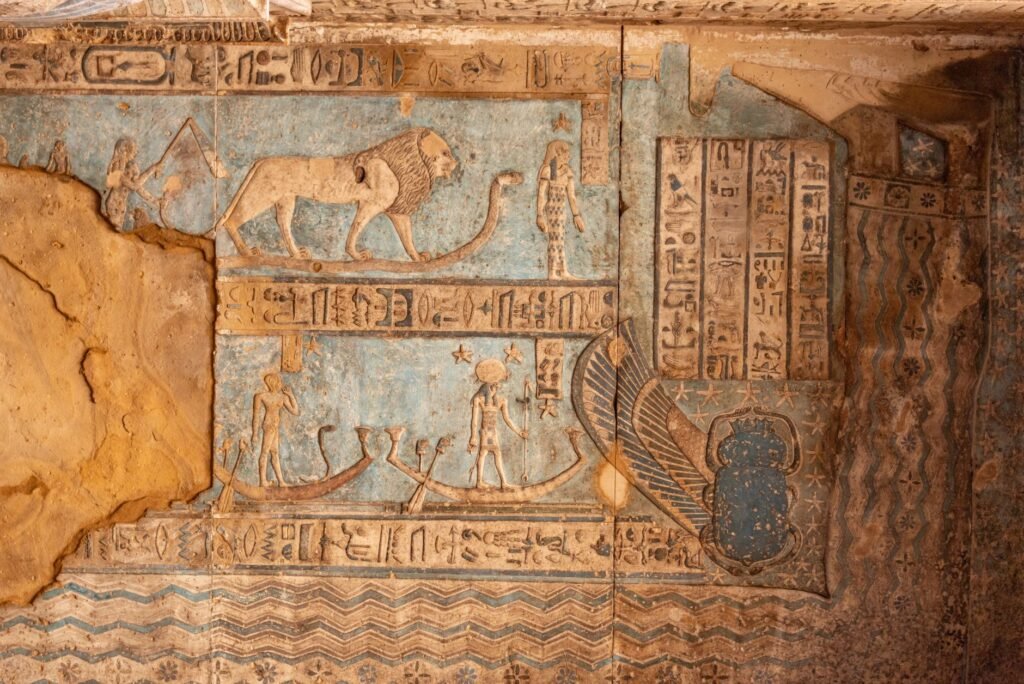
Seshat is primarily known from Egyptian primary sources, especially temple reliefs, inscriptions, and ritual scenes rather than from Greek literary authors.
Important Source Types
- Temple reliefs showing foundation rituals
- Royal inscriptions recording reigns and ceremonial acts
- Scribal and administrative iconography
- Religious texts and ritual scenes from different periods of Egyptian history
Classical Authors
Classical Greek and Roman authors do not usually focus on Seshat in the way they discuss more famous Egyptian deities. Authors such as Herodotus, Diodorus Siculus, and Plutarch wrote about Egyptian religion broadly, but Seshat is not a major figure in their surviving accounts.
This is important because it means that much of what is known about her comes not from literary myth but from visual and ritual evidence preserved in Egypt itself.
Modern Scholarship
Modern Egyptology has been essential for identifying Seshat’s role. Scholars analyze her iconography, titles, and appearances in temple scenes to reconstruct her significance. Since ancient texts do not provide a single narrative biography, interpretation depends heavily on archaeological and epigraphic evidence.
Roman Equivalent
Seshat does not have a direct Roman equivalent in the strict sense. Roman religion did not include an exact counterpart for a goddess whose specific role was writing, surveying, and temple measurement.
Closest Functional Parallels
- Minerva: as a goddess of wisdom and skilled crafts, she is the nearest broad Roman comparison, though not an exact match.
- Vesta or Fides: in limited ritual or civic contexts, these deities may share aspects of order and institutional stability, but they are not true equivalents.
Any Roman identification of Seshat is therefore approximate and based on function rather than direct religious correspondence.
Influence on Modern Culture
Seshat has a modest but growing presence in modern culture, especially in works that draw on Egyptian mythology, symbolism, or ancient wisdom traditions.
Areas of Modern Influence
- Egyptology and academic writing: She is frequently cited in studies of scribal culture and temple ritual.
- Popular reference works: Seshat appears in encyclopedias, educational websites, and museum materials about Egyptian gods.
- Fantasy and role-playing games: She may appear as a deity of knowledge, writing, or civilization.
- Art and design: Her distinctive emblem and elegant iconography make her visually appealing in stylized depictions of ancient Egypt.
- Modern spiritual and esoteric circles: She is sometimes invoked as a symbol of wisdom or memory, although such uses are modern reinterpretations rather than ancient practice.
Her modern fame remains much smaller than that of Isis or Anubis, but she is increasingly recognized by audiences interested in the intellectual side of Egyptian religion.
Curiosities
Here are some lesser-known facts about Seshat:
- She is one of the few major Egyptian deities strongly associated with written record-keeping rather than with natural forces or cosmic cycles.
- Her name is closely related to the Egyptian word for scribe.
- She is often shown helping the king during measurement rituals, showing that sacred architecture was treated as a divine act.
- Her emblem remains one of the most debated symbols in Egyptian iconography.
- She may be one of the clearest examples of a deity whose role reflects the administrative sophistication of ancient Egypt.
- Some depictions suggest she functioned as a female counterpart to Thoth, balancing male and female aspects of knowledge.
- Her importance can be understood as part of Egypt’s belief that order, counting, and documentation were sacred acts.
Frequently Asked Questions
1. Who is Seshat in Egyptian mythology?
Seshat is the Egyptian goddess of writing, measurement, record-keeping, and sacred knowledge. She was especially connected with temple foundation rituals and royal documentation.
2. What does the name Seshat mean?
Her name is generally linked to the Egyptian root for “scribe” or “writing,” and is often interpreted as meaning “Female Scribe” or “She of the Writing.”
3. Is Seshat the wife of Thoth?
Ancient sources do not consistently identify Seshat as Thoth’s wife. She is more accurately described as his counterpart or complementary female counterpart in writing and knowledge.
4. What is Seshat known for?
She is known for helping measure temple grounds, recording royal years and events, and symbolizing the sacred importance of writing and accurate calculation.
5. What does Seshat wear on her head?
She wears a distinctive emblem, often described as a seven-pointed star or rosette above a bow-like base. Its exact meaning is debated.
6. Did Seshat have a major cult center?
No single major cult center for Seshat is clearly known from the surviving evidence. She appears mainly in royal and temple ritual contexts across Egypt.
7. Is Seshat the same as Ma’at or Thoth?
No. Seshat is distinct from both. She is related to Thoth in function and to Ma’at in the sense that all three support order, but each deity has a different role.
8. Why is Seshat important?
Seshat is important because she represents the sacred value of writing, measurement, and knowledge in ancient Egyptian civilization. She embodies the intellectual foundations of state power and temple culture.
Conclusion
Seshat is a specialized yet highly significant goddess in Egyptian mythology. As the divine patron of writing, measurement, and record-keeping, she reflects the practical intelligence and ritual order that sustained ancient Egyptian society. Her role in temple foundation rites, royal documentation, and the preservation of sacred knowledge shows that literacy and calculation were not merely administrative tools but acts imbued with religious meaning.
Although she does not feature in dramatic myths as prominently as some other Egyptian gods, Seshat remains essential for understanding how the Egyptians connected divine authority with knowledge, architecture, and historical memory. Her enduring legacy lies in her embodiment of the idea that civilization itself depends on the power to measure, record, and remember.

Orin Vale has spent the better part of two decades tracing the threads that connect the world’s oldest stories — from the halls of Asgard to the banks of the Nile, from Olympus to the jungles of the Maya. What began as a childhood fascination with flood myths and trickster gods grew into years of independent study across comparative mythology and ancient religion, always chasing the same question: what did these stories mean to the people who first told them? Orin writes for readers who want more than trivia — the ones looking for the beliefs, fears, and truths that myths were built to carry.