Who Is Nephthys in Egyptian Mythology?
Nephthys is one of the major goddesses of ancient Egyptian religion, best known as a member of the Ennead of Heliopolis and as a divine figure connected with death, protection, mourning, and ritual lamentation. Although she is often overshadowed by better-known deities such as Isis and Osiris, Nephthys played an important role in funerary belief and temple theology for more than two millennia.
In Egyptian mythology, she is usually associated with the liminal spaces between life and death, order and chaos, and protection and loss. Her presence in myths, funerary texts, and artistic scenes reflects the Egyptian concern with safeguarding the dead and maintaining cosmic balance. Because ancient Egyptian religion was not based on a single fixed canon, her character varies somewhat across regions and periods, but she is consistently portrayed as a powerful goddess linked to the transition between worlds.
Origin and Meaning
The name Nephthys is the Greek form of the Egyptian name Nebet-Het or Nebt-Het, commonly translated as “Lady of the House” or “Mistress of the House.” The meaning of this title is not entirely certain, and scholars have proposed several interpretations. It may refer to a temple, a household, or a symbolic sacred space rather than a literal domestic residence.
The ancient Egyptian writing of her name suggests a goddess of status and guardianship. The Greek transcription “Nephthys” became standard in classical literature and modern scholarship. In Egyptian texts, she appears under forms of the name that emphasize her rank and dignity rather than a personalized mythological narrative.
Her origin is deeply rooted in ancient Egyptian religion, especially in the theological system of Heliopolis, where she belongs to a divine family associated with creation, kingship, and death. Like many Egyptian deities, her development was shaped by local traditions and changing religious ideas over time.
Historical Context
Nephthys was worshipped throughout much of ancient Egyptian history, from the Old Kingdom onward. She appears in some of the earliest funerary compositions and remains present in later temple traditions, magical texts, and Greco-Roman religious practice. Her prominence is especially clear in mortuary contexts, where she served as a protector of the deceased and a divine mourner.
Ancient Egyptian religion was highly regional. Different cities emphasized different gods, and divine family relationships often varied by theological school. In Heliopolitan theology, Nephthys is typically a daughter of Geb and Nut and the sister of Osiris, Isis, Seth, and sometimes Horus the Elder depending on the tradition. Her role in this family helps explain her close association with funerary rites and the myth of Osiris.
Her religious significance grew out of Egyptian ideas about:
- Ma’at, the cosmic order that had to be maintained
- The afterlife, which required protection and ritual knowledge
- Duality, a core principle in Egyptian thought, often expressed through pairs such as life/death, light/darkness, and order/chaos
Nephthys often functions in paired relationships, especially with Isis. The two goddesses together represent complementary forms of protection, mourning, and magical support.
Main Characteristics
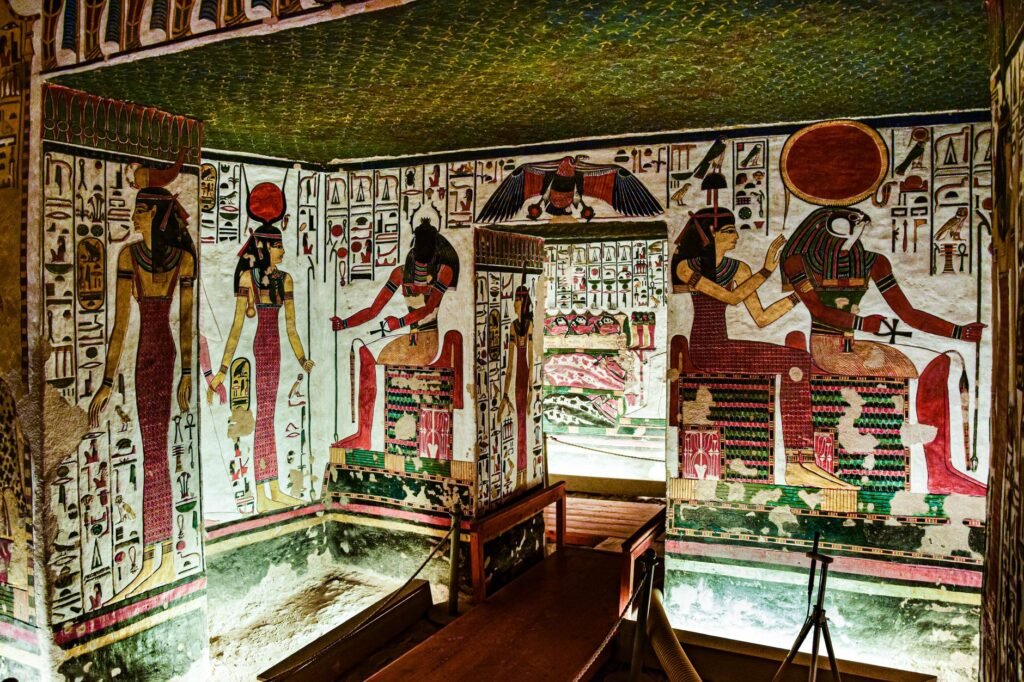
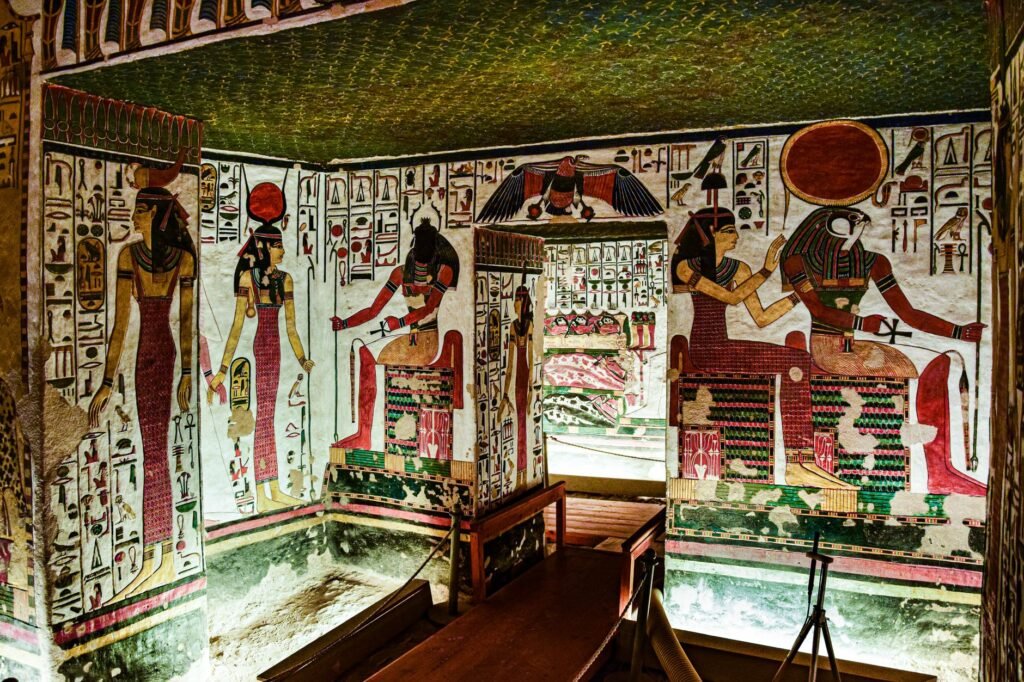
Nephthys is usually depicted as a woman wearing the hieroglyph of her name on her head, often a combination of a house-plan sign and a basket or enclosure sign. In some later artistic forms, she may wear a stylized headdress similar to that of Isis.
Her main characteristics include:
- Protective goddess of the dead and the vulnerable
- Mourner and lamenter in funerary rituals
- Guardian of tombs and embalming spaces
- Helper of the deceased in the journey to the afterlife
- Liminal deity, associated with boundaries and transitions
Unlike deities strongly associated with rulership or creation, Nephthys is more often identified with service, shelter, and ritual support. She is not usually a central creator goddess, but she is indispensable in myths and mortuary religion because she helps preserve divine and human order at the threshold of death.
She is also sometimes linked to night, hiddenness, and the unseen. This does not necessarily make her an “evil” goddess; rather, it reflects her connection to what lies beyond ordinary sight and beyond the boundaries of ordinary life.
Family and Genealogy
Nephthys belongs to one of the most important divine families in Egyptian mythology, though the details differ among sources.
Common family relationships
In the most widespread tradition:
- Father: Geb, the earth god
- Mother: Nut, the sky goddess
- Siblings: Osiris, Isis, and Seth
- Possible additional sibling: Horus the Elder in some traditions
Spouses and partners
Her marital and sexual relationships vary in the sources:
- She is commonly paired with Seth, sometimes as his wife.
- In some texts and myths, she is linked with Osiris, though this relationship is often ambiguous and symbolic.
- In certain later interpretations, she is connected with Horus the Elder or other figures in ways that reflect theological variation rather than a fixed myth.
Children
The best-known child associated with Nephthys is:
- Anubis, the jackal-headed god of embalming and funerary rites
However, sources differ on Anubis’s parentage. Some traditions name him as the son of Nephthys and Osiris, while others present him as the son of Nephthys and Seth, or as a deity whose birth resulted from a complex myth involving disguise and deception.
Because Egyptian myth often developed through local cults and theological reinterpretation, family relationships should be understood as flexible rather than universal.
Symbols
Nephthys is identified by several symbolic elements in ancient art and religious writing.
| Symbol | Meaning |
|---|---|
| Name hieroglyph on the head | Identifies her as “Lady of the House” |
| House sign | Suggests shelter, ritual space, and sacred enclosure |
| Basket/enclosure sign | Part of her name and symbolic of containment or protection |
| Mourning posture | Indicates grief, ritual lamentation, and funerary care |
| Pairing with Isis | Expresses complementary divine protection |
Common symbolic themes
- Protection
- Lamentation
- Containment
- Transition
- Hidden knowledge
- Funerary guardianship
In funerary scenes, Nephthys may stand at the head or foot of a coffin or sarcophagus, often opposite Isis, emphasizing the two goddesses’ role as divine protectors of the dead.
Sacred Animals
Nephthys does not have a single universally dominant sacred animal in the way that some Egyptian deities do. Nevertheless, several animals are associated with her broader funerary and protective context.
Associated animals
- Falcon or hawk imagery in some religious contexts related to sky and protection
- Jackal, indirectly through her association with Anubis, who is often interpreted as her son
- Vultures, in funerary symbolism and maternal protection, though not exclusive to Nephthys
- Scorpions and serpents, sometimes in magical protection contexts where she appears as a guardian against danger
Because Egyptian iconography is complex, these associations should not be treated as rigid sacred animal pairings. Nephthys is better understood through her ritual role than through a single animal emblem.
Sacred Plants
There are no universally agreed-upon sacred plants uniquely and consistently tied to Nephthys in the way that some plants are associated with particular Egyptian gods. However, certain plants appear in the broader funerary and protective environment in which she functions.
Plants often linked to funerary religion
- Papyrus: associated with life, marshland, and sacred writing
- Linen: used in mummification and ritual wrapping, relevant to her funerary role
- Lotus: a general symbol of rebirth in Egyptian religion
- Trees and reeds: sometimes used in protective or liminal symbolism
If plant associations are mentioned in modern references, they usually derive from her funerary and magical functions rather than from a well-defined cult of plant worship.
Sacred Places
Nephthys was not confined to one major cult center, and her worship appears across Egypt in temples, tombs, and funerary spaces.
Important locations and contexts
| Place | Significance |
|---|---|
| Heliopolis | Theological center of the Ennead and creation traditions |
| Abydos | Major center of Osiris worship and funerary religion |
| Memphis | Important for embalming and mortuary cults |
| Dendera | Temple environment where many goddesses were venerated |
| Tombs and necropolises | Primary ritual context for Nephthys’s protective role |
Funerary space as sacred geography
For Nephthys, the most important sacred place is often the tomb itself. She is frequently depicted as a guardian of burial chambers and a divine presence at the transition from the world of the living to the world of the dead.
In this sense, she belongs to the sacred geography of thresholds: doors, tomb entrances, embalming tents, and ritual spaces where the deceased was prepared for eternal life.
Powers and Attributes
Nephthys’s powers are closely tied to protection, mourning, and boundary-crossing.
Major domains
- Funerary protection
- Lamentation and grief
- Guardianship of tombs
- Support of the dead
- Magical assistance
- Protection during transition
Functional attributes
She is often invoked in contexts where divine aid is needed to:
- protect the body of the deceased
- support the soul in the afterlife
- defend against harmful forces
- assist in ritual purification and embalming
- preserve the integrity of sacred order
Nephthys is not typically portrayed as a wrathful or militarized goddess. Her power is more subtle and ritualized. She acts through presence, mourning, magic, and guardianship.
Main Myths
Nephthys appears in several important myths, especially those connected with Osiris.
The Osiris myth
The most famous myth involving Nephthys is the Osiris cycle. In the best-known version, Osiris is killed by Seth, his body is dismembered or hidden, and Isis searches for and restores him. Nephthys appears as a helper and mourner, often aligned with Isis in the search for Osiris and in the protection of his body.
She is sometimes portrayed as a sister who supports Isis in grief and in magical restoration. This makes her part of the divine response to death and disorder.
Birth of Anubis
One of the most famous Nephthys-related stories concerns the birth of Anubis. In some traditions, Nephthys disguises herself or uses deception to conceive a child associated with mummification and funerary rites. The details differ between sources, and no single version is definitive.
This myth reinforces her connection to:
- secrecy
- liminality
- funerary knowledge
- the generation of protective divine power
Role in funeral texts
In the Pyramid Texts, Coffin Texts, and later Book of the Dead traditions, Nephthys often appears as a divine helper who protects the deceased and supports resurrection or safe passage into the afterlife. Her mythic role is therefore not only narrative but also ritual and liturgical.
Relationship with Other Mythological Figures
Nephthys’s identity is best understood through her relationships with other gods and goddesses.
Isis
The relationship between Nephthys and Isis is one of the most important in Egyptian religion. They are often portrayed as complementary sisters who jointly protect Osiris and assist the dead. In art, they may appear on opposite sides of a coffin or sarcophagus, symbolizing balanced protection.
Their relationship is sometimes described as cooperative, but the mythological tradition also includes moments of contrast:
- Isis is often linked with restoration, kingship, and maternal magic
- Nephthys is more closely tied to mourning, protection, and hidden places
Osiris
Nephthys’s relationship with Osiris varies in the sources. She is often a mourner for him and a protector of his remains. Some traditions imply a closer intimate connection, especially in myths involving the conception of Anubis. However, these details are not uniform across all ancient accounts.
Seth
As the sister and sometimes wife of Seth, Nephthys occupies a complex position. Seth is the god of disorder, storms, and violence, but also of necessary strength and boundary defense in some periods. Nephthys’s association with Seth does not make her chaotic in the same way; instead, she often appears as a balancing force linked to the protection of what is endangered by disorder.
Anubis
If Anubis is understood as her son, the relationship is central to Egyptian funerary religion. Anubis handles embalming and mummification, while Nephthys provides maternal and protective support. Their association reinforces the sacred nature of burial and the preservation of the body.
Other deities
Nephthys also appears in relation to:
- Ra, in some solar and cosmic traditions
- Horus, through broader family and political myth
- Bastet, Hathor, and other goddesses, in contexts of ritual protection and divine femininity
Worship and Cult
Nephthys was worshipped in temples, funerary chapels, and private religious practices, although she did not always have the same large independent cult as major state gods.
Forms of worship
- Funerary offerings
- Lamentation rituals
- Protective spells and recitations
- Temple associations with Osiris and Isis
- Invocation in burial contexts
Ritual importance
Her most visible worship came in mortuary settings. Priests and mourners may have invoked her in rituals for:
- embalming the dead
- guarding the body
- ensuring safe passage into the afterlife
- protecting the tomb from hostile forces
Festivals
Specific festivals dedicated solely to Nephthys are less prominent in the surviving record than festivals for Osiris or Isis. She often appears within broader ceremonial cycles connected to death, renewal, and divine mourning.
Personal devotion
Like many Egyptian deities, Nephthys could also be honored in household and personal religion. Ancient Egyptians sometimes called on a wide range of deities for protection, healing, and afterlife security.
Ancient Sources
Nephthys is documented primarily in Egyptian sources, but later Greek and Roman authors also mention her through the lens of interpretatio graeca.
Egyptian primary sources
Important ancient Egyptian sources include:
- Pyramid Texts
- Coffin Texts
- Book of the Dead
- Temple inscriptions
- Funerary stelae and sarcophagi
- Mythological papyri and ritual texts
These sources present Nephthys as a protector, mourner, and ritual helper, especially in relation to Osiris and the deceased.
Classical authors
Greek and Roman writers who discuss Egyptian religion include:
- Herodotus
- Plutarch, especially in On Isis and Osiris
- Diodorus Siculus
- Strabo
- Apuleius, indirectly, through broader Egyptianized mystery traditions
These authors do not always preserve Egyptian beliefs accurately, but they are important for the transmission of Nephthys’s name and role into the classical world.
Caution on sources
Because ancient Egyptian religion was not systematized in one fixed text, no single source should be treated as the final authority. Nephthys’s image is reconstructed from many texts, images, and ritual contexts.
Roman Equivalent
Nephthys does not have a perfect Roman equivalent. She was sometimes interpreted through Roman religious and literary frameworks, but no single Roman goddess fully matches her role.
In the broader Greco-Roman world, she may be loosely compared with goddesses associated with:
- mourning
- funerary protection
- hidden knowledge
- ritual lamentation
However, these are only approximate analogies. Unlike Isis, who became widely identified with various Greco-Roman goddesses and mystery cults, Nephthys remained more specifically tied to Egyptian funerary religion.
Influence on Modern Culture
Nephthys continues to appear in modern culture, especially in works drawing on Egyptian mythology, archaeology, and esoteric traditions.
Modern references include:
- Literature, where she appears in historical fiction, fantasy, and mythology retellings
- Cinema and television, often as part of broader Egyptian-themed narratives
- Video games, especially those involving gods, magic, or ancient civilizations
- Visual art and illustration, where she is depicted alongside Isis and Osiris
- Occult and neo-pagan traditions, which sometimes reinterpret her as a goddess of death, magic, or shadow
Modern portrayals vary widely in accuracy. Some emphasize her as a dark or mysterious figure, while more careful retellings highlight her authentic ancient role as a mourner and protector rather than a villainous or purely “dark” goddess.
Curiosities
Here are some lesser-known facts about Nephthys:
- She is often one of the two women shown guarding the coffin of Osiris or the deceased.
- Her name means “Lady of the House,” but the “house” may be symbolic rather than domestic.
- Although sometimes treated as a secondary goddess, she was essential in funerary theology.
- In some traditions, her maternal role with Anubis is more famous than her marriage to Seth.
- She is part of a recurring Egyptian theme of balanced pairs, especially with Isis.
- Her image in tombs and ritual scenes often stresses support and protection, not conflict.
- The surviving record shows that her mythology could shift significantly from one temple tradition to another.
Frequently Asked Questions
1. Who is Nephthys in Egyptian mythology?
Nephthys is an ancient Egyptian goddess associated with mourning, protection, funerary rites, and the afterlife. She is usually described as a sister of Isis, Osiris, and Seth.
2. What does the name Nephthys mean?
The name comes from the Egyptian Nebet-Het, often translated as “Lady of the House” or “Mistress of the House.”
3. Is Nephthys the wife of Seth?
In many traditions, yes, but Egyptian myths vary. Some texts describe her as Seth’s wife or partner, while others emphasize different relationships.
4. Who are Nephthys’s children?
The best-known child associated with Nephthys is Anubis, though ancient sources differ on his exact parentage.
5. What is Nephthys the goddess of?
She is linked to mourning, funerary protection, tomb guardianship, and magical aid for the dead.
6. How is Nephthys different from Isis?
Isis is often associated with restoration, motherhood, and royal magic, while Nephthys is more closely tied to mourning, protection, and liminal spaces. They are complementary rather than identical.
7. Did the ancient Egyptians worship Nephthys widely?
Yes, especially in funerary contexts. She was honored across Egypt, though often as part of broader cults involving Osiris and Isis.
8. Was Nephthys considered evil?
No. Despite her association with Seth and the realm of death, she was generally viewed as a protective and benevolent goddess.
Conclusion
Nephthys is a significant figure in Egyptian mythology, not because she dominates the major creation stories, but because she embodies the sacred duties of protection, mourning, and transition. As a daughter of Geb and Nut, sister of Isis and Osiris, and closely linked with funerary religion, she played a vital role in helping the dead reach the afterlife and in maintaining cosmic balance.
Her mythology reflects a central feature of ancient Egyptian thought: death was not an end, but a passage requiring divine care. Nephthys stands at that threshold as a guardian, mourner, and ritual ally. For that reason, she remains one of the most important and enduring goddesses of ancient Egypt.

Orin Vale has spent the better part of two decades tracing the threads that connect the world’s oldest stories — from the halls of Asgard to the banks of the Nile, from Olympus to the jungles of the Maya. What began as a childhood fascination with flood myths and trickster gods grew into years of independent study across comparative mythology and ancient religion, always chasing the same question: what did these stories mean to the people who first told them? Orin writes for readers who want more than trivia — the ones looking for the beliefs, fears, and truths that myths were built to carry.