Introduction
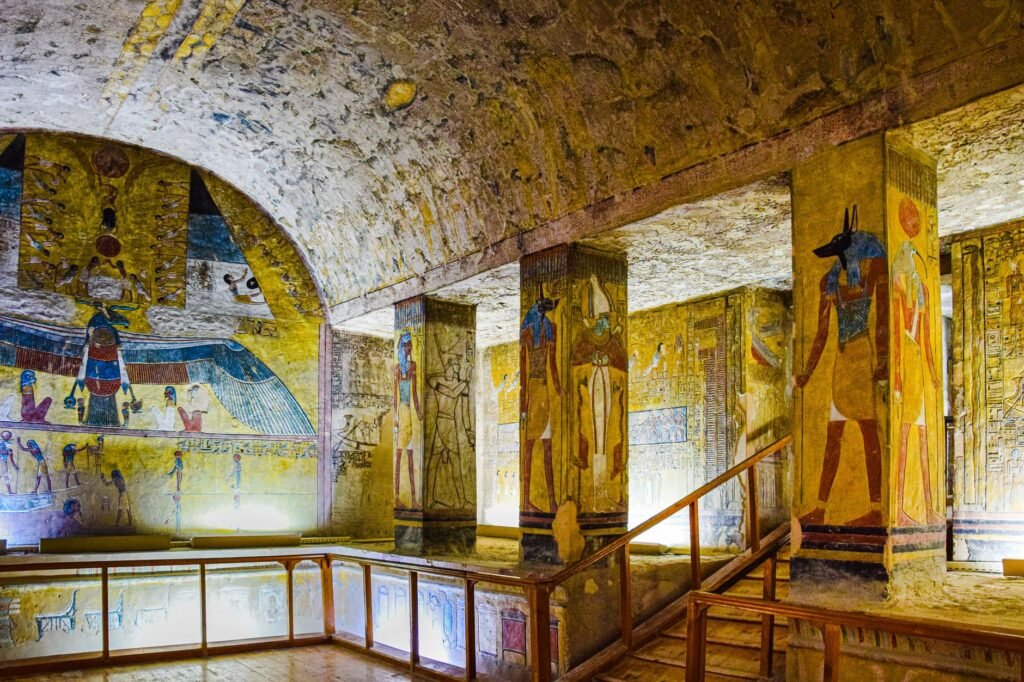
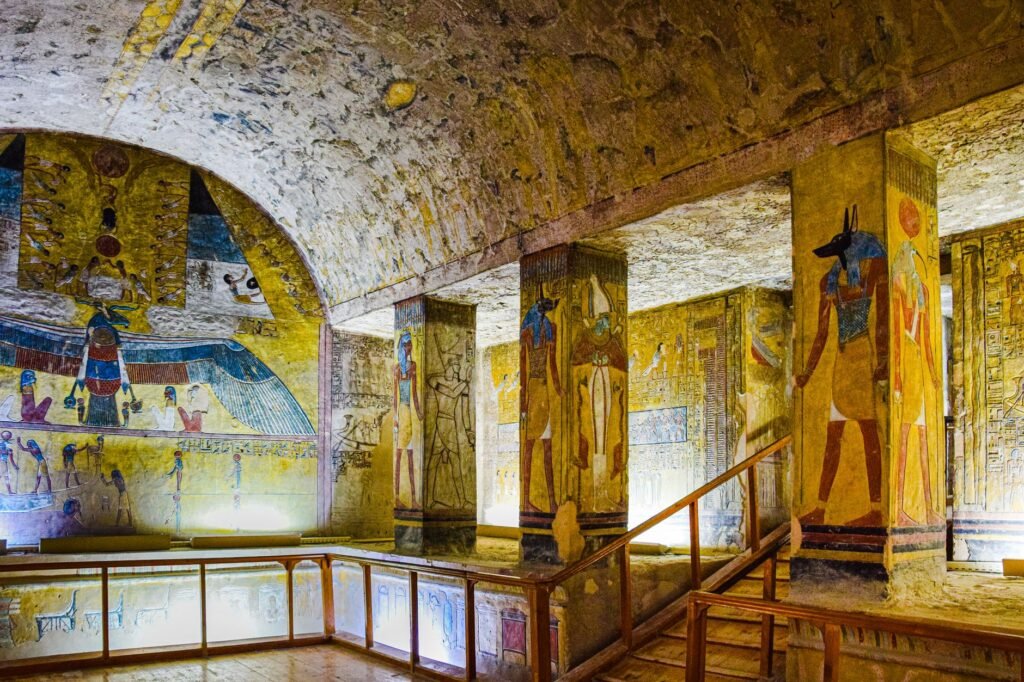
Anubis is one of the best-known gods of ancient Egypt and a major figure in Egyptian mythology. He is most commonly associated with mummification, funerary rites, tomb protection, and the guidance of the dead into the afterlife. In art, he is usually shown as a jackal-headed man or as a reclining jackal, a form connected with the animal most often seen near cemeteries in ancient Egypt.
Anubis was not merely a god of death. He represented the careful preservation of the body, the protection of graves, and the orderly transition from life to the next world. For the ancient Egyptians, these functions were essential, because the survival of the person after death depended on ritual correctness, preservation, and divine assistance. As a result, Anubis became one of the most important deities in Egyptian religion, funerary literature, and visual culture.
Origin and Meaning
The Egyptian name of Anubis is commonly reconstructed as Inpw or Anpu. The exact pronunciation in the ancient language is uncertain, because Egyptian writing did not record vowels in the way modern alphabets do. The familiar Greek form Anubis came later, through Hellenistic transmission.
The meaning of the name is debated. Some scholars have connected it with words or roots suggesting a royal child or a complex symbolic association with cemeteries and the dead, but no single explanation is universally accepted. In historical sources, the name itself is less important than the god’s role and iconography.
Anubis appears very early in Egyptian religion. He is attested from the Early Dynastic Period and remains prominent throughout pharaonic history. His association with jackals likely reflects the presence of wild canids around burial grounds, where they could disturb graves. Over time, this practical observation developed into a powerful religious symbol: the jackal became a guardian of the dead rather than only a threat to them.
Historical Context
Ancient Egyptian religion was deeply concerned with death, burial, and the maintenance of cosmic order. The journey after death was not automatic. It required correct funerary rites, protection of the body, and divine judgment. In this setting, Anubis played a crucial practical and theological role.
He was especially important in the development of mummification, which aimed to preserve the body so that the deceased could continue existence in the afterlife. He also appears in tomb iconography, funerary texts, and temple traditions as a guardian who protected the dead from danger.
Anubis in the Changing Egyptian Religious Landscape
Anubis’ prominence changed over time:
- In early Egyptian religion, he was one of the central funerary gods.
- During the Old Kingdom, he was strongly associated with royal burial and embalming.
- By the Middle and New Kingdoms, Osiris increasingly became the dominant ruler of the dead, while Anubis retained his role as guide, embalmer, and protector.
- In the Greco-Roman period, Anubis was often interpreted through Greek religious ideas and could be identified with Hermes in a syncretic form known as Hermanubis.
This shift did not mean that Anubis disappeared. Rather, his function was redefined within a broader religious system in which Osiris ruled the underworld and Anubis served as an important attendant and ritual specialist.
Main Characteristics
Anubis is most easily recognized by his jackal head, upright ears, and dark or black coloration. He is typically shown as a man with a jackal’s head or as a full jackal lying on a shrine, coffin, or tomb. His black color is especially significant and does not refer simply to the animal itself. In Egyptian symbolism, black suggested fertility, rebirth, and the color of the fertile Nile soil, all of which were associated with restoration after death.
Core Features of Anubis
| Feature | Meaning |
|---|---|
| Jackal head | Connection to cemeteries, protection of the dead, and funerary guardianship |
| Black color | Rebirth, preservation, and the fertile powers of restoration |
| Mummification tools | Ritual role in embalming and preparing the body |
| Tomb guardianship | Protection of graves from desecration and supernatural danger |
| Guide of souls | Assistance in the transition to the afterlife |
Anubis is also portrayed as a calm, solemn, and ritual-focused deity. Unlike gods associated with kingship, warfare, or cosmic creation, he is defined by care, precision, and protection. This makes him one of the most distinctly “funerary” gods in the Egyptian pantheon.
Family and Genealogy
The family relationships of Anubis vary across Egyptian traditions. Ancient myths were not completely uniform, and different cult centers preserved different genealogies.
Commonly Given Relationships
- Mother: Often identified as Nephthys, especially in later sources.
- Father: Various traditions name Osiris, Set, or in some cases Ra or another god.
- Spouse: Anubis is not usually described as having a major, widely accepted divine spouse.
- Children: He is not generally portrayed as the father of a large divine family.
Different Traditions
A particularly important tradition says that Nephthys, wife of Set, conceived Anubis with Osiris. In this account, she disguised herself and united with Osiris, producing Anubis. Another tradition instead makes Anubis the son of Set and Nephthys, which fits a different mythic pattern.
These conflicting genealogies show that Egyptian gods often had multiple overlapping identities. Rather than indicating error, the variations reflect the flexibility of mythic storytelling across temples and periods.
Anubis also became closely associated with Osiris, not as a child in every tradition, but as a ritual helper and protector. The relationship between the two gods is one of the most important in Egyptian funerary theology.
Symbols
Anubis is linked with a range of symbols, many of them related to burial and protection.
Important Symbols of Anubis
- Jackal head: His most recognizable emblem.
- Black color: Sign of regeneration, embalming, and funerary rebirth.
- Mummy wrappings: Associated with embalming and preservation.
- Scale of judgment: In later funerary art, he appears near the weighing of the heart.
- Ankh: A symbol of life, sometimes held in scenes connected to death and rebirth.
- Was scepter: A sign of divine power and authority.
- Imiut fetish: A ritual emblem linked to Anubis in some contexts, especially in funerary and protective rites.
The symbolism of Anubis is strongly practical. His objects are not decorative additions but visual representations of his duties in funerary religion.
Sacred Animals
Anubis is most strongly associated with the jackal, though in ancient Egyptian art the animal is sometimes stylized in ways that do not correspond perfectly to any single modern species. The choice of the jackal is significant because jackals and similar canids were known to linger near cemeteries and desert burial grounds.
Why the Jackal Matters
The jackal symbolized both danger and protection:
- It was a real threat to graves and corpses.
- It became a guardian figure through ritual and myth.
- Its desert habitat connected it to the boundary between the living world and the world of the dead.
In some depictions, Anubis may also be linked more broadly with wild canids rather than only the jackal in a modern zoological sense. Egyptian art was symbolic rather than naturalistic in the modern scientific sense.
Sacred Plants
No plant is uniquely or universally sacred to Anubis in the way that some plants are associated with other gods. However, funerary and embalming contexts connected him indirectly with several important plants and plant products.
Plants and Materials Associated with Anubis
- Linen: Used in mummification; strongly connected to Anubis through wrappings.
- Natron: A mineral rather than a plant, but central to embalming and therefore to Anubis’ ritual sphere.
- Incense and aromatic resins: Used in purification and burial rites.
- Lotus and papyrus motifs: These belong more generally to Egyptian ideas of life, renewal, and order, and may appear in funerary settings connected to him.
Because ancient sources do not consistently assign a specific sacred plant to Anubis, it is best to say that his sphere included materials of embalming and ritual purity rather than a single botanical symbol.
Sacred Places
Anubis was worshiped across Egypt, but some places became especially associated with him.
Major Cult Centers and Funerary Sites
| Place | Importance |
|---|---|
| Cynopolis | Greek name meaning “city of dogs”; associated with canine worship and Anubis |
| Memphis | Important center of embalming and funerary practice |
| Saqqara | Major necropolis with strong funerary associations |
| Thebes | Important site for royal tombs and mortuary religion |
| Abydos | Strongly linked to Osiris, but part of the broader funerary landscape in which Anubis was important |
Anubis was not confined to one temple city. Instead, he was present wherever burial rituals were performed. That makes him different from gods whose identity was more tightly bound to a single cult center. His “sacred place” was often the tomb, the embalming workshop, or the necropolis itself.
Powers and Attributes
Anubis’ powers are best understood as responsibilities within the Egyptian religious system.
Main Domains of Anubis
- Mummification and embalming
- Protection of tombs and burial chambers
- Guidance of the dead
- Supervision of funerary rites
- Association with the weighing of the heart
- Safeguarding the deceased during transition to the afterlife
Anubis is not usually described as a creator god or a cosmic ruler. Instead, he is a specialist deity, one whose power lies in ritual knowledge and practical guardianship. This made him indispensable in both elite and ordinary burials.
One of his most famous functions is his role in the judgment of the dead. In funerary scenes, Anubis often oversees the weighing of the heart against the feather of Ma’at, the principle of truth and cosmic order. In this capacity, he does not judge in the moral sense alone, but ensures the correctness of the process.
Main Myths
Several myths and funerary traditions feature Anubis, though he is often more prominent in ritual scenes than in dramatic narrative myths.
The Embalming of Osiris
One of the most important stories involving Anubis concerns the death of Osiris. In this tradition, Osiris is slain, dismembered, or otherwise killed by Set, and Anubis plays a key role in protecting and reconstituting the body. He becomes associated with the first embalming and with the sacred practices later performed on all mummies.
This myth explains why embalming had divine authority: Anubis himself was believed to have helped preserve Osiris.
The Weighing of the Heart
In funerary literature, especially the Book of the Dead, Anubis oversees the weighing of the deceased’s heart. The heart is placed on a scale against the feather of Ma’at. If the heart is balanced, the deceased may continue to the afterlife; if not, the result is catastrophic.
Anubis’ role here is procedural and protective rather than punitive. He ensures that the judgment is conducted properly.
Guidance of the Dead
Anubis also functions as a psychopomp, a guide of souls. He leads the dead through dangerous thresholds, helping them move from the tomb or burial chamber into the broader realm of the afterlife.
Protecting the Burial Chamber
A recurring theme in funerary art is Anubis guarding the tomb. He may be shown standing at the entrance to a coffin, shrine, or sacred space, reinforcing the idea that the dead require divine defense.
Relationship with Other Mythological Figures
Anubis’ role is best understood in relation to other Egyptian gods.
Relationship with Osiris
The relationship between Anubis and Osiris is one of the most important in Egyptian mythology. As Osiris became increasingly associated with kingship in the afterlife, Anubis took on the role of embalmer, protector, and guide. In some traditions, Anubis is even said to be Osiris’ son. In others, he is more of an assistant or ritual ally.
Relationship with Nephthys
Nephthys is often described as Anubis’ mother. She is linked with mourning, protection, and funerary lamentation, which makes her a natural mother for a god of burial rites. Their association appears frequently in later religious thought and funerary scenes.
Relationship with Set
Because some traditions identify Set as Anubis’ father, Anubis is occasionally connected to the god of disorder and the desert. However, Anubis is not generally a chaotic figure. Even where this genealogy is accepted, Anubis’ own role is protective and ordered.
Relationship with Ma’at
Anubis works closely with Ma’at, the principle of truth, justice, and cosmic balance. The weighing of the heart is one of the clearest examples of their interaction.
Relationship with Thoth
In the judgment scene, Thoth often records the result of the weighing. Anubis supervises the scales, while Thoth acts as divine scribe. Their cooperation reflects the Egyptian emphasis on order, documentation, and ritual correctness.
Worship and Cult
Anubis was widely venerated, though his worship was often embedded in funerary practice rather than large state festivals.
Forms of Worship
- Prayers for safe passage after death
- Offerings at tombs
- Ritual embalming performed under his protection
- Protective spells in funerary texts
- Cultic images of jackals or jackal-headed forms in mortuary settings
Priestly Role
Embamers and funerary priests were closely associated with Anubis. In some contexts, priests who performed mummification wore jackal masks or invoked Anubis as they prepared the body.
Offerings and Rituals
Offerings to Anubis could include:
- Incense
- Wine
- Bread
- Linen
- Purification rites
- Funerary recitations
The exact ritual varied by period and region. Anubis was not worshiped in a single uniform way across all of ancient Egypt.
Festivals
Specific major festivals dedicated solely to Anubis are not as well documented as those for some other gods. His worship was more often tied to burial ceremonies, memorial observances, and temple rites linked to the dead.
Ancient Sources
Anubis is primarily known from Egyptian inscriptions, funerary texts, temple scenes, and tomb decoration, rather than from Greek literary epics.
Important Egyptian Sources
- Pyramid Texts: Among the earliest references to Anubis, especially in royal funerary contexts.
- Coffin Texts: Expand his role in afterlife guidance and protection.
- Book of the Dead: Contains many scenes where Anubis weighs the heart or guides the deceased.
- Tomb inscriptions and temple reliefs: Show him guarding and assisting the dead.
Greek and Roman Writers
Greek and Roman authors discussed Egyptian religion in broader terms, often interpreting Egyptian gods through their own categories.
- Herodotus mentions Egyptian customs and religious practices, though not always in detail about Anubis.
- Plutarch, in On Isis and Osiris, offers valuable but late interpretive material on Egyptian religion.
- Diodorus Siculus and other classical authors provide additional descriptions of Egypt and its gods.
- In Greco-Roman contexts, Anubis appears in syncretic forms and philosophical reinterpretations.
Because these classical writers viewed Egypt from outside its native religious language, their accounts are useful but must be read critically.
Roman Equivalent
Anubis does not have a perfect Roman equivalent. The closest Roman adaptation is the syncretic deity Hermanubis, a fusion of Hermes and Anubis that emerged in the Greco-Roman world.
Why Hermes?
Hermes, in Greek religion, was a messenger and guide of souls. This made him a natural counterpart for Anubis’ role as guide of the dead. The Roman world adopted this blended figure in some religious and artistic settings.
Roman Adaptation
In Roman Egypt and the wider empire:
- Anubis could appear in Egyptian-style temple art.
- Hermanubis represented a Hellenized religious interpretation.
- Anubis also became known in Roman literature as a distinctive Egyptian god, sometimes treated with fascination or exoticism.
He was not simply “translated” into Rome. Instead, he was reimagined within a multilingual, multicultural religious environment.
Influence on Modern Culture
Anubis remains one of the most recognizable figures from ancient mythology in modern culture.
Areas of Modern Influence
- Literature: Appears in novels, fantasy, horror, and historical fiction.
- Cinema and television: Often depicted as a mysterious or supernatural Egyptian god.
- Video games: Frequently used as a boss, guardian, or divine character.
- Comics and animation: Common in stories involving ancient gods and mythological powers.
- Art and design: His jackal-headed image is widely used in contemporary visual culture.
Modern Misconceptions
Modern media often simplifies Anubis into a god of death alone. This is incomplete. In Egyptian religion, he was more accurately a protector, embalmer, and guide, whose work supported the possibility of afterlife rather than representing death as an end in itself.
Curiosities
- Anubis is sometimes called the “Lord of the Sacred Land”, a reference to necropolises and burial spaces.
- His black coloration is symbolic and does not mean the Egyptians imagined jackals as black animals in a literal zoological sense.
- The name Cynopolis literally means “city of dogs,” showing how strongly canine imagery was tied to his cult in the Greek period.
- In some funerary scenes, Anubis is shown with a ribbon or collar, emphasizing his ritual identity.
- The jackal-headed figure familiar today is a product of long artistic tradition, not a single fixed portrait.
- Anubis’ role remained important even after Osiris became the main ruler of the dead.
- Some modern depictions combine Anubis with later fantasy imagery that has little basis in ancient sources.
Frequently Asked Questions
1. Who is Anubis in Egyptian mythology?
Anubis is the ancient Egyptian god of mummification, tomb protection, and guidance of the dead. He is usually shown as a jackal-headed figure.
2. Why is Anubis associated with jackals?
Jackals were seen near cemeteries and could disturb graves. The Egyptians transformed this threat into a symbol of divine guardianship, linking Anubis to the jackal.
3. Is Anubis the god of death?
He is more accurately the god of embalming, funerary rites, and protection of the dead. He is connected with death, but not as a destroyer or ruler of chaos.
4. What is Anubis’ role in the afterlife?
Anubis guides the deceased, protects the tomb, and oversees the weighing of the heart in the judgment of the dead.
5. Who are Anubis’ parents?
Different traditions give different answers. Nephthys is often named as his mother, while his father may be Osiris or Set, depending on the source.
6. Did the ancient Egyptians worship Anubis in temples?
Yes, though his worship was often tied to funerary practice and necropolis sites rather than to one single major temple cult.
7. What is the difference between Anubis and Osiris?
Osiris is the god-king of the afterlife, while Anubis is the embalmer, protector, and guide who helps the dead reach the afterlife.
8. Is Hermanubis the same as Anubis?
Not exactly. Hermanubis is a Greco-Roman fusion of Hermes and Anubis, combining Egyptian and Greek religious ideas.
Conclusion
Anubis is one of the most enduring and recognizable gods in Egyptian mythology because he addresses a universal human concern: what happens after death. In ancient Egyptian religion, he was not a symbol of fear alone, but a divine guardian of order, preservation, and safe passage. His role in mummification, tomb protection, and the weighing of the heart made him essential to Egyptian funerary belief.
Across centuries of Egyptian history, Anubis remained a powerful presence in tombs, texts, and ritual practice. Even as Osiris became more prominent as ruler of the dead, Anubis continued to embody the careful, sacred work required to prepare the deceased for eternity. His legacy survives not only in archaeology and scholarship, but also in the modern imagination, where he remains a lasting emblem of ancient Egypt’s profound concern with life, death, and renewal.

Orin Vale has spent the better part of two decades tracing the threads that connect the world’s oldest stories — from the halls of Asgard to the banks of the Nile, from Olympus to the jungles of the Maya. What began as a childhood fascination with flood myths and trickster gods grew into years of independent study across comparative mythology and ancient religion, always chasing the same question: what did these stories mean to the people who first told them? Orin writes for readers who want more than trivia — the ones looking for the beliefs, fears, and truths that myths were built to carry.