Fortuna
Fortuna is the Roman goddess of chance, fortune, luck, and the uncertain turns of human life. In the ancient Mediterranean world, she was one of the most widely recognized divine powers because she expressed a universal human experience: the belief that success, failure, wealth, safety, and disaster can change suddenly. Unlike many gods with narrow mythic roles, Fortuna was flexible, complex, and often contradictory. She could grant prosperity, protect cities, guide sailors, favor rulers, or overturn all human plans without warning.
Her importance extended far beyond religion. Fortuna became a major symbol in Roman politics, public life, literature, and later European culture. She was invoked in temples, festivals, private households, and state ceremonies. In art, she was represented with powerful symbols such as the wheel, the cornucopia, the rudder, and the veil. In philosophical writings, she stood for the instability of worldly success. Even today, the idea of “fortune” remains deeply shaped by her ancient legacy.
Origin and Meaning
The Latin word Fortuna is generally understood as related to fors, meaning chance, luck, or fate. The name therefore refers to the condition of things that happen unpredictably. In Roman usage, fortuna could mean both the goddess herself and the abstract idea of fortune or fate.
The goddess likely developed from early Roman religious traditions rather than being borrowed directly from Greece, though later Roman religion strongly identified her with the Greek Tyche. Her worship is ancient and may reflect an early Italic concern with the uncertainty of life, especially agricultural success, military outcomes, and personal prosperity.
In Roman thought, Fortuna was not simply “good luck.” She was the power that distributed both favorable and unfavorable outcomes. Her domain included the entire unstable balance between human effort and chance.
Historical Context
Fortuna emerged in a society that valued practical success, public order, and divine favor. Roman religion was deeply connected to civic life, and gods were often associated with specific functions, places, and social needs. Fortuna fit this pattern especially well because Romans sought divine explanations and protections for the unpredictability of war, trade, harvests, childbirth, politics, and travel.
Her cult became especially important in the Republic and Empire. Several public cults of Fortuna were established in Rome and elsewhere in Italy. Different aspects of her character were worshipped under different names, including:
- Fortuna Primigenia (“First-born Fortune”)
- Fortuna Publica (“Public Fortune”)
- Fortuna Redux (“Fortune of the Return”)
- Fortuna Muliebris (“Women’s Fortune”)
- Fortuna Virilis (“Men’s Fortune”)
- Fortuna Populi Romani (“Fortune of the Roman People”)
These titles show how widely her power was adapted to social and political needs. Fortuna could be invoked for childbirth, safe return from journeys, the stability of the state, and the legitimacy of rulers.
The Hellenistic and Roman worlds also saw a growing philosophical interest in fate, chance, and providence. Stoic and later Christian writers often discussed Fortuna as a symbol of the instability of earthly success. In this sense, she became not only a goddess but also a concept used to explain the limits of human control.
Main Characteristics
Fortuna is usually portrayed as a goddess of unpredictability. Unlike deities associated with fixed cosmic order, she embodies change, contingency, and the uneven distribution of blessings. Her main characteristics include:
- Changeability: she can grant favor and withdraw it suddenly.
- Generosity: she bestows abundance, success, and prosperity.
- Instability: she is not fully controllable by prayer or ritual.
- Public and private influence: she affects both states and individuals.
- Ambivalence: she may protect, but she may also deceive or overturn expectations.
Roman authors often treated Fortuna as a force that could not be fully trusted. She might raise a person to greatness and then destroy them. This made her especially relevant in political and moral literature, where her actions served as reminders of human vulnerability.
Fortuna also had several localized and specialized forms. Some images present her as a benevolent goddess with a cornucopia. Others emphasize her unpredictability through the wheel or globe, showing that fortune turns without warning.
Family and Genealogy
Unlike Olympian gods such as Zeus or Hera, Fortuna does not have a single fixed genealogy accepted across all ancient sources. Her origins are often local, abstract, or symbolic rather than mythologically detailed.
Different traditions sometimes connected her with:
- Jupiter, in a general sense, as a power operating under supreme divine authority
- Primigenia, in cult titles suggesting a primordial or first-born aspect
- Isis, in later syncretic religion, where Fortuna could be interpreted through broader Mediterranean divine systems
Ancient sources do not provide a uniform family tree for Fortuna. She was not consistently described as the daughter, wife, or mother of a specific major god. This lack of genealogical certainty is typical of Roman abstract deities whose authority came from function rather than mythic family drama.
In later literature and allegory, Fortuna was sometimes personified with attendants such as Pax (Peace), Victoria (Victory), or Abundantia (Plenty), but these are symbolic associations rather than secure genealogical relationships.
Symbols
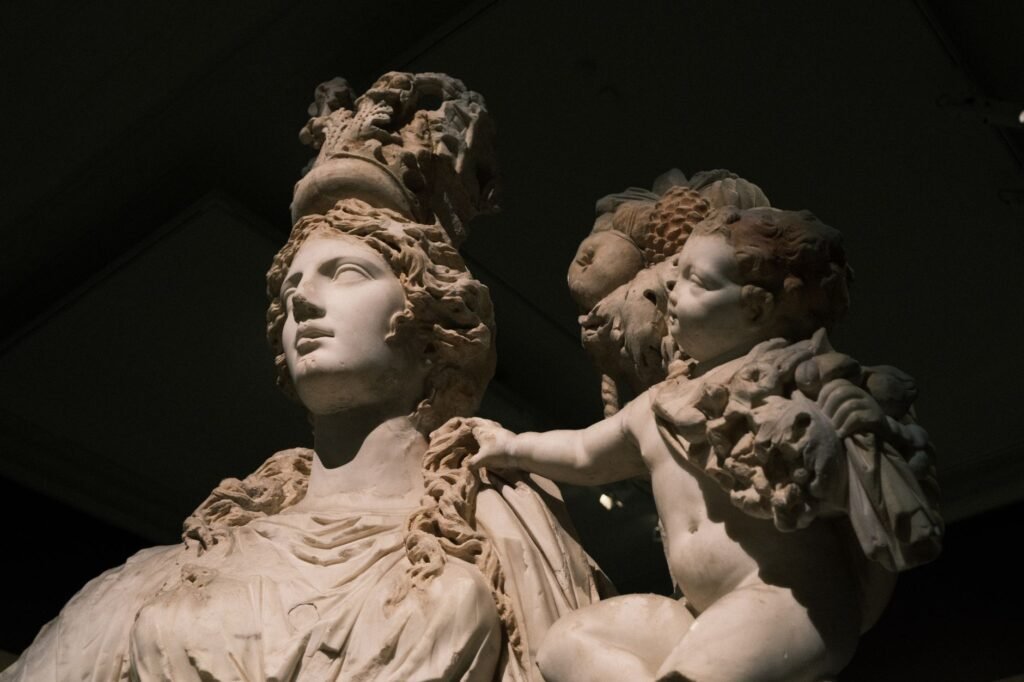
Fortuna is one of the most symbol-rich deities in antiquity. Her visual language was highly developed in Roman art, coinage, sculpture, and temple decoration.
Common Symbols of Fortuna
| Symbol | Meaning |
|---|---|
| Wheel | The changing cycles of luck and fate |
| Cornucopia | Abundance, prosperity, and gifts of fortune |
| Rudder | Guidance and the direction of human affairs |
| Globe | Instability and worldly change |
| Veil | Concealment, mystery, and unpredictability |
| Rota Fortunae | Medieval and later symbol of fortune’s turning power |
The wheel of fortune became especially influential in later European culture. It represents the rise and fall of human fortunes, with those at the top eventually descending and those below potentially rising. Although the wheel is more strongly emphasized in later medieval reception than in all ancient cult practice, it derives from ancient ideas about Fortuna’s power.
The cornucopia shows her as a giver of wealth and nourishment. The rudder, sometimes held in one hand, suggests that she can steer human destiny. Together these symbols show the tension between control and chance that defines her character.
Sacred Animals
Fortuna is not as closely associated with sacred animals as some other ancient gods, and traditions vary. In Roman art and later iconography, animals are less central to her identity than objects such as the wheel or cornucopia.
That said, some symbolic associations appear in broader Greco-Roman religious imagery:
- Snakes may appear in connection with fertility, renewal, or household protection, though not as a universal symbol of Fortuna.
- Birds, especially in broader divinatory contexts, can be linked indirectly to fate and omens.
- Lions occasionally appear in later artistic settings, symbolizing power rather than a specific cultic animal of Fortuna.
Because ancient sources do not establish a strong, consistent sacred-animal tradition for Fortuna, any such associations should be treated cautiously and understood as contextual rather than canonical.
Sacred Plants
There is no universally attested sacred plant uniquely dedicated to Fortuna in the way that some deities are associated with specific trees or flowers. However, plants connected to abundance and prosperity often appear in her artistic and ritual environment.
Commonly symbolic plants include:
- Laurel: associated with victory, honor, and public success
- Grain and wheat: symbols of abundance, food security, and prosperity
- Flowers and garlands: used in offerings and festive decoration
- Vines and fruit: associated with plenty and generative wealth
In Roman religious practice, such plant offerings were often part of broader devotional or civic ceremonies rather than exclusive to Fortuna. Their significance lies in what they express: fertility, well-being, and the hope that fortune may remain favorable.
Sacred Places
Fortuna had many sanctuaries in the Roman world, reflecting her popularity and the range of her functions. Among the most famous were her temples in and around Rome and in Latin Italy.
Notable Places Associated with Fortuna
| Place | Significance |
|---|---|
| Praeneste (modern Palestrina) | Major sanctuary of Fortuna Primigenia |
| Rome | Multiple temples and cult sites dedicated to different forms of Fortuna |
| Antium | Important shrine and oracle associated with Fortuna |
| Baiae and coastal sites | Links with seafaring, travel, and elite devotion |
| Various Italian towns | Local cults and dedications to Fortune in civic life |
Fortuna Primigenia at Praeneste
The sanctuary at Praeneste was among the most famous centers of Fortuna worship. Fortuna Primigenia was especially important there, and the sanctuary became renowned for its monumental architecture and oracular function. Ancient writers describe it as a major religious site where devotees sought guidance and divine favor.
Roman Temples
In Rome, Fortuna was honored in several forms. Her cult was woven into the topography of the city, underscoring her public significance. Some temples were linked to historical moments, military victories, or state concerns, showing how Roman religion connected divine power with civic identity.
Powers and Attributes
Fortuna governed the fragile conditions that shape human life. Her powers were broad and adaptable, which explains her popularity across many different social groups.
Areas of Influence
- Luck and chance
- Prosperity and wealth
- Success in war and politics
- Childbirth and family well-being
- Safe travel and return
- Public welfare
- Personal destiny
Some traditions emphasize her benevolent aspect, while others stress her volatility. A person could pray to Fortuna for success in business, but the goddess remained unpredictable. This duality made her both attractive and unsettling.
In philosophical contexts, Fortuna often stands for external circumstances beyond human control. In that sense, she is not simply a goddess of random luck but a figure who reveals the limits of rational planning and human ambition.
Main Myths
Fortuna does not possess a single, unified cycle of myths comparable to the stories of Hercules, Venus, or Mars. Instead, she appears in many discrete narratives, allegories, and ritual traditions.
Fortuna and the Wheel of Fortune
The most enduring mythic image associated with Fortuna is the wheel of fortune, which turns the destinies of rulers and ordinary people alike. This image became especially important in later literature, where it expressed the rise and fall of worldly power. Although the full medieval iconography develops later, the ancient roots lie in Roman ideas of fortune’s instability.
Fortuna and State Success
Fortuna appears frequently in historical narratives where Roman leaders credit victory or survival to her favor. In such contexts, she functions as a divine explanation for success that cannot be entirely attributed to human strategy.
Fortuna and Oracles
At places such as Praeneste, Fortuna was connected with divination and oracle traditions. Seekers asked for guidance through sacred lots or other ritual means. The exact procedures vary by source, and modern scholars note that some details come from literary accounts rather than fully preserved ritual manuals.
Fortuna and Personal Destiny
In literature, Fortuna often determines the fate of individuals. She may elevate the humble, humble the proud, or suddenly reverse a person’s circumstances. This theme is central in Roman poetry and moral prose, where the goddess becomes a narrative force illustrating life’s instability.
Relationship with Other Mythological Figures
Fortuna interacted with many other deities and symbolic figures in Roman religion and later mythography.
Tyche
Fortuna is most commonly compared with the Greek goddess Tyche, who also represents fortune, luck, and city destiny. The two are often treated as equivalents in Greco-Roman religious syncretism. However, Fortuna maintained distinct Roman features, especially her ties to civic cult and practical social concerns.
Jupiter
Jupiter, as the chief Roman god, represents order, sovereignty, and public authority. Fortuna is different: she expresses chance and unpredictability. In Roman thought, the two powers were not identical, though they could coexist within the same religious and political worldview.
Abundantia, Victoria, and Pax
These figures overlap with Fortuna in art and civic ideology:
- Abundantia symbolizes plenty and material wealth.
- Victoria represents victory and triumph.
- Pax stands for peace and stability.
Fortuna may appear with them in visual programs that celebrate imperial prosperity.
Fates and Destiny Figures
Fortuna can resemble or overlap conceptually with the Fates in Greek and Roman thought, but she is not the same as the Moirai or Parcae. The Fates determine destiny more rigidly, while Fortuna represents the unpredictable turn of circumstances.
Worship and Cult
Fortuna was widely worshipped in both public and private settings. Her cult was practical, adaptable, and deeply embedded in everyday Roman life.
Forms of Worship
- Dedication of temples and shrines
- Sacrifices and offerings
- Prayers for success, safety, and return
- Consultation of oracles and lots in some sanctuaries
- Votive inscriptions thanking her for favors received
Festivals and Public Ritual
Different cult titles of Fortuna were associated with different ritual settings. For example, Fortuna Muliebris had special relevance for women, while Fortuna Redux was connected with safe homecoming, especially in imperial contexts. Public celebrations often reflected the political or social purpose of the cult.
Household and Personal Devotion
Fortuna was also important in domestic religion. Individuals prayed to her for daily success, business outcomes, childbirth, or family safety. This private devotion helps explain why she remained popular over centuries: her domain touched ordinary life as much as state ritual.
Ancient Sources
Several classical authors mention Fortuna, though usually in different contexts.
Key Ancient Sources
| Author | Relevance |
|---|---|
| Cicero | Philosophical discussions of fortune and providence |
| Livy | Historical references to temples, cults, and Roman religious practice |
| Ovid | Literary personification of Fortune and her changing power |
| Pliny the Elder | Notes on cult and religious customs |
| Pausanias | Descriptions of Greek sanctuaries relevant for comparison |
| Apuleius | Later religious and philosophical references |
| Seneca | Moral reflections on fortune’s instability |
| Vergil | Poetic treatment of fate, success, and divine favor |
Important Caveat
Ancient authors do not always agree. Some treat Fortuna as a goddess; others use her name more abstractly to mean luck or fate. Some write from a religious perspective, while others use her as a philosophical or literary symbol. This variety is central to understanding her historical role.
Roman Equivalent
Fortuna is already Roman, but she also served as the Roman counterpart to the Greek Tyche. In many later contexts, the two were identified or blended.
This equivalence was not exact. Roman religion often adapted Greek gods while preserving local titles, rituals, and political meanings. Fortuna retained a more distinctly Roman civic identity than Tyche in many settings, especially through her multiple local and state cults.
In Roman imperial ideology, Fortuna could be tied to the destiny of the emperor and the Roman people. That makes her more than a simple luck goddess; she became a bearer of political legitimacy and collective hope.
Influence on Modern Culture
Fortuna has had a major influence on Western culture, especially through the medieval and Renaissance reception of Roman ideas.
Literature
The image of the wheel of fortune became a central literary motif in medieval and early modern writing. It appears in moral, philosophical, and poetic texts that reflect on the instability of power and wealth. Writers used Fortuna to represent the unpredictability of life and the limits of human control.
Art
Fortuna appears in sculpture, painting, manuscript illumination, and decorative arts. She is often shown with a wheel, rudder, or cornucopia. Renaissance artists revived classical personifications and used Fortuna to explore themes of luck, virtue, and political change.
Philosophy and Political Thought
The word “fortune” remains central in European languages, and Fortuna’s legacy is visible in debates about fate, agency, and risk. Political thinkers have used her image to discuss the fragility of power and the role of contingency in history.
Games and Popular Culture
In modern games, fantasy fiction, and branding, Fortuna often appears as a symbol of chance, destiny, or luck. Her name is used for casinos, ships, companies, and characters, showing the enduring appeal of the idea she represents.
Curiosities
- Fortuna was one of the most versatile deities in Roman religion, with many local forms and epithets.
- Her sanctuary at Praeneste was famous in antiquity for its oracle and monumental scale.
- The modern phrase “the wheel of fortune” is one of her most enduring cultural legacies.
- Roman emperors could associate themselves with Fortuna to emphasize divine favor and political legitimacy.
- Fortuna could be treated both as a goddess and as an abstract force, depending on the author and context.
- Some Roman dedications to Fortuna were made by people seeking success in love, travel, childbirth, or public office.
- Unlike many gods, Fortuna’s “personality” is defined more by function than by family myth.
Frequently Asked Questions
What is Fortuna the goddess of?
Fortuna is the Roman goddess of luck, chance, fortune, prosperity, and the unpredictable turns of life.
Is Fortuna the same as Tyche?
They are closely related and often identified with each other, but Fortuna is the Roman version with distinct local cults and political significance.
What are Fortuna’s main symbols?
Her main symbols are the wheel, cornucopia, rudder, globe, and veil.
Where was Fortuna worshipped?
She was worshipped throughout the Roman world, especially in Rome, Praeneste, and Antium.
Did Fortuna have a fixed family tree?
No single genealogy is universally accepted. Ancient sources vary, and Fortuna is often treated more as a divine power than as a family-based mythological figure.
Why is Fortuna important in literature?
She became a powerful symbol of chance, instability, and the rise and fall of human fortunes, especially in Roman, medieval, and Renaissance literature.
What does the wheel of Fortune mean?
It symbolizes the changing nature of worldly success: people rise and fall as fortune turns.
Is Fortuna still relevant today?
Yes. The modern concept of “fortune” in language, literature, and culture still reflects her ancient legacy.
Conclusion
Fortuna is one of the most enduring figures in Roman religion and Western cultural memory. As goddess of chance, prosperity, and instability, she captured a fundamental truth of human experience: life is shaped not only by effort and virtue but also by events beyond control. Her many cults, symbols, and literary appearances show how deeply the Romans understood and respected the power of uncertainty.
From ancient temples and civic rituals to the medieval wheel of fortune and modern uses of her name, Fortuna has remained a potent image of life’s unpredictability. Her legacy continues because the questions she embodies are timeless: why do fortunes rise and fall, and how much of human destiny lies beyond our hands?

Orin Vale has spent the better part of two decades tracing the threads that connect the world’s oldest stories — from the halls of Asgard to the banks of the Nile, from Olympus to the jungles of the Maya. What began as a childhood fascination with flood myths and trickster gods grew into years of independent study across comparative mythology and ancient religion, always chasing the same question: what did these stories mean to the people who first told them? Orin writes for readers who want more than trivia — the ones looking for the beliefs, fears, and truths that myths were built to carry.