Introduction
Ceres’s Search for Proserpina is one of the most enduring stories in Greco-Roman mythology. It tells of the goddess Ceres, the Roman equivalent of the Greek Demeter, wandering the world in grief and anger after the abduction of her daughter Proserpina by Pluto, ruler of the underworld. The myth explains the changing seasons, the cycle of growth and decay in agriculture, and the emotional bond between mother and child. It also reflects ancient ideas about divine power, fertility, and the boundary between life and death.
The story has had lasting importance in religion, literature, visual art, and modern popular culture. It appears in different forms across ancient sources, especially in the Greek Hymn to Demeter and later Roman retellings by Ovid and others. While the details vary, the central narrative remains the same: Ceres searches desperately for Proserpina, and her sorrow affects the whole natural world.
Origin and Meaning
The Roman name Ceres is the Latin name of the goddess of grain, agriculture, and fertility. Her Greek counterpart is Demeter. The name Proserpina is the Roman form of the Greek Persephone, though the exact etymology of both names is ancient and partly uncertain.
In Roman religion, Ceres was one of the major agricultural deities and part of the old Italian divine tradition. Over time, Roman mythology absorbed Greek stories and identified Ceres with Demeter’s myth of the lost daughter. The search for Proserpina became central to Roman literary and artistic traditions, even though the original religious roots of Ceres were older and more specifically linked to farming, grain supply, and civic welfare.
The myth likely developed through a combination of:
- older fertility and seasonal traditions
- Greek Eleusinian religious narratives
- Roman adaptation of Greek myth in literature and cult
Historical Context
The story of Ceres’s search for Proserpina belongs to a wider ancient Mediterranean pattern in which the disappearance and return of a fertility figure explains the cycles of nature. In agrarian societies, the annual loss and renewal of vegetation was often expressed through myth.
In Greek tradition, the story is most fully preserved in the Homeric Hymn to Demeter, usually dated to the archaic period. The Roman version became especially influential through Ovid’s Metamorphoses and Fasti, where the myth is shaped into elegant narrative poetry for a Roman audience.
The historical context includes:
- Agricultural religion: grain and planting were matters of survival
- Mystery cults: especially the Eleusinian Mysteries, which centered on Demeter and Persephone
- Roman religious adaptation: Roman writers reworked Greek divine stories into Latin literary forms
- Seasonal symbolism: the myth explains why fertility seems to disappear and return
The story also reflects ancient assumptions about women, marriage, and family separation. In some versions, Proserpina’s descent into the underworld is not only a kidnapping but also a forced marriage, which was a powerful mythic expression of a bride leaving her mother’s household.
Main Characteristics
Ceres in the myth of Proserpina is defined by several key characteristics:
- Maternal devotion: she is a grieving mother searching for her lost daughter
- Agricultural power: her sorrow causes the earth to become barren
- Divine dignity: she is not merely emotional but acts with authority and force
- Endurance: she travels across the world in search of the truth
- Wrath and restraint: she punishes humanity indirectly by halting fertility until justice is restored
Proserpina is characterized by:
- Youth and beauty
- Vulnerability
- Ambiguous role as daughter and queen
- Dual existence between the upper world and the underworld
Pluto is marked by:
- Sovereignty over the dead
- Underworld authority
- Abduction and possession
- A severe but not always hostile role, depending on the source
Core Motifs in the Myth
| Motif | Meaning |
|---|---|
| Abduction | Sudden loss, transition, and forced separation |
| Search | Maternal grief, divine justice, and persistence |
| Fasting or mourning | Ritual sorrow and suspension of fertility |
| Seasonal return | Renewal, growth, and cyclical time |
| Split residence | Balanced division between worlds |
Family and Genealogy
In Roman tradition, Ceres is generally the daughter of Saturn and Ops. She is the sister of several major gods, including:
- Jupiter
- Neptune
- Pluto
- Juno
- Vesta
Her most famous child is Proserpina. In many literary retellings, Proserpina’s father is Jupiter; in Greek tradition, Persephone is the daughter of Demeter and Zeus. Roman sources often preserve this family structure.
Proserpina becomes the wife of Pluto after her abduction and descent to the underworld. Her children are not prominent in the main Roman version of the myth, though some later traditions and local cult interpretations associate her with underworld or fertility themes.
Ceres’s family relationships are central to the myth because the story depends on the break between mother and daughter. The drama is not only cosmic but also domestic, turning family separation into a divine explanation for seasonal change.
Symbols
The myth of Ceres’s search for Proserpina is associated with several symbolic objects and signs.
Major Symbols
- Torch: Ceres searches with torches, symbolizing longing, illumination, and ritual mourning
- Wheat and grain ears: represent agriculture, life, and fertility
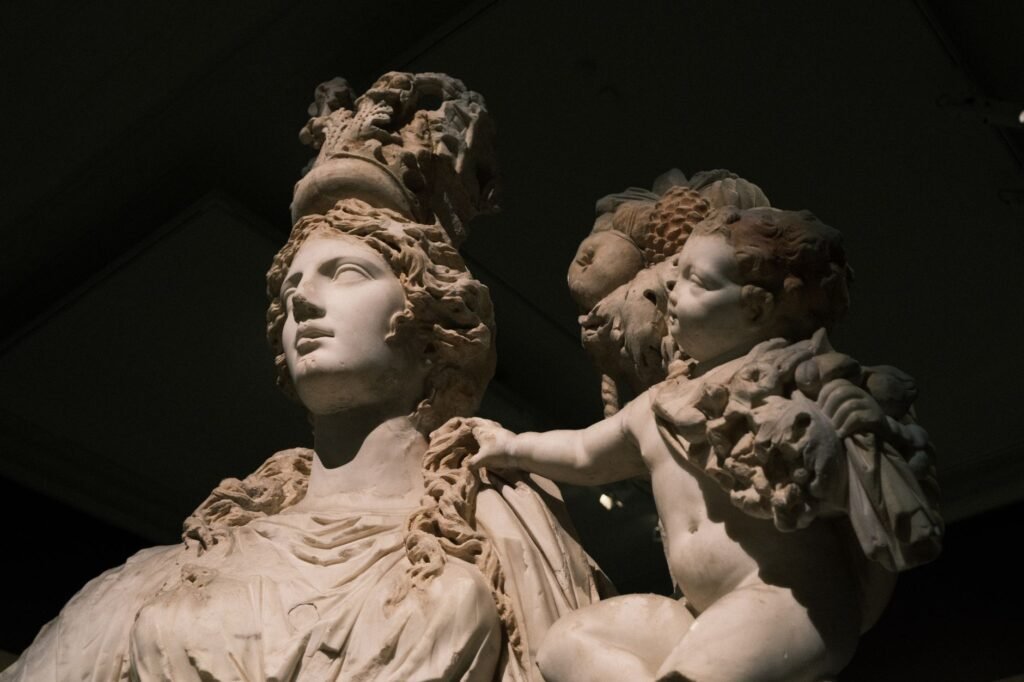
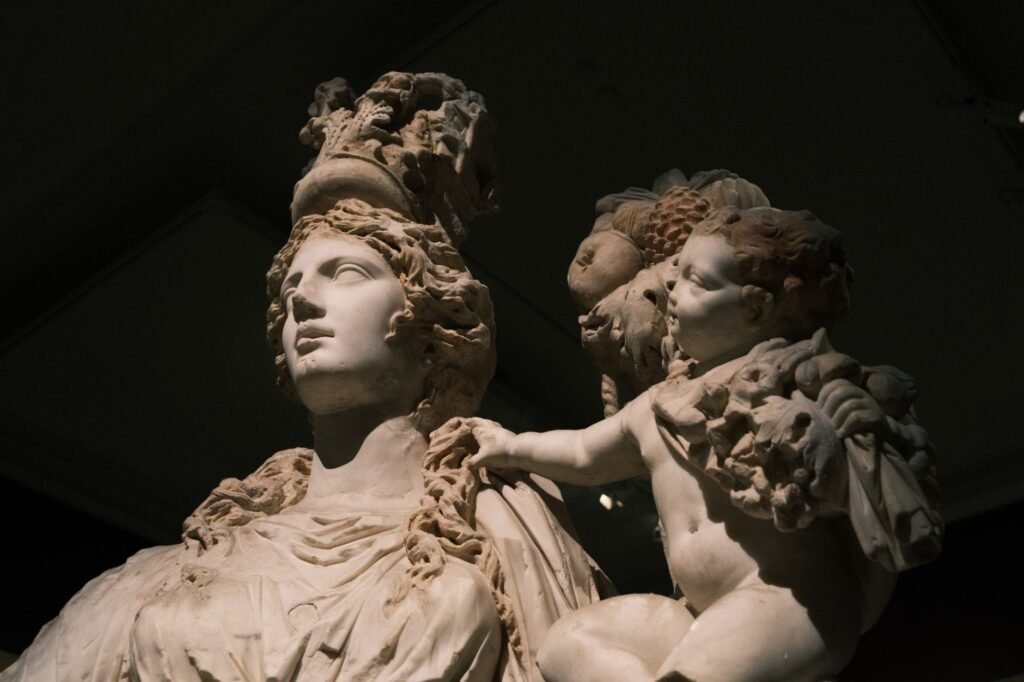
- Cornucopia: a symbol of abundance often linked to Ceres in Roman art
- Poppies: associated with sleep, fertility, and the agricultural sphere
- Veil or mourning dress: denotes grief and ritual sorrow
- Sheaves of grain: reminders of harvest and abundance
The torch is especially significant in the search narrative. It recalls Ceres wandering at night and across distant lands while seeking her daughter. In art, this makes her easily recognizable.
Symbolic Colors
Ancient texts do not always assign fixed colors, but later artistic tradition often associates:
- gold with grain and abundance
- black with mourning and the underworld
- green with renewal and vegetation
Sacred Animals
Ceres is not as strongly associated with specific animals in the Proserpina myth as some other deities are. Still, certain animals appear in broader traditions linked to her.
Commonly Associated Animals
- Serpent: in some agricultural and chthonic contexts, the serpent can symbolize fertility, earth power, or hidden life
- Pig: used in sacrificial practice connected to agricultural divinities in parts of the Greek and Roman world
- Mule or ox: linked indirectly to agriculture, ploughing, and grain production
These associations vary by region and ritual practice. They are not exclusive to Ceres, but they fit her broader agricultural identity.
Sacred Plants
Plants are central to Ceres’s identity as a grain goddess and to the symbolism of the Proserpina myth.
Principal Plants
- Wheat
- Barley
- Poppies
- Narcissus in some Greek versions of the Persephone myth
Wheat is the most important plant associated with Ceres. It represents nourishment, cultivation, and civilization. In mythic terms, the disappearance of Proserpina coincides with the loss of fertility in the fields.
Poppies are often shown with Ceres in Roman art because they grow in grain fields and may symbolize sleep or death, linking the agricultural world with the underworld.
In Greek versions of the myth, the narcissus plays a role in the abduction of Persephone, when she is drawn to the flower before Hades seizes her. This detail is more prominent in Greek than Roman sources, but it influenced later interpretations.
Sacred Places
The myth is connected to several important places in the ancient Mediterranean world.
Key Locations
| Place | Significance |
|---|---|
| Eleusis | Major center of Demeter/Persephone worship and mystery rites |
| Sicily | Strongly connected in Roman and Greek tradition; sometimes the place of Proserpina’s abduction |
| Enna | In later tradition, often identified as the site of the abduction in Sicily |
| Mount Etna region | Associated in some Roman and Greek accounts with the setting of the myth |
| The underworld | The realm of Pluto and Proserpina’s new domain |
Eleusis is the most important cultic center in the Greek tradition and deeply influenced later Roman and literary versions. Sicily became especially prominent in Roman literature, where the landscape itself is mythologized as the place of Ceres’s search.
The story’s geography is partly symbolic. Ceres’s movement across the earth represents a goddess traversing the human world, while Proserpina’s descent marks the boundary with the invisible realm below.
Powers and Attributes
Ceres’s powers in the myth are tied to agriculture and divine authority over fertility.
Main Domains
- grain and crops
- fertility of the earth
- harvest and abundance
- motherhood and maternal grief
- seasonal cycles
- ritual nourishment
In the search for Proserpina, Ceres shows a remarkable power: when she withholds her favor, the earth becomes sterile. This makes her grief cosmically consequential. Her emotions are not private; they alter the natural order.
The myth presents several connected attributes:
- Life-giving power
- Punitive withdrawal
- Negotiating authority with Jupiter and Pluto
- Control over the pace of seasonal abundance
The story also emphasizes her endurance. Ceres searches relentlessly, often with torches, until she learns the truth and forces a settlement.
Main Myths
The core myth of Ceres’s search for Proserpina exists in several related versions.
The Abduction
In the best-known account, Proserpina is gathering flowers when Pluto rises from the underworld and carries her away. The earth opens, and she is taken below. Depending on the source, Jupiter has already consented to the marriage or at least allowed it to happen.
The Search
Ceres searches for her daughter in grief. She roams the earth, often carrying torches. In some versions, she asks the sun, the stars, or local people for news. Her search is not merely emotional; it is active and determined.
The Sorrow of the Earth
As Ceres mourns, she withholds fertility from the land. Crops fail, seeds do not grow, and humanity suffers. This aspect of the myth powerfully links divine emotion to agriculture.
The Truth Revealed
Eventually, the truth of Proserpina’s fate becomes known. Ceres negotiates with Jupiter and Pluto for her daughter’s return.
The Pomegranate and the Division of Time
A famous element in the Greek tradition is that Proserpina eats pomegranate seeds in the underworld. Because she has consumed food of the dead, she must remain part of the year with Pluto. The number of seeds and months varies in different accounts.
This is one of the clearest mythic explanations for seasonal division:
- time spent above ground = growth and spring
- time spent below ground = barrenness or winter
Roman Retellings
In Ovid’s version, the story is stylized and emotionally vivid. Roman literary culture often emphasizes Ceres’s maternal anguish and the landscape of Sicily. The story becomes both a myth of nature and a dramatic tale of loss and recovery.
Relationship with Other Mythological Figures
Ceres interacts with a wide range of mythological figures in the search for Proserpina.
Pluto
Pluto is the central opposing figure. He is Proserpina’s abducting husband, though the myth does not always frame him as purely villainous. In some traditions, he acts with Jupiter’s consent. In others, the abduction is emphasized as violent and unjust.
Jupiter
Jupiter is crucial because he may authorize the marriage or fail to prevent the abduction. His role makes the story one of divine family politics, not merely personal tragedy.
Hecate
In Greek tradition, Hecate sometimes hears or helps in the search and becomes connected to the episode. This element is preserved more strongly in Greek than Roman versions.
Helios or the Sun
The sun god often serves as a witness who reveals the truth. This reinforces the theme that nothing in the divine order remains hidden forever.
Trinacrian or Sicilian Nymphs and Mortals
In some versions, local figures witness the abduction or aid Ceres in her search. Such details help anchor the myth in a specific landscape.
Other Connections
Ceres is also related to broader cycles of:
- death and rebirth
- descent and return
- female mourning and reconciliation
- divine law versus emotional justice
Worship and Cult
The myth had strong ritual significance, especially in agricultural and mystery contexts.
Greek Worship
In the Greek world, the story is linked most famously to the Eleusinian Mysteries, secret rites centered on Demeter and Persephone. These were among the most important religious initiations in ancient Greece. The precise rites were kept secret, but they likely involved sacred objects, ceremonial processions, and symbolic reenactments of loss and restoration.
Roman Worship
In Rome, Ceres was worshiped as a guardian of grain, the plebeian order, and agricultural wellbeing. Her cult had civic importance, and the myth of Proserpina enriched her literary and ritual profile.
Ritual Themes
Common themes include:
- mourning and fasting
- torchlight processions
- offerings of grain and first fruits
- invocations for fertility and abundance
- seasonal or agricultural festivals
The myth itself may have encouraged ritual expressions of grief and hope. The goddess’s search and the daughter’s return embody a sacred pattern of absence followed by restoration.
Ancient Sources
Several ancient authors and texts are important for understanding Ceres’s search for Proserpina.
Major Primary Sources
- Homeric Hymn to Demeter: the most important early narrative source in Greek tradition
- Hesiod: provides broader genealogical and divine context
- Apollodorus: summarizes mythological genealogy and episodes
- Pausanias: preserves local religious and mythic traditions
- Ovid, Metamorphoses: a major Roman literary version
- Ovid, Fasti: important for Roman religious interpretation
- Cicero and other Roman writers: occasionally discuss cultic and religious aspects
Source Differences
Ancient sources do not always agree on the same details. For example:
- whether Jupiter directly arranged the marriage
- whether Proserpina ate one seed or several
- where exactly the abduction occurred
- how much agency Pluto had versus divine compulsion
Because of these variations, modern retellings often combine elements from multiple traditions.
Roman Equivalent
Ceres is the Roman equivalent of Demeter, and Proserpina corresponds to Persephone. However, the Roman version is not simply a copy of the Greek myth.
Roman Adaptation
Roman culture emphasized:
- agriculture and food supply
- civic order
- the practical importance of grain
- literary elegance in works by poets like Ovid
Proserpina becomes Proserpina, a Romanized figure whose story fits Roman religious imagination. Pluto is the Roman counterpart of Hades, though in Latin literature he often receives a more clearly personal name and role as ruler of the dead.
The Roman telling often stresses the moral and emotional drama of the search, while preserving the seasonal and agricultural symbolism inherited from Greek tradition.
Influence on Modern Culture
The myth of Ceres’s search for Proserpina has remained influential in modern culture because it speaks to universal themes: motherhood, loss, seasonal change, death, and return.
In Literature
Writers have long used the myth as a symbol of:
- maternal grief
- the rhythm of nature
- descent into darkness and recovery
- the tension between possession and freedom
It appears in poetry, novels, and scholarly reinterpretations of classical myth.
In Art
The story has been especially popular in painting and sculpture. Artists are drawn to:
- the dramatic abduction scene
- Ceres searching with torches
- Proserpina’s beauty and vulnerability
- the emotional contrast between earth and underworld
In Music and Opera
Classical mythology often inspired opera, cantatas, and symphonic works, and this myth has provided fertile material for emotional and symbolic composition.
In Film, Television, and Games
Modern fantasy and media sometimes adapt the myth or use its structure:
- underworld journeys
- seasonal powers
- mother-daughter separation
- goddesses of harvest and death
Even when not named directly, the pattern of descent and return remains recognizable.
In Psychology and Cultural Interpretation
The myth has also been read as:
- an allegory of seasonal cycles
- a story of female transition and initiation
- a symbolic account of separation and reunion
- a representation of grief transformed into order
Curiosities
- The story is one of the clearest examples in classical mythology of a goddess’s emotions affecting the entire natural world.
- Ceres’s torch is one of her most recognizable attributes in Roman art.
- The pomegranate seed episode is a key explanation for why Proserpina belongs to both the upper world and the underworld.
- In some traditions, the myth is tied closely to Sicily, giving the island a special mythological status.
- The Eleusinian Mysteries were secret, so many ancient details about Demeter and Persephone’s worship remain unknown.
- Roman poetry often transformed Greek divine myth into a highly political and cultural Roman setting.
- The myth helped shape later European ideas about the “dying and returning” fertility pattern in literature and comparative religion.
Frequently Asked Questions
1. Who is Proserpina in Roman mythology?
Proserpina is the Roman goddess corresponding to the Greek Persephone. She is the daughter of Ceres and, in many accounts, Jupiter, and she becomes the wife of Pluto after her abduction to the underworld.
2. Why does Ceres search for Proserpina?
Ceres searches for Proserpina because Pluto has taken her daughter away, causing grief and disrupting the fertility of the earth. The search is both maternal and cosmic.
3. What does the myth explain?
The myth explains the changing seasons, especially the alternation between fertility and barrenness. It also symbolizes death, rebirth, and the bond between mother and daughter.
4. What are the main ancient sources for the story?
The most important sources are the Homeric Hymn to Demeter, Ovid’s Metamorphoses, and Ovid’s Fasti. Other references appear in Hesiod, Apollodorus, and Pausanias.
5. Why is the pomegranate important?
In the Greek tradition, Proserpina eats pomegranate seeds in the underworld. This act binds her to Pluto and explains why she must spend part of the year below ground.
6. Is Pluto always portrayed as evil?
Not always. Some sources present him as a forceful abductor, while others treat him more neutrally as a ruler acting within divine order. The degree of blame varies by tradition.
7. What is the connection to the Eleusinian Mysteries?
The Eleusinian Mysteries were major Greek religious rites centered on Demeter and Persephone. They emphasized sacred knowledge, fertility, and hope concerning life after death.
8. Why does the myth remain important today?
It remains important because it combines personal emotion with natural cycles. The story is deeply human, yet cosmic in scope, which makes it enduring in literature, art, and cultural interpretation.
Conclusion
Ceres’s Search for Proserpina is more than a myth of loss and recovery. It is a foundational story about agriculture, seasonal change, divine authority, and maternal devotion. In both Greek and Roman forms, it explains why the earth becomes barren and fertile in recurring cycles, and why descent into darkness is followed by return.
The myth’s strength lies in its balance of intimacy and scale. A mother’s grief becomes the reason for a world’s winter. A daughter’s divided existence becomes the model for natural renewal. Through its ancient religious significance and its later literary and artistic influence, the story of Ceres and Proserpina has remained one of the most powerful myths in the classical tradition.

Orin Vale has spent the better part of two decades tracing the threads that connect the world’s oldest stories — from the halls of Asgard to the banks of the Nile, from Olympus to the jungles of the Maya. What began as a childhood fascination with flood myths and trickster gods grew into years of independent study across comparative mythology and ancient religion, always chasing the same question: what did these stories mean to the people who first told them? Orin writes for readers who want more than trivia — the ones looking for the beliefs, fears, and truths that myths were built to carry.