Faunus
Faunus is a major figure in Roman religion, associated with forests, wild places, fertility, flocks, and prophetic speech. He is often described as a rustic god of the countryside, closely connected with shepherds, farmers, and woodland life. In Roman myth and cult, Faunus occupies an important place as one of the best-known indigenous deities of Italy, later linked with the Greek Pan and with broader ideas of nature spirits and fertility gods.
His significance lies not only in mythology but also in the history of Roman religion. Faunus reflects the older agricultural and pastoral world of central Italy, where divine powers were believed to inhabit fields, groves, springs, and hills. He also illustrates how Roman religion absorbed, adapted, and interpreted local and Greek traditions over time.
Origin and Meaning
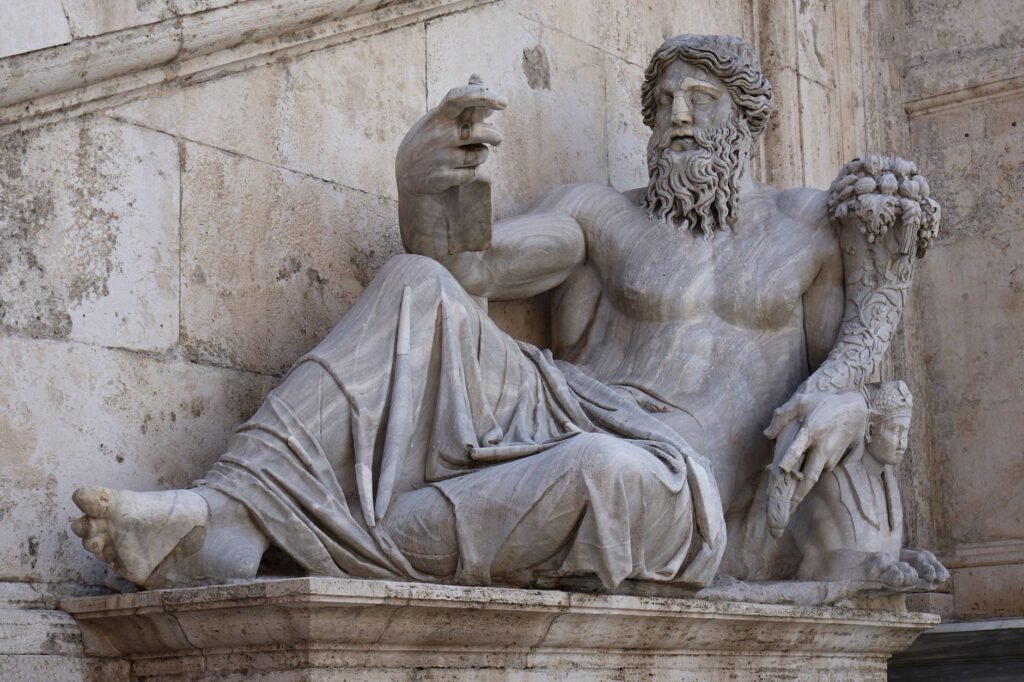
The name Faunus is generally connected with the Latin word favere, meaning “to be favorable,” though ancient and modern scholars have also explored links with the notion of speaking or prophecy. Because ancient etymologies are often speculative, the precise linguistic origin remains uncertain.
Faunus is commonly regarded as the divine ancestor of the Fauni, a group of woodland spirits or rustic deities. In Roman religious thought, he belongs to the older stratum of Italian gods, predating strong Greek influence. His cult likely developed from indigenous pastoral and agricultural beliefs in rural Latium and neighboring regions.
Roman writers sometimes interpreted Faunus through Greek categories, especially by comparing him to Pan. This comparison, however, should not be understood as a full identity. Faunus had his own Italian character, especially in relation to prophecy, fertility, and the protection of livestock.
Historical Context
Faunus belongs to the religious world of archaic and republican Rome, when agriculture, animal husbandry, and seasonal rhythms structured daily life. In such societies, divine beings were thought to govern forests, grazing land, boundaries, and productive land. Faunus was one of the deities invoked to protect these vital concerns.
He is also part of the broader category of rustic gods in Roman religion. These included deities associated with farms, woods, and natural processes rather than the urban temples of the state cult. Faunus was especially important to rural communities, shepherds, and those seeking divine guidance in relation to the land.
In Roman literature, especially in the Augustan age, Faunus appears as an ancient and somewhat archaic figure. Poets used him to evoke the primordial Italy of forests and shepherds, contrasting the simplicity of the countryside with urban power and imperial order. At the same time, his cult survived within official Roman religion and popular practice.
Main Characteristics
Faunus is usually described as a benevolent but unpredictable nature god. His domains include:
- wild places and wooded landscapes
- flocks and herds
- fertility and animal reproduction
- rustic prosperity
- prophecy and oracular inspiration
- the protection of shepherds and travelers in the countryside
He is often imagined as a bearded rural deity, sometimes with features resembling Pan or a satyr in later art. However, in strictly Roman terms, Faunus was not originally a comic half-animal figure. That more hybrid appearance is largely a result of later Greco-Roman artistic blending.
A particularly distinctive feature of Faunus is his role as a prophetic god. Ancient sources describe him as communicating through sounds, dreams, or oracular revelations, especially in groves or sacred places. This prophetic dimension distinguishes him from many other rural divinities.
Common traits attributed to Faunus
| Trait | Meaning |
|---|---|
| Rustic and pastoral | Linked to countryside life, shepherds, and livestock |
| Fertility-bearing | Associated with the productivity of land and animals |
| Woodland deity | Connected with groves, forests, and untamed nature |
| Oracular | Capable of prophecy and divine messages |
| Protective | Guarded flocks, fields, and rural communities |
| Ambiguous and wild | Beneficial, but also unpredictable and awe-inspiring |
Family and Genealogy
The genealogy of Faunus varies according to source and tradition. Roman and later mythographers did not preserve a single universally accepted family tree.
Faunus is often considered the son of Picus in some traditions, while in others he appears as the father of later rustic beings known as Fauni. He is also linked in Roman myth to Latin kings and early Italy, suggesting that he was not merely a minor woodland spirit but a significant ancestral deity in the mythic history of the Italian peoples.
In some accounts, Fauna is presented as his female counterpart, spouse, or sister. The relationship between Faunus and Fauna is not entirely consistent across sources, and ancient authors differ on whether they should be understood as husband and wife, complementary deities, or mythological parallels. Fauna is sometimes associated with fertility, women, and healing, making the pair a symbolic expression of masculine and feminine natural force.
Family relationships in tradition
| Figure | Relationship to Faunus | Notes |
|---|---|---|
| Fauna | Consort or female counterpart | Traditions vary; sometimes called wife or sister |
| Picus | Possible father | Appears in some genealogical traditions |
| Fauni | Descendants or related spirits | Rustic woodland beings associated with Faunus |
| Latin legendary figures | Sometimes linked through mythic ancestry | Reflects his role in Italian ancestral religion |
Because the surviving material is fragmented and often literary rather than cultic, Faunus should be understood more as a divine type embedded in Roman tradition than as a figure with a fixed mythological family structure.
Symbols
No single canonical set of symbols is universally tied to Faunus, but several recurring signs and objects are associated with him in Roman and later tradition.
Common symbols associated with Faunus
- Shepherd’s staff: reflects pastoral guardianship.
- Horn: linked with animal abundance and rustic sound.
- Wreaths of leaves or greenery: suggest woodland life and fertility.
- Goat imagery: especially in later identification with Pan.
- Groves and sacred trees: natural spaces considered appropriate to his worship.
- Prophetic sounds: rustling leaves, murmurs, or nocturnal voices as signs of divine speech.
Colors are not consistently specified in ancient sources, so it is safer to speak of symbolic associations rather than fixed ritual colors. Green and earth tones are modern interpretive associations rather than securely attested ancient symbols.
Sacred Animals
Animals connected with Faunus reflect his role as a pastoral and woodland god.
Principal animals
| Animal | Symbolic significance |
|---|---|
| Goats | Fertility, wildness, and rustic vitality |
| Sheep | Protection of flocks and pastoral life |
| Cattle | Agricultural prosperity and rural wealth |
| Wolves | The dangers of the wilderness that must be warded off |
| Birds | Sometimes linked with prophecy and omens |
Goats are especially important because of later associations with Pan and satyric imagery. In the Roman context, however, the animal symbolism of Faunus extends beyond goats to encompass the broader world of herding and nature.
Animals in Faunian cult were not necessarily worshipped in themselves. Rather, they functioned as signs of divine power over fertility, reproduction, and the safety of livestock.
Sacred Plants
Plants associated with Faunus are those of woodland and countryside worship. Ancient sources do not provide an exhaustive botanical list, but certain plants appear repeatedly in rustic religious contexts.
Plants and their meanings
| Plant | Significance |
|---|---|
| Grove trees | Sacred natural space and divine presence |
| Laurel | Purification and ritual dignity in Roman religion |
| Oak | Strength, permanence, and wooded sanctity |
| Wild greenery | Fertility and the untamed countryside |
| Verbena and rustic herbs | Purificatory and devotional uses in Roman ritual |
Sacred groves were especially important. In the Roman religious imagination, a grove was not merely a collection of trees but a living sacred site where divine power could be encountered. Such places suit Faunus well, since he belongs to the threshold between cultivated land and untamed nature.
Sacred Places
Faunus was worshipped in rural sanctuaries, groves, and other places outside the city center. His cult was less about monumental temples than about natural sites and local shrines.
One of the most famous sacred places connected with Faunus was the grove and oracle of Faunus at Bovillae, in Latium, though traditions vary and the details are not always clear. Such places were valued because the deity’s speech was believed to emerge from the landscape itself.
The Lupercal, the cave associated with the Lupercalia festival in Rome, is not exclusively a Faunian sanctuary, but it belongs to the wider cluster of traditions surrounding rustic, wolf-related, and fertility-centered cults in which Faunus and related figures are sometimes discussed.
Types of sacred spaces associated with Faunus
- sacred groves
- rural clearings
- caves and wooded hollows
- boundary areas between farmland and wilderness
- small local shrines in pastoral communities
These locations reflect the nature of the deity: he is a god of edges, thresholds, and uncultivated spaces rather than of formal urban temples.
Powers and Attributes
Faunus is primarily a god of fertility, flocks, nature, and prophecy. His powers cover both practical and spiritual aspects of rural life.
Key powers
- ensuring the fertility of fields and animals
- protecting shepherds and livestock
- warning humans through prophecy or omens
- governing the vitality of forests and wild areas
- blessing seasonal abundance
- warding off dangers from the wilderness
His prophetic power is especially noteworthy. Ancient Romans believed some deities could reveal the future through dreams, voices, or signs in nature. Faunus was one of these oracular figures. His messages were often believed to come in a state between order and wildness, fitting his liminal character.
Faunus therefore combines two important religious ideas:
- productive fertility, which benefits human communities
- untamed natural force, which can inspire awe and fear
This dual character helps explain why Faunus remained culturally significant over time.
Main Myths
The myths of Faunus are not preserved in a single epic cycle. Instead, they appear in scattered literary references, ritual stories, and mythographic traditions.
Prophetic encounters
A recurring theme is Faunus as a prophetic voice. In some traditions, he reveals divine messages to kings, heroes, or worshippers through dreams or nocturnal signs. His prophecy is often indirect and symbolic, requiring interpretation.
Faunus and Numa
One important Roman tradition connects Faunus with Numa Pompilius, the second king of Rome, who was known as a lawgiver and religious reformer. In some versions, Numa receives instructions about ritual matters from Faunus or from divine intermediaries linked to him. This association reinforces Faunus’s role as an ancient Italian authority on sacred knowledge.
Faunus and the history of Italy
Faunus sometimes appears in legendary accounts of early Italy, where he is described as a king, a wise ruler, or a divine ancestor of local peoples. Such stories are not historical in the modern sense, but they show how Roman tradition imagined divine power as embedded in the founding era of Italy.
Faunus and Fauna
The relationship between Faunus and Fauna also carries mythic significance. Different traditions explain their roles in fertility, women’s mystery, and ritual secrecy. Some Roman writers connected Fauna with women’s healing and with discreet domestic cults, while Faunus represented the male counterpart of rustic force.
Because sources diverge, any summary of Faunus’s myths must remain cautious. He is not a god whose story survives in a single coherent narrative. Rather, he appears in a network of ritual, legendary, and poetic associations.
Relationship with Other Mythological Figures
Faunus is closely related to several other figures in Roman and Greco-Roman tradition.
Pan
The most famous comparison is with Pan, the Greek god of the wild, shepherds, and rustic music. Roman authors frequently interpreted Faunus through Pan, and later art often merged the two. Both are associated with goats, forests, and pastoral life.
However, Faunus is not merely a Roman version of Pan. His Italian roots, oracular role, and place in Roman legendary history distinguish him from his Greek counterpart.
Silvanus
Faunus is sometimes compared with Silvanus, another Roman deity of woods, fields, and boundaries. The two figures overlap in function, but Silvanus is usually more closely tied to woods and property boundaries, while Faunus has stronger pastoral and prophetic associations.
Lupercus and the Luperci
Faunus is also linked in scholarship and ancient interpretation with Lupercus, the god or divine power behind the Lupercalia. The relationship is not entirely certain, since ancient sources do not always agree on whether Lupercus is a distinct deity, an epithet, or a local aspect of Faunus.
Fauna
As noted above, Fauna is the female counterpart most often connected with Faunus. Their pairing reflects Roman ideas of complementary divine forces governing fertility, nature, and the life of the household or countryside.
Numa Pompilius and Roman kingship
Faunus’s association with Numa places him in a broader constellation of figures concerned with law, ritual, and foundational authority. In such traditions, he becomes a source of sacred legitimacy rather than simply a woodland spirit.
Worship and Cult
Faunus was honored through rural rites, offerings, and festivals. His cult was practical, seasonal, and deeply connected to agricultural and pastoral concerns.
Offerings and rituals
Offerings to Faunus likely included:
- wine
- milk
- grain
- honey
- sacrificial animals, especially in rustic settings
- garlands and greenery
As with many Roman deities, the exact details varied by locality and period. Faunus was not worshipped through a single standardized liturgy. Instead, his cult was part of the flexible and local nature of Roman religion.
The Faunalia
One of the clearest festival connections is the Faunalia, a festival associated with Faunus. It was celebrated in the countryside and emphasized agricultural abundance, the well-being of animals, and rustic merriment. Accounts suggest that people rejoiced in the fields, and that animals were given freedom from labor on the festival day.
This kind of celebration fits the god’s profile: Faunus is a deity of both protection and release, order and wildness.
The Lupercalia
Faunus is sometimes connected with the Lupercalia, one of Rome’s oldest and most distinctive festivals. The connection is debated. Some ancient and modern interpretations associate the god honored in the ritual, or the underlying divine power, with Faunus or with a Faunian aspect known as Lupercus. Other interpretations treat the festival as distinct.
Because the evidence is uncertain, it is best to say that Faunus belongs to the same religious environment as the Lupercalia rather than definitively identifying him as its sole deity.
Cultic character
Faunus worship was likely characterized by:
- local participation rather than centralized state control
- rural and seasonal observance
- emphasis on fertility and protection
- divination and oracular consultation
- communal feasting or countryside revelry
Ancient Sources
Faunus appears in several important ancient texts, though not always in the same way.
Major classical authors
- Virgil: refers to Faunus in poetic contexts involving Italy, countryside religion, and mythic history.
- Ovid: includes Faunus in Fasti and other works discussing Roman festivals and divine traditions.
- Vergil and Ovid both help frame Faunus as part of an ancient Italian religious landscape.
- Varro: a crucial source for Roman antiquarian religion, especially useful for identifying old deities and rituals.
- Livy: provides historical and religious context for Roman traditions, though not always focused directly on Faunus.
- Pausanias: useful mainly for comparative Greco-Roman religious interpretation, though Faunus is fundamentally Roman.
- Servius: the late antique commentator on Virgil preserves valuable explanations of rustic divinities and Roman myth.
- Macrobius: preserves antiquarian religious discussion relevant to Roman gods and festivals.
Source limitations
Ancient evidence is fragmentary. Faunus is often mentioned indirectly, explained through comparison, or embedded in antiquarian discussion. This means that modern understanding depends on reading many sources together rather than relying on a single authoritative narrative.
Roman Equivalent
Faunus is a Roman deity, so in a strict sense he does not have a Roman equivalent. The more relevant question is his adaptation within the Greco-Roman system.
The closest Greek equivalent is Pan, and Roman literature often treated Faunus as the Italian counterpart to Pan. Yet the Roman conception of Faunus retained a distinct profile:
- more deeply rooted in Italian rural religion
- more closely associated with prophecy
- more connected to Roman legendary history
- less fully satyr-like in origin
In later Roman and post-Roman tradition, Faunus and Pan became increasingly blended, especially in art and literature. This syncretism is common in ancient religion, where gods with similar functions were often interpreted through one another.
Influence on Modern Culture
Faunus has had a lasting though indirect influence on modern culture. He appears less often as a major standalone figure than as part of the broader image of the wild rustic god.
Literature and art
- Renaissance and neoclassical art frequently used Faunus or Faunian imagery to represent pastoral fertility and nature.
- Poets and writers interested in classical antiquity used Faunus as a symbol of the lost harmony between humans and nature.
- He appears in allegorical and pastoral literature, often as a figure of rustic abundance or natural spontaneity.
Visual culture
In modern illustration and sculpture, Faunus is often depicted in ways that borrow from Pan:
- horns
- goat legs
- musical instruments
- forest settings
These representations are more influenced by later artistic convention than by precise ancient iconography.
Popular culture
Faunus appears occasionally in modern fantasy, gaming, and role-playing contexts, often as:
- a forest deity
- a nature spirit
- a prophetic wild god
- a symbol of untamed fertility
The name also carries resonance in modern fictional world-building because it suggests antiquity, nature, and mystery. In some modern uses, however, the term may be applied loosely to goat-like or woodland beings without close adherence to Roman religion.
Curiosities
- Faunus is one of the clearest examples of an indigenous Italian deity later reinterpreted through Greek mythology.
- His prophetic role makes him unusual among rustic gods, since nature deities are not always also oracular.
- The distinction between Faunus, Pan, Silvanus, and Lupercus is sometimes blurred in ancient and modern writing.
- Faunus is part of the Roman habit of giving religious significance to liminal spaces: groves, fields, edges, and countryside thresholds.
- The female figure Fauna is sometimes treated as his spouse, but the traditions are not fully consistent.
- The survival of Faunus in literature is stronger than the survival of detailed ritual records, so many reconstructions remain tentative.
- His cult reflects the practical concerns of ancient rural life: animal health, fertility, weather, and divine guidance.
Frequently Asked Questions
1. Who was Faunus in Roman mythology?
Faunus was a Roman god of the countryside, forests, fertility, and prophecy. He was especially associated with shepherds, livestock, and rustic life.
2. Is Faunus the same as Pan?
Not exactly. Faunus was often compared with the Greek god Pan, and the two became closely associated in later tradition. However, Faunus had his own Italian religious identity.
3. What did Faunus protect?
Faunus was believed to protect flocks, rural communities, and the fertility of land and animals. He also had prophetic functions.
4. Did Faunus have a family?
Different sources give different accounts. Fauna is commonly presented as his female counterpart or spouse, and some traditions connect him with other legendary Italian figures.
5. What symbols are associated with Faunus?
Common symbols include goats, shepherd imagery, green groves, horns, and wooded landscapes. These reflect his pastoral and wild nature.
6. Was Faunus worshipped in temples?
He was more often honored in groves, rural shrines, and countryside settings than in grand urban temples. His cult was strongly local and seasonal.
7. What ancient festival was linked to Faunus?
The Faunalia was a festival associated with Faunus. Some ancient and later interpretations also connect him with the Lupercalia, though that relationship is debated.
8. Why is Faunus important?
Faunus is important because he represents the ancient Roman connection to nature, fertility, and prophecy. He also helps show how Roman religion preserved older Italian beliefs while adapting to Greek influence.
Conclusion
Faunus is a significant figure in Roman religion and mythology, embodying the vitality, unpredictability, and sacredness of rural life. As a god of forests, flocks, fertility, and prophecy, he stands at the intersection of practical agriculture and religious imagination. His cult reflects the ancient Roman view that the natural world was alive with divine presence, especially in groves, fields, and wild places beyond the city.
Although the surviving sources are incomplete and sometimes contradictory, Faunus remains a powerful example of an indigenous Italian deity whose identity was both deeply local and widely influential. His later association with Pan helped preserve his image in classical scholarship and modern culture, but his original Roman character remains distinct: an old rustic god whose voice could be heard in the woods, in the wind, and in the life of the land itself.

Orin Vale has spent the better part of two decades tracing the threads that connect the world’s oldest stories — from the halls of Asgard to the banks of the Nile, from Olympus to the jungles of the Maya. What began as a childhood fascination with flood myths and trickster gods grew into years of independent study across comparative mythology and ancient religion, always chasing the same question: what did these stories mean to the people who first told them? Orin writes for readers who want more than trivia — the ones looking for the beliefs, fears, and truths that myths were built to carry.