Is the Leprechaun Authentic Celtic Mythology?
Introduction
The leprechaun is one of the best-known figures associated with Ireland and, by extension, with Celtic mythology in popular imagination. Yet the question “Is the leprechaun authentic Celtic mythology?” requires a careful answer: the leprechaun is authentically part of Irish folklore, but it is not a major figure of the ancient Celtic gods or heroic myth cycles preserved in medieval manuscripts. Its origins lie in later Irish tradition, especially in tales of fairies, solitary supernatural beings, and local belief.
This distinction matters because “Celtic mythology” is often used broadly to describe everything supernatural from the Celtic-speaking world. In academic terms, however, the leprechaun belongs more securely to Irish folkloric tradition than to the oldest layers of Irish myth, such as the stories of the Tuatha Dé Danann, Cú Chulainn, or the Ulster Cycle. Understanding that difference helps separate ancient religion from later folk belief and modern cultural branding.
Origin and Meaning
The English word leprechaun comes from Irish Gaelic forms such as leipreachán or luchorpán in older sources, with the meanings and etymology debated by scholars. One traditional explanation links the term to Irish words meaning a small-bodied being, while other proposals connect it to words suggesting shoemaking or a spirit-like creature. No single derivation is universally accepted.
What is clear is that the leprechaun was not originally a treasure-holding mascot in the modern sense. The figure emerged in Irish oral tradition as a small, solitary fairy or fairy craftsman, often associated with shoes. Over time, especially in the 18th to 20th centuries, the leprechaun became increasingly standardized in literary and commercial depictions: a tiny man in green clothing, guarding gold, living in remote places, and outwitting humans.
Etymological and historical notes
| Term | Source/Meaning | Notes |
|---|---|---|
| Leprechaun | Anglicized from Irish forms | Modern English spelling stabilized later |
| Luchorpán | Often glossed as “small body” or “little spirit” | Appears in early Irish textual traditions |
| Leipreachán | Later Irish form | Common in modern Irish usage |
Because the name evolved through translation and oral transmission, exact origin remains uncertain. This uncertainty is common in folklore studies, where names often change as stories pass between regions and languages.
Historical Context
To ask whether the leprechaun is “authentic Celtic mythology” is also to ask what counts as Celtic myth in the first place. The ancient Celtic peoples did not leave behind a single unified mythology comparable to Greek or Roman religion. Instead, what survives is a patchwork of:
- Insular Celtic traditions from Ireland and Wales
- Medieval manuscripts written by Christian scribes
- Oral folklore preserved much later in local communities
- Modern reinterpretations shaped by nationalism, literature, and tourism
The leprechaun belongs mainly to the folk-belief tradition of Ireland, which flourished long after the conversion to Christianity. Irish manuscripts from the medieval period preserve tales of supernatural beings, but the modern leprechaun image is largely a product of later storytelling and literary adaptation.
Cultural setting
The leprechaun is usually understood within the broader world of Irish fairies, or the aes sídhe (people of the mounds). These beings inhabit an enchanted landscape of hills, hollow places, lakes, and isolated terrain. In that worldview, supernatural beings are often close to human society but remain distinct, ambiguous, and potentially dangerous.
Unlike the great gods and heroes of early Irish literature, leprechauns are typically portrayed as:
- solitary rather than communal
- clever rather than majestic
- occupational figures, especially shoemakers
- tricksters who can be deceived or who deceive others
This places them in the domain of folklore, not formal cult religion.
Main Characteristics
The leprechaun has several recurring characteristics, though details vary by region and period.
Common traits
- Small stature: commonly depicted as a tiny man
- Solitary nature: unlike some fairy groups, leprechauns are usually alone
- Shoemaking or leatherwork: one of the most persistent traditions
- Wealth or hidden treasure: especially in modern stories
- Trickery and cleverness: known for deception and escape
- Ambiguous morality: not purely evil, but not benevolent either
The shoemaker aspect is particularly important in older folklore. Leprechauns are sometimes described as busy craftsmen making shoes for other fairies. This detail likely helped distinguish them from other supernatural beings and may reflect symbolic associations with industry, craft skill, and secrecy.
Appearance
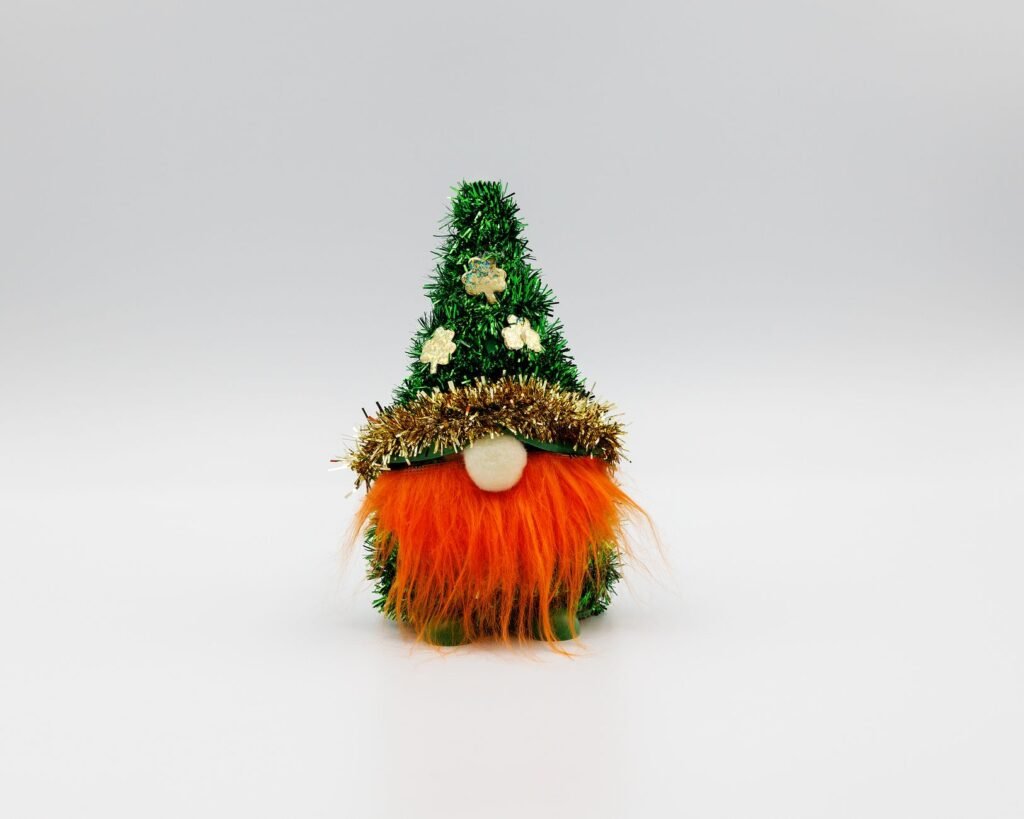
The modern visual stereotype—green coat, buckled shoes, red beard, tall hat—owes much to later illustration, theater, advertising, and Saint Patrick’s Day imagery. Traditional descriptions are more varied and do not always emphasize green clothing. In fact, older accounts sometimes present the leprechaun in red or describe him as wearing practical, workmanlike attire.
Family and Genealogy
Unlike gods and heroes in structured mythological genealogies, the leprechaun is not usually given a stable family tree. Most traditions present leprechauns as solitary beings without a detailed lineage. This is one reason they differ from deities such as Lugh, Brigid, or the Dagda in Irish mythic literature.
Typical genealogical features
- Parents: rarely named
- Spouse: generally absent from the tradition
- Children: not a common motif
- Descendants: not typically relevant
- Social ties: usually minimal, though they may be linked to the wider fairy population
Some folklore notes connect leprechauns loosely with other fairy kinds, such as clurichauns or household spirits, but these relationships are fluid rather than canonical. Regional storytelling often merges, separates, or reclassifies such beings depending on local usage.
Symbols
The leprechaun has acquired a set of modern symbols, but not all are equally ancient or traditional.
Common symbols and their meanings
| Symbol | Meaning | Historical reliability |
|---|---|---|
| Shoes | Shoemaking, craft, small trade | Strong in older folklore |
| Pot of gold | Hidden wealth, elusive fortune | Strong in modern tradition, less central in early sources |
| Green clothing | Irish identity, spring, festivity | Mostly modern popular imagery |
| Buckled hat or coat | Visual standardization in illustration | Modern |
| Pipe or tobacco | Folkloric domesticity, old age, solitude | Appears in some later depictions |
The pot of gold at the end of the rainbow is perhaps the most recognizable symbol associated with the leprechaun today, but it is best understood as a modern folkloric elaboration rather than a fixed ancient motif. It reflects the broader theme of unattainable or trickster-protected wealth.
Sacred Animals
There is no universally established list of sacred animals associated with the leprechaun. Unlike deities in some traditions, leprechauns do not have a formal cult animal or consistent symbolic fauna.
That said, folklore and modern storytelling occasionally associate leprechauns with:
- rabbits or hares, through general fairy associations
- horses, in some fairy-lore contexts
- insects or small creatures, because of their miniature scale
- dogs, sometimes as household or guarding animals in broader fairy narratives
These links are suggestive rather than canonical. They reflect the leprechaun’s place in a wider ecosystem of Irish fairy belief, where animals often act as omens, messengers, or companions to supernatural beings.
Sacred Plants
No sacred plant is uniquely and consistently associated with the leprechaun in the way certain plants are tied to other mythic figures or rituals. Nevertheless, a few plants recur in Irish folklore and modern imagery connected to leprechauns or fairy beings generally.
Frequently associated plants
- Shamrock: strongly tied to Irish identity and Saint Patrick’s Day; more national than specifically leprechaun-related
- Clovers: used in modern lucky imagery
- Hawthorn: important in Irish fairy lore, though not specific to leprechauns
- Rowan: often protective in Celtic folk belief
- Brambles and wild herbs: common in liminal landscapes where fairy beings are said to dwell
The association with clover and shamrock is largely modern and symbolic. It is part of the broader merging of leprechaun imagery with Irish national iconography.
Sacred Places
The leprechaun does not have temples, shrines, or sanctuaries in the institutional sense. However, folklore attaches leprechauns to certain places of enchantment and seclusion.
Commonly associated locations
- Rural hills and fields
- Fairy mounds and ancient earthworks
- Remote woodland edges
- Hollow trees
- Stony, isolated places
- Threshold spaces, such as paths and boundaries
In Irish belief, supernatural beings often inhabit liminal landscapes—places between cultivated and wild, human and otherworldly. Leprechauns fit this pattern well. They are not typically city beings and are rarely associated with grand sacred architecture.
Place and landscape
The landscape matters because folklore places leprechauns where humans may encounter them unexpectedly. Their environment reflects their character: hidden, marginal, and difficult to pin down. This is one reason they became such effective figures in cautionary tales and trickster stories.
Powers and Attributes
Leprechauns are not usually powerful in the divine sense. Their “powers” are more like supernatural skills or folk-magical abilities.
Common attributed abilities
- Illusion and trickery
- Escaping capture
- Concealing wealth
- Craft expertise, especially shoemaking
- Control over hidden knowledge
- Mischief without large-scale destruction
Unlike gods who govern natural forces or cosmic order, leprechauns influence small-scale human concerns: money, luck, deception, and practical labor. Their power often lies in being hard to catch and harder to trust.
Moral profile
Leprechauns are not consistently evil. They are better described as ambiguous. A person who catches one may gain something, but the creature will likely seek a loophole, distraction, or bargain to regain freedom. This ambiguity is typical of fairy figures in Irish folklore, where humans and supernatural beings interact in a tense but not always hostile relationship.
Main Myths
There is no single canonical myth of the leprechaun comparable to the creation stories of major religious traditions. Instead, there are recurring folktale motifs.
Common story patterns
The captured leprechaun
- A human catches a leprechaun and forces him to reveal the location of treasure.
- The leprechaun tricks the human, often by pointing to a spot that is later lost or impossible to recover.
The shoemaker tale
- The leprechaun works secretly as a shoemaker for fairies.
- If observed, he may vanish, leaving unfinished shoes behind.
The bargain story
- A leprechaun offers a deal or grants limited knowledge.
- The human accepts but loses the advantage through greed, distraction, or faulty wording.
The hidden pot of gold
- Treasure is said to be concealed and guarded by a leprechaun.
- The rainbow motif becomes the visual shorthand for elusive fortune.
These tales emphasize wit, greed, and the instability of possession. The leprechaun is often less a magical treasure-guardian than a narrative device teaching caution about desire and overconfidence.
Relationship with Other Mythological Figures
The leprechaun’s relationships are mostly with other fairy beings rather than with the major gods of Irish mythology.
Connections within Irish supernatural tradition
- The aes sídhe: broader fairy people to which leprechauns are often loosely connected
- Clurichauns: sometimes confused with leprechauns or viewed as related beings
- Banshees: part of the wider supernatural landscape, though not directly linked
- Púca: another trickster-like figure in Irish folklore
- Household spirits and local fairies: overlapping categories in oral tradition
Comparison with mythic deities
The leprechaun differs sharply from deities such as:
- The Dagda
- Lugh
- Brigid
- Morrígan
These figures belong to the mythological cycles of medieval Irish literature and have more clearly defined roles, powers, and narrative significance. The leprechaun, by contrast, is a later folkloric spirit, not a high deity.
Worship and Cult
There is no evidence of an organized ancient cult of leprechauns. They were not worshipped in temples, and there is no known priesthood, liturgy, or formal sacrificial system dedicated to them.
Folk practices and beliefs
What exists instead are elements of customary belief:
- leaving space for fairies
- avoiding interference with certain places
- treating supernatural beings with caution
- telling cautionary tales to children and adults
- respecting local folklore about hidden beings
Some people may have offered milk, food, or other small gifts to fairy beings in broader Irish tradition, but this is not specific to leprechauns and should not be confused with formal worship. In general, leprechauns belong to the realm of vernacular belief, not institutional religion.
Ancient Sources
A key issue in evaluating whether the leprechaun is authentic Celtic mythology is the absence of a major classical or early medieval textual tradition centered on this figure.
Important source categories
- Medieval Irish manuscripts: preserve fairy lore and supernatural narratives, though not always in the modern leprechaun form
- Early modern Irish and English writings: increasingly document the figure in more recognizable terms
- Folklore collections from the 18th to 20th centuries: crucial for the modern image
Classical authors
Greek and Roman authors such as Homer, Hesiod, Apollodorus, Pausanias, and Ovid do not mention leprechauns. They are irrelevant as direct sources for this figure. Their inclusion in comparative mythology is useful only to show that the leprechaun is not part of the classical Mediterranean mythic corpus.
Medieval and early modern context
The leprechaun appears in a body of Irish material that is substantially later than the oldest mythological layers. Since many texts were written down by Christian scribes, scholars must distinguish between:
- older pre-Christian traditions
- Christian reinterpretations
- later folk developments
- modern editorial and commercial reshaping
This layered transmission makes the leprechaun authentic as Irish folklore, but not straightforwardly authentic as an ancient pan-Celtic deity.
Roman Equivalent
There is no true Roman equivalent of the leprechaun.
Roman religion had household spirits, minor deities, and trickster-like beings, but none correspond exactly to the leprechaun. At most, broad comparative analogies can be drawn with:
- Lares and Penates: household protectors
- genius loci: spirit of a place
- certain minor numinous beings in Roman folk belief
These parallels are only approximate. The leprechaun remains distinctive in its Irish fairy context, especially because of its shoemaking, solitary trickster profile, and later association with hidden gold.
Influence on Modern Culture
The leprechaun has had an enormous influence on modern culture, often exceeding its importance in older mythology.
Literary and artistic influence
In literature, leprechauns appear in:
- Irish nationalist writing
- children’s stories
- fantasy fiction
- humorous folklore retellings
Artists and illustrators helped define the modern leprechaun as a tiny, cheerful, green-clad man. This visual form became dominant in the 19th and 20th centuries.
Cinema, television, and games
The leprechaun has appeared in:
- films, often in horror or fantasy contexts
- television specials and animated programs
- role-playing and video games
- advertising mascots
- sports branding and school mascots
In these media, the leprechaun is often simplified into a symbol of Irishness, luck, or mischief.
Saint Patrick’s Day and commercialization
Perhaps the strongest modern association is with Saint Patrick’s Day. In many countries, especially the United States, leprechauns have become commercial icons of Irish heritage. This use is culturally powerful but historically distant from early Irish belief.
Stereotype and criticism
Modern scholars and cultural commentators have sometimes criticized the leprechaun’s commercialization because it can flatten rich Irish mythology into a single cartoon figure. The result may obscure the broader and more complex traditions of Irish fairy lore.
Curiosities
- The modern “leprechaun with a pot of gold” is much more a product of popular imagination than of ancient mythic sources.
- Traditional folklore often portrays leprechauns as old men, not as cheerful little mascots.
- The leprechaun is one of the few fairy beings whose occupational identity—shoemaker—is so persistent in the tradition.
- Some regional stories confuse or merge leprechauns with clurichauns, a related but distinct figure.
- The green costume now associated with leprechauns became especially prominent in modern times; older descriptions do not always emphasize green.
- The leprechaun’s modern image has been shaped as much by advertising and tourism as by folklore.
- In many folktales, the human’s failure comes from using the wrong wording or being distracted at the crucial moment.
- The leprechaun is a useful example of how folklore can be both ancient in origin and modern in form.
Frequently Asked Questions
1. Is the leprechaun part of authentic Celtic mythology?
Yes, but with an important qualification. The leprechaun is authentic Irish folklore, which is part of the broader Celtic cultural world. However, it is not a major figure of the oldest mythological cycles and should not be treated as one of the principal ancient Celtic gods.
2. Did ancient Celts worship leprechauns?
There is no evidence of organized worship of leprechauns in ancient Celtic religion. They belong to later folk belief and storytelling, not to a formal cult.
3. Are leprechauns mentioned in early Irish myths?
Not in the most famous early mythic narratives in the way major gods and heroes are. Their recognizable form is more associated with later folklore and oral tradition.
4. Why are leprechauns linked to gold?
The gold association comes from later storytelling, especially tales of hidden treasure and clever trickery. It is now central to the modern image but is not the only, or necessarily the oldest, leprechaun motif.
5. What do leprechauns do in traditional folklore?
They are usually portrayed as solitary fairy beings, often shoemakers, who are clever, elusive, and mischievous. They may trick humans or guard hidden wealth.
6. Are leprechauns male or female?
Traditional depictions overwhelmingly present leprechauns as male. Female leprechaun figures are not prominent in the standard folklore.
7. How are leprechauns different from gods like Lugh or Brigid?
Lugh and Brigid belong to the mythological and religious traditions of early Ireland, with larger narrative and divine roles. Leprechauns are later folkloric beings with a narrower, more localized function.
8. Why are leprechauns so famous today?
Their fame comes from modern literature, illustration, commercial branding, and Saint Patrick’s Day imagery. They became international symbols of Irishness, luck, and fantasy.
Conclusion
The answer to “Is the leprechaun authentic Celtic mythology?” is nuanced. The leprechaun is authentic to Irish folklore and to the broader imaginative world of Celtic-speaking traditions, but it is not a central figure of ancient Celtic religion or the major medieval mythological cycles. Its roots lie in vernacular belief, fairy lore, and storytelling traditions that developed over time.
As a cultural figure, the leprechaun is significant because it shows how myths and folklore evolve. A local spirit of Irish oral tradition became a global icon of luck, mischief, and Irish identity. In that sense, the leprechaun is both real in folklore and transformed by modern culture—a living example of how tradition changes while still retaining a recognizable core.

Orin Vale has spent the better part of two decades tracing the threads that connect the world’s oldest stories — from the halls of Asgard to the banks of the Nile, from Olympus to the jungles of the Maya. What began as a childhood fascination with flood myths and trickster gods grew into years of independent study across comparative mythology and ancient religion, always chasing the same question: what did these stories mean to the people who first told them? Orin writes for readers who want more than trivia — the ones looking for the beliefs, fears, and truths that myths were built to carry.