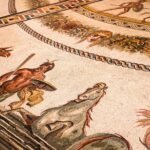
Key of Janus
Introduction

The Key of Janus is a symbolic object associated with Janus, the ancient Roman god of beginnings, transitions, gates, doorways, thresholds, and endings. In Roman religion, Janus was one of the most distinctive deities because he presided over moments of passage: the opening of a door, the start of a war, the beginning of a month, and the transition from one state to another. The key belongs to this sphere of meaning. It represents access, control, protection, and the authority to open or close what is hidden, sacred, or guarded.
Unlike some mythological objects that are described in detail in a single canonical text, the Key of Janus is best understood as a symbolic attribute rather than a fixed artifact with a universally agreed mythology. Ancient sources discuss Janus’ connection to gates, locks, thresholds, and beginnings, but they do not preserve a single standardized myth about a specific “key” in the way later literature or modern esoteric traditions might imagine. For that reason, the key should be read through the wider framework of Roman religion and iconography.
Origin and Meaning
The name Janus is traditionally linked to the Latin word ianua, meaning “door” or “gateway.” Ancient writers and later scholars also associated Janus with ire (“to go”), because he governs movement, entry, and transition. While the precise etymology is debated, the god’s name clearly reflects his role as a deity of passages and openings.
The key as Janus’ attribute follows naturally from this role. In Roman culture, a key was not merely a domestic tool. It also symbolized:
- authority over a household or property,
- the power to admit or exclude,
- guardianship of thresholds,
- control over sacred or civic spaces.
Because Janus presides over the opening of doors and the movement between states, the key became one of the most fitting objects to represent him. In iconography, he is often imagined with a staff or key, sometimes both, emphasizing his power over entry, departure, and the administration of passage.
Historical Context
Janus occupied a unique place in Roman religion. He was not simply a domestic household god, nor a distant cosmic force. Instead, he was deeply integrated into the practical and ceremonial life of Rome. His cult is especially connected with the idea that every significant action begins with a threshold.
Janus in Roman religion
Janus was invoked at the start of prayers, rituals, and public ceremonies. Romans believed that one must begin correctly, and Janus, as guardian of beginnings, was therefore addressed first. This made him unusually important in a religion that valued correct procedure and ritual order.
His association with the key reflects the practical Roman understanding of divine power. The gods were not only worshiped through myth but also through formal acts that marked opening, initiation, and access. A key was therefore an emblem of both ritual order and social control.
Gateways and war
Janus also had a famous association with the Gates of Janus in Rome, which were said to be opened in times of war and closed in times of peace. Different Roman authors preserve different versions of this tradition, and its historical development is not entirely clear. However, the image of opening and closing is central: the key becomes a natural symbol of this function.
Main Characteristics
The Key of Janus is best understood through the god’s defining qualities.
Key traits associated with Janus
- Dual directionality: Janus looks to the past and future, inside and outside, entrance and exit.
- Threshold guardianship: he presides over doors, gates, borders, and passages.
- Beginning and ending: he governs the opening of cycles and the completion of transitions.
- Order and access: he determines what may be entered, initiated, or released.
- Ambivalence: Janus is neither fully one thing nor another; he belongs to the moment between states.
Visual and symbolic associations
Janus is often shown with:
- two faces or a double head,
- a key,
- a staff,
- sometimes a number of fingers interpreted symbolically in later traditions.
The key is especially important because it condenses his role into a single object: he opens what is closed and closes what is open. In symbolic terms, this means not only physical spaces but also periods, conditions, and rites of passage.
Family and Genealogy
Janus is an ancient Roman deity, and his genealogy is not consistently defined across sources. Unlike the Olympian gods of Greek tradition, whose family relationships are often extensively narrated, Janus belongs to a more archaic Roman religious horizon where precise mythic parentage is often absent or variable.
Different traditions
Ancient and later accounts differ on Janus’ family connections. Some traditions treat him as a primordial or highly ancient deity with no clear parentage. In other later literary traditions, he is given a more elaborate role within Roman legendary history, sometimes associated with ancient kingship or early Italian myth.
Because of this, it is more accurate to say that:
- Janus is not strongly defined by family genealogy in the surviving sources.
- His importance comes from function, not from an elaborate divine family tree.
- The Key of Janus therefore symbolizes authority rather than inherited lineage.
Symbols
The key is the most direct symbol associated with Janus, but it appears alongside other important signs.
| Symbol | Meaning |
|---|---|
| Key | Access, guardianship, control over openings and closures |
| Door or gate | Threshold, transition, passage |
| Two faces | Past and future, beginning and end, inside and outside |
| Staff | Authority, guidance, ceremonial power |
| Archways and portals | Civic and ritual boundaries |
The key as a Roman symbol
In Roman life, keys were associated with household management and legal authority. A person who held the key controlled the space. Applied to Janus, this becomes cosmic and ritualized: he controls the entrance to new periods, new actions, and new states of being.
The key is also a symbol of trust. Only the rightful guardian can open or close the door. In that sense, the Key of Janus signifies the divine legitimacy of transitions.
Sacred Animals
No single sacred animal is universally and securely attached to Janus in the same way that animals are linked to some other deities. Ancient sources do not provide a well-developed bestiary for him.
However, later symbolic interpretation sometimes connects Janus with animals that embody vigilance or passage, such as:
- dogs, as guardians of thresholds,
- goats, in broader Roman sacrificial contexts,
- birds, when interpreted through auspicious movement and boundaries.
These associations are secondary and should not be treated as fixed ancient doctrine. The strongest evidence remains Janus’ connection to architecture and ritual rather than animal symbolism.
Sacred Plants
As with sacred animals, Janus does not have a widely attested plant cult in the surviving classical sources. There is no single plant universally recognized as sacred to him.
Nevertheless, in Roman ritual culture, plants used at beginnings, purification, or protection may be considered conceptually relevant. These can include:
- laurel, associated broadly with victory and ritual dignity,
- vervain or other purificatory herbs in Roman practice,
- olive, in wider Mediterranean symbolism of peace and sacred order.
These are contextual associations rather than exclusive sacred plants of Janus. The key point is that Janus’ cult is more strongly tied to architecture, gesture, and opening rites than to a plant-based devotional tradition.
Sacred Places
Janus was connected to specific places in Rome, especially those linked to gates, openings, and public ritual.
The Janus Geminus
The most famous location is the Janus Geminus or Gates of Janus, a shrine in the Roman Forum. Ancient authors describe it as having doors that were opened or closed according to the state of war and peace. The exact historical details of its use are debated, but its symbolic importance is clear.
Other threshold spaces
Janus was also associated with:
- doorways in homes,
- city gates,
- public entrances,
- the first moments of the calendar year.
Because Janus governs all beginnings, any significant point of entry could be conceptually under his protection.
Powers and Attributes
The powers of Janus are among the most distinctive in Roman religion. He is not a god of one element or one domain, but of the conditions that make action possible.
Main domains of influence
- beginnings and endings,
- gates and thresholds,
- doors and locks,
- transitions and change,
- time, especially the opening of cycles,
- ritual initiation,
- civic and military passage.
The Key of Janus in this context
The key stands for the divine capacity to:
- open the way forward,
- permit entry into a new state,
- safeguard what is enclosed,
- end or suspend a condition,
- regulate transitions between peace and war, private and public, old and new.
This makes the Key of Janus a powerful symbol of authority over liminal space—the space between one condition and another.
Main Myths
Janus is not the subject of a large number of elaborate myths in the manner of Greek gods such as Zeus or Athena. His importance is more ritual and symbolic. Still, several traditions are associated with him.
The opening of the year
Janus gives his name to January in the Roman calendar. As the first month, January marks the opening of the year, making Janus the appropriate divine figure for beginnings. The key symbolizes the opening of time itself.
The Gates of Janus
One of the best-known Roman traditions says that the gates of Janus were opened in wartime and closed in peacetime. Roman authors present this as an ancient custom, though historical practice may have changed over time and is difficult to reconstruct precisely. The key belongs to this mythic-ritual image of controlled access.
Hospitality and access
Because Janus governs entry, some later interpretations link him to hospitality, admission, and the lawful opening of space. However, these are interpretive extensions rather than preserved standalone myths.
Relationship with Other Mythological Figures
Janus is unusual because he is often compared with gods from other traditions, but he does not always fit neatly into a Greek or Roman family of deities.
Relationship with Saturn
In Roman literature, Janus is sometimes connected with Saturn and the primordial past of Italy. Some traditions imagine Janus as a ruler in ancient times, associated with the Golden Age or early civil order. This is not the same as a direct mythic partnership, but it shows Janus’ importance in foundational narratives.
Relationship with Vesta
Janus and Vesta are often paired conceptually: Janus presides over the doorway, while Vesta is linked with the hearth and the inner center of the household and city. Together, they represent two essential poles of Roman sacred space: entrance and interior. The key reinforces Janus’ outer, opening function.
Relationship with other gods
Janus was invoked before many other gods in ritual order, which reflects a kind of hierarchical relationship. He does not necessarily dominate them mythically, but he precedes them ceremonially.
Worship and Cult
Janus had a strong ritual presence in Roman religion, even if his mythological storytelling was comparatively limited.
Ritual invocation
Romans often invoked Janus at the beginning of prayers. This opening invocation recognized his role as the divine doorkeeper of all sacred action. The key, in this sense, is a ritual emblem of permission and commencement.
Offerings
Specific offerings to Janus are not as richly documented as those for some other gods. The evidence points more strongly to formal address and public ritual than to an elaborate sacrificial cult with stable iconography.
Festivals and calendrical significance
Janus is especially associated with:
- the Kalends of January,
- the beginning of the Roman year,
- the transition from one civil or ritual period to another.
Because the Romans structured religious life around time and sequence, Janus occupied an essential place in calendrical observance.
Ancient Sources
Our knowledge of Janus and the symbolic role of his key comes from a range of ancient and antiquarian sources, though no single text fully explains the object.
Important classical and ancient authors
| Author | Relevance |
|---|---|
| Ovid | Discusses Janus extensively in Fasti, especially his role in January and beginnings |
| Varro | Important for Roman religious antiquarianism and etymology |
| Livy | Preserves traditions about the Gates of Janus and Roman history |
| Macrobius | Offers later antiquarian reflections on Roman religion |
| Augustine | Refers to Janus in critiques of pagan religion |
| Cicero | Mentions Janus in broader discussion of Roman religious practice |
Caution in interpretation
These sources often belong to different periods and agendas. Some are poetic, some antiquarian, some polemical. For that reason, statements about the Key of Janus must be understood as part of a broader Roman symbolic system rather than a single, uniform myth.
Roman Equivalent
Janus is already Roman, so he does not have a foreign “equivalent” in the strict sense. However, modern readers often compare him with other gods of thresholds or beginnings in different traditions.
Possible cross-cultural comparisons
- Hermes in Greek thought, for travel and boundary-crossing, though not an exact match.
- Hecate, as a guardian of thresholds and crossroads, though with very different functions.
- Protector deities of gates and doors in various cultures.
These comparisons are useful for interpretation, but they should not obscure the fact that Janus is a distinctly Roman deity with his own religious logic.
Influence on Modern Culture
Janus has had a notable impact on modern culture, especially as a symbol of duality, beginnings, and transition. The Key of Janus appears in literature, fantasy, art, and symbolic language whenever access and hidden passage are central themes.
In literature and philosophy
Writers and thinkers often use Janus as a metaphor for:
- dual perspective,
- historical change,
- ambiguity,
- threshold experiences.
The key enhances this symbolism by suggesting that some figure, institution, or idea can open one world and close another.
In popular culture
Modern fantasy and speculative fiction often borrow Janus-like imagery for:
- enchanted keys,
- portal guardians,
- time-bending devices,
- secret doors.
While these uses may not be directly derived from ancient Roman religion, they build on the enduring power of Janus as a symbol of transition.
In visual art and design
Janus frequently appears in art as a two-faced figure or as an emblem of the new year. The key may be used in heraldic, decorative, or symbolic contexts to represent authority, thresholds, or time.
Curiosities
- Janus is one of the few major Roman gods whose significance is strongly tied to process rather than substance.
- The word January comes from Janus, highlighting his role at the start of the year.
- In Roman symbolism, the key did not merely lock and unlock doors; it represented jurisdiction and control.
- Janus is often described as having two faces, but some later interpretations expand this into a broader symbol of all opposites: past and future, war and peace, open and closed.
- The Gates of Janus were famous enough to become a shorthand for the state of peace or war in Roman political memory.
- Because ancient sources vary, the Key of Janus is best understood as a symbolic attribute rather than a uniquely documented cult object.
Frequently Asked Questions
What is the Key of Janus?
The Key of Janus is a symbolic object associated with the Roman god Janus. It represents access, authority, beginnings, and the power to open or close thresholds.
Was the Key of Janus a real artifact?
No single ancient artifact is universally identified as “the Key of Janus.” The term is mainly a symbolic and iconographic expression tied to Janus’ role as guardian of doors and transitions.
Why is Janus shown with a key?
The key fits his function as a god of gateways, beginnings, and passage. It symbolizes his control over entry, closure, and ritual transition.
Is Janus a Greek god?
No. Janus is a Roman deity, though later Roman literature sometimes compared him with or interpreted him alongside Greek gods.
What does Janus’ key symbolize today?
Today, the Key of Janus often symbolizes transition, hidden knowledge, access, duality, and the opening of new paths.
What is the connection between Janus and January?
January is named after Janus because it marks the beginning of the year, and Janus governs beginnings and transitions.
Did Romans worship Janus in a special way?
Yes. Janus was commonly invoked at the start of prayers and rituals, and his gates were associated with the state of peace or war.
Conclusion
The Key of Janus is a powerful symbol of Roman religion and cultural imagination. It expresses Janus’ unique authority over doors, thresholds, beginnings, and endings. Although ancient sources do not provide a single detailed myth about a literal key, the symbol is deeply consistent with Janus’ role as guardian of transitions and controller of access.
In the Roman world, where ritual precision, civic order, and the marking of beginnings were essential, the key of Janus carried profound meaning. It signified divine permission, lawful passage, and the hidden structure of time itself. Its enduring presence in modern language and symbolism shows that the ancient Roman idea of the threshold remains compelling: every beginning requires an opening, and every opening implies a guardian.

Orin Vale has spent the better part of two decades tracing the threads that connect the world’s oldest stories — from the halls of Asgard to the banks of the Nile, from Olympus to the jungles of the Maya. What began as a childhood fascination with flood myths and trickster gods grew into years of independent study across comparative mythology and ancient religion, always chasing the same question: what did these stories mean to the people who first told them? Orin writes for readers who want more than trivia — the ones looking for the beliefs, fears, and truths that myths were built to carry.