Neptune (Roman god)
Introduction
Neptune was the Roman god of fresh waters, the sea, and horses, later identified closely with the Greek god Poseidon. In Roman religion and literature, he became one of the major divine figures associated with water, navigation, storms, and horse breeding. Although modern audiences usually think of Neptune primarily as a sea god, his earliest Roman profile was more complex and may have centered on fresh water rather than the ocean alone.
Neptune’s importance extends beyond mythology. He reflects how the Romans understood the natural world, practical concerns such as agriculture and transport, and the cultural influence of Greek religion on Roman identity. His name lives on in astronomy, art, literature, and popular culture, most famously in the name of the eighth planet of the Solar System.
Origin and Meaning
The etymology of Neptune is not fully certain. Ancient and modern scholars have proposed various explanations, but none is universally accepted.
A common ancient association connects Neptune with water and moisture. His name in Latin appears as Neptūnus. Some scholars have suggested a relation to an Indo-European root connected with “moisture” or “wetness,” though the linguistic evidence is debated.
Unlike many Greek gods adopted into Roman religion, Neptune appears to have been an originally Italic or Roman deity whose character later absorbed strong Greek influence. His early functions likely included control over springs, rivers, and other waters important to agriculture and daily life. Only later did he become more fully identified with the sea and with Poseidon.
Name in Historical Context
The name Neptune became increasingly associated with the Greek sea god as Roman religion became more Hellenized. Roman writers often used Neptune as the Latin equivalent of Poseidon, especially in literary and mythological contexts. This equivalence shaped how later generations understood Neptune, even when older Roman traditions may have differed.
Historical Context
Neptune belonged to the religious world of ancient Italy and Rome, where gods were often linked to practical aspects of life. Water was essential for farming, livestock, health, and settlement. In this environment, a deity governing springs and other waters had clear importance.
During the early Roman Republic, Neptune was less prominent than major gods such as Jupiter, Mars, and Quirinus. Over time, however, Roman contact with Greek culture transformed many native deities. Neptune’s profile expanded under Greek influence, and he increasingly took on the attributes of Poseidon: command over the sea, earthquakes, and horses.
Neptune also became part of the Roman system of public religion. He had festivals, sacred places, and priestly associations, though he never reached the central civic importance of Jupiter or Mars. His cult was meaningful both in practical life and in literary imagination.
Greek Influence on Roman Religion
Roman religion did not simply copy Greek religion, but it often adapted Greek myths and divine personalities. Neptune is a good example of this process:
- An older Italic water deity was identified with Poseidon.
- Artistic representations adopted Greek-style imagery.
- Mythological narratives were retold in Roman terms.
- Neptune acquired broader marine and cosmic significance.
This blending helps explain why Neptune can seem both distinctly Roman and strongly Greek in later sources.
Main Characteristics
Neptune is usually depicted as a powerful, mature male deity associated with water and motion. In classical art he commonly appears as a bearded man, often holding a trident. His iconography closely resembles Poseidon’s.
Core Traits
- Lord of waters: especially the sea in later tradition, but also springs and flowing water.
- Horses and horse breeding: a significant and often overlooked part of his identity.
- Storm and tempest: he can calm or stir the waters.
- Strength and force: he is a god of power, depth, and movement.
- Unpredictability: like the sea, he could be generous or dangerous.
Neptune’s character is less morally defined than that of some gods. He is not typically portrayed as benevolent or hostile in a simple sense. Instead, he embodies the natural force of water itself: life-giving, necessary, and potentially destructive.
Family and Genealogy
Neptune’s genealogy varies somewhat across sources, especially because Roman authors often equated him with Poseidon.
Parents
In the standard Greco-Roman tradition, Neptune is the son of Saturn and Ops (the Roman equivalents of Cronus and Rhea). He is therefore one of the principal Olympian-style deities in Roman mythological genealogies.
Siblings
He is usually listed among the children of Saturn and Ops, alongside:
- Jupiter
- Juno
- Ceres
- Vesta
- Pluto
Different ancient authors present variations in the ordering or emphasis of these divine siblings.
Spouses and Consorts
Neptune’s chief consort in Roman tradition is Salacia, a goddess often interpreted as representing the sea’s motion or salt water. She is sometimes compared to Amphitrite, Poseidon’s wife in Greek myth. Another related figure is Venilia, associated with seashore waters or waves in Roman tradition.
Because Roman and Greek traditions were frequently merged, sources may treat Salacia and Amphitrite as parallel or overlapping figures rather than entirely separate ones.
Children
As with many gods, Neptune’s offspring vary across traditions. Because he is often merged with Poseidon, many Greek mythic figures are also counted among his children in Roman retellings.
Some commonly associated children include:
- Triton, a sea deity or messenger figure in later tradition
- Pegasus, in the broader Greek tradition linked to Poseidon
- Bellerophon’s horse lineage, in some myths
- Various heroes, sea creatures, and divine or semi-divine figures depending on the source
Roman authors do not always present a single fixed genealogy. The family of Neptune is best understood as a flexible mythological network rather than a rigid family tree.
Symbols
Neptune’s symbols reflect his dominion over water and movement.
| Symbol | Meaning |
|---|---|
| Trident | Power over the sea and waters; divine authority |
| Horse | Connection with horses, speed, and force |
| Dolphin | Sea life, guidance, and maritime good fortune |
| Fish | Aquatic abundance and marine domain |
| Sea shell | Association with the sea and maritime imagery |
| Wave imagery | The sea’s power and unpredictability |
The Trident
The trident is Neptune’s most recognizable emblem. In myth and art, it functions as a sign of his authority and a tool of action. It can strike the earth, stir the waters, or symbolize control over sea and storm.
Color Associations
Ancient sources do not provide a single standardized “sacred color” for Neptune in the modern sense. However, blue, green, and sea-white are frequently used in later artistic and cultural representations because they evoke the sea, foam, and water.
Sacred Animals
Neptune is strongly associated with animals linked to water, motion, and power.
The Horse
The horse is perhaps the most surprising sacred animal associated with Neptune. In Roman and Greek traditions, he was linked to horses, horse taming, and horse breeding. This may reflect a deeper Indo-European pattern in which a water deity also possessed horse-related powers, though the exact origins remain debated.
Dolphins
Dolphins are common companions of Neptune in art and iconography. They symbolize the sea’s vitality, speed, and navigational assistance.
Fish and Marine Creatures
Fish, seals, and other marine creatures are linked to Neptune through his sea domain. In artistic traditions, sea horses and hybrid marine beings may also appear in his retinue.
Sacred Plants
Ancient sources do not give Neptune a strongly fixed set of sacred plants comparable to those of other gods such as Apollo or Dionysus. Still, certain plants are sometimes associated with him indirectly through water, sea, or coastal environments.
Likely Associations
- Reeds and aquatic plants: connected to marshes, rivers, and shorelines
- Seaweed and coastal vegetation: linked symbolically to marine life
- Olive and laurel: not uniquely Neptune’s, but often used in broader Roman religious settings
Because evidence is limited, any plant associations should be treated cautiously. Neptune’s cult was defined more by waters, animals, and rituals than by a clear botanical symbolism.
Sacred Places
Neptune had temples and cult sites in Rome and elsewhere, but unlike some gods he was not tied to a single universally famous sanctuary.
Temple of Neptune in Rome
A notable Roman temple to Neptune stood on the Campus Martius. Roman sources and later scholarship associate this area with the god’s presence in the city. Neptune’s prominence there reflects his public and civic role.
Circus and Racing Associations
Neptune was connected to horse racing and equestrian culture. This made him relevant to places such as the circus, where horses and chariots played a central role in Roman spectacle and ritual.
Coastal and Maritime Sites
As a god of the sea, Neptune was naturally associated with harbors, shorelines, and maritime communities throughout the Roman world. Sailors, merchants, and coastal populations could invoke him for safe passage and favorable conditions.
Springs and Fresh Waters
Older Italic aspects of Neptune likely connected him with springs, rivers, and wells. In that sense, many water sources could be considered under his protection, even if they were not all formal sanctuaries.
Powers and Attributes
Neptune’s powers reflect the broad range of waters in Roman religious thought.
Main Areas of Influence
- Seas and oceans
- Rivers and springs
- Storms and tempests
- Horses and horse breeding
- Coastal safety and navigation
- Earth-shaking or disruptive force in some traditions
Practical Significance
For ancient communities, water was essential for survival. A deity like Neptune was important not only in myth but in daily life:
- farmers needed water for crops and animals
- sailors needed safe seas
- horse breeders valued divine favor
- communities depended on rivers and springs
This practical dimension helps explain why Neptune remained culturally meaningful even when he was not the most politically prominent Roman god.
Main Myths
Neptune appears in a wide range of myths, especially those retold through the lens of Greek Poseidon.
The Division of the Cosmos
One of the major mythic frameworks places Neptune among the sons of Saturn who divide the universe after the overthrow of their father. In this division:
- Jupiter receives the sky
- Neptune receives the sea
- Pluto receives the underworld
This story establishes Neptune’s cosmic jurisdiction.
Contest for Patronage of Cities
In Greek tradition, Poseidon famously competed with Athena for the patronage of Athens. Roman authors sometimes retell or allude to such stories in connection with Neptune. These myths highlight his importance in city-foundation narratives and his rivalry with other gods.
Neptune and Horses
In myths explaining the origin of horses or horse-related divine favor, Neptune often appears as creator or master of the horse. This association is especially visible in stories that connect him with chariot culture and equestrian excellence.
Neptune in the Trojan Cycle
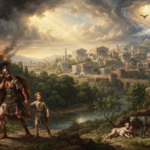
Because Roman literature often absorbs Greek myth, Neptune appears in stories surrounding Troy. In some versions, he helps build Troy’s walls with Apollo, only to later resent the dishonesty of King Laomedon. He then punishes the king by sending a sea monster or by aiding the Greeks against Troy, depending on the version.
Neptune and Medusa’s Offspring
In Greek myth, Poseidon fathers Pegasus with Medusa. Since Neptune is the Roman counterpart, Roman retellings may attribute this to Neptune as well. This is an example of how Roman mythology frequently inherits and reassigns Greek narratives.
The Flooding and Stirring of Waters
Many stories emphasize Neptune’s ability to raise storms, disrupt sea travel, or calm the waves. He is a god whose action is often felt through natural events rather than elaborate narrative sequences.
Relationship with Other Mythological Figures
Neptune’s relationships with other deities and heroes are shaped by both Roman religion and Greek mythological borrowing.
Jupiter
Jupiter is Neptune’s brother and the supreme sky god. Their relationship reflects the cosmic division of power. Jupiter generally outranks Neptune in Roman religious hierarchy, though Neptune retains significant independent authority.
Pluto
Pluto, the god of the underworld, is another brother. Together with Jupiter and Neptune, he forms the triad of major male divine rulers.
Salacia and Amphitrite
Salacia is Neptune’s Roman consort, often treated as a sea goddess. In Greek-influenced contexts, Amphitrite fills a similar role. Their relationships reveal the blending of Roman and Greek mythic systems.
Poseidon
Poseidon is not a separate Roman figure, but rather Neptune’s closest Greek counterpart. In practice, Roman authors often treat them as identical. This makes Neptune one of the clearest examples of Roman religious syncretism.
Other Gods and Heroes
Neptune often appears in relation to:
- Apollo, especially in building or punishment myths
- Athena/Minerva, in city-patronage stories
- Ceres, through the shared divine family
- Vulcan, in broader mythic interactions involving the cosmos and craft
- Triton and other sea beings, as part of his aquatic retinue
Worship and Cult
Neptune was worshipped in the Roman state religion, though his cult was less central than that of Jupiter or Mars.
Ritual Practice
Worship of Neptune likely included sacrifices, prayers, and offerings made for:
- safe travel by sea
- protection from storms
- abundant water
- success in horse-related matters
Because the ancient evidence is not complete, exact ritual details vary by region and period.
Festival: Neptunalia
The main festival associated with Neptune was the Neptunalia, celebrated on 23 July. This festival took place during the dry season, which suggests a practical concern with water and relief from heat.
Ancient sources indicate that people built temporary shelters from branches and leaves, possibly seeking shade and celebrating in a festive, open-air manner. The festival likely connected Neptune with water preservation, rural life, and summer survival.
Social and Religious Meaning
Neptune’s worship shows how Roman religion often merged sacred and practical concerns. A god of water was relevant both to farmers managing dry conditions and to sailors facing the dangers of the sea.
Ancient Sources
Neptune is known through a wide range of classical authors. Different sources emphasize different aspects of his identity.
Major Ancient Authors
- Hesiod: in Greek tradition, especially for the genealogy of the gods
- Homer: for Poseidon’s role, later identified with Neptune
- Apollodorus: useful for mythographic summaries
- Pausanias: valuable for local cult and religious geography
- Ovid: especially important for Roman literary reinterpretation
- Virgil: Neptune appears in Roman epic contexts, particularly in relation to the sea
- Livy and other Roman historians: for religious and civic references
- Varro: for antiquarian and religious interpretation
- Macrobius and Servius: later interpreters preserving earlier traditions
Value and Limitations of the Sources
Ancient sources are not always consistent. Some present Neptune as a deeply Roman water god; others mainly use him as the Latin name for Poseidon. Readers should therefore distinguish between:
- early Italic Roman tradition
- later Greco-Roman literary tradition
- mythographic and allegorical interpretation
Roman Equivalent
Neptune is the Roman equivalent of Poseidon, but the equivalence is not perfect.
Similarities
Both gods are associated with:
- the sea
- storms
- horses
- tridents
- divine power over water
Differences
Neptune’s older Roman identity may have emphasized:
- freshwater sources
- practical water use
- agricultural relevance
Poseidon, by contrast, is more strongly tied in Greek tradition to:
- the Aegean and wider sea
- earthquakes
- a broad mythic role in Greek heroic literature
In Roman culture, the two figures are often fused, but the older Roman god likely had a somewhat different original scope.
Influence on Modern Culture
Neptune has had a lasting impact on Western culture.
Astronomy
The planet Neptune was named after the Roman god, following the tradition of naming planets after classical deities. The name suits the planet’s deep blue appearance, reinforcing its maritime association.
Art and Sculpture
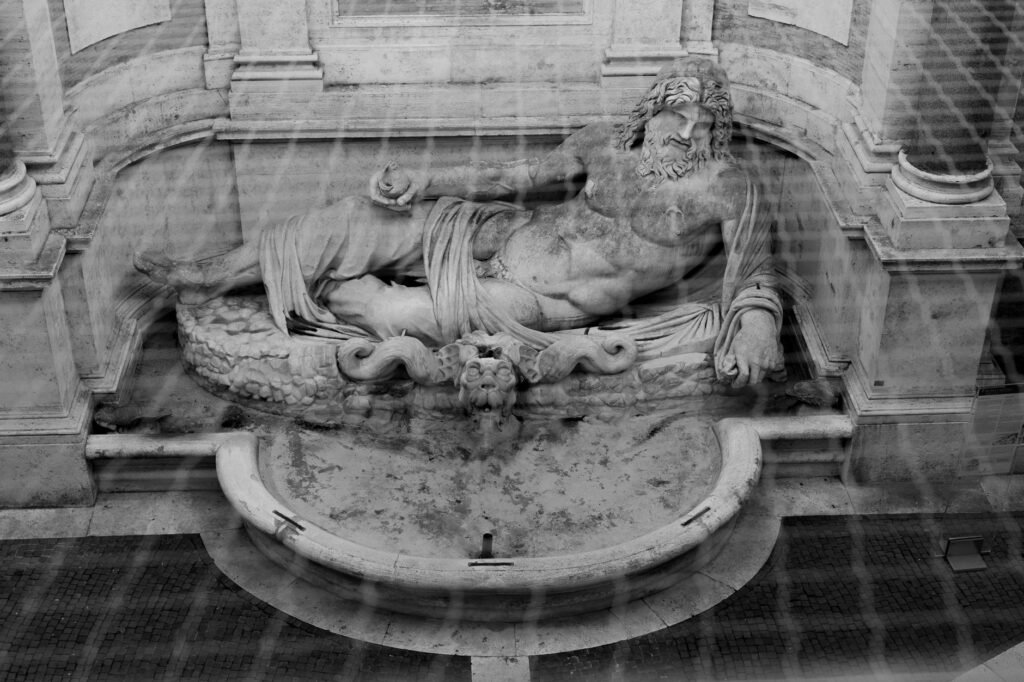
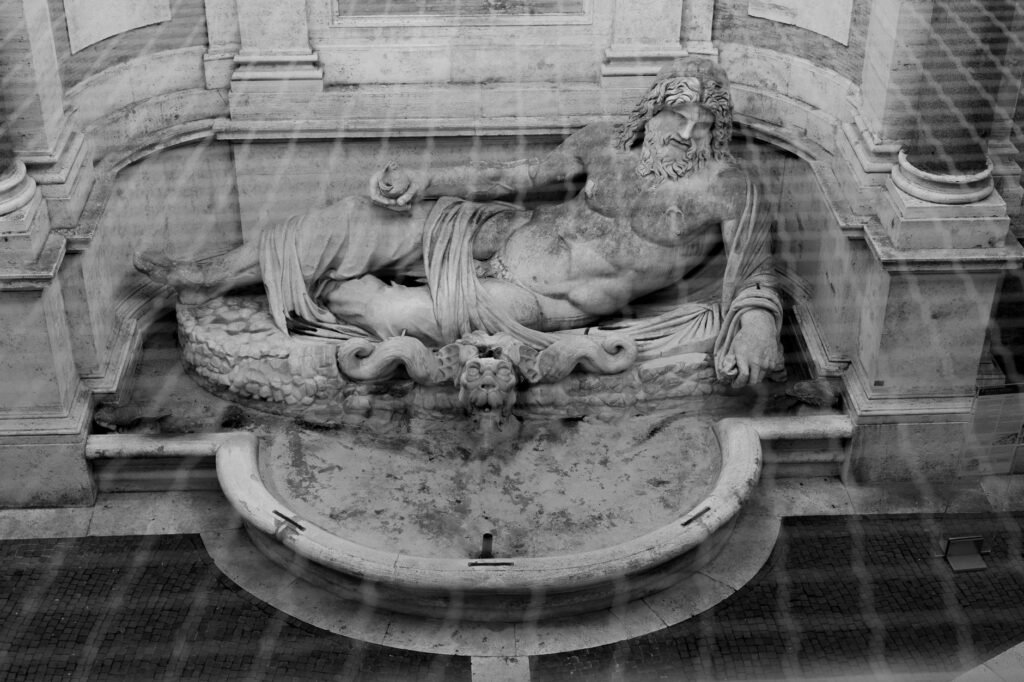
Neptune appears frequently in Renaissance, Baroque, and modern art as a powerful sea god, usually with a trident and often surrounded by horses, dolphins, or sea nymphs. Fountain sculptures of Neptune are common in European cities.
Literature
Neptune appears in epic poetry, opera, modern retellings, and fantasy literature as a symbol of the sea’s grandeur and danger. Classical allusions to Neptune are common in poetry and scholarly writing.
Cinema, Television, and Games
In modern entertainment, Neptune may appear as:
- a mythological character
- a symbolic sea ruler
- a planet-based or science-fiction reference
- a source of names for characters, ships, or places
Popular Symbolism
Neptune remains a cultural shorthand for:
- oceanic power
- nautical authority
- ancient divinity
- the awe inspired by deep water
Curiosities
- Neptune was not always primarily a sea god; his older role may have been closer to that of a water deity connected with springs and freshwater.
- Horses are among his most distinctive symbols, even though modern audiences often overlook this aspect.
- The Neptunalia was celebrated in the heat of July, when water would have had especially practical importance.
- Roman art often depicts Neptune in a very Greek style, showing how strongly his image was shaped by cultural exchange.
- The modern planet Neptune was discovered in 1846, long after the god had become a standard classical name in astronomy.
- In some traditions, Neptune’s consort Salacia is interpreted as embodying the sea’s calm or the salt water itself.
- Because ancient authors used Neptune and Poseidon almost interchangeably, details about him can vary considerably from one text to another.
Frequently Asked Questions
1. Who was Neptune in Roman mythology?
Neptune was the Roman god of water, the sea, and horses. In later Roman tradition, he was identified with the Greek god Poseidon.
2. Was Neptune originally a sea god?
Not necessarily in the earliest Roman tradition. Many scholars think his oldest role may have centered on fresh water, springs, and moisture before he became closely associated with the sea.
3. Why is Neptune associated with horses?
Neptune was linked to horses in both Roman and Greek traditions. The reason is not fully certain, but the connection was important enough that horses became one of his major symbols.
4. What is Neptune’s main symbol?
His best-known symbol is the trident, a three-pronged spear associated with power over waters and the sea.
5. What was the Neptunalia?
The Neptunalia was a Roman festival held on 23 July in honor of Neptune. It likely reflected the importance of water during the dry season.
6. Is Neptune the same as Poseidon?
In Roman literature and art, Neptune is usually treated as the Roman equivalent of Poseidon. However, the earlier Roman deity may have had a somewhat different original function.
7. Did Romans worship Neptune often?
Neptune had an established cult and was honored in festivals and prayers, especially in contexts involving water, sailing, or horses. He was important, though not as central as Jupiter.
8. Why is the planet Neptune named after the god?
The planet was named after the Roman god because of the classical tradition of naming planets after deities and because the planet’s blue color evokes the sea.
Conclusion
Neptune is one of the most enduring figures in Roman mythology. As a god of waters, seas, and horses, he united practical concerns with cosmic significance. His character evolved over time, shaped by Italic religion, Roman ritual, and strong Greek influence. This makes him a valuable example of how ancient religions changed through contact, reinterpretation, and literary tradition.
From the Neptunalia in ancient Rome to the modern planet bearing his name, Neptune has remained a powerful symbol of the sea’s majesty and unpredictability. His legacy survives not only in mythological studies but also in art, astronomy, and the broader cultural imagination of the classical world.

Orin Vale has spent the better part of two decades tracing the threads that connect the world’s oldest stories — from the halls of Asgard to the banks of the Nile, from Olympus to the jungles of the Maya. What began as a childhood fascination with flood myths and trickster gods grew into years of independent study across comparative mythology and ancient religion, always chasing the same question: what did these stories mean to the people who first told them? Orin writes for readers who want more than trivia — the ones looking for the beliefs, fears, and truths that myths were built to carry.