The Founding of Rome by Romulus and Remus
Introduction
The founding of Rome by Romulus and Remus is one of the most famous origin stories in Western tradition. It explains how Rome, the city that would become the center of a vast empire, was believed to have begun through a dramatic mixture of divine ancestry, royal intrigue, abandonment, survival, and fratricide. Although the story belongs to mythology rather than verifiable history, it has shaped Roman identity for centuries and remains a foundational narrative in literature, art, politics, and public memory.
The legend of Romulus and Remus was not simply a tale about two brothers. It was also a story about legitimacy, destiny, violence, and the relationship between humans and the gods. For the Romans, it helped explain why their city had a sacred destiny and why its institutions were thought to be rooted in divine favor and ancient tradition.
Origin and Meaning
The names Romulus and Remus are central to the legend, and ancient authors themselves debated the meaning and origin of the story. In the standard version, Romulus is the founder and first king of Rome, while Remus is his twin brother and rival. The name Rome was traditionally linked to Romulus, implying that the city took its name from its founder.
Ancient and modern scholars have long recognized that the story is not a straightforward historical record. It is a foundation myth: a narrative created to explain a city’s beginnings, identity, and sacred status. The details vary among sources, and some elements may have been shaped or expanded over time to fit Roman political and cultural needs.
Etymological and traditional explanations
Several ancient traditions tried to explain the names and the city’s origin:
- Romulus was connected to Roma, the city name, as its eponymous founder.
- Remus may have been an older or alternative figure in local legend, later paired with Romulus.
- Some ancient writers proposed that the brothers’ story developed from earlier Italic or Greek myths about twins, royal infants, or divine ancestry.
The name Roma itself has uncertain etymology. Ancient explanations were varied, and no single derivation is universally accepted.
Historical Context
The legend of Romulus and Remus emerged in the broader context of early Roman identity formation. Rome’s traditional founding date, 753 BCE, was established by Roman antiquarians, especially Varro, and became the standard date in later Roman chronology. This date is not independently confirmed by archaeology as a precise historical moment, but it reflects the Roman attempt to organize their past into a coherent civic timeline.
Political and religious background
The story reflects key features of early Roman society:
- Kingship and royal succession, since the brothers are linked to a royal Alban lineage.
- Divine ancestry, through their mother Rhea Silvia and the god Mars.
- Exile and survival, common themes in mythic founding narratives.
- Sacred geography, especially the hills along the Tiber River.
Rome’s later institutions were often projected backward into the legendary age. As a result, the myth served both religious and political purposes. It established Rome as a city born under divine sanction and destined for greatness.
Relation to other foundation myths
The founding of Rome by Romulus and Remus shares features with other ancient origin stories:
- A miraculous or noble birth
- An abandoned child motif
- A sign or omen proving legitimacy
- A violent struggle preceding political order
These elements appear in various forms in Greek, Near Eastern, and Italic traditions, showing that the Roman story belonged to a wider mythological pattern.
Main Characteristics
Romulus and Remus are usually presented as twin brothers of royal descent whose lives are marked by danger from the beginning. Their defining characteristics in the myth include:
- Royal lineage: they are connected to the ruling house of Alba Longa.
- Divine paternity: Mars, the god of war, is commonly named as their father.
- Abandonment and rescue: they are exposed after birth and saved by extraordinary means.
- Leadership and rivalry: both claim the right to found a city.
- Fraternal conflict: the myth culminates in Remus’s death.
- Founding authority: Romulus becomes the sole founder of Rome.
The story is notable for combining heroic origin with tragic conflict. The city’s beginning is not peaceful; it is achieved through division, competition, and bloodshed.
Family and Genealogy
The genealogy of Romulus and Remus places them within a prestigious mythic line.
Family tree in the traditional account
| Figure | Relationship | Notes |
|---|---|---|
| Numitor | Grandfather | Deposed king of Alba Longa |
| Rhea Silvia | Mother | Daughter of Numitor; a Vestal Virgin in the myth |
| Mars | Father, in most versions | God of war; divine paternity is often emphasized |
| Romulus | Twin brother | Founder of Rome |
| Remus | Twin brother | Killed before or during the founding |
Rhea Silvia and Numitor
Rhea Silvia, also called Ilia in some traditions, was the daughter of Numitor, king of Alba Longa, a city in Latium linked to Rome’s legendary ancestry. Her uncle Amulius usurped the throne and forced her to become a Vestal Virgin, supposedly to prevent her from producing heirs. Despite this, she became pregnant with the twins.
Spouses and descendants
In the strict myth of the foundation, Romulus and Remus do not have spouses or children together. Romulus, in later traditions, is associated with a Roman wife or wives only in incidental or variant accounts, but the core foundation myth does not depend on a family line through marriage. Romulus is more important as a founder and king than as an ancestor through descent.
Symbols
The legend is associated with several powerful symbols that became important in Roman culture.
Key symbolic elements
- The she-wolf: the most famous symbol of the myth, representing rescue, nurture, and fierce survival.
- The Tiber River: a boundary, danger, and route of deliverance.
- The Palatine Hill: the site traditionally linked with Romulus’s city.
- The furrow or boundary line: a sacred marker of the city’s limits.
- The augur’s staff and birds: symbols of divine approval and ritual authority.
Meaning of the symbols
| Symbol | Meaning |
|---|---|
| She-wolf | Protection, nourishment, ferocity, and the abnormal circumstances of Rome’s birth |
| Tiber River | Threat and salvation; the natural setting of the myth |
| Palatine Hill | Sacred center of early Rome |
| Boundary furrow | Legal and religious foundation of the city |
| Bird omens | Divine sanction in deciding leadership |
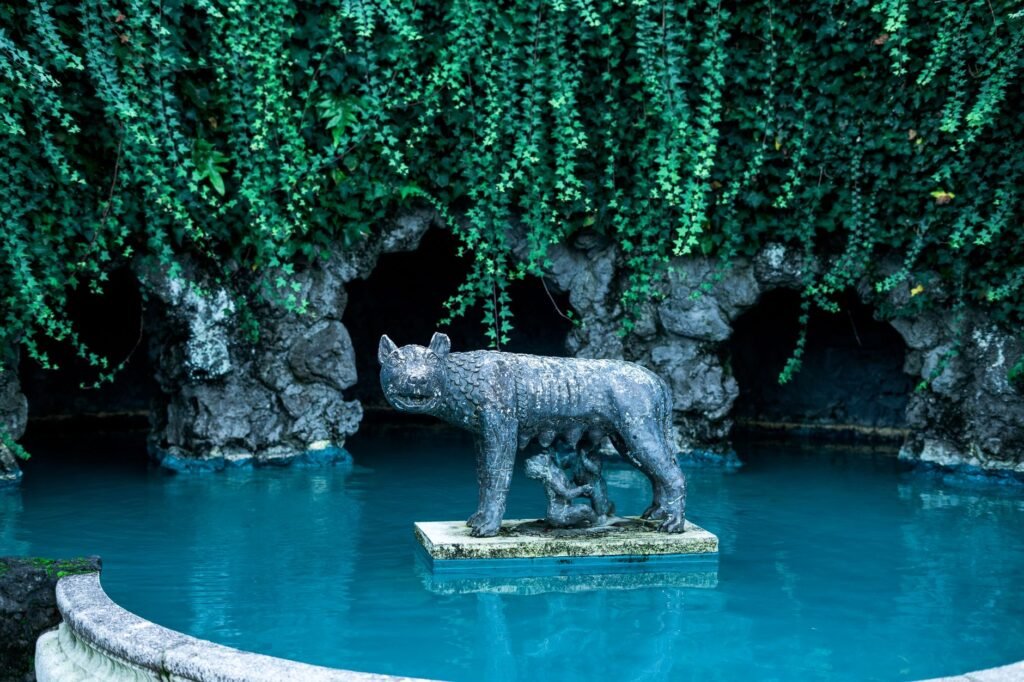
The image of the she-wolf nursing the twins became one of the most enduring emblems of Rome.
Sacred Animals
Several animals are central to the foundation story and Roman interpretations of it.
The she-wolf
The most famous sacred animal in the myth is the wolf, especially the she-wolf who nurses the infants. In Latin, the word lupa can mean “she-wolf,” but it could also be used colloquially for a prostitute. Some ancient interpreters and modern scholars have noted that this ambiguity may have influenced versions of the story, though the wolf interpretation became canonical in Roman culture.
The wolf symbolizes:
- Nurture through danger
- Wild strength
- Survival outside normal human protection
- The harshness and vitality of Rome’s beginnings
The woodpecker
In some ancient accounts, a woodpecker also feeds or guards the twins. This bird is associated with Mars, reinforcing the divine connection of the brothers. The role of the woodpecker varies by source and is less prominent than that of the wolf.
Other animals in the story
- Cattle and shepherds appear in the pastoral environment where the twins are raised.
- Birds play a crucial role in the later rivalry between Romulus and Remus, since augury based on bird signs determines leadership.
Sacred Plants
The myth is not strongly associated with a single sacred plant in the way that some gods or heroes are, but several plants and natural settings appear in related Roman traditions.
Important vegetal associations
- Fig tree: The twins are often connected with the Ficus Ruminalis, a sacred fig tree near the site of the wolf’s cave.
- Sacred groves: Early Roman religion often emphasized groves and natural sacred spaces rather than monumental temples.
- Boundary vegetation: Trees and shrubs around the city’s limits were symbolically significant in marking sacred space.
The Ficus Ruminalis
The Ficus Ruminalis was especially important because it was traditionally located near the place where the twins were found. The name was linked in Roman tradition to Rumina, a deity or protective power associated with nursing and infant care. This gave the story additional religious depth, connecting survival to sacred nurture.
Sacred Places
The myth is tied to several locations in and around Rome and Alba Longa.
Major places in the tradition
| Place | Significance |
|---|---|
| Alba Longa | Legendary royal homeland of the twins’ maternal family |
| The Tiber River | Where the infants are exposed and where the basket drifts |
| Palatine Hill | Site of Romulus’s settlement and later central to Rome |
| Lupercal | The cave where the she-wolf is said to have sheltered the twins |
| Capitoline Hill | Closely associated with later Roman power and urban development |
The Lupercal
The Lupercal was a cave or sacred site on the Palatine Hill associated with the wolf and the twins. It played a lasting role in Roman ritual and memory. Although the exact historical and archaeological relationship between the cave and the myth is debated, ancient Romans treated the site as profoundly significant.
Alba Longa
Alba Longa belongs to the legendary prehistory of Rome. It provided Rome with an aristocratic ancestry and linked Roman origins to an older Latin settlement tradition. Its destruction or absorption in later accounts symbolized Rome’s rise over its regional predecessors.
Powers and Attributes
Romulus and Remus are not gods, but the myth attributes to them roles and qualities that give them near-sacred authority in Roman memory.
Principal attributes
- Founders of a city
- Claimants to royal legitimacy
- Receivers of divine signs
- Agents of order and boundary-making
- Symbols of Roman identity
Romulus in particular becomes associated with:
- The founding of the city
- The creation of political institutions
- Military leadership
- Sacred boundaries
- The assumption of kingship
Remus, by contrast, is often remembered as the challenger whose death marks the cost of founding. Different sources vary on the circumstances of his death, but the fraternal conflict is central to the myth.
Main Myths
The myth of the founding of Rome develops through several major episodes.
The overthrow of Numitor
Numitor is displaced by his brother Amulius, who seizes the throne of Alba Longa. To prevent Numitor’s line from continuing, Amulius forces Numitor’s daughter Rhea Silvia to become a Vestal Virgin. Despite this, she conceives the twins, usually said to be by Mars.
Exposure of the infants
Amulius orders the infants to be destroyed, but they are placed in a basket and set adrift on the Tiber River. The river recedes or carries them to safety, depending on the version.
Rescue and upbringing
The twins are found near the Palatine Hill, where the she-wolf nurses them. In some accounts, a shepherd named Faustulus and his wife Acca Larentia raise the boys. These details vary somewhat among ancient authors.
Recognition and return
As young men, Romulus and Remus discover their true identity, overthrow Amulius, and restore Numitor. This phase of the myth connects the twins with rightful kingship and justice.
The dispute over the city’s site
Romulus and Remus then decide to found a city, but they disagree over where and who should rule. They seek divine signs through augury. The exact sequence varies by source:
- In some accounts, Remus sees birds first.
- In others, Romulus sees more birds or more favorable signs.
- The dispute escalates into conflict.
The death of Remus
The most famous and tragic element is the death of Remus. In the best-known version, Remus either mocks or violates the boundary of the new city, and Romulus kills him. Ancient authors differ on whether Romulus acted deliberately, in anger, or as an act of political necessity. This episode has been interpreted as a mythic statement that the city’s law and boundary must prevail over personal ties.
Romulus as founder and king
After Remus’s death, Romulus becomes the sole founder and first king of Rome. He is credited in later tradition with organizing the city, establishing institutions, and populating Rome by attracting settlers and outsiders.
Relationship with Other Mythological Figures
The story of Romulus and Remus is connected to a wider network of gods, heroes, and ancestral figures.
Major relationships
- Mars: the divine father in most versions; links Rome to war and strength.
- Rhea Silvia: the mother, whose status as a Vestal gives the story religious tension.
- Numitor: the rightful grandfather and restored king.
- Amulius: the usurping uncle and enemy.
- Faustulus and Acca Larentia: foster figures in some versions.
- Aeneas: an earlier Trojan ancestor in Roman foundational tradition, often linked to the broader genealogy of Rome.
- Faunus or other rustic figures: appear in some local or variant traditions associated with the twins’ upbringing.
Romulus and Aeneas
Roman tradition eventually connected Romulus to Aeneas, the Trojan hero, through a long genealogical chain involving Alba Longa. This allowed Romans to integrate multiple origin stories: one rooted in Troy and another in Latium. In this broader scheme, Romulus became the ultimate founder of the city, while Aeneas served as a distant ancestral predecessor.
Worship and Cult
Romulus and Remus were not worshipped in the same way as Olympian gods, but their memory entered Roman religious life and public ritual.
Ritual and civic memory
- Boundary rituals at the city’s foundation reflected the sacred importance of Romulus’s act.
- The Lupercalia, an ancient Roman festival held in February, was associated with fertility, purification, and the Lupercal. Its exact connection to the twins is traditional rather than fully certain, but it was strongly linked in Roman memory to the founding legend.
- The Parilia was later connected in Roman tradition to the anniversary of Rome’s founding on April 21.
Cult of Romulus
Romulus was later honored in Roman tradition under a deified form sometimes called Quirinus. The relationship between Romulus and Quirinus was complex and debated even in antiquity. Some Romans believed Romulus was transformed into a god after death or disappearance.
Public commemorations
Rome’s political culture repeatedly invoked the founding myth through:
- Speeches
- Civic festivals
- Coins
- Temples and monuments
- Historical writings
These practices reinforced the city’s sacred identity.
Ancient Sources
The story of Romulus and Remus is preserved across many ancient writers, and their accounts do not always agree.
Major classical sources
| Author | Work | Contribution |
|---|---|---|
| Livy | Ab Urbe Condita | The most influential historical narrative of Rome’s early history |
| Dionysius of Halicarnassus | Roman Antiquities | Detailed Greek account of Roman origins |
| Plutarch | Life of Romulus | Biographical treatment with variants and interpretations |
| Virgil | Aeneid | Broader mythic framework for Rome’s destiny |
| Ovid | Fasti | Ritual and calendrical associations |
| Varro | Chronological and antiquarian works, known through later references | Standardized Rome’s traditional founding date |
| Servius | Commentary on Virgil | Preserves antiquarian explanations |
| Festus and later antiquarians | Lexicographic and antiquarian material | Additional details on Roman ritual and place names |
Differences among sources
Ancient authors differ on:
- Whether Mars was the twins’ father or only a symbolic ancestor
- Whether the she-wolf was literal or the result of a linguistic ambiguity
- The exact role of Faustulus and Acca Larentia
- The details of the augural contest
- How Remus died and whether Romulus intended his death
Because of these differences, the legend should be understood as a tradition with multiple versions, not a single fixed narrative.
Roman Equivalent
There is no strict “Roman equivalent” to Romulus and Remus because they are the Roman origin figures themselves. However, in comparative terms, Romulus functions like a culture hero and founder-king, combining the roles of lawgiver, warrior, and city founder.
If one speaks of Roman adaptation, it is more accurate to say that Rome adopted and reshaped earlier Italic and Mediterranean motifs into a uniquely Roman foundation story. The myth also became a counterpart to other Roman ancestral traditions, especially the story of Aeneas.
Influence on Modern Culture
The founding of Rome by Romulus and Remus has had a major influence on Western culture.
Literature and scholarship
The story appears in:
- Classical reception studies
- Renaissance historical writing
- Modern historical fiction
- Poetry and drama
- Academic works on myth, politics, and religion
Art and visual culture
The she-wolf nursing the twins is one of the most recognizable images in world art. It has been reproduced in:
- Statues
- Coins
- Paintings
- Book illustrations
- Public monuments
Film, television, and games
Romulus and Remus have appeared in:
- Historical films
- Television dramas about ancient Rome
- Strategy and role-playing games
- Documentaries on Roman history
- Fictional retellings of Rome’s origins
Political symbolism
The myth has also been used in modern political imagery, sometimes to evoke:
- National origin
- Civilizational endurance
- Military strength
- Collective identity
Because the story is so closely tied to Roman power, it has often been invoked in discussions of empire, authority, and state formation.
Curiosities
- The famous wolf image may have been inspired by a linguistic ambiguity in Latin, since lupa could mean either “she-wolf” or, in some contexts, a woman of loose reputation.
- The date 21 April became Rome’s traditional birthday in antiquity.
- The she-wolf statue often associated with the twins became a lasting emblem of Rome, though the precise dating of surviving versions has been debated.
- Some ancient traditions connect Remus not only with rivalry but also with the idea that Rome’s foundation required a victim or sacrifice.
- The story of the twins was important enough to be used in Roman public identity, state imagery, and later imperial propaganda.
- The myth combines elements of pastoral life, royal politics, and divine ancestry, making it unusually rich compared with many simple city-foundation stories.
Frequently Asked Questions
1. Did Romulus and Remus really found Rome?
No historical evidence confirms the literal story. The account is a Roman foundation myth that explains the city’s origins and identity.
2. Why is the she-wolf so important?
The she-wolf symbolizes the miraculous survival of the twins and has become the most famous image associated with Rome’s origin.
3. Who killed Remus?
In the traditional version, Romulus kills Remus during a dispute over the founding of the city. Ancient sources vary on the details.
4. Was Mars really their father?
Most Roman traditions say yes, but this belongs to mythology, not historical fact. The claim linked Rome to divine power and military strength.
5. What is the significance of the Palatine Hill?
The Palatine Hill was believed to be the site where the twins were found and where Romulus founded the city, making it central to Roman sacred geography.
6. What ancient authors wrote about Romulus and Remus?
Major sources include Livy, Dionysius of Halicarnassus, Plutarch, Virgil, and Ovid, among others.
7. Why does the story matter today?
It remains important because it shaped Roman self-understanding and continues to influence art, politics, and historical imagination.
Conclusion
The founding of Rome by Romulus and Remus is one of antiquity’s most enduring myths. It is not a historical account in the modern sense, but a powerful narrative that explains how Romans imagined their city’s beginnings, its sacred legitimacy, and its destiny. Through the themes of divine ancestry, survival, conflict, and foundation, the story expresses key Roman values while also revealing the tensions at the heart of Roman identity.
From ancient literature to modern symbolism, the legend has remained a central part of Rome’s cultural legacy. The image of the twins and the she-wolf continues to represent not only the city of Rome but also the enduring power of foundational myths in human history.

Orin Vale has spent the better part of two decades tracing the threads that connect the world’s oldest stories — from the halls of Asgard to the banks of the Nile, from Olympus to the jungles of the Maya. What began as a childhood fascination with flood myths and trickster gods grew into years of independent study across comparative mythology and ancient religion, always chasing the same question: what did these stories mean to the people who first told them? Orin writes for readers who want more than trivia — the ones looking for the beliefs, fears, and truths that myths were built to carry.