Introduction
Heka is one of the most important concepts in ancient Egyptian religion and mythology. In modern discussions, people often ask “who is Heka in Egyptian mythology?” because the answer is more complex than identifying a single god or spirit. Heka was both a divine force and a personified deity associated with magic, sacred power, and the effective use of words and rituals. In Egyptian thought, he was not simply a magician in the modern sense, but the power that made creation, divine action, and ritual efficacy possible.
Heka mattered deeply in ancient Egyptian culture because it stood at the intersection of religion, medicine, kingship, and cosmic order. The concept appears in texts across many centuries and was central to how Egyptians understood the relationship between gods, humans, and the unseen forces that shaped the world.
Origin and Meaning
The word heka in ancient Egyptian refers to magic, ritual power, or effective divine force. It is both a common noun and the name of a divine being. This dual use is significant: in Egyptian religion, abstract power could be understood as something personal and divine.
The exact linguistic development of the term is discussed by scholars, but in general it is understood as a deeply native Egyptian concept rather than a borrowing from another culture. Heka as an idea appears very early in Egyptian religious thought and remains important for millennia.
Meaning in Egyptian religion
In Egyptian usage, heka was not restricted to illusion or trickery. It referred to:
- the power that makes spoken words effective
- ritual efficacy
- divine authority
- supernatural protection
- the force that allows gods and kings to act in the world
This is why modern translations such as “magic” can be misleading if taken in a narrow sense. Egyptian heka was a sacred and legitimate force, often necessary for maintaining order against chaos.
Historical Context
Heka is among the oldest religious concepts in ancient Egypt. It is prominent in funerary and ritual texts from the Old Kingdom onward and continues to appear in later temple inscriptions, magical papyri, and medical spells.
Heka in Egyptian worldview
Ancient Egyptian religion emphasized balance, order, and continuity. The cosmos was understood as a fragile system that required constant maintenance. Heka played a vital role in this system because it was the power through which:
- gods created and protected
- priests performed effective rituals
- kings governed by divine sanction
- the dead were safeguarded in the afterlife
- disease, demons, and chaos could be countered
In this sense, Heka was not peripheral to Egyptian religion. He was part of the mechanism of divine order itself.
Historical development
Over time, Heka moved between two related roles:
- A principle or force
- A deity personifying that force
This fluidity is typical of Egyptian religion, where gods, concepts, and cosmic functions often overlap. Heka was sometimes treated as an independent god and at other times as an essential power available to major gods such as Ra and Osiris.
Main Characteristics
Heka’s main characteristic is that he represents magical and divine power in its most authentic Egyptian form. He is not usually depicted as a major mythological actor with a long narrative cycle. Instead, he is a foundational presence underlying ritual and divine action.
Key traits
- Personification of magical power
- Association with speech, names, and ritual words
- Connection to protection and healing
- Linked to kingship and priestly practice
- Seen as an ancient force older than many formal cults
Iconography
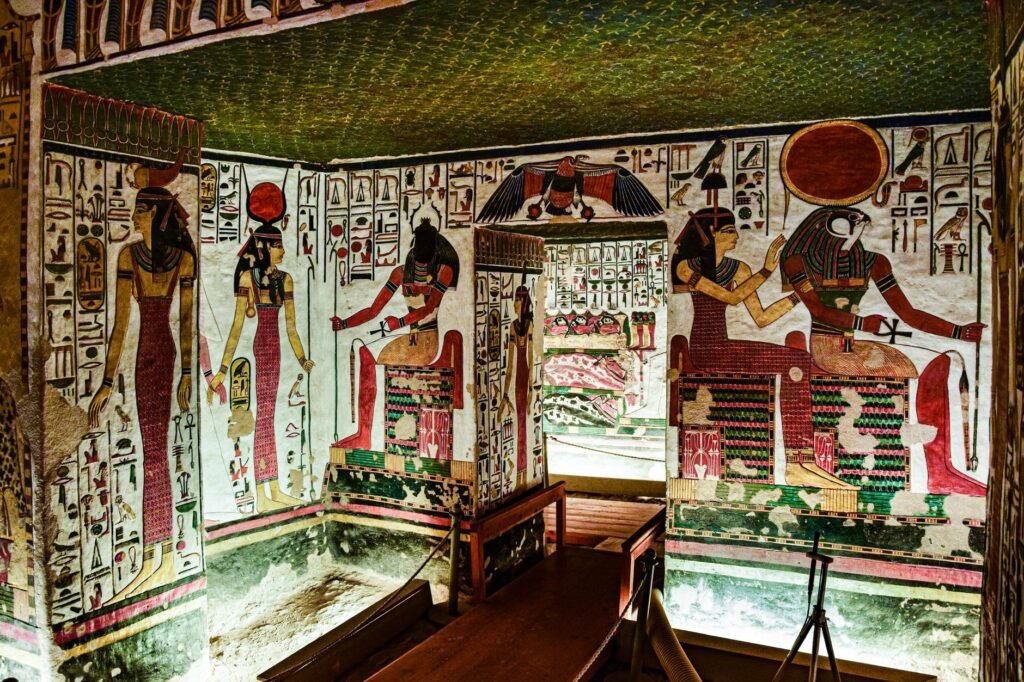
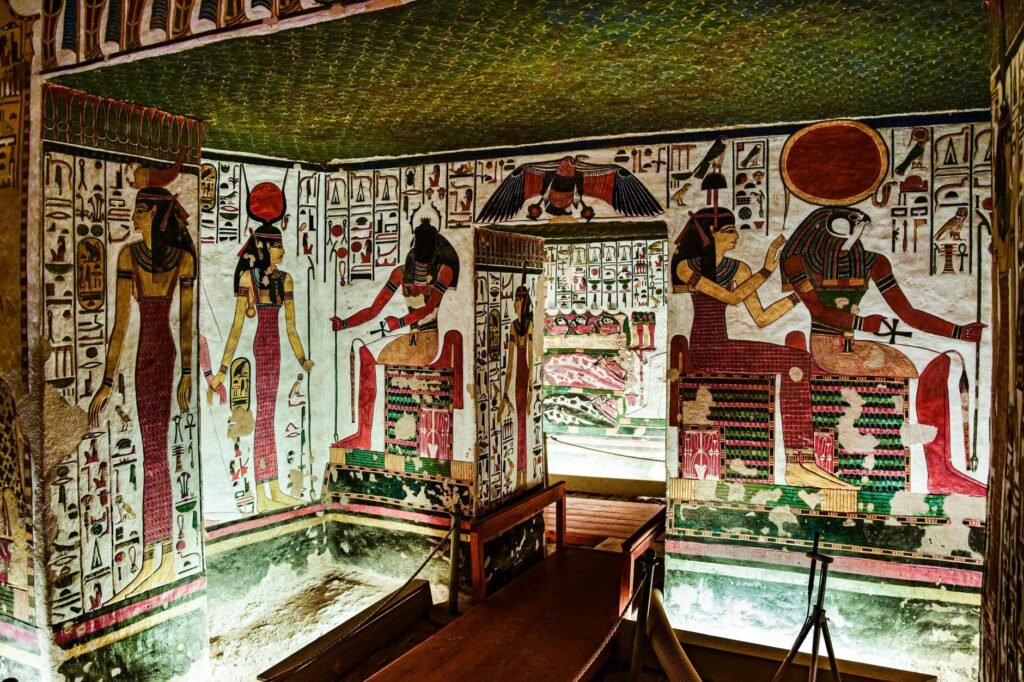
When Heka is represented as a deity in Egyptian art, he is commonly shown as a man wearing a special headdress and often carrying symbols of power. However, his iconography is less standardized than that of major gods like Horus or Anubis, and representations vary depending on period and context.
Family and Genealogy
Unlike many Egyptian gods, Heka does not have a universally fixed genealogy. Ancient sources do not present one single family tree for him, and this is an important point for understanding his nature.
Genealogical status
- In many contexts, Heka appears without parents, spouse, or children
- Some traditions integrate him among the divine retinue of Ra
- In late theological texts, he may be described as a primordial or necessary divine presence rather than a family-based deity
Because Egyptian religion was highly local and textually diverse, different sources may give different theological relationships. No single canonical genealogy exists for Heka.
Symbols
Heka does not have a universally fixed set of symbols like the ankh or the Eye of Horus, but several objects and signs are associated with his power.
Common symbolic associations
- Crook and flail in some royal or divine contexts, reflecting authority
- Hieroglyphic signs and written words, because magic was often activated through names and inscriptions
- Ritual implements used by priests and healers
- Protective amulets, especially those employed in spells
Symbolic meaning
These objects reflect an important Egyptian belief: power becomes effective when properly named, inscribed, and ritually enacted. Heka therefore stands not only for supernatural force but for the principle that language and ritual can shape reality.
Sacred Animals
Heka does not have a single sacred animal comparable to the ibis of Thoth or the falcon of Horus. Nevertheless, in Egyptian religion, animals were often used to express divine qualities, and Heka’s associations are indirect rather than fixed.
Animal associations in broader context
Heka may appear in contexts connected to:
- serpents, due to the role of protective and dangerous serpent magic in Egyptian thought
- lions, sometimes linked more generally to protective strength and apotropaic power
- bulls or other strong creatures in the wider symbolic language of divine force
These are not exclusive sacred animals of Heka, but they help express the kind of power he embodied.
Sacred Plants
There is no single plant uniquely and consistently associated with Heka across ancient Egyptian sources. However, plants were important in Egyptian ritual, medicine, and protective magic, areas closely linked to his domain.
Plants in magical and healing contexts
Plants often used in Egyptian spells and remedies included herbs, resins, and other medicinal substances. Because Heka governed the efficacy of ritual and healing, he is conceptually tied to plant-based preparation in magic and medicine, even if no exclusive sacred plant is attested.
Common ritual substances in Egyptian practice included:
- incense
- myrrh
- frankincense
- herbal ingredients used in amulets and potions
These materials mattered less as symbols of Heka than as media through which heka, the force, could be activated.
Sacred Places
Heka was not limited to one local cult center in the way some gods were. His presence was widespread, because heka as a power was essential everywhere in Egypt.
Important places of association
Since Heka was integrated into many religious systems, his significance is found in:
- temples, where priests used ritual speech and offerings
- funerary complexes, where spells protected the dead
- medical workshops and priestly houses of life (per ankh), where sacred texts were studied and copied
- royal courts, where the king’s authority was believed to depend on divine power
Broader sacred geography
Rather than belonging to one mountain, city, or shrine, Heka belonged to the ritual landscape of Egypt as a whole. He was present wherever sacred words, offerings, and protective rites were performed.
Powers and Attributes
Heka’s powers are best understood as the powers of effective sacred action.
Main domains
- Magic and ritual efficacy
- Protection against harmful forces
- Healing and medicine
- Empowerment of divine speech
- Support of kingship and legitimacy
- Maintenance of cosmic order
Why Heka mattered
In Egyptian thought, a ritual was not merely symbolic. If performed correctly, it could produce real effects. Heka was the power that made this possible. Priests, physicians, and even kings relied on heka to:
- protect the living
- heal the sick
- ward off demons and hostile forces
- preserve the dead in the afterlife
- uphold maat, the principle of cosmic order
Heka and spoken language
One of Heka’s most important attributes is his connection to words. Names, spells, prayers, and formulas were not just speech; they were instruments of action. This is why Egyptian magical texts often emphasize exact wording and precise performance.
Main Myths
Unlike gods such as Osiris, Isis, or Horus, Heka is not the center of a single major narrative myth cycle. Instead, he appears across a broad range of religious literature and cosmological thought.
Heka in creation and divine action
Egyptian theology sometimes treats Heka as a power present at creation or necessary to creation. In some texts, he is closely associated with Ra, the sun god, and with the ability of gods to act through word and intention.
Heka in the afterlife
Heka is also important in funerary traditions. Spells in texts such as the Pyramid Texts, Coffin Texts, and Book of the Dead often invoke divine power to protect the deceased, repel enemies, and ensure passage to the afterlife. Heka is not always named as a character in these texts, but his force is fundamental to their operation.
Heka in healing and protection
Magical and medical papyri from later periods show that Egyptian healers used spells alongside practical remedies. Heka was the unseen power that made those spells effective. In this way, he belongs to the mythic world of Egyptian healing and defense against chaos.
Relationship with Other Mythological Figures
Heka’s identity is often defined through relationships with other gods rather than through isolated stories.
Relationship with Ra
Heka is frequently linked to Ra, the solar creator and supreme cosmic power in many Egyptian traditions. This connection emphasizes heka as a force that accompanies divine authority and creation.
Relationship with Osiris
Because Osiris is central to death, resurrection, and the afterlife, Heka’s power is relevant to Osirian funerary beliefs. The protective spells used to restore and guard the dead depend on heka.
Relationship with Isis
Isis is one of the most famous Egyptian goddesses associated with magic, especially in later tradition. Her magical skill is sometimes more visible in myth than Heka himself. The relationship between the two is not one of clear rivalry, but rather of complementary roles: Isis is the skilled divine practitioner, while Heka is the power that makes magic work.
Relationship with Thoth
Thoth, the god of wisdom, writing, and sacred knowledge, also overlaps with Heka. Thoth provides the intellectual and scribal dimension of sacred language, while Heka represents its active force.
Relationship with priests and kings
Human ritual specialists and the pharaoh were not gods, but they were believed to use heka legitimately. The king especially was thought to possess divine sanction and the capacity to mediate between gods and people through ritual authority.
Worship and Cult
Heka was worshiped differently from many gods because his presence was embedded in ritual practice itself. There was not necessarily a highly centralized public cult focused only on Heka, but he was invoked everywhere sacred power was needed.
Forms of worship
Heka was expressed through:
- temple rites
- funerary spells
- healing rituals
- protective incantations
- amuletic practices
- royal ceremonial acts
Ritual context
Egyptian rituals often required:
- recitation of precise words
- offering of food and incense
- use of figurines, amulets, or written texts
- purification and repetition
These were not viewed as symbolic gestures alone. They were practical religious technologies based on heka.
Magic and legitimacy
The Egyptians did not generally divide religion and magic in the modern way. Much of what scholars call “magic” was simply part of legitimate religious life. Heka was therefore not marginal or forbidden; he was central to proper ritual activity.
Ancient Sources
Heka appears across many kinds of ancient Egyptian sources, though not always as a fully individualized deity.
Important Egyptian sources
- Pyramid Texts: early royal funerary spells that preserve ancient ideas of sacred power
- Coffin Texts: Middle Kingdom funerary literature expanding access to protective spells
- Book of the Dead: later funerary compositions used to guide and protect the dead
- Medical papyri: texts combining practical remedies with ritual incantation
- Temple inscriptions: later theological and ritual references to divine power
- Magical papyri from the Greco-Roman period: evidence of continued interest in ritual efficacy
Classical authors
Classical Greek and Roman writers discussed Egyptian religion, but they did not always isolate Heka as clearly as modern scholarship does. Writers such as Herodotus, Plutarch, and others provide general observations about Egyptian ritual and divine practice, though their accounts are filtered through Greek interpretation. For specific concepts like heka, the most reliable evidence remains the Egyptian textual record itself.
Roman Equivalent
Heka does not have a direct Roman equivalent. Roman religion contained gods and practices related to protection, sacred authority, and ritual effectiveness, but there is no one-to-one counterpart.
Approximate comparisons
Depending on context, Heka may be loosely compared with:
- the Roman idea of religio as proper ritual observance
- the power of incantation and sacred formulae
- certain protective or magical functions associated with deities such as Janus, Apollo, or Mercury, though these are only partial parallels
These comparisons are limited and should not be taken as equivalences. Heka is uniquely Egyptian in both concept and theological role.
Influence on Modern Culture
Heka has attracted growing attention in modern scholarship, popular religion, fantasy media, and museum interpretation, especially as interest in ancient Egyptian magic has increased.
In scholarship
Modern Egyptology often uses the term heka to explain how ancient Egyptians understood ritual power. It has become a key concept in studies of:
- religion
- medicine
- language
- kingship
- funerary practice
In popular culture
Heka appears in modern books, games, and online discussions about Egyptian mythology, though sometimes simplified into “the god of magic.” This description is useful as a starting point but can be misleading if it obscures the broader meaning of heka as a sacred force.
In museum and educational contexts
Museums and documentaries increasingly present heka as part of the intellectual world of ancient Egypt, helping audiences understand that Egyptian “magic” was closely tied to religion, healing, and divine order rather than entertainment or superstition.
Curiosities
Here are some lesser-known facts about Heka and the concept of heka:
- Heka is both a concept and a deity. This dual identity is central to understanding him.
- Egyptian “magic” was not always viewed negatively. In many contexts, it was a legitimate part of religion.
- Words had power. Speaking a name correctly could be as important as using an object or gesture.
- Heka supported both gods and humans. Divine beings, kings, priests, and the dead all relied on sacred power.
- There is no single fixed myth of Heka. He is better understood as a foundational force than as a narrative hero.
- Medical and magical practice overlapped. Ancient Egyptian healing often combined remedies with ritual formulae.
- Modern translations can oversimplify him. Calling Heka merely “the god of magic” misses his wider role in order, language, and divine efficacy.
Frequently Asked Questions
1. Who is Heka in Egyptian mythology?
Heka is the ancient Egyptian deity and personification of magic, ritual power, and sacred efficacy. He represents the force that makes words, rituals, and divine actions effective.
2. Was Heka a major god?
Heka was important, but not always a major mythological figure in the sense of having a large narrative cycle. His importance lies in being a fundamental divine power present throughout Egyptian religion.
3. Is Heka the same as magic?
Not exactly. Heka is often translated as “magic,” but in Egyptian thought it meant sacred power, ritual effectiveness, and the force behind proper speech and action.
4. Did Heka have a family?
Ancient sources do not give Heka a fixed or universal family tree. Different texts may relate him to other gods in different ways, but there is no single canonical genealogy.
5. What symbols are associated with Heka?
Heka does not have one universally fixed symbol, but he is associated with ritual implements, sacred speech, inscriptions, amulets, and divine authority.
6. Was Heka worshiped in temples?
Yes, though not always as a single stand-alone cult figure. Heka was invoked in temple rituals, funerary texts, healing practices, and protective spells.
7. Which gods are closest to Heka?
He is often connected with Ra, Osiris, Isis, and Thoth, depending on the theological context.
Conclusion
So, who is Heka in Egyptian mythology? Heka is the divine embodiment of magic, sacred power, and ritual efficacy in ancient Egypt. He is not merely a trickster or sorcerer, but a foundational concept that helps explain how Egyptians understood creation, healing, kingship, protection, and the afterlife.
His importance lies in the fact that heka was considered a real and necessary force in the universe. Through ritual words, offerings, and divine knowledge, Heka made religious action effective. For this reason, he remains one of the most significant and revealing figures for understanding ancient Egyptian religion as a whole.

Orin Vale has spent the better part of two decades tracing the threads that connect the world’s oldest stories — from the halls of Asgard to the banks of the Nile, from Olympus to the jungles of the Maya. What began as a childhood fascination with flood myths and trickster gods grew into years of independent study across comparative mythology and ancient religion, always chasing the same question: what did these stories mean to the people who first told them? Orin writes for readers who want more than trivia — the ones looking for the beliefs, fears, and truths that myths were built to carry.