Introduction
Meretseger is a significant goddess in ancient Egyptian religion, especially in the religious landscape of Thebes and the Valley of the Kings. Her name is commonly translated as “She Who Loves Silence” or “She Who Loves Silence/Quiet”, reflecting her association with the desert mountain overlooking the royal necropolis. Meretseger is best known as a protector of the Theban mountain region and as a fearsome guardian of sacred and funerary spaces. She could punish wrongdoing, particularly acts committed against tombs, while also showing mercy and granting healing when appeased.
Although she was not among the most widely worshipped Egyptian deities, Meretseger is important because she reveals how Egyptians understood the relationship between landscape, divine power, moral order, and the dead. She personifies a sacred place as much as a divine being, making her a valuable figure for understanding local cults in ancient Egypt.
Origin and Meaning
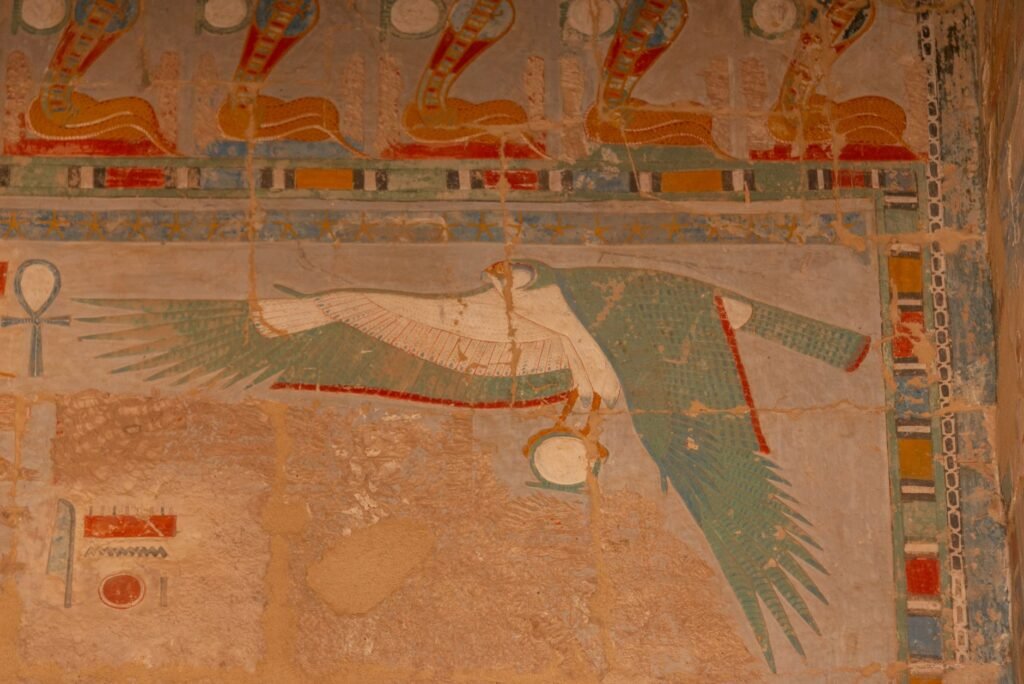
The name Meretseger is usually rendered from Egyptian as mr.t-sgr, often interpreted as “She Who Loves Silence” or “Lover of Silence.” The meaning is generally linked to the quiet of the desert necropolis and the sacred stillness expected in funerary contexts. Some scholars also associate her name with the mountain itself, indicating that she is not merely a goddess of silence but a divine embodiment of the Theban peak.
Her origin is strongly tied to the Theban necropolis on the west bank of the Nile, opposite modern Luxor. Unlike universal gods such as Ra, Isis, or Osiris, Meretseger was primarily a local goddess. She emerged from the religious environment of Deir el-Medina, the workers’ village for the artisans who built and decorated the royal tombs of the New Kingdom.
Her cult appears most clearly during the New Kingdom, especially from the 18th Dynasty onward, when the royal tombs were concentrated in the Valley of the Kings. In this setting, Meretseger became a powerful guardian of the mountain and the cemetery.
Historical Context
Meretseger belongs to the religious world of ancient Thebes, one of Egypt’s major political and spiritual centers during the New Kingdom. The western desert beyond Thebes contained the tombs of kings, queens, officials, and priests. Ancient Egyptians believed this area was under divine supervision.
Her worship developed in a society where:
- the afterlife was a central concern,
- tomb protection was essential,
- local deities often arose from specific landscapes,
- and divine punishment was understood as a real force in everyday life.
The workers of Deir el-Medina lived close to the royal tombs and therefore had a practical and religious relationship with Meretseger. They were responsible for building and maintaining tombs, and they would have feared divine retribution for negligence, theft, or disrespect. As a result, Meretseger came to be seen as a deity who protected the tombs and punished those who violated them.
At the same time, she was not only punitive. In surviving texts and inscriptions, she could also be merciful, especially when the guilty person repented or made offerings. This dual role made her both feared and revered.
Main Characteristics
Meretseger is usually described as a serpent goddess, although her forms vary in Egyptian art and religious texts. She is also associated with the mountain above the Valley of the Kings, which may have been imagined as her living body.
Key characteristics include:
- Guardian of the necropolis
- Protector of the royal tombs
- Punisher of oath-breakers, thieves, and tomb violators
- Goddess of mercy and forgiveness
- Associated with healing and protection from disease
- Personification of the Theban peak
Her iconography is not as standardized as that of major state gods. She may appear:
- as a cobra
- as a snake-headed woman
- as a woman with a cobra on her head
- or as a mountain-shaped divine presence
Because Egyptian religion often linked divinity with landscape, Meretseger’s form as a mountain and as a serpent are not contradictory. In Egyptian symbolism, snakes could be dangerous, protective, regenerative, and liminal at once.
Family and Genealogy
Meretseger is not part of a universally agreed divine family in the way that some major Egyptian deities are. Different sources and local traditions preserve different relationships, and much remains uncertain.
Commonly noted relationships
- She is often linked with the Theban mountain itself, rather than placed within a large mythological genealogy.
- Some traditions associate her with Ptah, Re, or Hathor in broader theological frameworks, though these are not always direct family ties.
- In some scholarly interpretations, she may have been connected conceptually with Hathor, who also had a strong association with the western desert, tombs, and the afterlife.
Unlike Isis and Osiris, Meretseger does not have a well-developed mythic family cycle. Her importance lies more in her function and locality than in a clearly defined family tree.
Symbols
Meretseger’s symbolism reflects her role as a guardian deity of the necropolis.
| Symbol | Meaning |
|---|---|
| Serpent / cobra | Protection, danger, hidden power, and divine punishment |
| Mountain peak | The Theban mountain and the sacred necropolis |
| Silence | The sacred stillness of the desert and tomb area |
| Desert landscape | Boundary between life and death |
| Eye imagery in some contexts | Watchfulness and divine surveillance |
Symbolic interpretations
The cobra is especially important in Egyptian religion. Snakes could represent both threat and protection, and this ambiguity fits Meretseger well. She watched over the necropolis much like a sentinel, ready to strike violators but capable of protecting those who honored her.
The mountain symbolism is equally important. The peak overlooking the Valley of the Kings was seen as a divine presence, a kind of guardian over the tombs below. Meretseger therefore embodied both the physical geography and the spiritual authority of the western Theban desert.
Sacred Animals
The principal sacred animal associated with Meretseger is the snake, especially the cobra.
Symbolic significance of the snake
In ancient Egypt, snakes could symbolize:
- royal protection
- divine wrath
- renewal and rebirth
- the hidden forces of the earth
- thresholds between worlds
Meretseger’s snake form emphasizes her role as a guardian and avenger. The serpent was an especially apt symbol for a goddess connected to tombs, since snakes often inhabit rocky and desert areas and can appear suddenly, suggesting unpredictable divine power.
There is no strong evidence that Meretseger had other major sacred animals in the way that some Egyptian deities were linked with bulls, cats, ibises, or crocodiles.
Sacred Plants
No plant is securely and universally established as Meretseger’s sacred plant. Egyptian religion sometimes connected deities with local vegetation or symbolic plants, but in Meretseger’s case, surviving evidence focuses more strongly on mountain, serpent, and necropolis imagery.
That said, the desert and tomb landscape itself may have had symbolic associations with hardy plants that survived in dry conditions, though these are not specifically tied to her in the sources.
Because the evidence is limited, it is best to say that no particular sacred plant is clearly documented for Meretseger.
Sacred Places
Meretseger is most strongly connected with the Theban necropolis, especially:
- the Valley of the Kings
- the Valley of the Queens
- Deir el-Medina
- the western Theban mountain overlooking these sites
The Theban Peak
The most important sacred place associated with Meretseger is the mountain called Dehnet, often identified with the peak above the Valley of the Kings. This mountain was seen as her home or body. The very shape of the landscape encouraged the idea of a divine guardian watching over the dead.
Deir el-Medina
The workmen’s village at Deir el-Medina provides some of the most valuable evidence for her worship. The artisans who lived there interacted with Meretseger through prayers, vows, offerings, and personal piety. Their records show that she was not an abstract goddess but a practical presence in daily life.
Other connected places
- Tombs in the Valley of the Kings
- Shrines in and around Deir el-Medina
- The western desert near Thebes
Meretseger’s sacred geography is therefore intensely local and closely tied to funerary administration.
Powers and Attributes
Meretseger’s powers are best understood in relation to her role as guardian of sacred space.
Her main domains included:
- Protection of tombs
- Guardianship of the necropolis
- Punishment of wrongdoing
- Healing and mercy
- Overseeing moral conduct in sacred places
- Watching over the hidden world of the dead
She was especially feared by those who violated taboos. Ancient texts suggest that she could strike offenders with illness or suffering. Some individuals who believed they had offended her made confessional prayers, asking for pardon and relief.
This is one of the most striking aspects of Meretseger’s cult: she was not only a deity of punishment but also one of repentance and healing. In this respect, she resembles other Egyptian gods and goddesses whose anger could be transformed through proper ritual behavior.
Main Myths
Meretseger does not have a large mythological cycle comparable to the stories of Osiris, Horus, or Isis. Instead, her myths are largely local, devotional, and moralizing. They survive in inscriptions, hymns, and personal prayers rather than in elaborate narrative literature.
Common themes in her stories
1. Punishment of tomb violators
She was believed to punish those who damaged, stole from, or improperly entered tombs. This reflects the Egyptian view that sacred burial places required vigilant divine protection.
2. Mercy after repentance
Some sources and devotional texts imply that if a person confessed wrongdoing and sought her forgiveness, Meretseger could relent. This gives her a role similar to that of a divine judge who balances justice with mercy.
3. Healing through divine favor
People suffering from illness or misfortune could appeal to her for healing. A disease might be understood as a sign of divine displeasure, and recovery depended on reconciliation.
4. The mountain as a living presence
The Theban peak itself was imagined as alive and divine. In this sense, the “myth” of Meretseger is also a myth of landscape: the mountain watches, judges, and protects.
Relationship with Other Mythological Figures
Meretseger was part of a larger Egyptian religious ecosystem, especially the Theban one.
Important relationships and comparisons
- Hathor: Both were connected to the western desert and could be associated with the dead. Hathor is broader and more prominent, while Meretseger is more local and mountain-centered.
- Ptah: In the world of artisans and craftspeople, Ptah could be important as a creator and patron of skilled labor. He was not Meretseger’s counterpart, but he belonged to the religious environment of Deir el-Medina.
- Amun: As the chief deity of Thebes, Amun dominated official religion. Meretseger belonged to the local cultic landscape beneath the larger state theology.
- Maat: Her role as punisher of wrongdoing aligns with the Egyptian concept of cosmic and moral order.
- Osiris: As lord of the dead, Osiris presided over the afterlife, while Meretseger guarded the physical approaches to tombs.
Rivalries and conflicts
There are no major surviving myths in which Meretseger fights other gods. Her conflicts are more often with human offenders than with divine rivals.
Worship and Cult
Meretseger was worshipped primarily by people living and working near the Theban necropolis, especially the artisans of Deir el-Medina.
Forms of worship likely included:
- prayers for forgiveness
- vows and promises
- small offerings
- personal piety
- appeals for healing
- ritual respect for tomb spaces
Evidence for cult practice
The strongest evidence comes from:
- ostraca
- inscriptions
- votive texts
- funerary and devotional prayers
These sources reveal a deeply personal religious relationship. People did not simply fear her; they also depended on her for protection and help.
Offerings
While the full ritual calendar is not completely known, typical Egyptian offerings may have included:
- food and drink
- incense
- libations
- small figurines or dedicatory objects
- prayers carved or written on stone or pottery
Festivals
No major pan-Egyptian festival of Meretseger is securely documented. Her cult seems to have been local rather than state-wide, so any festival activity would have been regional and tied to Theban and funerary contexts.
Ancient Sources
Meretseger is not widely attested in the most famous classical literary sources such as Homer, Hesiod, or Ovid, who are more relevant to Greek and Roman mythology than to Egyptian goddess traditions. Instead, she is known mainly from Egyptian archaeological and epigraphic evidence.
Primary evidence includes:
- inscriptions from Deir el-Medina
- prayers and hymns written by tomb workers
- references in New Kingdom texts
- funerary and devotional graffiti in the Theban area
Important scholarly source types
- ostraca and papyri
- tomb inscriptions
- stelae
- votive texts
- religious graffiti
Classical authors
Classical Greek and Roman writers generally do not discuss Meretseger by name. As a result, her reconstruction depends far more on Egyptological evidence than on Greco-Roman literary tradition.
Roman Equivalent
Meretseger does not have a precise Roman equivalent. She was a specifically Egyptian, locally Theban deity, and no Roman goddess fully matched her role.
Closest functional parallels
- Nemesis, in her role as a punishing power
- Trivia/Hecate, in a broad sense as a guardian of thresholds and liminal spaces
- local protective spirits, though these are not exact equivalents
However, these comparisons should be used cautiously. Meretseger’s identity as a mountain goddess of the Theban necropolis is unique and does not translate neatly into Roman religion.
Influence on Modern Culture
Meretseger is not as famous in modern popular culture as Isis, Anubis, or Bastet, but she has gained attention in scholarship, museums, and modern reconstructions of Egyptian religion.
Areas of modern interest include:
- Egyptology
- museum displays on Thebes and Deir el-Medina
- books on ancient Egyptian religion
- historical documentaries
- fiction inspired by Egyptian mythology
She occasionally appears in:
- historical novels,
- fantasy works,
- educational media,
- and role-playing or strategy games that draw on Egyptian deities.
Her modern relevance is strongest among readers interested in local cults, workmen’s religion, and the religious geography of ancient Egypt.
Curiosities
- Meretseger is one of the clearest examples of a god embodied by a landscape feature.
- Her cult shows how Egyptians linked moral behavior with physical space.
- She was especially relevant to tomb builders and decorators, not just priests and royalty.
- Her role combines fear and compassion, which is common in Egyptian religion but particularly visible in her case.
- The name “She Who Loves Silence” fits the atmosphere of the desert necropolis and the sacred quiet expected around tombs.
- She demonstrates that ancient Egyptian religion was not only centered on major national gods, but also on powerful local deities with highly specific roles.
Frequently Asked Questions
Who is Meretseger in Egyptian mythology?
Meretseger is a local Egyptian goddess associated with the Theban necropolis, especially the Valley of the Kings. She was seen as a guardian of tombs and the desert mountain overlooking them.
What does Meretseger’s name mean?
Her name is commonly translated as “She Who Loves Silence” or “Lover of Silence.” The meaning reflects the quiet, sacred character of the necropolis.
What was Meretseger the goddess of?
She was associated with tomb protection, punishment of wrongdoing, healing, and the Theban mountain itself.
What animal represents Meretseger?
Meretseger is most often represented by a snake or cobra, symbolizing protection, danger, and divine power.
Where was Meretseger worshipped?
She was worshipped mainly in Thebes, especially around Deir el-Medina and the Valley of the Kings.
Was Meretseger a major Egyptian goddess?
She was important locally, but not among the most famous state deities of Egypt. Her cult was especially significant for people working in the Theban necropolis.
Did Meretseger punish people?
Yes. She was believed to punish tomb violators and those who committed offenses in sacred spaces, though she could also forgive repentant worshippers.
Is Meretseger connected to other gods?
She is sometimes compared with Hathor, Amun, or other Theban deities, but she remains a distinct local goddess with her own identity.
Conclusion
Meretseger occupies a distinctive place in Egyptian mythology as a local protective goddess of the Theban necropolis. She embodies the sacred mountain overlooking the Valley of the Kings and reflects the Egyptian belief that the landscape itself could be divine. Her role as both punisher and healer made her deeply relevant to the workers, priests, and communities associated with the royal tombs.
Although she is less famous than many other Egyptian deities, Meretseger is historically important because she reveals how ancient religion operated at the local level. She shows that in Egypt, divinity was not limited to cosmic gods and grand myths; it also lived in mountains, deserts, tombs, and the daily concerns of those who served the dead.

Orin Vale has spent the better part of two decades tracing the threads that connect the world’s oldest stories — from the halls of Asgard to the banks of the Nile, from Olympus to the jungles of the Maya. What began as a childhood fascination with flood myths and trickster gods grew into years of independent study across comparative mythology and ancient religion, always chasing the same question: what did these stories mean to the people who first told them? Orin writes for readers who want more than trivia — the ones looking for the beliefs, fears, and truths that myths were built to carry.