Who Is Wepwawet in Egyptian Mythology?
Introduction
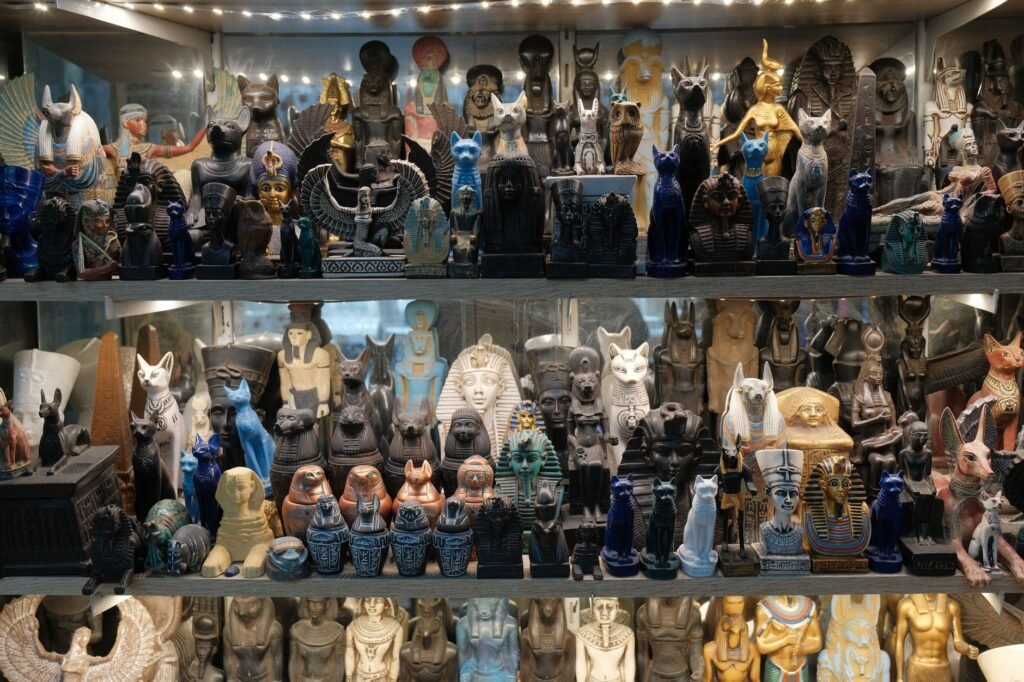
Wepwawet is an ancient Egyptian deity best known as a jackal-headed god associated with warfare, royal power, and the opening of paths. His name is commonly translated as “Opener of the Ways” or “Opener of the Roads.” In Egyptian religion, this title reflects both a practical and symbolic function: Wepwawet guided the king and the dead through dangerous territory, whether on the battlefield, in ritual processions, or into the next world.
He is especially important because he appears at the intersection of several major themes in ancient Egyptian thought: kingship, funerary belief, military conquest, and sacred geography. Although he is sometimes confused with Anubis because both are linked with jackals and cemeteries, Wepwawet is a distinct deity with his own identity and cult history.
Origin and Meaning
The name Wepwawet is usually rendered from the Egyptian wp-w3wt, meaning “Opener of the Ways” or “Opener of Roads.” The exact nuance of the title is important. In ancient Egyptian usage, “opening the way” could refer to:
- clearing a path physically,
- preparing a ceremonial route,
- enabling a ruler’s advance in battle,
- or opening the passage to the afterlife.
The god’s name therefore expresses both protection and guidance. As with many Egyptian divine names, the meaning is not purely descriptive. It also reflects ritual action: a god who opens a way makes movement possible in a dangerous world.
Wepwawet’s earliest origins are difficult to reconstruct with certainty. He is strongly associated with Upper Egypt, especially the city of Asyut (known in ancient Egyptian as Sut or Zawty), where he appears to have been especially prominent. Some scholars consider him a local funerary and martial deity who later acquired broader national significance. Over time, his roles expanded beyond local worship into royal ideology and mortuary religion.
Historical Context
Wepwawet belongs to the religious world of pharaonic Egypt, where gods were deeply connected to specific places, political institutions, and ritual roles. Egyptian religion was not organized around a single creed. Instead, deities could vary by region and period, and their traits often overlapped.
Wepwawet’s prominence is connected to several contexts:
- Pre-dynastic and early dynastic religion: local animal deities were associated with settlement centers and ancestral landscapes.
- Royal ideology: the king was seen as a victorious leader whose path had to be ritually secured.
- Funerary belief: the dead required divine guidance through the dangerous landscape of the afterlife.
- Military culture: divine support for royal campaigns was essential in a society where kingship was tied to conquest and territorial control.
In many sources, Wepwawet is associated with processions, triumphal entries, and opening the route for the ruler. This makes him a god of threshold moments: beginnings, crossings, and transitions. That symbolic role helps explain why he appears in both martial and funerary settings.
Main Characteristics
Wepwawet is usually depicted as a jackal or jackal-headed man. In some images he may resemble Anubis, but his identity is indicated by inscriptions and ritual context. His most important characteristics include:
- Path-opening and guidance
- Military escort and victory
- Funerary protection
- Association with royal processions
- Connection with the dead and the necropolis
He is often portrayed as moving ahead of others, which matches the meaning of his name. In royal and funerary imagery, Wepwawet can function as a leader, scout, or divine standard-bearer. In that sense, he is not merely a guardian after the fact; he is a deity who ensures that movement can begin safely.
A key point is that Egyptian gods often had overlapping functions. Wepwawet and Anubis both relate to jackals, cemeteries, and the dead. However, Wepwawet is more strongly associated with opening the way in a practical and royal sense, while Anubis is more closely linked with embalming and mortuary rites.
Family and Genealogy
The family relationships of Egyptian gods are often not fixed across sources, and Wepwawet is no exception. Ancient traditions do not present a single universally accepted genealogy for him.
Possible relationships in different traditions
| Relationship | Notes |
|---|---|
| Father | In some later traditions, he may be linked with Anubis as a parent or counterpart, but this is not universal and should not be treated as a fixed genealogical fact. |
| Mother | Not consistently identified in the surviving sources. |
| Spouse | No widely accepted spouse is securely established in the major sources. |
| Children | No standard set of children is known. |
| Divine role in family network | He is sometimes grouped with funerary and canine deities through shared iconography rather than direct kinship. |
Because Egyptian theology was flexible, gods could be related through mythic analogy, local cult, or ritual association rather than strict family trees. For Wepwawet, those relationships are less important than his function as a divine opener and protector.
Symbols
Wepwawet’s symbolism is closely tied to movement, victory, and safe passage.
Common symbols and their meanings
| Symbol | Meaning |
|---|---|
| Jackal form | Association with cemeteries, desert edges, vigilance, and protective power |
| Staff or standard | Leadership, ritual procession, royal authority |
| Military imagery | Victory, advance, and escort of the king |
| Path or road | Safe passage, transition, and divine guidance |
| White Upper Egyptian crown in some contexts | Connection to the southern royal tradition and kingship |
The jackal is a significant animal in Egyptian thought because jackals were seen around desert burial grounds. Rather than being a symbol of evil, the animal could represent watchfulness, liminal space, and protection. Wepwawet’s symbolism draws on these qualities and transforms them into divine service.
Sacred Animals
Wepwawet is primarily associated with the jackal. In Egyptian religion, the jackal was not only a scavenger of the desert and necropolis but also a symbol of alertness and guardianship.
Symbolic significance of the jackal
- Guardian of cemeteries: jackals were linked with burial places at the desert edge.
- Liminal presence: they inhabited the boundary between cultivated land and wilderness.
- Protective watchfulness: their reputation as nocturnal and alert animals suited deities of protection.
- Association with the dead: they became connected to funerary rites and the safe passage of souls.
Wepwawet’s jackal identity is part of a broader Egyptian pattern in which gods could appear in animal form to express divine power. The animal form does not mean the deity was worshipped as a mere animal; rather, the form conveyed sacred qualities.
Sacred Plants
There is no securely established sacred plant uniquely and consistently associated with Wepwawet in the main surviving tradition. Egyptian gods often had plant associations in temple art, offerings, or local cult practice, but Wepwawet is not especially known for a distinctive botanical symbol in the way some other deities are.
If plants were used in his worship, they would most likely have been part of general Egyptian ritual offerings rather than a unique Wepwawet-specific botanical cult. Because the evidence is limited, it is best to avoid assigning him a plant association that cannot be supported by sources.
Sacred Places
Wepwawet was especially important in Upper Egypt, and his chief cult center is generally identified as Asyut.
Important locations
- Asyut (Sut/Zawty): the most significant center associated with Wepwawet.
- Necropolis sites in Upper Egypt: fitting for a god linked with burial and passage.
- Royal and temple processional routes: places where he functioned symbolically as opener of the way.
Asyut was a major religious and administrative center in Middle Egypt/Upper Egypt, and local deities there could gain great prestige. Wepwawet’s association with this city is one of the strongest clues to his early prominence.
Because Egyptian gods often had local and national dimensions, Wepwawet was not limited to one sanctuary. He could appear wherever ritual movement, burial rites, or royal advance required divine sanction.
Powers and Attributes
Wepwawet’s powers are best understood through his name and ritual role.
Main domains of influence
- Opening paths
- Protecting travelers and processions
- Guiding the dead
- Supporting kings in battle
- Ensuring victory and successful advance
- Guarding sacred transitions
In practice, “opening the way” could mean several things:
- Military advance – leading the king’s forces or enabling triumph.
- Funerary passage – helping the deceased move safely through the necropolis and beyond.
- Ritual procession – clearing the sacred route for offerings, festivals, or royal ceremonies.
- Cosmic transition – facilitating movement from one state to another.
His attributes make him a god of thresholds and beginnings. He does not merely protect a fixed place; he enables movement through uncertain space.
Main Myths
Unlike major state gods such as Ra, Osiris, or Horus, Wepwawet does not have a large surviving body of narrative myth in the classical sense. Ancient Egyptian religion preserved many divine roles through hymns, ritual texts, and inscriptions rather than long storytelling cycles.
Major mythic functions
- Processional leader: Wepwawet appears as the god who goes before the king.
- Funerary guide: he helps open the route to the afterlife.
- Warrior escort: he accompanies royal military power.
- Protector of transitions: he ensures success at moments of danger or change.
Some sources and later interpretations connect Wepwawet to the complex of gods associated with Osiris and the underworld, but the evidence is often ritual rather than narrative. His significance lies less in a single famous myth and more in the repeated ancient Egyptian idea that sacred movement required divine authorization.
Relationship with Other Mythological Figures
Wepwawet is often discussed alongside other Egyptian deities because of shared iconography and overlapping functions.
Wepwawet and Anubis
This is the most common comparison. Both are jackal-associated gods connected with death and burial. However:
- Anubis is more specifically tied to embalming, mummification, and the mortuary workshop.
- Wepwawet is more often the god of opening paths, escorting, and leading the way.
Their overlap is strong enough that some ancient and modern discussions blur the distinction, but they remain separate figures.
Wepwawet and the king
Wepwawet had a close relationship with royal ideology. The king depended on divine support to:
- defeat enemies,
- enter sacred spaces,
- and pass successfully through ritual transitions.
In this context, Wepwawet acts as a divine standard-bearer or vanguard.
Wepwawet and Osiris
Because both are tied to death and the afterlife, Wepwawet may appear in mortuary settings connected to Osiris. Yet Osiris is the great ruler of the dead, while Wepwawet serves more as an escort and opener than as a sovereign of the underworld.
Wepwawet and Horus
Horus is a major royal and martial god, and in some contexts Wepwawet’s role as a supporter of kingship can resemble Horus’s functions. The two are not the same, but both belong to the symbolic language of divine kingship and victory.
Worship and Cult
Wepwawet was worshipped through the general framework of Egyptian temple and funerary religion. Because surviving evidence is uneven, many details remain limited or local in character.
Forms of worship likely associated with him
- Temple offerings
- Processional rites
- Funerary invocations
- Royal ceremonies
- Prayers for safe passage and victory
In cult practice, a deity like Wepwawet would have been invoked to clear obstacles, protect processions, and help the king or the dead move forward successfully. Offerings in Egyptian religion commonly included food, drink, incense, and ritual recitations, though the exact local patterns for Wepwawet vary by time and place.
His cult likely had a strong regional character in Upper Egypt, especially at Asyut, and a broader ritual presence wherever movement and transition needed divine support.
Ancient Sources
The evidence for Wepwawet comes largely from Egyptian inscriptions, religious texts, temple scenes, and funerary material rather than from Greek or Roman authors. As a result, classical writers are not major sources for his mythology.
Important source types
- Pyramid Texts
- Coffin Texts
- Temple inscriptions
- Funerary papyri
- Local cult inscriptions from Upper Egypt
These sources show Wepwawet in ritual and symbolic contexts, especially related to kingship and the dead.
Classical authors
Unlike gods such as Isis or Osiris, Wepwawet is not a major figure in surviving works by Homer, Hesiod, Apollodorus, Pausanias, or Ovid. Greek and Roman writers focused more on Egyptian gods that were widely integrated into Mediterranean literary traditions. Therefore, references to Wepwawet in classical literature are limited or indirect.
This absence is itself informative: Wepwawet was a significant Egyptian god, but one whose cult remained more deeply rooted in indigenous religious practice than in Greco-Roman literary myth.
Roman Equivalent
Wepwawet does not have a precise Roman equivalent. Roman religion did not contain an exact counterpart to a jackal-headed god whose primary function was to open the way for kings and the dead.
If a comparison is necessary, he can be loosely related to Roman ideas of:
- guidance and passage
- military advance
- ritual opening
- psychopompic functions
However, these are only functional analogies, not true equivalents. In Greco-Roman syncretism, Egyptian deities were often interpreted through familiar Greco-Roman categories, but Wepwawet remained relatively distinctive.
Influence on Modern Culture
Wepwawet is less famous in modern popular culture than Isis, Anubis, or Ra, but he appears in scholarship, museum catalogues, games, and creative works inspired by ancient Egypt.
Areas of modern influence
- Egyptology and academic study: Wepwawet is discussed as an important example of a local deity with military and funerary significance.
- Fantasy literature and games: he may appear as an obscure Egyptian god or inspiration for jackal-headed divine figures.
- Art and design: his iconography influences modern depictions of jackal-headed guardians.
- Museum interpretation: exhibits on ancient Egyptian religion sometimes mention him in relation to Anubis and Asyut.
Modern portrayals sometimes simplify Egyptian gods into single functions, but Wepwawet is more nuanced than a generic “death god.” He represents transition, leadership, and sacred movement, which are more specific and historically grounded roles.
Curiosities
Here are some lesser-known facts about Wepwawet:
- His name is often translated as “Opener of the Ways,” but this should be understood broadly, not just as a literal road opener.
- He is sometimes confused with Anubis, though they are distinct deities.
- His association with war and the dead may seem different, but in Egyptian thought both involve dangerous crossings that require divine help.
- Wepwawet could function as a royal escort deity, making him important in state ceremonies.
- He is one of the best examples of how an Egyptian god could be both local in origin and national in significance.
- His cult center, Asyut, was a major religious hub in Upper Egypt.
- The jackal, a creature often feared in burial contexts, was transformed into a symbol of protection rather than threat.
- He is not among the most widely known Egyptian gods today, but he played a meaningful role in ancient religious imagination.
Frequently Asked Questions
1. Who is Wepwawet in Egyptian mythology?
Wepwawet is an ancient Egyptian god associated with opening the way, guiding the dead, protecting royal processions, and supporting military advance. He is usually shown as a jackal or jackal-headed figure.
2. Is Wepwawet the same as Anubis?
No. Wepwawet and Anubis are separate deities, although both are linked to jackals and funerary contexts. Anubis is more closely associated with embalming and mummification, while Wepwawet is the opener of paths and a god of procession and victory.
3. What does the name Wepwawet mean?
The name generally means “Opener of the Ways” or “Opener of the Roads.” It reflects his role in clearing the path for kings, the dead, and ritual movement.
4. Where was Wepwawet worshipped?
He was especially associated with Asyut in Upper Egypt, though his role could extend beyond one city into broader funerary and royal religion.
5. What animal is Wepwawet connected with?
Wepwawet is connected with the jackal. In Egyptian symbolism, the jackal represented vigilance, the desert edge, and protection around cemeteries.
6. Did Wepwawet have a major mythological story?
Not a single famous narrative story is securely preserved for him. His importance comes mainly from his ritual role, inscriptions, and symbolic functions rather than from a long myth cycle.
7. What was Wepwawet’s role in warfare?
He could be invoked as a divine leader and escort for the king in battle, helping to open the way to victory and secure successful advance.
8. Is Wepwawet still known today?
Yes, mostly through Egyptology, museum collections, and modern retellings of Egyptian mythology. He is not as famous as some other Egyptian gods, but he remains an important figure for understanding ancient Egyptian religion.
Conclusion
Wepwawet is a distinctive and significant figure in Egyptian mythology. As the “Opener of the Ways,” he embodies the ancient Egyptian concern with safe passage, divine guidance, and successful transitions. His jackal form reflects the protective power of the desert-edge guardian, while his roles in war, royal ritual, and funerary religion show how closely the Egyptians linked movement with sacred authority.
Although he is not as widely known as Anubis or Osiris, Wepwawet offers a valuable window into Egyptian religious thought. He reveals how the Egyptians understood the world as full of thresholds that could only be crossed with divine assistance. In that sense, Wepwawet is not only a god of roads and paths, but a symbol of transition itself.

Orin Vale has spent the better part of two decades tracing the threads that connect the world’s oldest stories — from the halls of Asgard to the banks of the Nile, from Olympus to the jungles of the Maya. What began as a childhood fascination with flood myths and trickster gods grew into years of independent study across comparative mythology and ancient religion, always chasing the same question: what did these stories mean to the people who first told them? Orin writes for readers who want more than trivia — the ones looking for the beliefs, fears, and truths that myths were built to carry.