Roman mythology’s greatest narratives are stories of founding — of a city, a people, and a set of values. This guide brings together the essential myths and legends of ancient Rome, from Aeneas’s flight out of burning Troy to the early Republic’s legendary tales of courage and sacrifice.
The Aeneid: From Troy to Italy
Aeneas’s Flight from Troy
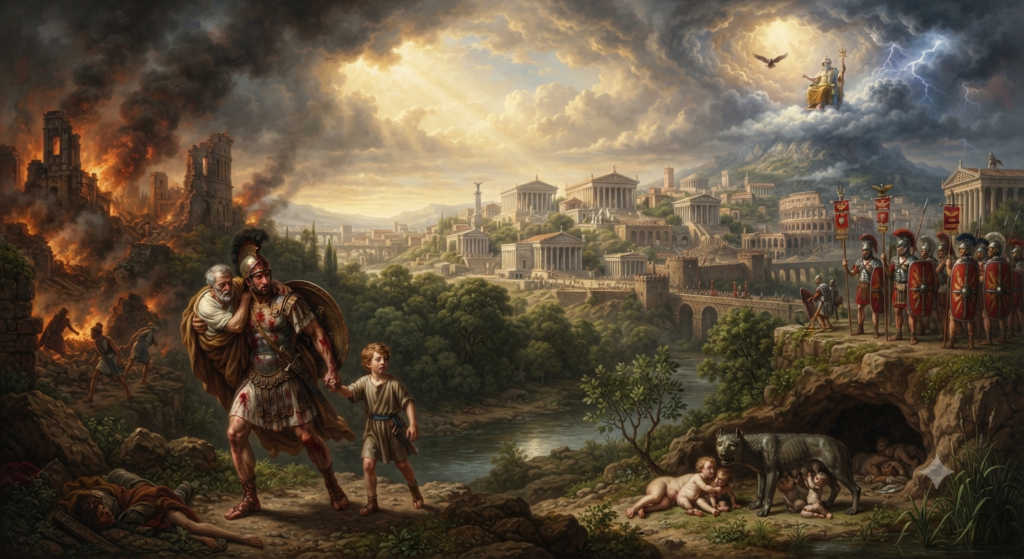
As Troy burned, Aeneas carried his aged father Anchises on his shoulders and led his young son from the ruined city, beginning the long journey that Roman tradition credited with the eventual founding of Rome.
Aeneas and Dido in Carthage
Aeneas’s love affair with Queen Dido of Carthage ended in tragedy when duty called him onward to Italy, and Dido’s dying curse was later said to explain the long enmity between Rome and Carthage.
Aeneas’s Descent into the Underworld
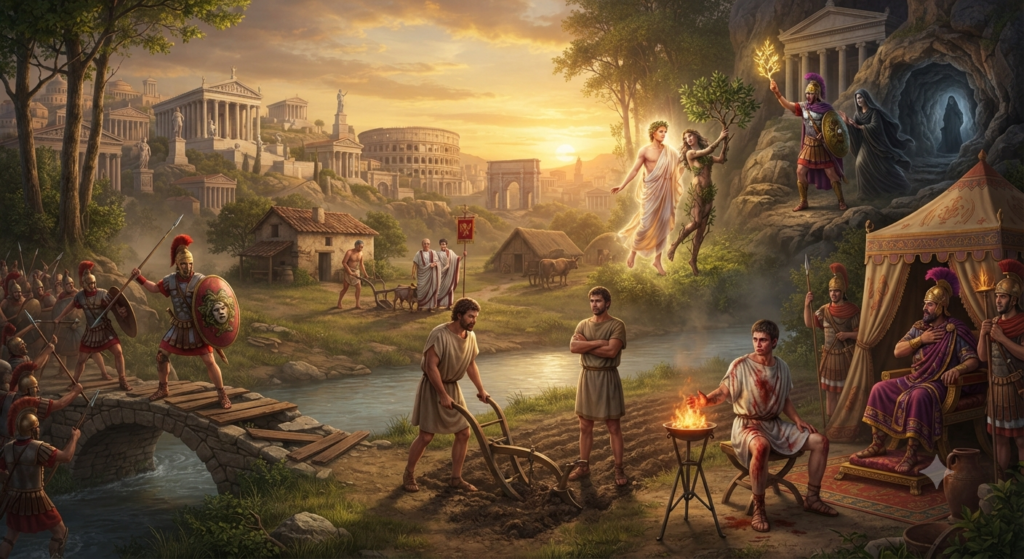
Guided by the Sibyl of Cumae and bearing the Golden Bough, Aeneas descended into the underworld to meet his father’s spirit, who revealed a vision of Rome’s future glory and the great souls yet to be born.
The War in Latium
Aeneas’s arrival in Italy sparked a bitter war with the local Rutulian king Turnus over the hand of Princess Lavinia, ending in single combat that secured Aeneas’s place as ancestor of the Roman people.
The Founding of Rome
The Founding of Rome by Romulus and Remus
After being raised by a she-wolf, the twins Romulus and Remus set out to found a city of their own, with Romulus ultimately tracing Rome’s sacred founding boundary on the Palatine Hill.
The Death of Remus
When Remus mockingly leapt over his brother’s newly built city wall, Romulus killed him in anger, a founding tragedy that later Roman writers treated as a somber warning about the cost of civil strife.
The Rape of the Sabine Women
To secure wives for Rome’s early male population, Romulus orchestrated the abduction of Sabine women during a festival, a conflict that was ultimately resolved when the women themselves intervened to make peace between their fathers and husbands.
Romulus’s Apotheosis into Quirinus
According to Roman legend, Rome’s founder Romulus vanished in a sudden storm and was later revealed to have been taken up among the gods, becoming worshipped as the deity Quirinus.
Legendary Kings and Roman Virtue
Numa Pompilius and the Nymph Egeria
Rome’s legendary second king, Numa Pompilius, was said to receive guidance from the nymph Egeria at a sacred spring, shaping many of Rome’s earliest religious laws and institutions through her counsel.
The Horatii and the Curiatii
To settle a war between Rome and Alba Longa without full-scale battle, three Roman brothers, the Horatii, fought three brothers from the enemy city, the Curiatii, in a legendary duel that determined the fate of both cities.
The Rape of Lucretia
The tragic violation and subsequent death of the noblewoman Lucretia became the catalyst that ended the Roman monarchy, inspiring the revolt that established the Roman Republic under Lucius Junius Brutus.
Horatius at the Bridge
Horatius Cocles famously held a narrow bridge alone against an invading Etruscan army while his comrades destroyed it behind him, then swam to safety across the Tiber, becoming a lasting symbol of Roman courage.
Mucius Scaevola and the Burning Hand
After a failed assassination attempt on an enemy king, the young Roman Gaius Mucius thrust his hand into a fire without flinching to demonstrate Roman resolve, earning the name Scaevola, “left-handed,” and securing peace through sheer defiance.
Cincinnatus and the Plow
Called from his modest farm to serve as dictator in a moment of crisis, Cincinnatus defeated Rome’s enemies and then voluntarily relinquished absolute power to return to his plow, becoming an enduring symbol of civic virtue.
Coriolanus’s Betrayal and Return
Exiled from Rome after political conflict, the general Coriolanus led an enemy army against his own city, ultimately turning back only when his mother pleaded with him before the gates, sparing Rome but sealing his own tragic fate.
Castor and Pollux at the Battle of Lake Regillus
According to Roman legend, the divine twins Castor and Pollux appeared on the battlefield to fight alongside Roman soldiers at the Battle of Lake Regillus, later arriving in Rome itself to announce the victory before news could otherwise arrive.
Roman Retellings of Timeless Myths
Ceres’s Search for Proserpina
Ceres’s desperate search for her daughter Proserpina, abducted by Pluto, explained the barrenness of winter in Roman tradition and was commemorated annually through the Cerealia festival honoring the goddess of agriculture.
Pyramus and Thisbe
Preserved for us through Ovid’s Metamorphoses, the tragic tale of the star-crossed lovers Pyramus and Thisbe explained why mulberries turned from white to dark red, their doomed love ending in a double suicide beneath the fateful tree.
Baucis and Philemon
When Jupiter and Mercury traveled in disguise and were turned away by the wealthy, only the poor elderly couple Baucis and Philemon offered them hospitality, earning divine reward for their humble kindness in this tale preserved by Ovid.
Apollo and Daphne
Fleeing Apollo’s unwanted pursuit, the nymph Daphne prayed for rescue and was transformed into a laurel tree, a myth preserved through Ovid’s Metamorphoses that explained the sacred origin of Apollo’s laurel wreath.
Clarifications and Distinctions
Founding of Rome: Myth or History?
While archaeology confirms early settlement on Rome’s hills around the traditional founding date, the specific stories of Romulus, Remus, and the she-wolf are considered legendary rather than literal historical events, blending genuine history with foundational myth.
Why Does Rome Have Two Founding Myths (Aeneas and Romulus)?
Roman tradition reconciled its two founding myths by treating Aeneas as a distant ancestor whose Trojan bloodline, generations later, produced Romulus and Remus, linking Rome’s origins to both venerable Troy and its own legendary twins.
Difference Between the Aeneid and the Iliad/Odyssey
While Homer’s Iliad and Odyssey were shaped by centuries of oral tradition, Virgil’s Aeneid was a deliberate literary work composed to give Rome a foundational epic of its own, deliberately echoing and rivaling Homer’s Greek tradition.
Frequently Asked Questions
What is the most important myth in Roman mythology?
The story of Aeneas’s journey from Troy to Italy, and the subsequent founding of Rome by Romulus and Remus, together form the most important mythological narrative underpinning Roman identity.
Is the Aeneid based on the Iliad and Odyssey?
Yes — Virgil deliberately modeled the Aeneid’s structure on Homer’s epics, with its first half echoing the Odyssey’s journey and its second half echoing the Iliad’s warfare, while giving the story a distinctly Roman purpose.
Are the early Roman legendary kings historical figures?
Scholars generally regard Rome’s legendary early kings, including Romulus and Numa Pompilius, as semi-legendary figures whose stories blend genuine historical memory with later mythologizing and moral instruction.
Why are stories like Horatius and Cincinnatus considered mythology?
Though set in a quasi-historical period, these stories were shaped and embellished over generations to serve as moral exemplars of Roman virtue, placing them alongside mythology rather than strict historical record.
What role did Ovid play in preserving Roman myths?
Ovid’s Metamorphoses preserved many mythological tales, including several with only loose Greek origins or entirely independent Roman and Italian roots, becoming one of the richest surviving sources of classical mythology.
Why does Roman mythology feature so many legendary battles and duels?
Individual combat and duty-driven sacrifice reflected core Roman values around courage, discipline, and service to the state, making such stories ideal vehicles for reinforcing Roman civic identity.
What is the significance of Lucretia’s story?
Lucretia’s tragedy directly triggered the legendary overthrow of Rome’s monarchy, symbolizing the moral corruption of tyrannical rule and justifying the founding of the Roman Republic.
How did Roman myths reinforce Roman values?
Many Roman legends, from Cincinnatus’s humility to Mucius Scaevola’s defiance, were deliberately preserved and retold to model ideal civic virtues like duty, sacrifice, and restraint from personal ambition.

Orin Vale has spent the better part of two decades tracing the threads that connect the world’s oldest stories — from the halls of Asgard to the banks of the Nile, from Olympus to the jungles of the Maya. What began as a childhood fascination with flood myths and trickster gods grew into years of independent study across comparative mythology and ancient religion, always chasing the same question: what did these stories mean to the people who first told them? Orin writes for readers who want more than trivia — the ones looking for the beliefs, fears, and truths that myths were built to carry.