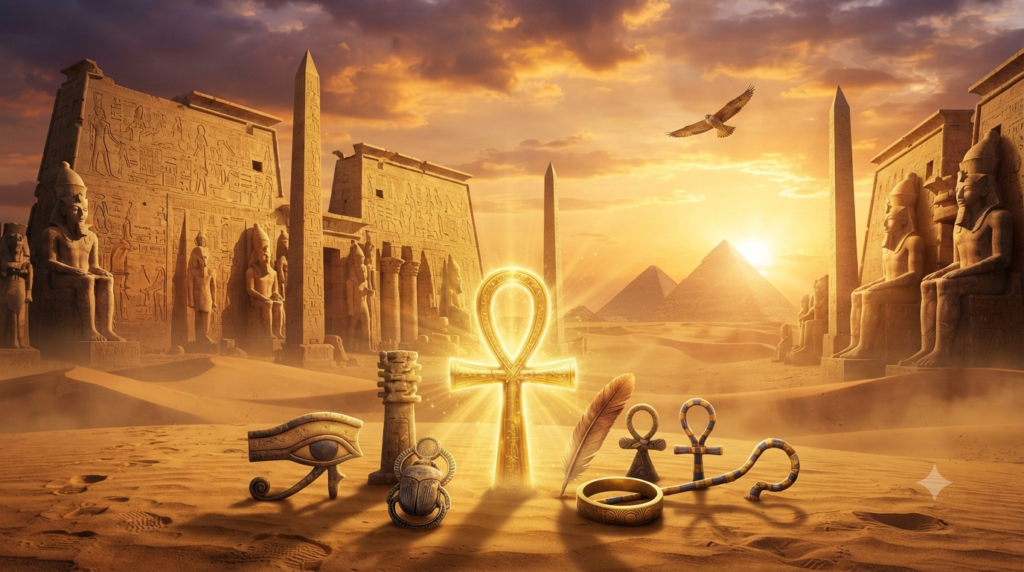
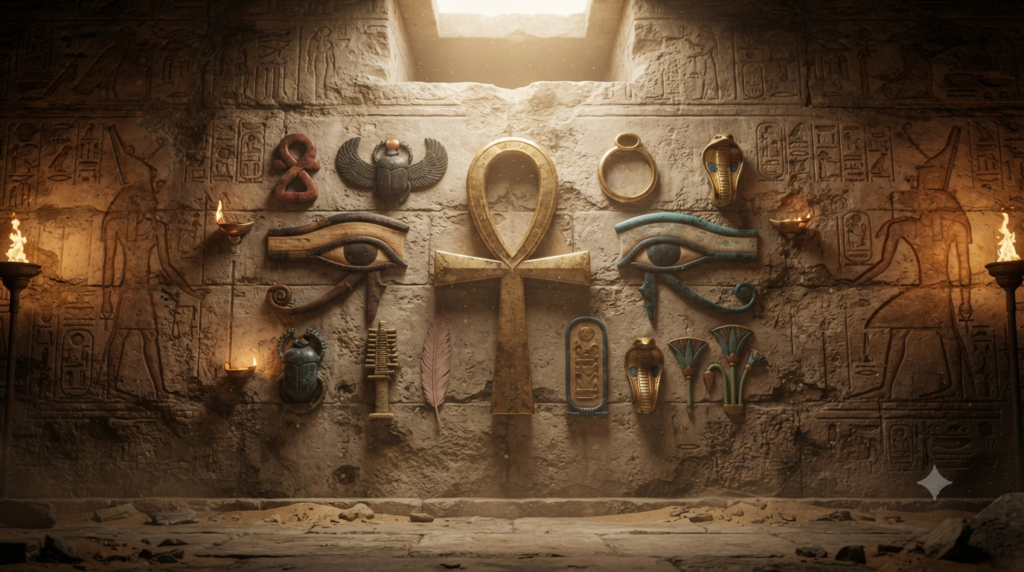
Ancient Egypt communicated its deepest religious beliefs through images long before most of its population could read a single hieroglyph. A carved ankh, a painted eye, a crown resting on a pharaoh’s head, a knot tied around a mummy’s neck: each of these Egyptian symbols carried a precise theological meaning instantly recognizable to anyone who saw it, whether on a temple wall, a coffin, or a piece of jewelry worn by a living person for protection. Symbols in Egyptian mythology were never decorative. They were treated as active carriers of divine power, capable of protecting, healing, or granting authority simply by being present.
This guide brings together the essential symbols of Egyptian mythology, organized by the role each one played in ancient Egyptian religion: protection and magic, royal authority, cosmic order, the natural world, and the soul’s journey through worship and the afterlife. Each entry introduces one symbol and sets the stage for a deeper, dedicated profile of that symbol elsewhere on the site.
Symbols of Life, Protection, and Magic
The Ankh
The ankh is the single most recognizable symbol to survive from ancient Egypt, a cross topped with a looped handle that represented the concept of life itself. Egyptian gods are shown holding the ankh to the noses of pharaohs and the newly dead, symbolically granting the breath of eternal life, and the sign appears constantly in temple reliefs, tomb paintings, and funerary jewelry. Because the ankh represented life in the most literal sense, it became one of the few Egyptian symbols that carried a positive meaning in every single context in which it appeared, without the darker or dual associations attached to many other signs.
The Eye of Horus
The Eye of Horus, also called the Wedjat Eye, represents healing, protection, and restoration, drawn from the myth in which Horus loses his eye during his battle with Set and has it magically restored by Thoth. Egyptian mythology treated the Wedjat as a symbol of wholeness recovered after injury, which is why it appears so frequently on protective amulets meant to guard the wearer’s health, and why fragments of the eye were even used in Egyptian mathematics to represent fractions used in medical prescriptions. Sailors, travelers, and the dead alike wore the Eye of Horus as a guarantee of safe passage.
The Eye of Ra
The Eye of Ra is a related but distinct symbol, representing the sun god’s active, sometimes destructive power rather than Horus’s healing restoration. In Egyptian mythology, the Eye of Ra could act almost as an independent goddess, most famously separating from Ra and becoming the raging lioness Sekhmet during the myth of humanity’s near-destruction. Where the Eye of Horus symbolizes recovery after harm, the Eye of Ra symbolizes the sun’s fierce, protective aggression against Egypt’s enemies, making it a favored royal symbol of righteous divine anger.
Eye of Horus vs. Eye of Ra: What Is the Difference?
Though visually similar and often confused, the two eyes of Egyptian mythology represent opposite emotional registers of divine power. The Eye of Horus is calm, restorative, and personal, tied to one god’s specific injury and recovery. The Eye of Ra is volatile, collective, and cosmic, tied to the sun god’s authority over the fate of humanity itself. Egyptian priests and artists were careful to use the correct eye for the correct context, reserving the Eye of Ra for scenes of royal power and divine punishment and the Eye of Horus for personal protection and medical or funerary healing.
The Scarab Beetle
The scarab beetle symbolized rebirth and transformation, drawn from the ancient Egyptian observation of dung beetles rolling balls of dung across the ground, which was mythologically compared to the sun god rolling the sun disk across the sky. This connection linked the humble scarab directly to the god Khepri, whose name meant “the one who comes into being,” making the scarab one of the most common amulets placed directly over a mummy’s heart to ensure successful rebirth in the afterlife. Scarab seals were also used in daily life as personal stamps, carrying the symbol’s protective meaning into ordinary Egyptian administration.
The Tyet Knot
The Tyet, sometimes called the Knot of Isis or the Isis Knot, resembles the ankh but with its arms folded downward, and represented protection specifically drawn from the goddess Isis’s own magical power. Egyptian funerary practice placed tyet amulets, traditionally carved from red stone to evoke the blood of Isis, on the body during mummification to invoke her protective strength over the deceased. The tyet’s close visual relationship to the ankh reflects how closely the Egyptians linked personal protection to the broader concept of preserved life.
The Shen Ring
The Shen ring is a simple closed loop of rope, symbolizing eternity and the endless, unbroken cycle of the sun’s journey around the world. Egyptian gods, especially protective ones like Horus and Nekhbet, are frequently shown grasping a shen ring in their claws or hands, extending eternal protection over whatever the ring encircled, most notably the name of the pharaoh. This same shen ring, stretched into an oval, became the origin of the royal cartouche used to enclose royal names.
Symbols of Kingship and Royal Authority
The Crook and Flail
The crook and flail are the two instruments crossed over the chest of nearly every pharaoh depicted in Egyptian art, borrowed from the tools of shepherding and farming to represent the king’s dual role as a caring guide and a firm ruler of his people. Egyptian mythology tied these objects directly to Osiris, the first mythical king of Egypt, meaning that every living pharaoh holding the crook and flail was visually claiming Osiris’s own royal legacy. The combination of gentle guidance and controlled discipline captured in these two objects summarized the ideal balance expected of Egyptian kingship.
The White Crown of Upper Egypt
The White Crown, known as the Hedjet, was the tall, bowling-pin-shaped crown associated specifically with rule over Upper Egypt, the southern region of the Nile valley. Long before Egypt’s political unification, the White Crown functioned as an independent regional symbol of kingship, and it continued to appear throughout Egyptian history as one half of the combined authority claimed by every pharaoh. Its association with the vulture goddess Nekhbet reinforced its southern, protective character within Egyptian mythology.
The Red Crown of Lower Egypt
The Red Crown, or Deshret, was the flat-based crown with a distinctive curling projection associated with rule over Lower Egypt, the northern Nile Delta region. Just as the White Crown represented the south, the Red Crown embodied the political and religious identity of the north, closely linked with the cobra goddess Wadjet. The Red Crown’s sharp, angular silhouette made it instantly distinguishable from its southern counterpart in Egyptian royal art.
The Double Crown
The Double Crown, or Pschent, combined the White Crown of Upper Egypt and the Red Crown of Lower Egypt into a single unified symbol, worn by pharaohs to declare their rule over both halves of a united Egypt. First appearing early in Egyptian history, the Double Crown became the standard image of legitimate kingship in Egyptian mythology, visually asserting that the wearer held the same authority once divided between two separate kingdoms. No other Egyptian symbol communicated political unity as directly or as permanently as the Pschent.
The Atef Crown
The Atef Crown built on the White Crown’s tall central shape by adding ostrich feathers on either side and a small sun disk at the top, and was worn almost exclusively by or in association with Osiris as ruler of the afterlife. Egyptian mythology reserved the Atef specifically for the god of the dead and for pharaohs shown in a fully divine, Osirian context, distinguishing it clearly from the crowns of living political rule. The feathers of the Atef also linked the crown symbolically to Ma’at, tying Osiris’s authority in the underworld to the same principle of cosmic balance every living king was sworn to uphold.
The Nemes Headdress
The Nemes is the striped cloth headdress, gathered into a tail at the back and folded into two flaps at the front, made globally famous by the golden funerary mask of Tutankhamun. Rather than representing a specific region like the White or Red Crown, the Nemes symbolized the pharaoh’s role as a solar being, protected by the uraeus cobra rising from its front band. As one of the most versatile Egyptian symbols of kingship, the Nemes could be worn alongside other crowns in layered royal imagery.
The Uraeus
The Uraeus is the rearing cobra shown on the front of royal crowns and headdresses, representing the protective, fire-spitting power of the goddess Wadjet defending the pharaoh from enemies. Egyptian mythology treated the uraeus as an active weapon rather than a passive decoration, believed to strike down anyone who threatened the king with a blast of destructive flame. Its constant presence across nearly every form of royal headgear made the uraeus one of the most consistent visual markers of divine kingship in Egyptian art.
The Cartouche
The cartouche is the elongated oval loop, derived from the shen ring, used to enclose the name of a pharaoh or a god considered worthy of the same eternal protection. Egyptian scribes reserved the cartouche exclusively for royal and select divine names, meaning that spotting one in an inscription instantly identifies the enclosed hieroglyphs as an important name rather than an ordinary word. The cartouche remains one of the most practically useful Egyptian symbols for modern readers first learning to identify hieroglyphic inscriptions.
Sema-Tawy
Sema-Tawy, meaning “union of the two lands,” depicted the windpipe and lungs symbol tied together with the papyrus and lotus plants representing Lower and Upper Egypt, often shown being bound by the gods Horus and Set together. This symbol expressed the same theme of national unity as the Double Crown but through an entirely different visual language, rooted in plant symbolism rather than royal regalia. Sema-Tawy frequently decorated the base of royal thrones, placing the concept of unified kingship literally beneath the pharaoh at all times.
Symbols of Cosmic Order and Balance
The Djed Pillar
The Djed pillar, a column with several horizontal bars near its top, symbolized stability and endurance, closely associated with the backbone of Osiris and his power to rise again after death. Egyptian religious festivals included a ceremony known as “raising the Djed,” in which the pillar was ritually lifted upright to reenact Osiris’s own resurrection and to renew the stability of the Egyptian state for another year. As one of the oldest Egyptian symbols, the Djed connected the personal resurrection promised to every deceased Egyptian directly to the continued survival of the kingdom itself.
The Feather of Ma’at
The single ostrich feather worn by the goddess Ma’at represented truth, balance, and cosmic order, and became the literal weight used against a deceased person’s heart during the underworld’s final judgment. Egyptian mythology treated a heart lighter than or equal to the feather as proof of a righteous life, while a heavier heart condemned its owner to be devoured by Ammit. Beyond its funerary role, the feather of Ma’at symbolized the ethical standard every pharaoh and every Egyptian official swore to uphold in daily governance and law.
The Was Scepter
The Was scepter, a long staff topped with a stylized animal head and ending in a forked base, symbolized dominion and power, carried by gods and pharaohs as a mark of their authority over the world. Egyptian mythology frequently paired the Was scepter with the ankh and Djed pillar in a combined image representing life, power, and stability together, a formula repeated constantly across temple walls and royal inscriptions. The scepter’s forked base was also believed to represent the ability to control and channel chaotic forces, reinforcing its association with active, exercised authority.
Symbols of the Land and Natural World
The Lotus Flower
The lotus flower, which closes at night and reopens with the morning sun, symbolized rebirth and the very beginning of creation in several versions of Egyptian mythology, most notably the myth in which the sun god first emerged from a lotus blossom at the dawn of the world. Its natural daily cycle of closing and reopening made the lotus a perfect symbol for the promised daily rebirth of both the sun and the Egyptian dead. The lotus also served as the heraldic plant of Upper Egypt, appearing constantly alongside its northern counterpart, the papyrus, in symbols of unity.
The Papyrus Plant
The papyrus plant, growing thickly along the Nile’s marshy edges, served as the heraldic symbol of Lower Egypt and represented the fertile abundance of the Nile Delta itself. Beyond its symbolic role, papyrus was harvested to produce the writing material that preserved nearly everything known about Egyptian mythology today, giving the plant a practical significance that matched its religious one. Column capitals shaped like open papyrus blossoms became one of the defining architectural features of Egyptian temple design.
The Sedge Plant
The sedge plant served as the heraldic symbol of Upper Egypt, paired constantly with the papyrus of the north in expressions of national unity, most famously in the royal title “He of the Sedge and the Bee,” which combined the plant of the south with the bee symbol of the north to name the king ruler of the whole unified land. Though less globally recognized today than the lotus or papyrus, the sedge held equal formal importance in Egyptian royal titulary and appears throughout temple inscriptions listing the pharaoh’s official names.
The Winged Sun Disk
The winged sun disk, showing a solar circle flanked by outstretched falcon wings and often a pair of uraeus cobras, symbolized protective divine kingship and appeared prominently above temple entrances and doorways throughout ancient Egypt. Egyptian mythology associated this specific image with the god Horus of Behdet, believed to have taken this form to defend Ra against his enemies during a great mythical battle. Placed above thresholds, the winged sun disk was meant to actively guard the sacred space beneath it from any hostile force attempting to enter.
Symbols of the Soul, Worship, and Ritual
The Ba
The Ba represented an individual’s unique personality and mobility after death, visually depicted as a human-headed bird capable of leaving the tomb by day and returning to the mummified body by night. Egyptian mythology treated the Ba as one of several essential components of a person’s identity, distinct from the body itself, and funerary texts placed enormous importance on ensuring the Ba could reunite successfully with its physical remains each night to sustain the deceased in the afterlife. The Ba bird remains one of the clearest visual expressions of how the Egyptians imagined the soul’s continued, active existence after death.
The Ka
The Ka represented a person’s life force or vital spirit, created at birth alongside the physical body and symbolized in hieroglyphic writing by a pair of raised, open arms. Unlike the mobile Ba, Egyptian mythology described the Ka as remaining closely tied to the body and its tomb, requiring regular offerings of food and drink, or their symbolic painted and carved equivalents, to sustain it eternally. Statues of the deceased were sometimes created specifically as a resting place for the Ka, ensuring the spirit had a stable form even if the mummy itself was damaged or destroyed.
The Menat Necklace
The Menat is a heavy, beaded ceremonial necklace, balanced by a counterweight worn at the back of the neck, closely associated with the goddess Hathor and used in temple rituals meant to invoke joy, fertility, and protective feminine power. Egyptian priestesses would shake the counterweight of the Menat against a worshipper’s skin as a blessing, believed to transfer Hathor’s revitalizing energy directly to the recipient. Far more than simple jewelry, the Menat functioned as an active ritual instrument within Egyptian temple worship.
The Sistrum
The sistrum is a rattling musical instrument, typically shaped like a loop strung with metal discs, shaken during temple rituals dedicated to Hathor and, later, Isis, to drive away hostile forces and please the goddess with its bright, percussive sound. Egyptian mythology credited the sistrum’s noise with the power to calm dangerous or destructive divine anger, echoing the same myth in which music and celebration helped soothe Sekhmet’s rage. Temple reliefs frequently show queens and priestesses shaking the sistrum directly before the gods as an act of formal worship.
Frequently Asked Questions About Egyptian Symbols
What is the most important symbol in Egyptian mythology?
The ankh is generally considered the single most important and most universally understood Egyptian symbol, representing life itself in a way that applied to gods, pharaohs, and ordinary Egyptians alike without variation across different religious contexts.
Are Egyptian symbols still used today?
Yes. Symbols like the ankh, the Eye of Horus, and the scarab remain widely recognized and are still used in modern jewelry, tattoos, and spiritual practices, though their contemporary meanings are often simplified compared to their original, highly specific roles in Egyptian mythology.
What did Egyptian amulets protect against?
Egyptian amulets shaped like protective symbols such as the Wedjat Eye, the scarab, or the Tyet knot were believed to guard the wearer against illness, physical harm, and dangerous supernatural forces both in life and during the vulnerable journey through the afterlife.
Why do so many Egyptian symbols involve plants like the lotus and papyrus?
Egyptian mythology drew heavily on the natural rhythms of the Nile valley, and plants that visibly cycled through daily or seasonal renewal, like the lotus reopening each morning, became natural symbols for rebirth, regional identity, and the fertility that sustained all of Egyptian civilization.
How were Egyptian symbols used in the judgment of the dead?
The feather of Ma’at served as the literal counterweight in the underworld’s weighing of the heart ceremony, while amulets like the scarab and the Wedjat Eye were placed on the mummified body to actively assist and protect the deceased through the same judgment.
What is the difference between a symbol and an amulet in Egyptian mythology?
A symbol is any image carrying a fixed religious meaning, appearing in temple art, writing, and royal regalia, while an amulet is a small, wearable object shaped like that symbol, crafted specifically to carry its protective or beneficial power directly onto a person’s body.
Did every Egyptian pharaoh use the same royal symbols?
The core set of royal symbols, including the crowns, the crook and flail, the uraeus, and the cartouche, remained remarkably consistent across most of Egyptian history, though individual pharaohs sometimes favored specific combinations or added unique regional elements to their own royal imagery.
What materials were Egyptian symbols usually made from?
Egyptian symbols appeared in nearly every available material, including carved stone temple reliefs, painted tomb walls, gold and semi-precious stone jewelry, and small glazed faience amulets, with the choice of material, such as red stone for the Tyet knot, often carrying its own additional symbolic meaning.

Orin Vale has spent the better part of two decades tracing the threads that connect the world’s oldest stories — from the halls of Asgard to the banks of the Nile, from Olympus to the jungles of the Maya. What began as a childhood fascination with flood myths and trickster gods grew into years of independent study across comparative mythology and ancient religion, always chasing the same question: what did these stories mean to the people who first told them? Orin writes for readers who want more than trivia — the ones looking for the beliefs, fears, and truths that myths were built to carry.