What Is the Menat Necklace in Egyptian Mythology?
Introduction
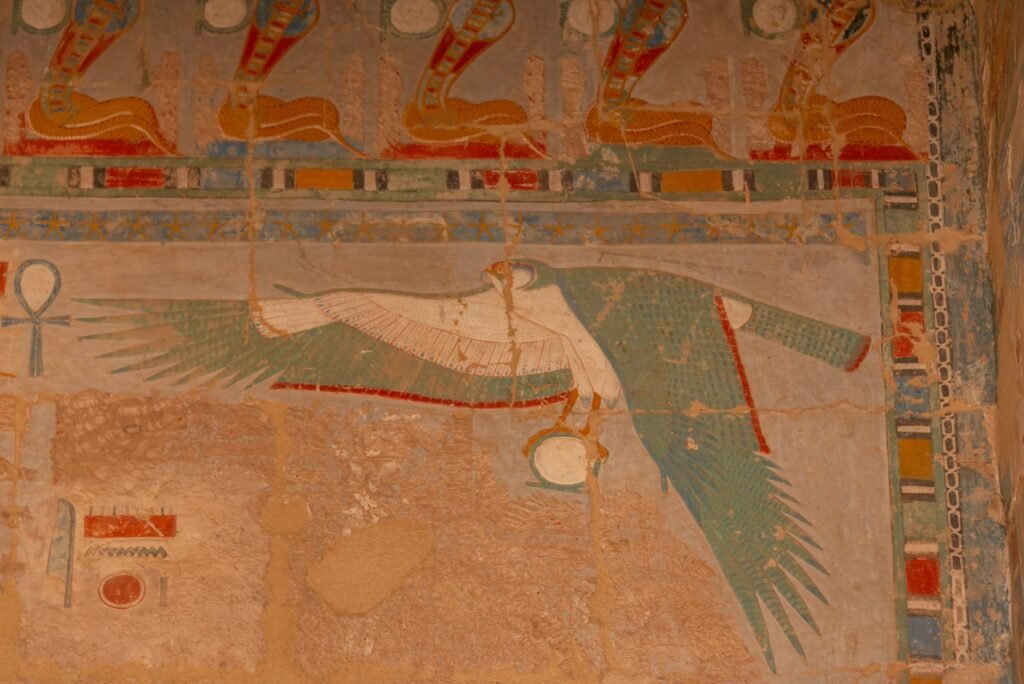
The menat necklace is one of the most distinctive ritual objects in ancient Egyptian religion and art. In modern discussion, people often ask what is the menat necklace in Egyptian mythology, because the object appears frequently in temple scenes, burial contexts, and depictions of deities, especially the goddess Hathor. Although it is commonly called a necklace, the menat was more than personal jewelry. It functioned as a sacred instrument, a ritual symbol, and a cultic object associated with fertility, music, joy, protection, and divine nourishment.
In Egyptian mythological and religious thought, the menat occupied a special place in ceremonies devoted to goddesses, particularly Hathor, Isis, and related female divinities. Its meaning was layered: it could signify life, rejuvenation, royal legitimacy, and the power of divine sound. Because ancient Egyptian religious symbolism is complex and often varies across periods and regions, the menat should be understood not as a single fixed object with one universal meaning, but as a ritual implement whose significance developed over time.
Origin and Meaning
The word menat comes from the ancient Egyptian term usually transliterated as mnit or menat. Scholars generally connect it with the idea of “nursing,” “sustenance,” or “protection,” though exact etymology is not always certain. This is appropriate to the object’s religious role, since the menat was closely associated with nourishment and the life-giving power of goddesses.
The menat is known from the Old Kingdom onward, and its image appears in both monumental and small-scale art. By the New Kingdom, it had become especially prominent in Hathoric worship. The term also referred to the physical object itself: a necklace-like arrangement of beads or discs with a heavy counterpoise at the back, designed to be worn, held, or shaken during ritual.
Different scholarly interpretations describe it as:
- a ceremonial necklace
- a percussion instrument
- a protective amulet
- a cultic symbol of divine power
All of these descriptions are partly correct, depending on the context.
Historical Context
The menat developed within the broader world of ancient Egyptian temple religion, where objects were often both beautiful and sacred. Egyptians did not sharply separate art, ritual, and symbol in the modern sense. A single cult object could be decorative, functional, and magically effective at the same time.
The menat is most strongly associated with Hathor, the goddess of:
- music
- dance
- love
- fertility
- motherhood
- foreign lands
- joy
- the western horizon and the dead
Hathor’s cult was widespread, and her temples preserved rituals in which the menat played an important role. The object also appears in connection with Isis, who in some periods absorbed many Hathoric traits. Because Egyptian religion evolved over millennia, the menat’s use and symbolism are not identical in every era.
A simplified historical overview is shown below.
| Period | Context of the Menat |
|---|---|
| Old Kingdom | Early appearances in religious art and elite contexts |
| Middle Kingdom | More clearly linked with female divinities and ritual symbolism |
| New Kingdom | Strong association with Hathor, temple ceremony, and priestly performance |
| Late Period and Greco-Roman Egypt | Continued use in iconography, especially in Hathoric and Isiac settings |
The menat is important because it illustrates a core feature of Egyptian religion: divine power was expressed through ritual objects as well as through statues, hymns, and offerings.
Main Characteristics
The menat is usually described as a broad, heavy necklace or collar with a distinctive form. In many artistic representations, it consists of:
- a beaded or segmented front section
- a counterweight at the back
- a clasp or terminal element
- materials such as faience, gold, shell, stone, or precious beads in elite and temple examples
Not all menat objects were identical. Some were elaborate ceremonial pieces, while others may have served as votive or symbolic versions. In visual art, the object is often shown:
- hanging from the neck
- held in the hand
- presented to a deity
- shaken or swung in ritual action
This last point is significant. Many scholars believe the menat could function as a sistrum-like ritual object or at least be associated with musical performance. However, it is not identical to the sistrum. The sistrum was a separate rattle-like instrument, also linked to Hathor. The menat may have been used alongside it.
Identifying Features
Common identifying features include:
- association with female deities
- presence in temple scenes of offering and ritual
- heavy counterpoise or pendant at the back
- symbolic link to divine nourishment and protection
- use in music, ceremony, and sacred display
Because the object combines adornment and ritual, scholars sometimes classify it as both jewelry and sacred implement.
Family and Genealogy
The menat is not a deity, so it does not have a family tree in the same way as gods and goddesses. However, it is closely associated with certain divine “families” in the sense of mythological relationships.
Principal Divine Associations
- Hathor: the primary goddess connected with the menat
- Isis: often linked through overlapping roles, especially in later periods
- Mut and other mother goddesses: in some contexts, related ritual symbolism appears
- Bastet: occasionally connected through music, joy, and protective femininity
Mythic and Ritual Relationship
The menat can be seen as an extension of the goddess’s power rather than as an independent being. In ritual imagery, it often appears as:
- a gift from the deity
- an emblem of the goddess’s beneficence
- a token of royal favor
- a symbol of fertility and renewal
In Egyptian theology, objects could carry divine force. Thus the menat’s “lineage” is better understood in terms of its cultic relationships than in terms of genealogical descent.
Symbols
The menat was rich in symbolism. Its meanings varied, but several themes recur consistently in ancient Egyptian sources and iconography.
Core Symbolic Meanings
| Symbolic Idea | Explanation |
|---|---|
| Fertility | Associated with female generative power and abundance |
| Nourishment | Connected to sustenance, maternal care, and divine provision |
| Protection | Served as an apotropaic object, warding off danger |
| Joy and music | Linked to dance, singing, and sacred celebration |
| Renewal | Symbolized rejuvenation and cyclical rebirth |
| Royal legitimacy | In some scenes, linked to kingship and divine approval |
Form and Meaning
The shape of the menat may itself have held significance. The heavy counterweight could suggest stability, balance, and controlled motion. The act of shaking or presenting the object in ritual may have been thought to activate its power.
Because Egyptian symbolism often relies on visual association rather than explicit explanation, the menat’s meaning is inferred from its repeated use with particular gods, ceremonies, and contexts.
Sacred Animals
The menat itself is not an animal, but its symbolism intersects with animals sacred to associated deities.
Associated Animals
- Cow: strongly tied to Hathor, who was often depicted as a cow or as a woman with cow horns and a sun disk
- Falcon: indirectly present in royal and solar contexts where Hathoric symbolism overlaps with kingship
- Lioness: connected with protective and fierce divine female power in broader Egyptian religion
- Cat: through later associations with Bastet and domestic, protective femininity
Symbolic Significance
The cow is the most important animal in this context. It represents:
- motherhood
- milk and nourishment
- calm power
- fertility
- celestial support
Hathor’s bovine imagery makes the menat especially appropriate as a symbol of life-giving female divinity.
Sacred Plants
No single plant is uniquely and universally attached to the menat in the way that some deities are linked to particular trees or flowers. However, in Hathoric and temple settings, certain plants frequently appear in the broader symbolic environment.
Commonly Relevant Plants
- Papyrus: associated with Lower Egypt, fertility, and renewal
- Lotus: a major symbol of rebirth and solar regeneration
- Sycamore fig: strongly associated with Hathor and with nourishment for the dead
Importance in Context
These plants matter because they reflect themes shared with the menat:
- life and regeneration
- divine feeding of the deceased
- abundance
- sacred landscape imagery
The sycamore fig is especially relevant, since Hathor could appear as a nurturing goddess of trees, providing sustenance in the afterlife. The menat and this tree symbolism both express divine care and renewal.
Sacred Places
The menat appears in contexts associated with major Hathoric cult centers and temple complexes.
Important Locations
| Place | Relevance |
|---|---|
| Dendera | One of the most important centers of Hathor worship |
| Thebes | Strong association with Hathor, royal cult, and temple ritual |
| Memphis | Broader cultic and ritual uses in elite religious life |
| Sinai | Hathor worship is attested in temple and mining contexts |
| Nubian sites | Hathoric symbolism appears in southern temple religion |
Temple Contexts
The menat is especially visible in temple reliefs and ritual scenes. Priests, kings, and sometimes goddesses themselves are shown handling the object in sacred spaces. Its presence in temple iconography emphasizes that it belonged to cult performance, not merely private devotion.
Dendera is particularly important because Hathor’s temple there preserves rich evidence for her rituals, festivals, and sacred symbolism.
Powers and Attributes
The menat was believed to embody or channel several divine powers.
Main Domains
- Fertility and childbirth
- Musical and ecstatic worship
- Protection and magical defense
- Nourishment and prosperity
- Renewal and restoration
- Female divine authority
Ritual Function
In practice, the menat may have been used to:
- accompany songs and hymns
- sanctify offerings
- honor a deity
- promote wellbeing and abundance
- reinforce the presence of Hathor or a related goddess
In this sense, it was not passive ornamentation. It participated in the ritual economy of ancient Egypt, where sound, movement, and sacred objects could mediate divine power.
Spiritual Significance
The menat reflects an Egyptian religious principle: power could be made present through material form. A sacred object did not merely represent the goddess; it could help manifest her influence in the temple.
Main Myths
There is no single “menat myth” comparable to the major narrative cycles of Osiris, Isis, or Horus. Instead, the menat appears within the mythological atmosphere of Hathor-related traditions.
Hathor and Divine Joy
Hathor is linked with music, dance, and celebration. The menat fits into this sphere as an object of festivity and sacred delight. It appears in scenes where the goddess receives offerings or where ritual music is performed in her honor.
Nourishment of Gods and Dead
Hathor also functions as a nourishing and protective motherly figure. The menat may symbolize the sustaining power she grants to both the living and the dead.
Return of the Goddess
In some Egyptian myths, a dangerous goddess returns to a calmer, beneficent state through music, ritual, and appeasement. Although the menat is not always named in these narratives, it belongs to the same symbolic world as the sistrum and sacred music used to pacify or honor the goddess.
Because Egyptian myths are often preserved in fragments or in ritual texts rather than in a single canonical narrative, the menat’s mythic role is better understood as embedded within a network of mythic themes rather than as the subject of one independent story.
Relationship with Other Mythological Figures
The menat is most strongly connected to Hathor, but it also interacts with a wider divine network.
Hathor
Hathor is the central figure. The menat is one of her emblematic ritual objects and appears in contexts of:
- celebration
- maternal nourishment
- temple music
- royal ritual
- protection of the dead
Isis
In later periods, Isis absorbed many attributes of Hathor. As a result, the menat may also appear in Isiac contexts, especially where motherhood, magic, and divine care are emphasized.
Ra
Hathor’s relationship with Ra matters because she is often linked with solar theology. The menat’s ceremonial use can therefore be connected to the maintenance of cosmic order and solar renewal.
Kings and Queens
The object also appears in relation to rulers, especially queens and royal women, because it symbolized divine femininity, legitimacy, and protective blessing.
Worship and Cult
The menat was used in formal worship, especially in temple ritual. It was not typically an object of independent worship, but part of a larger sacred performance.
Ritual Uses
Possible and documented ritual uses include:
- being presented to a deity as an offering
- being held during hymns and ceremonies
- accompanying music and dance
- serving as a symbol of divine favor
- being placed in sacred space as a votive object
Offerings and Performance
Hathoric festivals often involved:
- music
- chanting
- dancing
- processions
- libations
- offering of food and drink
The menat belonged to this ceremonial environment. It may have helped create the joyful, ordered atmosphere suitable for receiving the goddess.
Priestly and Royal Contexts
Priests and kings both appear in scenes involving the menat. This indicates that it was not merely a popular or household object, but part of elite ritual life and state religion.
Ancient Sources
Direct textual evidence about the menat is limited compared with the evidence for major gods and myths. Much of what is known comes from artistic representations, temple inscriptions, and ritual contexts rather than long narrative texts.
Egyptian Sources
Important categories of source material include:
- temple reliefs
- offering scenes
- funerary art
- hymns to Hathor and other goddesses
- ritual inscriptions from temple complexes
Classical Authors
Greek and Roman authors do not usually describe the menat in detail as a distinct object, but they do discuss Egyptian religion, temples, and divine symbolism. Useful ancient writers include:
- Herodotus: on Egyptian customs and religion
- Plutarch: on Isis and Osiris
- Diodorus Siculus: on Egyptian religious practices
- Strabo: on Egypt and its sacred sites
These authors are not always reliable for precise technical details, but they help show how Egyptian religious traditions were understood in the wider ancient Mediterranean world.
Scholarly Caution
Because ancient sources do not provide a single, definitive explanation of the menat, modern reconstructions rely on comparative interpretation. Some aspects remain debated, especially its exact physical use in ritual performance.
Roman Equivalent
There is no exact Roman equivalent to the menat necklace. Roman religion had sacred jewelry, ritual instruments, and cult objects, but none corresponded perfectly to the menat’s mixture of necklace, symbol, and musical-sacred implement.
In the Roman period, however, the menat could be understood within the broader framework of Isis worship, since Isis cult became popular throughout the Roman Empire. In that setting, the object was part of the Egyptian religious heritage admired or adapted by non-Egyptians.
Thus, rather than a true Roman equivalent, the menat had a Roman-era continuation and reinterpretation in the cults of Isis and related deities.
Influence on Modern Culture
The menat appears in modern culture mostly through interest in Egyptian mythology, jewelry design, museum collections, and popular media.
Modern Areas of Influence
- Museums and archaeology: menat objects are displayed as examples of Egyptian ritual art
- Jewelry design: modern designers occasionally draw on Hathoric and menat forms
- Literature and historical fiction: ancient Egyptian symbols often appear in novels and fantasy works
- Film and television: Egyptian-inspired costuming may echo menat shapes or themes
- Video games and visual art: ancient amulets and divine regalia inspire character design
The menat is not as widely recognized as the ankh or scarab, but it has a strong appeal because it combines beauty, mystery, and sacred function.
Curiosities
- The menat was both ornamental and functional, a reminder that ancient Egyptian sacred objects often had multiple roles.
- It is especially associated with Hathor, one of the most beloved and complex goddesses in the Egyptian pantheon.
- Some depictions suggest it was handled rather than worn, which supports the idea that it could serve as a ritual instrument.
- The menat’s symbolism overlaps with that of the sistrum, another Hathoric ritual object, but the two were not the same.
- In temple scenes, the menat may represent not only the goddess’s presence but also the ordered joy that sacred music was meant to produce.
- The object illustrates how Egyptians linked sound, motion, and divine power in ritual life.
- Modern museum labels may describe it simply as a necklace, but that description can understate its religious significance.
Frequently Asked Questions
What is the menat necklace in Egyptian mythology?
The menat necklace was a sacred Egyptian ritual object associated mainly with the goddess Hathor. It functioned as both a necklace-like ornament and a cultic implement linked to music, fertility, protection, and divine nourishment.
Was the menat a piece of jewelry or a religious object?
It was both. In some contexts it could be worn like jewelry, but in religious settings it was a sacred object used in ritual and temple ceremony.
Which goddess is most closely associated with the menat?
The menat is most strongly associated with Hathor, though it can also appear in contexts linked to Isis and other female divinities.
Did the menat have magical powers?
Ancient Egyptians often believed that sacred objects could carry divine power. The menat was associated with protection, fertility, and blessing, though the exact mechanics were understood in religious rather than scientific terms.
Is the menat the same as the sistrum?
No. The sistrum was a separate musical rattle used in worship, especially of Hathor. The menat was a different object, though the two are closely related in ritual context.
Where was the menat used?
It appears in temple worship, especially in Hathoric centers such as Dendera and Thebes, and in iconography connected with royal and funerary ritual.
Do we know exactly how the menat was used?
Not completely. Ancient art and texts show it was held, presented, or shaken in ritual, but scholars still debate some details of its precise performance and construction.
Conclusion
The menat necklace in Egyptian mythology was far more than an accessory. It was a sacred emblem of Hathor and related goddesses, combining beauty, music, ritual motion, and protective force. Across Egyptian history, the menat symbolized fertility, nourishment, joy, and divine presence. Its repeated appearance in temple art and cult scenes shows how deeply Egyptians integrated sacred meaning into material objects.
Although modern observers may call it a necklace, the menat should be understood as a ritual instrument and religious symbol at the heart of Hathoric worship. Its legacy survives in archaeology, museum collections, and the continuing fascination of Egyptian mythology, where it remains a powerful example of how ancient cultures transformed everyday forms into expressions of the divine.

Orin Vale has spent the better part of two decades tracing the threads that connect the world’s oldest stories — from the halls of Asgard to the banks of the Nile, from Olympus to the jungles of the Maya. What began as a childhood fascination with flood myths and trickster gods grew into years of independent study across comparative mythology and ancient religion, always chasing the same question: what did these stories mean to the people who first told them? Orin writes for readers who want more than trivia — the ones looking for the beliefs, fears, and truths that myths were built to carry.