Proserpina
Introduction
Proserpina is a major figure in Roman religion and mythology, best known as the Roman goddess associated with the underworld, the cycles of nature, and seasonal renewal. She is the Roman counterpart of the Greek Persephone, and her story became one of the most enduring myths in the ancient Mediterranean world. Proserpina is especially important because her myth explains both the alternation of the seasons and the close relationship, in ancient thought, between fertility and death.
In Roman culture, Proserpina belonged to the realm of Ceres and Dis Pater or Pluto depending on the tradition, and she appears in literature, ritual, art, and later European cultural memory. Her abduction by Pluto, her descent into the underworld, and her periodic return to the world above formed the basis of one of antiquity’s most famous myths. Over time, Proserpina also became a symbol of the link between the fertile earth and the hidden powers beneath it.
Origin and Meaning
The name Proserpina is the Latin form of a goddess whose Greek name was Persephone. The Roman name is generally treated as a borrowing or adaptation of older Italian religious traditions combined with Greek influence. Ancient and modern scholars have long noted that the name’s deeper etymology is uncertain.
The most common ancient association connected Proserpina with Ceres, the Roman goddess of grain, and with the Latin verb serpere (“to creep” or “to spread”), though such explanations are not securely established and are best understood as later interpretive attempts rather than proven origins. In Roman religion, however, what mattered most was not an abstract linguistic derivation but Proserpina’s function: she represented the hidden, returning power of vegetation and the mysteries of life after death.
The Greek name Persephone is itself of uncertain origin, and ancient attempts to explain it vary widely. Because Roman religion absorbed many Greek myths, Proserpina’s identity was shaped by both Italic and Greek traditions. She is therefore best understood as a Roman goddess whose literary form became closely aligned with the Greek underworld queen.
Historical Context
Proserpina belongs to a religious world in which fertility, agriculture, death, and regeneration were deeply connected. In agrarian societies of the ancient Mediterranean, the seasonal disappearance and return of vegetation invited mythic explanation. Proserpina’s story provided that explanation by dramatizing the loss and restoration of a divine maiden whose fate controlled the rhythm of the earth.
In Rome, her cult was linked to Ceres, the goddess of grain, and to the state’s concern with food supply, fertility, and the stability of the community. The Roman world inherited the Greek myth of Persephone but adapted it to Roman religious priorities. This adaptation was not merely literary: it also shaped public ritual, artistic representation, and the vocabulary of the underworld.
Her significance was reinforced by the Roman fascination with the mysteries of death and rebirth. Although Proserpina was not the central figure of a single universally organized Roman mystery cult comparable to some Greek traditions, her myth resonated with initiatory ideas about the soul, afterlife, and renewal. The abduction and return of Proserpina became one of the most powerful sacred narratives in antiquity.
Main Characteristics
Proserpina is usually characterized as a maiden goddess who becomes the queen of the underworld. This dual identity is central to her myth and iconography.
Core traits
- Maiden and bride: She begins as a young, unattached goddess associated with spring and flowers.
- Underworld queen: After her descent, she becomes ruler or consort in the realm of the dead.
- Goddess of seasonal return: Her yearly emergence from the underworld symbolizes the rebirth of vegetation.
- Figure of transition: She stands at the boundary between life and death, innocence and sovereignty, absence and return.
Ancient art often depicts her either as a youthful woman in pastoral scenes or as a solemn queen beside Pluto. In literature, she is sometimes portrayed as passive, abducted against her will, and at other times as a powerful ruler capable of commanding respect in the underworld.
Because Roman and Greek sources do not always emphasize the same aspects of her character, it is best to regard Proserpina as a multifaceted goddess whose identity shifts according to context.
Family and Genealogy
Proserpina’s family relationships vary somewhat according to source and tradition.
Commonly cited family connections
| Relationship | Name | Notes |
|---|---|---|
| Mother | Ceres | Roman goddess of grain and agriculture |
| Father | Jupiter | In the most familiar version, he is her father and consents to or permits the marriage to Pluto |
| Spouse | Pluto / Dis Pater | Lord of the underworld |
| Children | Usually none in the main myth | Some later traditions give her offspring, but these are not part of the standard story |
In the familiar myth, Proserpina is the daughter of Ceres and Jupiter. Pluto, desiring her as a bride, carries her off to the underworld. The myth frequently presents Jupiter as having allowed or arranged the match, though this detail is treated differently by different ancient authors.
Variations in tradition
Some ancient and later sources associate Proserpina with other underworld figures or with local cultic traditions that altered her genealogy. In certain contexts, she is not merely Pluto’s wife but also an independent chthonic goddess linked to fertility and death. The precise family structure is therefore not entirely uniform across antiquity.
Symbols
Proserpina is associated with several symbols that reflect her dual nature as goddess of spring and underworld queen.
Common symbols
| Symbol | Meaning |
|---|---|
| Pomegranate | Marriage, descent, and the binding power of the underworld |
| Torch | Search, maternal grief, or ritual illumination |
| Flowers | Youth, fertility, springtime, and the moment of abduction |
| Wheat or grain | Agricultural life and the cycles of harvest |
| Scepter or throne | Authority as queen of the dead |
| Veil or veiled figure | Mystery, transition, and hidden identity |
The pomegranate is especially important. In the myth, Proserpina eats pomegranate seeds in the underworld, which binds her to return there for part of the year. The fruit’s many seeds made it a natural emblem of fertility, but also of entrapment and hidden complexity.
Flowers, especially those gathered in the meadow before her abduction, symbolize her maidenhood. Grain and agricultural imagery connect her to Ceres and to the Earth’s productivity. In Roman and later art, she may appear with a solemn, regal bearing that distinguishes her from the more youthful Greek-style Persephone.
Sacred Animals
Unlike some deities, Proserpina is not universally linked to one dominant sacred animal. However, several animals appear in artistic and literary traditions associated with her.
Animals connected with Proserpina
- Snakes: Common chthonic symbols in the ancient world, associated with the underworld, rebirth, and hidden power.
- Dogs: Especially as creatures linked to the underworld or to Pluto’s realm.
- Swine: Connected indirectly through agricultural sacrifice and fertility rites in Roman religion.
- Bees: In some wider ancient symbolic systems, bees were tied to the soul, purity, and renewal, though this is not unique to Proserpina.
Because ancient sources vary, no single animal can be called her exclusive sacred beast. The symbolism is better understood as part of a broader network of underworld and fertility associations rather than as a fixed zoological cult.
Sacred Plants
Several plants are associated with Proserpina through myth, ritual, and symbolism.
Key plants
| Plant | Significance |
|---|---|
| Pomegranate | The defining mythic plant; symbolizes binding, fertility, and underworld connection |
| Wheat | Links Proserpina to Ceres, grain cycles, and agricultural abundance |
| Flowers | Especially spring blossoms; symbolize maidenhood and the moment before abduction |
| Violets | Often associated in broader Greco-Roman floral symbolism with spring and tenderness |
| Asphodel | A common underworld plant in Greek tradition, connected to the dead |
The pomegranate is the most famous plant associated with Proserpina. It is central to the myth of her division between the underworld and the world above. Wheat, by contrast, emphasizes her role in agriculture and the life-giving surface world. Flower imagery appears in the episode of her abduction, where she is gathering blooms before being seized by Pluto.
Sacred Places
Proserpina is linked to several sacred or culturally significant locations, though traditions vary between Greek and Roman contexts.
Important places connected with Proserpina
- The underworld: Her primary realm after marriage to Pluto.
- Enna (Sicily): One of the most famous places associated with the myth of her abduction.
- Eleusis: In the broader Greek tradition, associated with Demeter and Persephone through the Eleusinian Mysteries.
- Rome and Italian sanctuaries of Ceres: Places where her Roman identity was integrated into agricultural cult.
- Mount Etna region: In later literary imagination, Sicily’s landscape was often tied to the myth.
The Sicilian setting became especially important in Roman literature. Ancient authors located the abduction near a flower-filled meadow in Sicily, often near Enna, giving the story a specific local geography. Eleusis, though Greek rather than Roman, profoundly influenced how Proserpina was understood as a mystery figure linked to the cycle of life and death.
Powers and Attributes
Proserpina’s domains are not limited to a single function. She is a goddess of transition, renewal, and the boundary between worlds.
Major areas of influence
- The underworld
- Seasonal change
- Vegetation and fertility
- Marriage and separation
- Death and return
- Mystery and transformation
In the mythic pattern, her powers are structured by absence and presence. When she is below, the earth is barren or diminished; when she returns, life resumes. This cosmological logic made her one of the most important divine figures in agricultural religion.
As underworld queen, Proserpina also participates in the governance of the dead. In some traditions she is stern and majestic, reflecting the authority of her new role. In others she remains primarily the beloved daughter of Ceres, emphasizing the human-emotional dimension of the myth.
Main Myths
The myth of Proserpina’s abduction and return is one of the central narratives of ancient religion.
The abduction by Pluto
According to the most familiar version, Proserpina was gathering flowers in a meadow when Pluto rose from the underworld and seized her. The earth opened, and he carried her away in a chariot to become his wife and queen in the realm below. Her mother Ceres searched for her in grief and anger, neglecting the earth’s fertility until the gods intervened.
Ceres’ search and the barrenness of the earth
Ceres’ mourning is a crucial part of the myth. As she wandered in search of her daughter, the land became sterile. Seeds failed, crops did not grow, and human survival was threatened. This aspect of the story explains the divine significance of agriculture and the dependency of mortals on the gods’ favor.
The compromise over the pomegranate
A resolution was eventually reached: Proserpina would spend part of the year with Pluto and part of the year with Ceres. The exact reason for her return to the underworld differs in sources, but the most famous detail is that she ate pomegranate seeds while below. Because she had consumed food of the underworld, she could not remain permanently above.
Seasonal interpretation
The myth was widely interpreted as explaining the seasons:
- Her absence corresponds to winter or the barren season.
- Her return corresponds to spring and renewed fertility.
This seasonal reading is especially prominent in later literary and religious interpretation, though the myth’s significance was broader than a simple agricultural allegory.
Other myths and local traditions
In some ancient traditions, Proserpina appears in underworld judgments, as a queen alongside Pluto, or in mysteries connected with ritual purity and the fate of the soul. These traditions are less unified than the central abduction story but show the flexibility of her figure.
Relationship with Other Mythological Figures
Proserpina’s myth is defined by her relationships, especially with Ceres, Pluto, and Jupiter.
Ceres
The most emotional and culturally significant relationship is with Ceres, her mother. Their separation and reunion drive the narrative. Ceres’ grief makes her one of the most humanized of the Roman deities, and Proserpina’s loss explains divine and earthly disorder.
Pluto / Dis Pater
Pluto is both abductor and husband. Their relationship is not romantic in the modern sense in the most ancient versions; rather, it reflects divine marriage, coercion, and the political structure of the underworld. Later art and literature sometimes soften the violence of the myth, but the abduction remains central.
Jupiter
Jupiter is usually the supreme divine authority and, in many versions, the father who permits the marriage arrangement. This places Proserpina’s myth within the politics of divine family power. Ancient sources differ on how directly Jupiter is implicated.
Other figures
- Mercury sometimes appears as the messenger who negotiates Proserpina’s return.
- Minerva and Venus may be present in some versions of the divine council or in later literary retellings.
- Hecate is associated in some traditions with the search for Proserpina and with liminal spaces.
- The Furies and other chthonic beings may be linked indirectly to her underworld domain.
Worship and Cult
Proserpina’s worship was closely tied to Ceres and to agricultural fertility. The exact nature of her cult varied in different regions of the Roman world.
Ritual context
In Roman religion, Proserpina was often invoked alongside Ceres in rituals concerned with:
- crop fertility
- grain storage
- the protection of seeds
- the continuation of the agricultural cycle
Her cult was not always separate from that of Ceres; rather, she often functioned as part of a divine pair or family. This reflects a common Roman religious pattern in which deities were worshiped through networks of relation.
Festivals and rites
Although Proserpina does not have a single universally dominant festival comparable to some major Roman feast days, she appears in the wider ritual life of the grain goddess Ceres and in underworld-related observances. Particular local rites may have varied by city and period.
Mystery associations
Because her myth was so strongly tied to descent and return, Proserpina was naturally associated with mystery religion and initiatory themes. The exact relationship between Roman worship and Greek mystery practices is complex and should not be oversimplified. Still, the emotional power of her myth made it adaptable to rituals of renewal and hope.
Ancient Sources
Proserpina is attested in both Greek and Roman literary traditions, especially through mythographic and poetic sources.
Key ancient authors
| Author | Relevance |
|---|---|
| Homer | Early Greek mythic background, especially the Hymn to Demeter tradition linked to Persephone |
| Hesiod | Early divine genealogy and mythic context |
| Apollodorus | Mythographic summaries of the abduction and return |
| Pausanias | Local cults and regional traditions |
| Ovid | The best-known Roman literary version in the Metamorphoses |
| Vergil | Underworld imagery and Roman poetic adaptations |
| Cicero | References to religious interpretation and cultic practice |
| Macrobius | Later antiquarian discussions of Roman religion |
The Hymn to Demeter
Although Greek rather than Roman, the Homeric Hymn to Demeter is one of the most important sources for the underlying myth of Proserpina/Persephone. It narrates the abduction, the mother’s grief, and the compromise that returns the daughter periodically.
Ovid’s Metamorphoses
Ovid’s retelling strongly shaped later Western perceptions of the myth. His narrative is vivid, literary, and emotionally intense, emphasizing the dramatic moment of seizure and the landscape of Sicily. Ovid helped establish the myth’s enduring place in European imagination.
Apollodorus and Pausanias
Apollodorus offers concise mythographic accounts, while Pausanias preserves local religious and cultural information. Together they show how widely the myth circulated and how it adapted to local traditions.
Roman Equivalent
Proserpina is the Roman equivalent of Persephone, but the relationship is not a simple one-to-one substitution. Roman religion did not merely copy Greek myth; it reshaped it through Roman values, cultic practice, and linguistic adaptation.
Comparison of Greek and Roman forms
| Greek | Roman |
|---|---|
| Persephone | Proserpina |
| Demeter | Ceres |
| Hades | Pluto or Dis Pater |
In Roman literature, Proserpina is often treated as both a translated goddess and a distinct Roman figure. Her story becomes intertwined with Roman ideas about grain, civic order, and the authority of Jupiter. The Roman version tends to preserve the myth’s essential structure while integrating it into Latin poetic and religious language.
Influence on Modern Culture
Proserpina has had a long afterlife in literature, visual art, music, and modern popular culture.
Literature and poetry
The myth inspired Renaissance, Baroque, Romantic, and modern writers. Proserpina often appears as a symbol of lost innocence, cyclical return, feminine transformation, or the painful transition from youth to experience. The abduction narrative has been especially influential in poetic treatments of nature and mortality.
Visual art
Artists frequently depicted:
- the flower meadow before the abduction
- the moment Pluto seizes Proserpina
- Ceres searching with torches
- Proserpina enthroned in the underworld
- the pomegranate episode
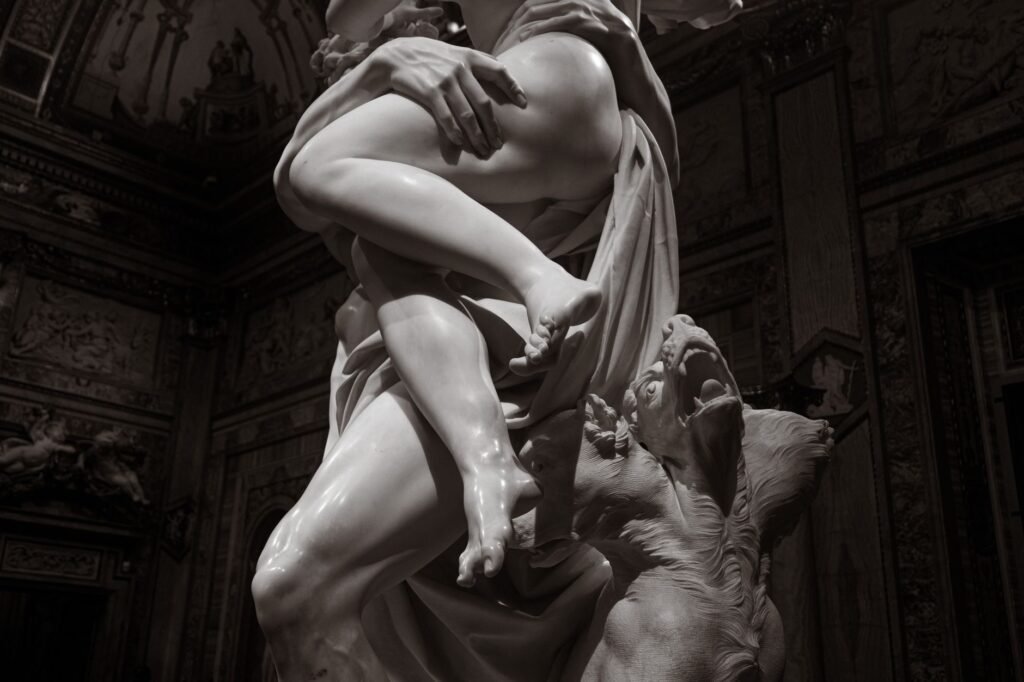
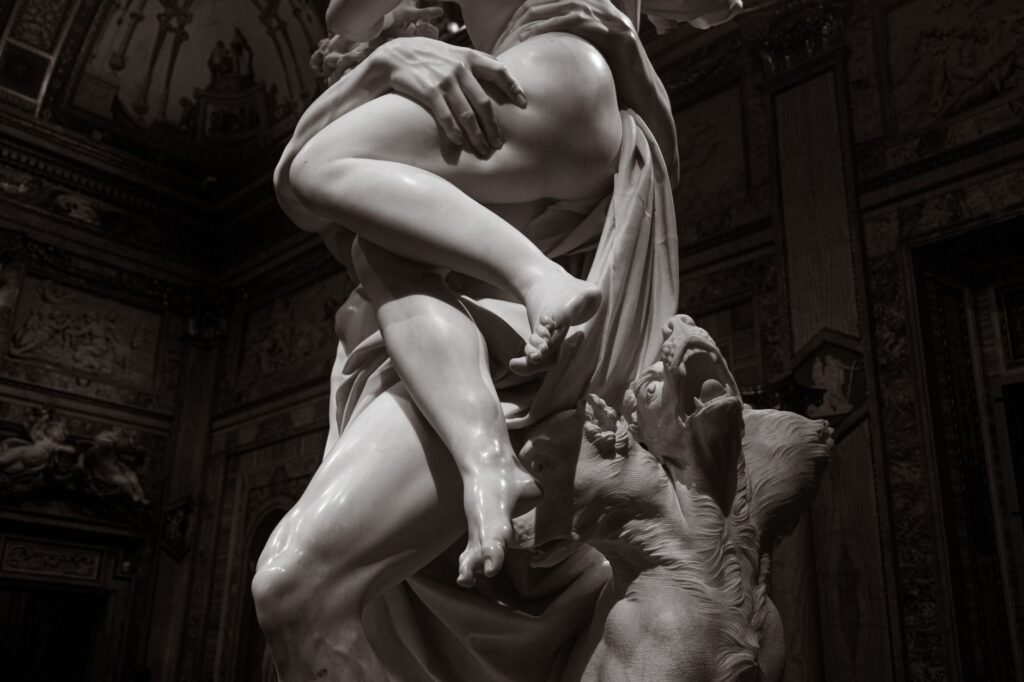
One of the most famous sculptural treatments of the subject is Gian Lorenzo Bernini’s “The Rape of Proserpina”, which dramatically captures the force and emotional intensity of the myth.
Music and opera
The story appears in operatic and musical works, where its themes of loss, descent, and return are especially well suited to dramatic composition.
Games, film, and television
Modern fantasy literature, role-playing games, and screen adaptations often draw on Proserpina as a figure of dark femininity, underworld sovereignty, or seasonal magic. In these settings, she may be reimagined as a queen, a reluctant captive, or a powerful liminal deity. Such uses are creative adaptations rather than historical reconstructions.
Curiosities
- Proserpina is often remembered through the pomegranate seeds, even though different sources vary in how many seeds she ate or how the episode is explained.
- Her myth is one of the clearest ancient explanations of seasonal change in the classical tradition.
- The story combines abduction myth, marriage myth, and agricultural myth in a single narrative.
- In some artistic traditions, she appears more like a majestic underworld queen than a frightened maiden.
- The Sicilian setting of her abduction made places such as Enna culturally significant in later Roman imagination.
- Although the Roman name is Proserpina, many modern readers know the figure primarily as Persephone, showing how Greek influence shaped later reception.
- Her myth has been interpreted not only as a nature story but also as a meditation on loss, maturity, and transformation.
Frequently Asked Questions
1. Who was Proserpina?
Proserpina was a Roman goddess associated with the underworld, fertility, and seasonal renewal. She is the Roman equivalent of the Greek Persephone.
2. Why is Proserpina important in mythology?
She is important because her myth explains the cycles of nature, especially the return of spring after winter, and because she embodies the connection between life, death, and rebirth.
3. Who were Proserpina’s parents?
In the most common tradition, her mother was Ceres and her father was Jupiter.
4. Why did Proserpina have to stay in the underworld?
According to the myth, she ate pomegranate seeds while in the underworld, which bound her to return there for part of the year.
5. What is the difference between Proserpina and Persephone?
They are the Roman and Greek forms of the same deity, but their cultural settings differ. Proserpina belongs to Roman religion, while Persephone belongs to Greek mythology.
6. What does the pomegranate symbolize?
The pomegranate symbolizes fertility, marriage, the underworld, and the binding power of hidden forces.
7. Where was Proserpina abducted?
Ancient sources often place the abduction in Sicily, especially near Enna, though details vary by tradition.
8. Is Proserpina a goddess of the dead?
Yes, in part. She is associated with the underworld and the dead, but she is also a goddess of fertility and seasonal return.
Conclusion
Proserpina is one of the most significant figures in Roman mythology because she unites themes that were central to ancient religious thought: fertility, loss, marriage, death, and renewal. Her myth gave meaning to the changing seasons and to the mystery of life beneath the earth. At the same time, she became a powerful symbol in literature and art, representing transformation and the tension between darkness and return.
As the Roman counterpart of Persephone, Proserpina stands at the crossroads of Greek and Roman religion. Her story has survived for millennia because it speaks to enduring human concerns: separation from those we love, the hidden cycles of nature, and the hope that what is lost may return in a changed form.

Orin Vale has spent the better part of two decades tracing the threads that connect the world’s oldest stories — from the halls of Asgard to the banks of the Nile, from Olympus to the jungles of the Maya. What began as a childhood fascination with flood myths and trickster gods grew into years of independent study across comparative mythology and ancient religion, always chasing the same question: what did these stories mean to the people who first told them? Orin writes for readers who want more than trivia — the ones looking for the beliefs, fears, and truths that myths were built to carry.