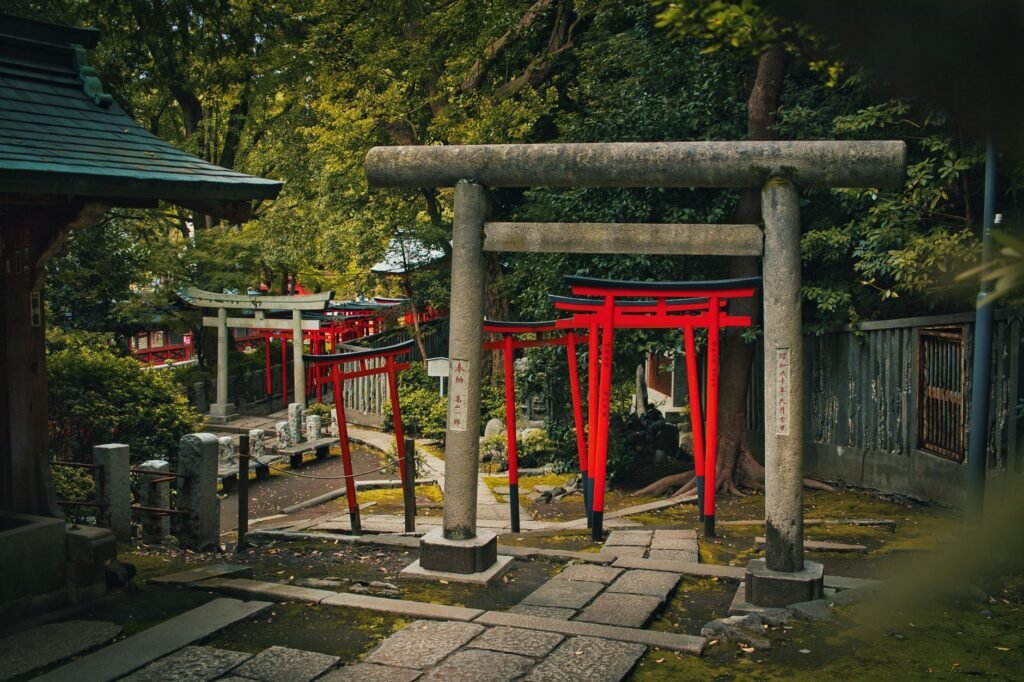
Torii Gate
Introduction
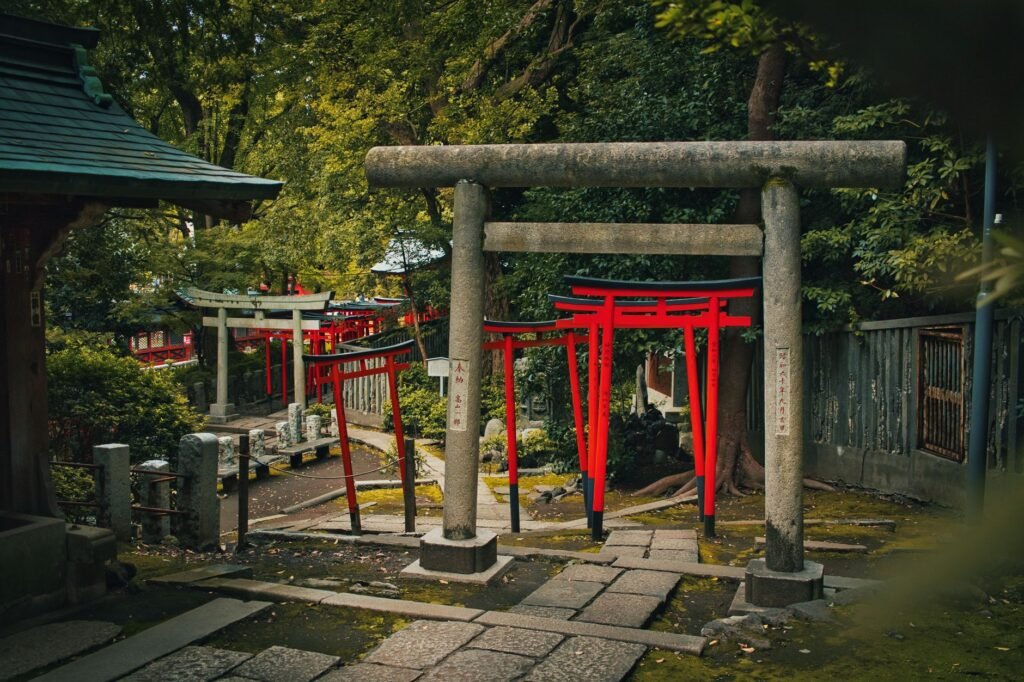
A torii gate is a traditional Japanese gateway most strongly associated with Shinto, Japan’s indigenous religious tradition. Usually built of wood, stone, metal, or concrete, a torii marks the transition from the ordinary world to a sacred space such as a shrine precinct. It is one of the most recognizable symbols of Japan and appears in religious sites, landscapes, art, literature, film, and popular culture.
Although torii are often linked specifically to Shinto, their cultural meaning extends beyond religion. They function as architectural markers, symbolic thresholds, and visual emblems of Japanese identity. Their simplicity and repetition across countless shrines have made them an enduring subject of study in history, architecture, religious studies, and art history.
Origin and Meaning
The word torii is written with the characters 鳥居, literally meaning “bird perch” or “bird’s residence.” This etymology, however, does not necessarily explain the original purpose of the structure. Scholars have proposed several theories about the name’s origin, and no single explanation is universally accepted.
Common theories include:
- Bird-perch theory: the gate may have been imagined as a perch for sacred birds.
- Linguistic transformation theory: the term may derive from older Japanese words that were later written with characters chosen for their sound and associations.
- Foreign influence theory: some scholars have suggested possible links with structures in continental Asia, though direct derivation is uncertain.
The torii’s historical origin is also debated. It is generally regarded as a form that developed in Japan, but its earliest prototypes may have been influenced by continental architectural or ritual forms. The exact pathway remains unclear because early records are limited and later interpretations vary.
Historical Context
The torii emerged within the broader development of Shinto shrine architecture. Shinto itself is not based on a single founder, scripture, or fixed creed. Instead, it consists of ritual practices, beliefs about kami, and local traditions that evolved over centuries.
Torii likely became more visible as shrine complexes became formalized. By the Heian period (794–1185), shrine architecture and ritual spaces were increasingly standardized in elite and court contexts. Over time, torii became a common feature at shrine entrances, at internal boundaries within shrine grounds, and sometimes at auxiliary sacred sites.
Important historical developments include:
- Integration into shrine landscapes as markers of sacred boundaries.
- Regional variation in form, material, and scale.
- Association with patron deities and powerful shrine networks, especially in major shrine traditions.
- Later spread into popular religion, where torii could appear at small neighborhood shrines, mountain sanctuaries, and local worship sites.
Torii are not exclusive to Shinto in every historical period. In some contexts, they were also found at Buddhist or syncretic sites, especially before the modern separation of Shinto and Buddhism in the Meiji period. This historical blending is important, because Japanese religious practice for centuries often included overlapping shrine and temple traditions.
Main Characteristics
A torii is typically a gate-like structure with two upright posts and one or more horizontal crosspieces. It does not usually have doors, walls, or a functional need to regulate passage in a practical sense. Its main role is symbolic.
Common structural features
| Element | Description | Symbolic or practical role |
|---|---|---|
| Pillars | Two vertical posts | Support the structure |
| Kasagi | Top lintel, often slightly curved | Creates the upper frame |
| Nuki | Lower connecting beam | Stabilizes the posts |
| Shimaki / daisawa | Additional structural elements in some styles | Reinforcement and design variation |
| Gakuzuka | Central plaque area in some gates | Often displays shrine name or inscription |
Typical characteristics
- They mark a boundary between the profane and the sacred.
- They are usually painted vermillion or left in natural wood, depending on shrine tradition and material.
- They may be found alone or in rows, especially at large shrine complexes.
- They are often aligned with paths, stairways, mountain entrances, or water edges.
- Their design ranges from extremely plain to highly stylized.
One of the most famous forms is the floating torii, seen when a gate appears to stand in water at high tide, as at the iconic Itsukushima Shrine. This visual effect is not universal, but it has become widely associated with torii imagery.
Family and Genealogy
A torii is not a living being, deity, or mythological figure, so it does not have parents, children, spouses, or descendants in the biological sense. However, it does have architectural lineages and typological relationships.
Major torii styles
There are many recognized styles, including:
- Shinmei torii: simple and archaic in appearance, associated with a basic, unadorned form.
- Myōjin torii: more elaborate, with curved upper beams.
- Ryōbu torii: a style linked historically with esoteric Buddhist influence and shrine-temple syncretism.
- Inari torii: often associated with Inari shrines and commonly painted vermillion.
- Mythical or regional variants: numerous local forms exist across Japan.
These types are not “families” in the literal sense, but they do represent historical branches in shrine architecture. Some styles are associated with particular shrines, periods, or religious developments.
Symbols
Torii are themselves symbols, but they also incorporate symbolic materials, colors, and forms.
Core symbolism
- Threshold: the shift from ordinary space to sacred space.
- Purification: entrance into a realm where ritual cleanliness matters.
- Presence of kami: the gate indicates a place where a deity or sacred force is honored.
- Protection: some traditions view torii as warding off impurity or harmful influence.
Colors and materials
| Material / Color | Meaning or use |
|---|---|
| Vermillion red | Often associated with vitality, protection, and visual prominence |
| Natural wood | Simplicity, age, and a more rustic sacred atmosphere |
| Stone | Durability and permanence |
| Metal | Less common, but used for longevity or modern construction |
| Black or unpainted finishes | Seen in some styles and regional traditions |
Vermillion is especially well known, though not universal. Its use is partly aesthetic and partly traditional, with associations that may include protection and sacred energy. However, meanings can vary by shrine and historical period.
Sacred Animals
Torii are not associated with a single sacred animal in the way some deities are, but they often appear in settings linked to kami with animal messengers or spiritual symbols. The animal associations depend on the shrine tradition rather than the gate itself.
Common associations in shrine culture
- Foxes are strongly associated with Inari shrines, which often feature torii gates.
- Deer are associated with Kasuga traditions and certain sacred landscapes.
- Bears, horses, and birds may appear in regional worship systems, though not specifically because of the torii.
The torii functions as a frame for the shrine’s sacred environment, where animal symbols may appear on votive objects, guardian statues, or ritual emblems.
Sacred Plants
Torii themselves are not directly tied to one sacred plant, but shrine surroundings often include plants with ritual or symbolic significance.
Plants commonly associated with shrine spaces
- Evergreen trees: symbols of continuity and sacred endurance.
- Sakaki (Cleyera japonica): an important ritual plant in Shinto offerings.
- Bamboo: associated with purity, resilience, and uprightness.
- Cryptomeria and other large trees: often regarded as sacred within shrine grounds.
- Rice plants: central in Japanese religious life and agricultural symbolism.
A torii may stand at the entrance to a grove, forest, or mountain path where sacred vegetation is preserved. In such contexts, the gate helps define the boundary of a spiritually charged natural landscape.
Sacred Places
Torii appear in many sacred locations, from major shrines to small roadside altars.
Important settings
- Shinto shrines: the most common and defining context.
- Mountains: entrances to sacred mountain routes may be marked by torii.
- Waterfronts: some torii are placed at sea or lakeside locations.
- Forest precincts: many shrines are located in wooded areas, where torii mark the transition into sacred nature.
- Urban neighborhood shrines: small torii can be found in cities, integrated into daily life.
Famous locations
| Location | Significance |
|---|---|
| Itsukushima Shrine, Hiroshima Prefecture | Famous for the “floating” torii in the sea |
| Fushimi Inari Taisha, Kyoto | Known for thousands of torii lining mountain paths |
| Meiji Jingu, Tokyo | Large shrine complex with prominent torii entrances |
| Kasuga Taisha, Nara | An important shrine with classical heritage |
| Local Inari shrines nationwide | Frequent use of vermillion torii gates |
The torii’s placement is often as meaningful as its design. A gate positioned at a shrine boundary or path entrance establishes sacred geography and guides the worshipper’s movement.
Powers and Attributes
A torii is not a supernatural being and does not possess personal powers. Its power lies in symbolic and ritual function.
Primary attributes
- Demarcation of sacred space
- Purification by transition
- Visual focus for worshippers and visitors
- Ritual orientation within shrine grounds
- Cultural identity as a symbol of Japan and Shinto tradition
In a religious sense, passing through a torii may be understood as entering a space where one should behave respectfully, cleanse oneself, and recognize the presence of kami. The gate thus participates in ritual order, even though it does not itself perform miracles or act as a deity.
Main Myths
Torii are not central figures in mythology, so there are no major myths about them equivalent to the stories of gods and heroes. However, several traditional narratives and symbolic associations help explain their cultural role.
Mythic and legendary associations
- Sacred boundary myths: many shrine traditions emphasize the idea that kami dwell in places separated from ordinary space.
- Bird imagery: some folklore explanations connect the gate’s name with birds, though these are interpretive rather than canonical myths.
- Sun and light symbolism: in some contexts, vermillion gates and shrine entrances are linked to life force, renewal, and divine presence.
- Sacred mountain and seashore narratives: torii often mark legendary sites where deities are believed to descend or manifest.
In Japanese mythology broadly, the distinction between sacred and profane space is fundamental. The torii visually expresses this distinction, even if it is not itself a mythic subject.
Relationship with Other Mythological Figures
Torii do not interact with mythological figures as characters in stories, but they are deeply connected to the worship of kami.
Key relationships
- Kami: torii indicate the presence of a deity or sacred force.
- Shrine priests and attendants: the gate forms part of the ritual environment they maintain.
- Worshippers and pilgrims: the torii guides bodily movement and spiritual awareness.
- Associated deities: particularly Inari, Amaterasu-related shrine traditions, and local tutelary kami.
Torii may also appear near Buddhist or syncretic settings in historical periods when religious boundaries were more fluid. This reflects not rivalry in a mythic sense, but Japan’s historical pattern of religious overlap.
Worship and Cult
A torii is not worshipped as a god, but it is treated with respect because it marks sacred space. Ritual behavior around torii reflects broader Shinto principles of cleanliness, reverence, and proper conduct.
Ritual practices associated with torii
- Bow before passing through: common etiquette at shrine entrances.
- Purification: visitors may cleanse hands and mouth at a water pavilion before proceeding.
- Avoiding the center of the path: in some traditions, the center is considered the route of kami, so worshippers walk slightly to the side.
- Offerings at shrines: rice, sake, salt, food, or symbolic offerings are made at the shrine beyond the torii.
- Festivals: local matsuri may involve processions passing under torii gates.
Torii are also connected to the aesthetics of pilgrimage. Rows of gates leading to a shrine or sacred site create a rhythmic path that supports meditation, anticipation, and ritual movement.
Ancient Sources
There is no single ancient text devoted to torii gates. Knowledge about them comes from historical records, shrine traditions, architectural evidence, and later scholarly study. Because torii are architectural forms rather than deities, references are scattered.
Relevant source traditions
- Classical Japanese chronicles such as the Kojiki and Nihon Shoki provide mythological and religious context for kami worship, though they do not systematically describe torii in the modern sense.
- Shrine records and local histories preserve information about specific gates and shrine lineages.
- Medieval and early modern writings on shrine architecture and ritual practice discuss gate forms and precinct organization.
- Pausanias, Homer, Hesiod, Apollodorus, and Ovid are important for Greco-Roman mythology, but they are not sources for torii, since torii belong to Japanese religious history.
Because the topic is architectural and cultural rather than mythic in a classical Mediterranean sense, evidence is often indirect. Archaeological and art historical study therefore plays a major role in understanding torii development.
Roman Equivalent
There is no true Roman equivalent to the torii gate. However, some Roman structures can be compared in a broad functional sense.
Possible analogies include:
- Triumphal arches: monumental gateways that mark passage and commemorate importance.
- Temple thresholds: ceremonial entrances signaling sacred space.
- Boundary markers: ritual or civic markers indicating transition.
These are only partial comparisons. Roman arches are usually monumental, commemorative, and urban, while torii are typically minimalist and tied to sacred boundary marking. The resemblance is functional rather than historical.
Influence on Modern Culture
Torii gates have become one of the most widely recognized symbols of Japanese culture worldwide. Their influence is visible across many modern media.
In art and design
- Used in prints, paintings, photography, and graphic design as a shorthand for Japan.
- Appearing in logo design and branding related to travel, hospitality, and cultural institutions.
- Inspiring contemporary architectural and landscape design.
In literature and cinema
- Torii often appear in stories involving shrine visits, spirits, ancestral memory, or journeys into the supernatural.
- They are frequently used in film to establish atmosphere and cultural setting.
- International audiences often associate torii with scenes of mystery, sacredness, or transition.
In games and animation
- Common in video games, especially those set in fantasy versions of Japan or in supernatural worlds.
- Often featured in anime and manga as visual markers of shrines, folklore, or spiritual spaces.
In tourism and identity
Torii are among the most photographed landmarks in Japan. Sites such as Fushimi Inari Taisha and Itsukushima Shrine attract visitors from around the world. Their image has become strongly linked to both religious heritage and national cultural identity.
Curiosities
- A torii is not a gate in the ordinary architectural sense, because it usually has no doors and does not secure an enclosure.
- Some shrines have multiple torii gates placed in sequence, creating a dramatic approach path.
- Torii can be made from wood, stone, bronze, copper, or even reinforced concrete.
- The largest torii are often local or modern constructions rather than ancient examples.
- The famous torii at Itsukushima Shrine appears to float during high tide, which contributes to its iconic status.
- Some torii are dedicated to Inari, the kami associated with rice, prosperity, and fox imagery.
- In historical periods of Shinto-Buddhist syncretism, torii could appear in religious landscapes that were not strictly “Shinto” in the modern sense.
- Torii are often used in film and game settings because a single gate immediately signals a sacred Japanese environment to viewers.
Frequently Asked Questions
What is a torii gate?
A torii gate is a traditional Japanese structure that marks the entrance to a sacred space, usually a Shinto shrine.
What does a torii symbolize?
It symbolizes the boundary between the ordinary world and a sacred realm associated with kami.
Why are many torii painted red?
Vermillion is a traditional color often associated with protection, vitality, and visibility, though not all torii are red.
Are torii only found at Shinto shrines?
Most are found at Shinto shrines, but historically they also appeared in some Buddhist or syncretic settings.
What is the most famous torii in Japan?
The floating torii at Itsukushima Shrine and the thousands of torii at Fushimi Inari Taisha are among the best known.
Do people worship the torii itself?
No. The torii is respected as a sacred marker, but worship is directed to the kami and the shrine beyond it.
What is the difference between a torii and a regular gate?
A torii is mainly symbolic and ritual, not a functional barrier. It marks a sacred threshold rather than enclosing space.
Are there different types of torii?
Yes. Common types include shinmei torii, myōjin torii, ryōbu torii, and many regional or shrine-specific variants.
Conclusion
The torii gate is one of Japan’s most enduring religious and cultural symbols. As a threshold between ordinary and sacred space, it embodies the spatial logic of Shinto and the aesthetics of restraint, balance, and reverence. Its history reflects the development of shrine worship, changing architectural styles, and the long coexistence of religious traditions in Japan.
Though simple in form, the torii carries profound meaning. It serves as a visual cue, a ritual marker, and a cultural icon recognized far beyond Japan. From ancient shrine precincts to modern films and tourist landscapes, the torii continues to signify entry into a realm shaped by memory, sanctity, and tradition.

Orin Vale has spent the better part of two decades tracing the threads that connect the world’s oldest stories — from the halls of Asgard to the banks of the Nile, from Olympus to the jungles of the Maya. What began as a childhood fascination with flood myths and trickster gods grew into years of independent study across comparative mythology and ancient religion, always chasing the same question: what did these stories mean to the people who first told them? Orin writes for readers who want more than trivia — the ones looking for the beliefs, fears, and truths that myths were built to carry.