Who Is Isis in Egyptian Mythology?
Introduction
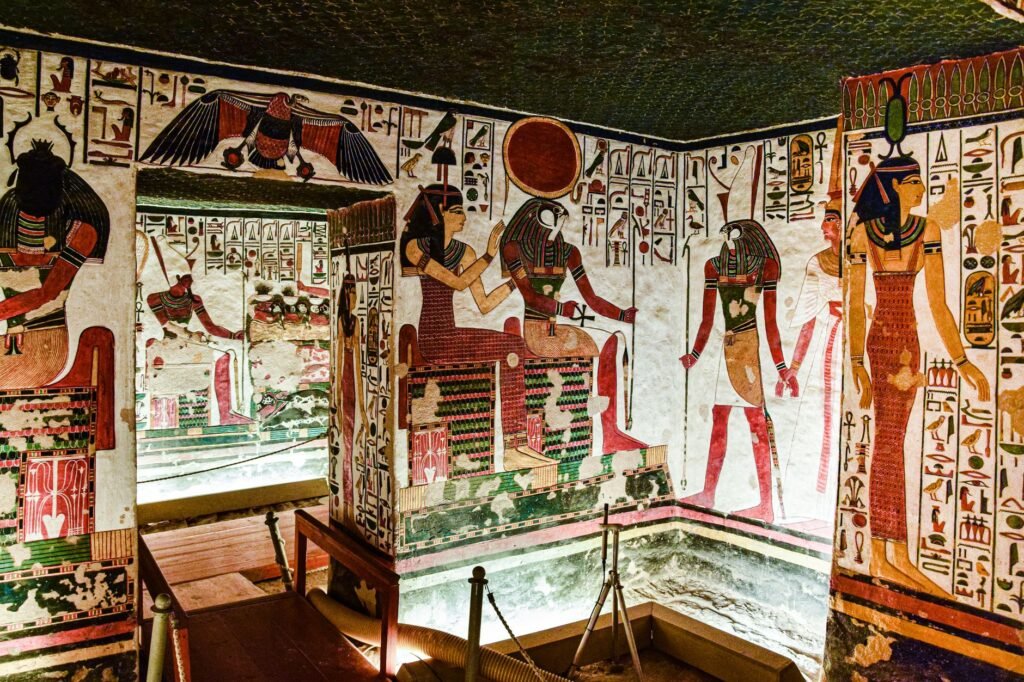
Isis is one of the most important and enduring goddesses in Egyptian mythology. She was revered in ancient Egypt as a powerful divine mother, magician, mourner, protector of the dead, and guardian of kingship. Over time, her worship spread far beyond Egypt, making her one of the best-known deities of the ancient Mediterranean world.
To ask “who is Isis in Egyptian mythology” is to ask about a goddess whose identity changed and expanded across more than two millennia of religious history. In early Egyptian religion, she was closely linked to the throne, royal power, and funerary rites. Later, she became widely celebrated as a universal mother and a compassionate savior figure. Her story is central to Egyptian ideas about kingship, rebirth, magic, and divine order.
Origin and Meaning
The name Isis is the Greek form of the Egyptian name Aset or Iset, written in hieroglyphs with the throne sign as one of its key elements. The exact original pronunciation is not fully certain, since ancient Egyptian writing did not record vowels in the way alphabetic scripts do.
The throne sign in her name is significant. It reflects her early association with royal authority and legitimacy, especially the pharaoh’s throne. In some interpretations, Isis was not originally a universal mother goddess but a divine personification of the throne itself, later developed into a much broader deity.
Etymological Notes
- Egyptian name: Aset / Iset
- Greek name: Isis
- Possible meaning: “Throne” or “She of the throne”
- Religious implication: The throne as a symbol of stability, kingship, and rightful rule
Her name alone reveals her deep connection to Egypt’s political and sacred order.
Historical Context
Isis appears in Egyptian sources from the Old Kingdom period, and possibly earlier in oral tradition. Her role grew over time as Egyptian religion developed complex myths about divine families, royal succession, death, and resurrection.
She belonged to the great Ennead of Heliopolis, a group of nine deities central to Egyptian cosmogony. Within this framework, she was the sister and wife of Osiris and the mother of Horus. This family cycle became one of the most influential mythological narratives in Egyptian religion.
Her worship spread through temples, local cults, and personal devotion. During the Late Period and especially the Ptolemaic and Roman periods, Isis became one of the most widely worshipped goddesses in the ancient world. Her cult reached Greece, Italy, North Africa, and beyond.
Why Isis Matters in Egyptian Religion
She was important because she combined several roles that Egyptians valued:
- Royal legitimacy
- Protection of the dead
- Magic and healing
- Motherhood and fertility
- Loyalty and mourning
- Cosmic order and restoration
This combination made her one of the most versatile deities in the Egyptian pantheon.
Main Characteristics
Isis is usually portrayed as a woman wearing a throne-shaped crown or the hieroglyph of her name. In many images she is shown with a solar disk between cow horns, a form she shares with other major goddesses in later periods.
She is often characterized by intelligence, magical knowledge, devotion, and protective power. Unlike some deities associated primarily with war or destruction, Isis is frequently depicted as resourceful and sustaining.
Common Traits Associated with Isis
- Powerful magician
- Protective mother
- Loyal spouse
- Mourning widow
- Healer and restorer
- Guardian of royal succession
- Goddess of rebirth and transformation
In Egyptian religious thought, she was not a passive figure. She actively searches, restores, protects, and intervenes in divine and human affairs.
Family and Genealogy
Isis belongs to one of the most important divine families in Egyptian mythology. Different traditions exist, but the standard mythic genealogy places her in the line of the Heliopolitan Ennead.
Standard Family Relationships
| Relationship | Deity | Notes |
|---|---|---|
| Father | Geb | Earth god |
| Mother | Nut | Sky goddess |
| Siblings | Osiris, Set, Nephthys | In many traditions |
| Husband | Osiris | Also her brother in mythic genealogy |
| Son | Horus | Often identified as Horus the Child |
| Sometimes associated children | Horus in various local or syncretic forms | Traditions vary |
Important Notes on Genealogy
Egyptian mythology is not always consistent. Some traditions emphasize Isis as the sister of Osiris and Set, while other local versions may differ in details. Her relationship with Nephthys is especially important, as the two sisters are frequently paired in funerary texts and rituals.
Isis’s role as mother of Horus is central to her identity, particularly because Horus represents the rightful heir and king. Her maternal protection of Horus became a major theme in later mythology and devotional practice.
Symbols
Isis is associated with a range of symbols that reflect her divine functions.
Main Symbols of Isis
| Symbol | Meaning |
|---|---|
| Throne sign | Royal authority, legitimacy, her name |
| Ankh | Life |
| Was scepter | Power and dominion |
| Tyet knot | Protection, often linked to Isis |
| Solar disk with horns | Divine femininity, cosmic power |
| Sistra | Ritual music and worship in later cults |
The Tyet Knot
The tyet, sometimes called the “knot of Isis,” is one of her best-known symbols. It resembles an ankh in style but is distinct in meaning. It appears in funerary contexts and is usually interpreted as a sign of protection and life-giving power.
The Throne Crown
Her throne-shaped crown is perhaps her most distinctive emblem. It visually links her to kingship and to the pharaoh’s legitimacy.
Sacred Animals
Unlike some Egyptian gods, Isis is not represented by a single exclusive sacred animal. However, several animals are associated with her through symbolism, iconography, and cult practice.
Animals Associated with Isis
- Cow: Linked to motherhood, nourishment, and divine femininity
- Birds, especially kites: In funerary symbolism, the kite could represent grieving and protective goddesses, including Isis and Nephthys
- Hawk imagery indirectly through Horus: Since Isis is the mother of Horus, falcon symbolism connects to her maternal role
- Serpents in protective contexts: Serpents appear in magical and protective scenes associated with her power
Symbolic Significance
These animals usually reflect aspects of Isis’s identity rather than being her exclusive sacred forms. The cow, for example, emphasizes nurturance, while the kite evokes mourning and ritual lamentation.
Sacred Plants
Ancient Egyptian religion often connected deities with plants, though the evidence for Isis is not always as direct as it is for some other gods. Certain plants appear in myths, rituals, or symbolic environments linked to her.
Plants Associated with Isis
- Papyrus: Common in marsh imagery and linked to concealment, protection, and the Nile environment
- Sycamore fig: Often associated with female divinities and nourishment in Egyptian belief
- Grain and vegetation generally: Connected to resurrection, fertility, and the renewed life of Osiris
The strongest plant associations usually arise through funerary symbolism and the cycle of death and rebirth rather than through a single sacred plant unique to Isis.
Sacred Places
Isis was worshipped throughout Egypt and later across the Mediterranean, but certain places became especially important.
Major Cult Centers and Sacred Sites
| Place | Significance |
|---|---|
| Philae | One of the most famous late temples of Isis |
| Behbeit el-Hagar | Important temple site in the Nile Delta |
| Giza and Memphis region | Early Egyptian cult activity and royal associations |
| Abydos | Strong links with Osiris and funerary religion |
| Dendera | Major temple complex in the Ptolemaic period, associated with neighboring goddess traditions |
| Throughout the Mediterranean | Temples and shrines in Greek and Roman cities |
Philae
The temple of Philae became one of the most important centers of Isis worship in the late ancient world. Its long survival into the Roman and later periods makes it especially significant in the history of her cult.
Abydos and Osirian Connections
Because of her role in the myth of Osiris, places associated with Osiris’s death and resurrection also became closely tied to Isis.
Powers and Attributes
Isis’s powers are broad and varied. She is not a narrowly defined goddess but a deity of exceptional range.
Key Domains of Isis
- Magic and secret knowledge
- Healing and protection
- Motherhood and fertility
- Royal authority and succession
- Mourning and funerary rites
- Rebirth and resurrection
- Guidance for the dead
- Divine kingship
Magic and Knowledge
One of Isis’s most important attributes is her mastery of heka, the Egyptian concept of magical power. In Egyptian religion, magic was not separate from religion; it was a legitimate divine force used to protect, heal, and restore order.
Isis is often described in texts as using cleverness and magical skill to achieve what strength alone cannot. This quality made her especially revered in ritual and healing contexts.
Protective Power
She protects:
- Her son Horus
- The dead
- The king
- Mothers and children
- Worshippers invoking her aid
Main Myths
The mythology of Isis is rich and varied. The most famous story is her role in the myth of Osiris, but she appears in other important narratives as well.
The Osiris Myth
The central myth concerns the murder of Osiris by his brother Set. According to the standard narrative, Set kills Osiris and dismembers his body. Isis searches for the body, gathers the pieces, and helps restore Osiris.
This myth is foundational because it explains:
- Kingship and succession
- Death and rebirth
- Mourning and ritual lamentation
- The legitimacy of Horus as heir
Key Episodes in the Osiris Cycle
- Set murders Osiris
- Isis searches for the body
- She mourns and gathers the remains
- She uses magic to restore Osiris temporarily or symbolically
- She conceives or protects Horus
- Horus later challenges Set for kingship
Different ancient sources present these events differently. In some versions, Isis conceives Horus after restoring Osiris; in others, the details are less explicit or are symbolically rendered.
The Search for Osiris
The image of Isis as a devoted seeker became one of her most famous qualities. Her grief is not simply emotional; it is ritual and cosmic. By restoring Osiris, she helps re-establish divine order.
Birth and Protection of Horus
Another major myth involves Isis hiding and protecting the infant Horus in the marshes of the Nile Delta, especially in the region of Chemmis in some traditions. She shields him from Set and other dangers until he is strong enough to claim his inheritance.
This story made her a model of maternal vigilance and magical defense.
The Magical Acquisition of Secret Power
In a later and famous tradition, Isis tricks or compels the sun god Ra into revealing his secret name, thereby gaining greater magical power. This story is preserved in Egyptian literature and illustrates her intelligence, persistence, and access to divine secrets.
Relationship with Other Mythological Figures
Isis’s identity is closely tied to several major deities.
Osiris
Her most important relationship is with Osiris. He is her husband and brother in mythic genealogy, and together they represent a sacred ideal of divine kingship, fertility, death, and renewal.
Horus
As the mother of Horus, Isis plays a central role in the restoration of legitimate rule. Horus’s victory over Set is also Isis’s victory, because it secures the future of her lineage and the order of the world.
Set
Set is her enemy by association, since he murders Osiris and threatens Horus. However, Egyptian sources do not always cast Set in purely negative terms; his relationship to the divine order is more complex in some periods.
Nephthys
Isis and Nephthys are often paired as mourning goddesses. Nephthys sometimes helps Isis in funerary rites and in the search for Osiris.
Ra
Isis’s relationship with Ra reflects her power to engage even the highest celestial god. In the “secret name” tradition, she acquires knowledge from him through magical means.
Worship and Cult
Isis was worshipped in temples, households, and funerary settings. Her cult evolved over time, becoming especially prominent in the later periods of Egyptian history.
Forms of Worship
- Temple rituals performed by priests
- Offerings of food, drink, and incense
- Hymns and prayers
- Protective amulets
- Funerary invocations
- Personal devotion and healing petitions
Festival Practice
Ancient festivals connected with Osiris and Isis often involved lamentation, ritual reenactment, and celebration of renewal. Exact details varied by time and place.
Personal Religion
One reason Isis became so important is that she was approachable. Worshippers could appeal to her for:
- Childbirth protection
- Healing
- Safe travel
- Family well-being
- Help for the dead
This personal accessibility helped her cult spread widely in the Greco-Roman world.
Ancient Sources
Isis appears in many Egyptian and later classical sources. Her oldest attestations are Egyptian, not Greek or Roman, and any account of her should begin there.
Important Ancient Sources
Egyptian Sources
- Pyramid Texts
- Coffin Texts
- Book of the Dead
- Temple inscriptions
- Hymns and magical spells
- The Osiris myth as preserved in Egyptian religious texts
Classical and Later Greco-Roman Authors
- Herodotus: Describes Egyptian religion broadly, though not always with precise theological detail
- Plutarch: In On Isis and Osiris, offers one of the most influential classical discussions of the goddess and the Osiris myth
- Diodorus Siculus: Provides historical and mythological observations about Egyptian religion
- Apuleius: In The Golden Ass, presents Isis in a Roman religious context
Caution About Classical Sources
Greek and Roman authors often interpreted Isis through their own cultural ideas. Their accounts are valuable, but they do not always preserve Egyptian theology in its original form.
Roman Equivalent
Isis did not have a single exact Roman equivalent. She was often adopted into Roman religion rather than translated into a direct native counterpart.
In Roman contexts, she was sometimes associated with:
- Ceres, because of fertility and nourishment
- Venus, because of divine femininity
- Fortuna, because of protective and fortunate power
- Juno, because of queenly authority and motherhood
However, these are analogies rather than true equivalents. Isis remained distinct, especially in the Isiac cults of the Roman Empire, where she was worshipped as a universal goddess with Egyptian prestige.
Influence on Modern Culture
Isis has had a major influence on modern scholarship, art, literature, and popular culture. Her image survived in European imagination as a symbol of mystery, feminine wisdom, motherhood, and ancient power.
Modern Appearances and Influence
- Literature: She appears in historical novels, fantasy, and retellings of Egyptian myth
- Art: Frequently depicted in neoclassical and symbolic art
- Occult and esoteric traditions: Sometimes treated as a goddess of hidden wisdom
- Film and television: Often used as a reference point for ancient Egyptian mysticism
- Games and fantasy media: Appears as a deity, mage, or maternal protector figure
Scholarly Importance
In modern Egyptology and religious studies, Isis is often studied as a key example of:
- Religious continuity
- Goddess evolution over time
- The relationship between myth and kingship
- The spread of Egyptian religion beyond Egypt
Curiosities
1. Isis became one of the most international Egyptian gods
Her cult spread from Egypt to Greece, Rome, and many other regions of the ancient world.
2. She is both a wife and a mother figure
Her dual role as wife of Osiris and mother of Horus made her central to Egyptian ideas of family and legitimacy.
3. Magic is part of her divine identity
Isis is not just a nurturing goddess; she is one of the most powerful magical figures in Egyptian mythology.
4. Her worship lasted for centuries
Some of the latest surviving ancient Egyptian temples were dedicated to Isis, showing the longevity of her cult.
5. She was adapted but never fully replaced
Even in Roman times, Isis remained recognizably Egyptian rather than being absorbed completely into another deity.
6. Her image influenced later religious and artistic symbolism
The mother-and-child imagery sometimes associated with Isis influenced later visual traditions in very broad cultural ways, though direct historical connections are often overstated and should be treated carefully.
Frequently Asked Questions
1. Who is Isis in Egyptian mythology?
Isis is a major Egyptian goddess associated with magic, motherhood, healing, protection, and kingship. She is best known as the wife of Osiris and mother of Horus.
2. What does the name Isis mean?
Her Egyptian name, Aset or Iset, is associated with the throne and royal power. The Greek form of her name is Isis.
3. What is Isis famous for?
She is famous for searching for the body of Osiris, protecting Horus, and using magical power to restore order and legitimacy.
4. Was Isis worshipped outside Egypt?
Yes. Her cult spread widely through the Mediterranean world, especially during the Hellenistic and Roman periods.
5. What are Isis’s main symbols?
Her main symbols include the throne crown, the tyet knot, the ankh, and sometimes the solar disk with cow horns.
6. Is Isis the same as a Roman goddess?
No single Roman goddess is exactly equivalent to Isis. Romans associated her with several goddesses, including Ceres and Juno, but she remained a distinct deity.
7. Why is Isis important in Egyptian mythology?
She is important because she embodies the restoration of order after chaos, the legitimacy of kingship, and the protective power of divine motherhood.
8. Are all myths about Isis the same?
No. Ancient sources vary by time, place, and purpose. Some details of her myths differ between Egyptian, Greek, and Roman accounts.
Conclusion
Isis is one of the central figures of Egyptian mythology and one of the most influential goddesses of the ancient world. She represents a remarkable combination of throne and motherhood, magic and protection, grief and renewal. Through her role in the Osiris myth, she became tied to the deepest Egyptian concerns: the continuity of kingship, the defeat of death, and the restoration of cosmic order.
Her worship endured for centuries and spread far beyond Egypt, leaving a lasting legacy in ancient religion and later cultural imagination. Understanding who Isis is in Egyptian mythology means understanding not only a goddess, but also the complex religious world of ancient Egypt itself.

Orin Vale has spent the better part of two decades tracing the threads that connect the world’s oldest stories — from the halls of Asgard to the banks of the Nile, from Olympus to the jungles of the Maya. What began as a childhood fascination with flood myths and trickster gods grew into years of independent study across comparative mythology and ancient religion, always chasing the same question: what did these stories mean to the people who first told them? Orin writes for readers who want more than trivia — the ones looking for the beliefs, fears, and truths that myths were built to carry.