Who Is Wadjet in Egyptian Mythology?
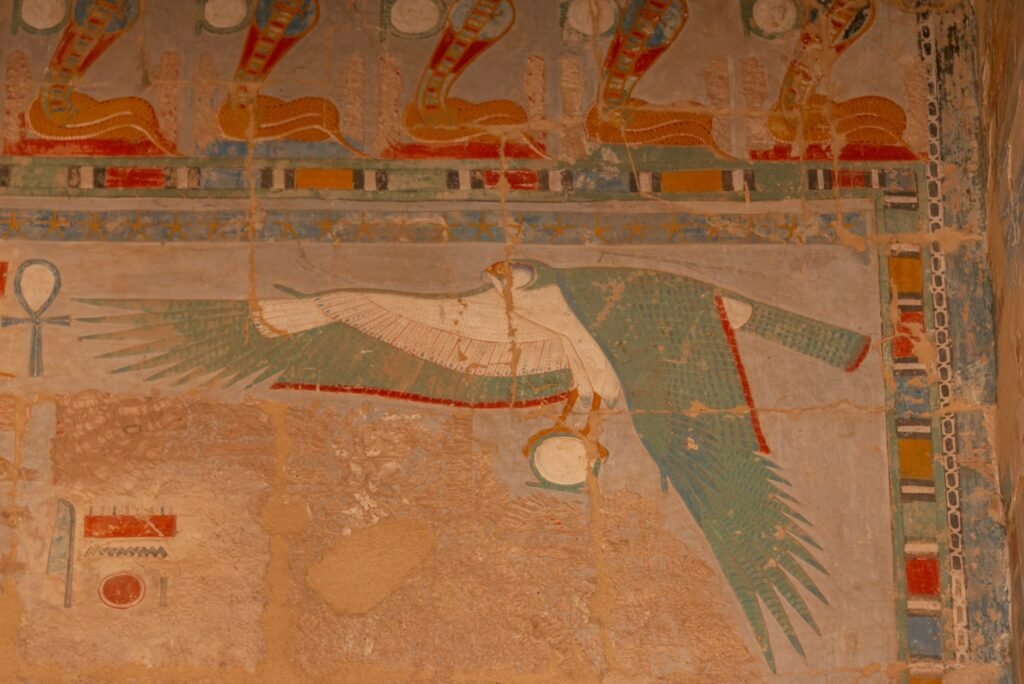
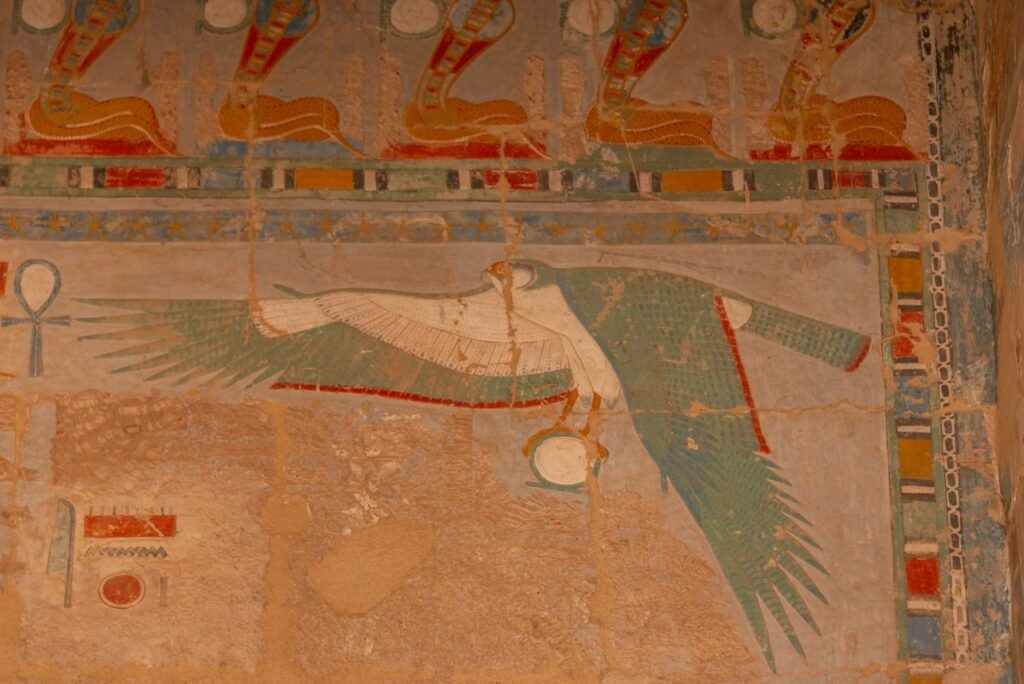
Wadjet is one of the major goddesses of ancient Egypt, best known as a protective cobra deity associated with kingship, Lower Egypt, and divine guardianship. She appears across Egyptian religious history as a fierce guardian of the pharaoh, a patron of the Nile Delta region, and a powerful symbol of sovereignty. In art and royal ideology, Wadjet is especially important because she is often represented as the cobra on the king’s forehead, the uraeus, which signified divine protection and legitimate rule.
Her importance lies not only in myth but also in the political and religious identity of Egypt itself. Along with Nekhbet, the vulture goddess of Upper Egypt, Wadjet formed part of the royal symbolism of the “Two Ladies,” reflecting the unification of the Two Lands. As a goddess of protection, childbirth, kingship, and the sun, she occupied a central place in temple religion and royal iconography for millennia.
Origin and Meaning
The name Wadjet is usually understood as deriving from the ancient Egyptian word wꜣḏt, meaning “the Green One” or “She of the Green.” This association may connect her with vegetation, fertility, and the lush marshlands of the Nile Delta, the region most closely linked to her cult.
Different spellings and transliterations appear in modern scholarship, including:
- Wadjet
- Wadjyt
- Udjat in older scholarly usage, though this can also refer to the Eye of Horus in some contexts
Her name is closely tied to the ancient city of Buto in the western Nile Delta, one of her principal cult centers. In early Egyptian religion, Wadjet was not merely an abstract divine force; she was a local protective deity whose worship became politically significant as Egypt developed a unified kingship.
Historical Context
Wadjet belongs to the earliest layers of Egyptian religious tradition. She is attested from the Predynastic and Early Dynastic periods onward, making her one of the oldest known Egyptian deities. Her importance grew as the kings of the Nile Valley unified Upper and Lower Egypt, because she became identified with Lower Egypt and with the royal crown symbolism of the north.
Political and religious role
In ancient Egypt, religion and monarchy were deeply intertwined. Gods were not only cosmic beings but also protectors of the state, its ruler, and its order. Wadjet’s role as a cobra goddess made her ideal for expressing the king’s divine protection. The image of the cobra raised on the brow of the pharaoh warned enemies and signaled that the king ruled under supernatural guardianship.
Regional identity
Wadjet was especially associated with the Delta region, marshes, papyrus, and the northern land of Egypt. Her worship at Buto linked her to local sacred geography, but as Egyptian state religion matured, her cult became national in scope. In this sense, Wadjet is a good example of how a regional deity could become part of the central ideology of the pharaonic state.
Main Characteristics
Wadjet is most commonly characterized as a:
- Cobra goddess
- Protective deity
- Royal guardian
- Patroness of Lower Egypt
- Symbol of divine legitimacy
- Associated with fertility and nourishment in some traditions
Appearance
She is usually depicted in one of three main ways:
As a cobra
- Often rearing upright and ready to strike
- Frequently shown on the king’s crown or forehead
As a woman with a cobra head
- A common divine hybrid form in later Egyptian art
As a serpent goddess with royal insignia
- Sometimes combined with symbols of sovereignty
Core identity
Wadjet’s identity is fundamentally protective. Snakes in ancient Egypt could be dangerous, but they were also powerful symbols of guardianship. The cobra’s aggressive posture made it a fitting emblem for a goddess whose purpose was to repel threats, especially against the king and sacred order.
Family and Genealogy
The family relationships of Wadjet are not fixed in a single canonical myth, because Egyptian religion developed over long periods and often included local variations. Unlike gods such as Osiris or Isis, Wadjet does not have one universally accepted family genealogy.
Common associations
In some traditions and later theological frameworks, Wadjet is connected with:
- Ra, the sun god, as a protective force of the solar king
- The pharaoh, whom she protects as a divine guardian
- Nekhbet, with whom she forms the pair of the “Two Ladies”
Relationship to the royal family
Wadjet is often treated less as a family-based deity and more as a political and cosmic protector. Her “children” are not usually central to her mythology. Instead, her role is relational and functional: she safeguards the ruler, the country, and the divine order.
Because Egyptian sources are diverse, it is best to say that Wadjet’s genealogy is not consistently defined across all traditions.
Symbols
Wadjet is rich in symbolism, much of it tied to royal power and protective magic.
| Symbol | Meaning |
|---|---|
| Cobra / uraeus | Protection, kingship, divine authority |
| Papyrus | Lower Egypt, marshland fertility, regional identity |
| Red crown of Lower Egypt | Political rule over the north |
| Solar imagery | Connection to Ra and royal divine power |
| Eye imagery in some contexts | Watchfulness, protection, and sacred power |
The uraeus
Her most famous symbol is the uraeus, the raised cobra worn on the brow of kings, queens, and sometimes deities. This emblem represented a living protective force capable of spitting fire or striking enemies. In Egyptian royal ideology, the uraeus was not decorative; it was magical and political.
Color symbolism
The color green is occasionally relevant through her name and associations with lush growth and life. However, in Egyptian art, Wadjet is more often identified by form and iconography than by a specific color scheme.
Sacred Animals
The sacred animal most strongly linked with Wadjet is the cobra, especially the Egyptian cobra.
Cobra symbolism
The cobra was a complex symbol in Egyptian thought:
- Dangerous and venomous
- Protective when invoked as a divine force
- Associated with kingship and royal authority
- Capable, in mythic imagination, of repelling enemies
Wadjet’s cobra form reflects this duality. She embodies both the threat and the defense, the perilous power that protects sacred order.
Other animal associations
Because Wadjet is a major protective goddess, she may at times overlap symbolically with other serpent or reptile deities, but the cobra remains her defining animal. There is no equally central bird or mammal association in the way that some other Egyptian gods have specific animal cults.
Sacred Plants
Wadjet is associated indirectly with the papyrus plant, especially through her role as goddess of Lower Egypt and the Nile Delta.
Papyrus
Papyrus was important because:
- It symbolized the marshes of the Delta
- It represented Lower Egypt in political iconography
- It was used in writing, ritual objects, and temple culture
Since Wadjet is tied to Lower Egypt, papyrus appears as part of the broader symbolic environment of her worship. It is not her only or exclusive sacred plant, but it is one of the most relevant.
The “Green One”
Her name’s connection to greenness suggests associations with vegetation, growth, and fertile land. This does not necessarily mean she was a plant goddess in a narrow sense, but it does show that her identity was linked to the life-giving qualities of the Delta.
Sacred Places
Wadjet was especially venerated in Buto in the Nile Delta, one of the most important religious centers of northern Egypt.
Buto
Buto, known in ancient Egyptian as Per-Wadjet in some contexts, was strongly associated with her cult. It served as:
- A major sanctuary of Lower Egypt
- A political-religious center in early Egyptian history
- A site linked to royal and divine legitimacy
Other connected locations
Because Wadjet became a national goddess, her influence extended beyond one sanctuary. She appears in temples, royal tomb iconography, and inscriptions across Egypt. Her presence is especially significant in contexts connected with:
- The Delta
- Royal palaces
- Coronation and kingship rituals
- Temple protective imagery
Powers and Attributes
Wadjet’s powers are closely tied to protection and royal authority.
Main domains of influence
- Protection of the king
- Guardianship of Lower Egypt
- Defense against enemies
- Royal legitimacy
- Childbirth and maternal protection in some contexts
- Solar protection and royal fire imagery
- Maintenance of order against chaos
Protective force
Her chief function is defensive. Like many Egyptian deities, she guards cosmic order (ma’at) by repelling disorder and danger. In mythic symbolism, the cobra does not merely guard passively; it actively attacks enemies of the rightful ruler.
Connection to kingship
Wadjet’s relationship with kingship is so strong that she becomes almost inseparable from the image of the pharaoh. The cobra on the crown declares that the ruler is under divine protection and authorized by the gods.
Main Myths
Egyptian mythology rarely preserves long, continuous narratives about Wadjet in the same way that Greek mythology preserves stories about Zeus or Athena. Instead, her significance is spread across religious texts, royal symbolism, and ritual imagery.
Protector of the infant king
In some later mythic and religious traditions, Wadjet is involved in protecting the young king or sacred child, paralleling broader Egyptian themes in which divine mothers and guardians shield future rulers from danger.
The uraeus as living defense
One of the most important “mythic” ideas about Wadjet is that the cobra on the king’s brow is not merely symbolic. It is a manifestation of divine force, capable of striking enemies. This concept appears in religious and royal texts where the cobra acts as an active guardian.
Association with solar mythology
Wadjet is also linked with the sun god Ra, especially in the idea of the Eye of Ra. In this tradition, powerful goddesses can act as the wrathful or protective eye of the sun god. Depending on the text or period, Wadjet may overlap with other lioness or serpent goddesses in this role.
The Eye of Ra and royal wrath
Egyptian theology often speaks of a divine eye that protects and punishes. Wadjet can be connected to this broader concept, though the exact identification may vary among traditions. Her serpent form suits the idea of a fierce, watchful force defending divine order.
Relationship with Other Mythological Figures
Wadjet interacts with many deities through symbolic and theological relationships rather than through dramatic mythic episodes.
Nekhbet
Her closest counterpart is Nekhbet, the vulture goddess of Upper Egypt. Together they represent the unity of the Two Lands.
| Goddess | Region | Animal | Symbolic role |
|---|---|---|---|
| Wadjet | Lower Egypt | Cobra | Protection, kingship, northern sovereignty |
| Nekhbet | Upper Egypt | Vulture | Protection, kingship, southern sovereignty |
These two goddesses are often called the Two Ladies and are associated with royal power and national unity.
Ra
Wadjet is strongly linked to Ra, especially in her protective solar aspects. She may function as a form of the Eye of Ra, defending the sun god and, by extension, the pharaoh.
Horus
Because the pharaoh is often associated with Horus, Wadjet’s role as royal protector can also connect her indirectly to Horus. In royal theology, she supports the king as a living Horus.
Isis
Wadjet sometimes overlaps in function with Isis as a guardian figure, particularly in themes of protection and royal or maternal care. However, they are distinct deities with different cult histories.
Apep and forces of chaos
In broader Egyptian religious thought, serpent imagery could also belong to chaos, especially in the figure of Apep. This creates an important contrast: not every serpent is benign. Wadjet represents the protective and legitimizing side of serpent power, whereas Apep embodies hostile disorder.
Worship and Cult
Wadjet was worshiped for centuries in temples and royal contexts. Her cult was both local and national.
Forms of worship
Worship may have included:
- Offerings in temples
- Royal dedications
- Protective prayers and spells
- Ritual use of cobra imagery
- Invocation during coronation and state ceremonies
Temple context
Her principal cult center at Buto would have housed priests, offerings, and ritual activity. Like other Egyptian deities, she may have had daily temple rites involving food, incense, and ceremonial maintenance of her divine image.
Royal and domestic devotion
Because of her protective role, Wadjet’s imagery could appear in:
- Royal regalia
- Amulets
- Household protective items
- Tomb decoration
Her power extended into both state religion and personal religiosity, especially where protection from danger was concerned.
Festivals
Specific festival details vary by period and source. While some festivals in Egyptian religion are well documented, Wadjet’s cult is better known through iconography and temple association than through detailed surviving festival calendars.
Ancient Sources
Wadjet is known primarily through Egyptian sources rather than Greek or Roman literary authors. Because the topic concerns Egyptian mythology, classical Greco-Roman writers are not the main authority here.
Primary Egyptian sources
Important evidence includes:
- Temple inscriptions
- Royal titles and crowns
- Funerary texts
- Religious iconography
- Amulets and wall reliefs
- Toponymic evidence from Buto and related Delta sites
Egyptian textual traditions
References to Wadjet appear across many Egyptian periods, from early inscriptions to later theological texts. Her image is especially visible in royal contexts, where the uraeus cobra signifies divine protection.
Classical authors
Greek and Roman authors occasionally mention Egyptian religion, but they generally do not provide a detailed, independent mythology of Wadjet comparable to Egyptian sources. When they discuss Egyptian snakes, goddesses, or royal symbols, they often do so through interpretive observation rather than direct theological explanation.
Roman Equivalent
Wadjet does not have a perfect Roman equivalent.
Possible partial parallels
She may be compared loosely with Roman ideas of:
- Protective state divinities
- Guardian spirits of rulers
- Serpent symbolism in household and civic religion
However, these are only approximate analogies. Roman religion did not have a direct goddess with the same combination of cobra symbolism, Lower Egyptian sovereignty, and royal forehead emblem.
Syncretic interpretation
In the Greco-Roman period, Egyptian gods were sometimes interpreted through Greek and Roman frameworks. Even so, Wadjet remained fundamentally Egyptian in identity and symbolism. There is no universally accepted Roman counterpart for her.
Influence on Modern Culture
Wadjet remains visible in modern scholarship, art, and popular culture, particularly through the enduring image of the cobra crown.
In archaeology and museums
She appears frequently in:
- Egyptian museum displays
- Royal crown reconstructions
- Amulets and jewelry inspired by ancient Egypt
- Educational materials about pharaonic symbolism
In literature and media
Modern fiction that draws on Egyptian mythology often includes serpent goddesses or cobra protectors inspired by Wadjet, though not always by name. She may appear indirectly in:
- Fantasy novels
- Historical fiction
- Films and documentaries about ancient Egypt
- Video games featuring Egyptian pantheons
In visual culture
The uraeus remains one of the most recognizable symbols of ancient Egypt. As a result, Wadjet influences modern design through:
- Jewelry motifs
- Logos and decorative arts
- Tattoo imagery
- Fashion inspired by ancient Egyptian iconography
Her legacy is often stronger as a symbol than as a widely personified character in modern storytelling.
Curiosities
Here are some lesser-known facts about Wadjet:
- She is among the oldest recorded deities in Egyptian religion.
- The cobra on a pharaoh’s crown is not just decoration; it is a divine emblem linked to Wadjet.
- She was one of the chief goddesses of Lower Egypt, paired with Nekhbet of Upper Egypt.
- Her name is connected with the idea of greenness, possibly reflecting fertility and the Delta’s marshland environment.
- The same serpent that can symbolize danger in Egypt can also symbolize protection when associated with Wadjet.
- Her cult center at Buto was one of the most important religious sites in the Nile Delta.
- In royal ideology, she helped express the political unity of Egypt’s northern and southern regions.
Frequently Asked Questions
1. Who is Wadjet in Egyptian mythology?
Wadjet is an ancient Egyptian cobra goddess associated with protection, kingship, and Lower Egypt. She is especially known as the protective uraeus cobra on the pharaoh’s forehead.
2. What does the name Wadjet mean?
Her name is commonly linked to the ancient Egyptian word meaning “the Green One” or “She of the Green,” though interpretations can vary slightly in scholarly discussion.
3. What animal represents Wadjet?
Wadjet is represented by a cobra, especially the Egyptian cobra. The upright cobra form symbolizes divine protection and royal power.
4. Is Wadjet the same as the Eye of Ra?
Not exactly. Wadjet can be connected with the Eye of Ra in some traditions, but the Eye of Ra is a broader theological concept that can involve multiple goddesses.
5. What is Wadjet’s relationship to Nekhbet?
Wadjet and Nekhbet are paired as the “Two Ladies.” Wadjet represents Lower Egypt, while Nekhbet represents Upper Egypt. Together they symbolize the united Egyptian state and royal legitimacy.
6. Where was Wadjet worshiped?
Her main cult center was Buto in the Nile Delta, though her symbolism and worship spread throughout Egypt.
7. Did Wadjet have a Roman equivalent?
There is no exact Roman equivalent. She remained distinctly Egyptian, though her protective role may be loosely compared with some Roman state or guardian divinities.
8. Why is Wadjet important?
Wadjet is important because she helped define Egyptian kingship, protected the pharaoh, and served as a central symbol of divine authority and national unity.
Conclusion
Wadjet is one of the most significant goddesses in Egyptian mythology and religious history. As a cobra goddess of protection, kingship, and Lower Egypt, she shaped both sacred symbolism and political ideology. Her image as the uraeus on the king’s forehead became one of the most enduring icons of ancient Egypt, representing divine authority, vigilance, and the power to repel chaos.
Although her myths are less narrative-driven than those of some other deities, Wadjet’s influence is unmistakable. She stands at the intersection of religion, monarchy, and national identity, embodying the protective force that ancient Egyptians believed sustained their world.

Orin Vale has spent the better part of two decades tracing the threads that connect the world’s oldest stories — from the halls of Asgard to the banks of the Nile, from Olympus to the jungles of the Maya. What began as a childhood fascination with flood myths and trickster gods grew into years of independent study across comparative mythology and ancient religion, always chasing the same question: what did these stories mean to the people who first told them? Orin writes for readers who want more than trivia — the ones looking for the beliefs, fears, and truths that myths were built to carry.