King of the Roman Gods
Introduction
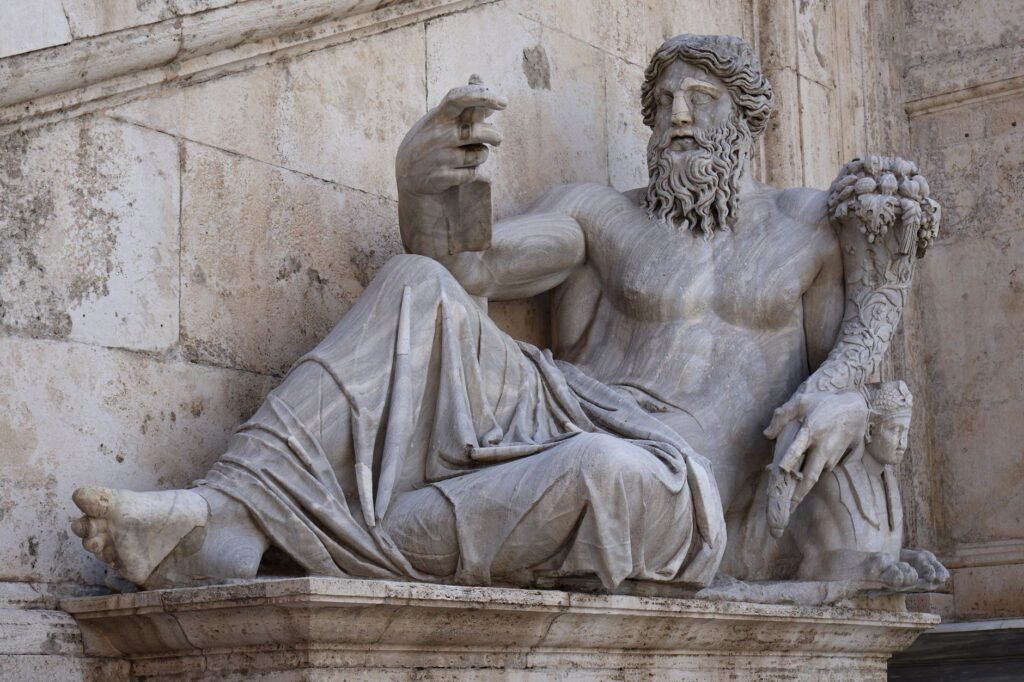
The king of the Roman gods is Jupiter (Iuppiter in Latin), the chief deity of Roman religion and the divine ruler associated with the sky, thunder, law, and state authority. In Roman thought, Jupiter was more than a mythological figure: he represented the protection of the community, the legitimacy of political power, and the sacred bond between Rome and its gods.
Although Roman religion borrowed heavily from Greek mythology, Jupiter developed his own distinct identity within Roman public life. He was honored as the guardian of oaths, treaties, military victory, and the Roman state itself. As the most elevated god in the Roman pantheon, Jupiter played a central role in religion from the early Republic through the Empire, and his influence remained important in art, literature, and political symbolism long after ancient pagan worship declined.
Origin and Meaning
The name Jupiter comes from the Latin form Iuppiter or Iovis Pater, meaning “Father Jove” or “Sky Father.” The name is historically related to the Indo-European sky-god root dyeu- or deiwos, which also appears in the names of deities such as the Greek Zeus and the Vedic Dyaus.
The original structure of the name reflects a very old divine concept: a paternal sky power associated with brightness, sovereignty, and heaven. In Roman religion, this ancient sky-father was adapted into the civic and legal framework of Rome, becoming not only a celestial god but also the protector of social order and public institutions.
Historical Context
Jupiter was central to the religious life of ancient Rome from its earliest periods. Unlike some deities whose importance was mainly local or domestic, Jupiter was closely tied to the Roman state. His cult reflected the Roman belief that divine favor was essential for the survival and success of the city.
Jupiter in early Rome
In the early Roman monarchy and Republic, Jupiter was already established as the highest god of the official religion. The Temple of Jupiter Optimus Maximus on the Capitoline Hill became one of the most important sanctuaries in Rome. It symbolized the authority of the Roman state and the connection between divine power and political legitimacy.
Jupiter and Roman public religion
Roman religion was highly public and ritualized. Jupiter was invoked in:
- state sacrifices
- military oaths
- treaty-making
- election and political ceremonies
- triumphal processions
- legal and civic acts
Because of this, Jupiter was not only a mythic ruler but also the divine guarantor of Roman law and international relations.
Roman contact with Greek religion
As Roman culture absorbed Greek traditions, Jupiter was increasingly identified with Zeus. This interpretatio graeca did not erase Jupiter’s Roman character, but it did influence Roman art and literature. The Romans adopted many Greek myths and attributes for Jupiter, while continuing to preserve his special role in Roman civic life.
Main Characteristics
Jupiter is usually presented as a majestic, mature male deity. In Roman art, he is typically portrayed as powerful, dignified, and authoritative, often seated on a throne or standing in a commanding pose.
Core traits
His main characteristics include:
- sovereignty and kingship
- control of thunder and lightning
- authority over the sky and weather
- protection of the Roman state
- defense of justice, law, and oaths
- patronage of victory and triumph
Visual identification
Jupiter is often shown with:
- a beard
- a scepter
- a thunderbolt
- an eagle
- a laurel wreath in some artistic and ceremonial contexts
He is usually depicted as a commanding father figure, more solemn than playful, and more concerned with order than with mischief.
Family and Genealogy
Roman and Greek sources generally agree that Jupiter corresponds to Zeus, but details of genealogy vary depending on the tradition.
Parents
In the standard mythological genealogy, Jupiter is the son of:
- Saturn (Cronus in Greek tradition)
- Ops (Rhea in Greek tradition)
Siblings
His most commonly named siblings are:
- Juno
- Neptune
- Pluto
- Vesta
- Ceres
In Roman myth, Jupiter and his siblings belong to the generation that overthrew Saturn.
Spouses and consorts
Jupiter’s chief wife is Juno, the goddess of marriage and queenship. However, as in Greek mythology, Jupiter is also associated with numerous other divine and mortal partners. Ancient sources differ widely in how they organize these traditions, and many stories were developed or elaborated over time.
Children
Among Jupiter’s many children are several major Roman and Greco-Roman deities. Depending on the source tradition, these include:
- Mars
- Vulcan
- Minerva
- Mercury
- Apollo
- Diana
- Bacchus
- Persephone/Proserpina in some traditions
- numerous heroes and semi-divine figures
Because Roman religion was not a single fixed system, genealogies were often adapted from Greek myth and local Italian traditions.
Symbols
Jupiter’s symbols reflect his role as ruler of heaven and protector of the state.
| Symbol | Meaning |
|---|---|
| Thunderbolt | Divine power, punishment, and control of the sky |
| Eagle | Majesty, sovereignty, and celestial authority |
| Scepter | Kingship and command |
| Throne | Supreme status among the gods |
| Laurel | Victory, honor, and sacred triumph |
| Oak tree | Strength, endurance, and sacred association with Jupiter |
The thunderbolt
The thunderbolt is Jupiter’s most famous symbol. It represents sudden divine force and the god’s ability to intervene decisively in human affairs.
The eagle
The eagle became strongly associated with Jupiter and, by extension, with Roman imperial power. The bird symbolized height, vision, and command over the heavens.
Sacred Animals
Several animals were especially associated with Jupiter.
Eagle
The eagle is the primary sacred animal of Jupiter. It appears in religious imagery, military iconography, and imperial symbolism. In Roman culture, the eagle could represent divine authority and the expansion of Roman power.
Ox and bull
In sacrificial contexts, oxen were especially important to Jupiter. Large public sacrifices of cattle were among the most solemn offerings in Roman religion. The best-known sacrificial victim for Jupiter was often the white ox, though practices varied by occasion and local custom.
Other birds
In augural practice, birds were observed for signs from the gods. While not exclusive to Jupiter, such divination reinforced his role as a god whose will could be read in the sky.
Sacred Plants
Jupiter is associated with a small number of plants, most notably the oak.
Oak tree
The oak was sacred to Jupiter because of its height, strength, and frequent role as a lightning target. In Roman symbolism, the oak represented durability and divine favor. Oak leaves also appear in honors and military decoration.
Laurel
The laurel was connected more broadly with victory and purification. While not exclusive to Jupiter, it was commonly used in triumphal and religious settings linked to his authority.
Sacred Places
Jupiter was worshiped throughout the Roman world, but some places held exceptional importance.
Temple of Jupiter Optimus Maximus
The most famous sanctuary was the Temple of Jupiter Optimus Maximus on the Capitoline Hill in Rome. Dedicated to Jupiter Best and Greatest, this temple was a primary center of state religion.
It was associated with:
- official Roman vows
- triumphal celebrations
- major sacrifices
- public thanksgiving after military success
The temple was rebuilt several times after fires and destructions, reflecting its enduring political and religious significance.
Capitoline Hill
The Capitoline Hill was closely identified with Jupiter and Roman civic identity. It was one of the symbolic centers of Roman power.
Other sacred sites
Important places connected with Jupiter include:
- Mount Olympus in later Greco-Roman literary imagination, though this is more Greek than Roman
- local hilltop sanctuaries across Italy
- temples dedicated to Jupiter under various titles, such as Jupiter Stator, Jupiter Feretrius, and Jupiter Tonans
These cult titles reflected different aspects of the god’s power.
Powers and Attributes
Jupiter’s powers were broad and deeply integrated into Roman religion.
Major domains
Jupiter governed:
- the sky and weather
- thunder and lightning
- kingship and sovereignty
- law and justice
- oaths and contracts
- military success
- the protection of the Roman state
- divine sanction for political authority
Epithets and titles
Jupiter’s many titles reveal the breadth of his functions. Among the best known are:
- Jupiter Optimus Maximus — “Best and Greatest”
- Jupiter Tonans — “Thunderer”
- Jupiter Stator — “The Stayer,” or the one who halts flight in battle
- Jupiter Feretrius — associated with spoils taken from an enemy commander
- Jupiter Latiaris — worshiped in the Latin League context
These titles were not merely decorative; they often referred to specific cults, rituals, or historical traditions.
Main Myths
Roman mythology preserves many stories about Jupiter, often adapted from Greek narratives involving Zeus. However, Roman authors also emphasized Jupiter’s relation to state order and political history.
The overthrow of Saturn
A major myth tells how Jupiter and his siblings were threatened by their father Saturn, who swallowed his children to prevent being overthrown. Jupiter survived, later defeated Saturn, and established a new divine order. This myth explains the transfer of power from one generation of gods to another.
The division of the world
After defeating Saturn, Jupiter and his brothers divided rulership:
- Jupiter received the sky
- Neptune received the sea
- Pluto received the underworld
This division reflects a structured cosmos ruled by a hierarchy of divine powers.
Jupiter and human affairs
Many myths present Jupiter as the god who punishes impiety, rewards piety, and oversees justice. In Roman storytelling, he often appears as the guarantor of order against chaos, arrogance, and oath-breaking.
Mythic punishment and divine justice
As in Greek tradition, Jupiter is associated with divine punishment in stories about:
- impious kings
- oath-breakers
- excessive pride
- threats to cosmic or social order
Roman authors often used these myths to reinforce moral and civic values.
Relationship with Other Mythological Figures
Jupiter’s interactions with other gods and mortals show his role at the top of the Roman pantheon.
Juno
Jupiter’s principal divine partner is Juno, his wife and queen. Their relationship is often tense in myth, reflecting rivalries, jealousy, and political symbolism. Juno represents marriage, legitimacy, and female sovereignty, while Jupiter represents supreme male authority.
Neptune and Pluto
Jupiter’s brothers, Neptune and Pluto, are major gods of their own realms. Their shared origin underscores the structure of Roman divine hierarchy.
Minerva
In Roman tradition, Minerva is commonly presented as a daughter of Jupiter, associated with wisdom, crafts, strategy, and the civic order.
Mars
Mars is also often described as Jupiter’s son in Roman mythic tradition. Mars had immense importance in Rome as a god of war and agriculture, and his relationship to Jupiter connected military strength with sovereign authority.
Mortals and heroes
Jupiter frequently interacts with mortals by:
- sending omens
- granting victories
- punishing arrogance
- legitimizing rulers
- fathering heroes and founders
Such stories linked myth to Roman political ideology and history.
Worship and Cult
Jupiter was one of the most publicly worshiped deities in the ancient world.
Sacrifices
Major sacrifices to Jupiter often involved:
- oxen or cattle
- formal prayers
- public vows
- thanksgiving after victory
These rituals were performed by magistrates, priests, and military commanders on behalf of the Roman people.
Festivals
Important festivals connected to Jupiter included ceremonies associated with:
- the Ides of September
- the Ides of October
- triumphal rites
- the Feriae Latinae, an ancient Latin festival linked to Jupiter Latiaris
Exact observances varied by period and location.
Political and military worship
Jupiter was essential in:
- senate meetings
- treaty ceremonies
- military oaths
- triumphs of victorious generals
A Roman general celebrating a triumph acknowledged that success came under Jupiter’s favor, not solely by human effort.
Priesthoods
The Flamen Dialis, the high priest of Jupiter, occupied one of the oldest and most prestigious priestly offices in Rome. The office carried numerous ritual restrictions, which reinforced the sacred status of Jupiter’s cult.
Ancient Sources
Our knowledge of Jupiter comes from a wide range of ancient texts and material evidence. Different sources emphasize different aspects of the god.
Literary sources
Important ancient authors include:
- Homer and Hesiod, for Greek parallels to Zeus
- Virgil, especially in the Aeneid, where Jupiter is central to Rome’s destiny
- Ovid, who retells many mythological episodes in the Metamorphoses and Fasti
- Livy, who describes Roman religious institutions and early history
- Varro, whose works preserve antiquarian Roman religious knowledge
- Cicero, who discusses Roman religion, divination, and the gods
- Dionysius of Halicarnassus, who writes about early Roman customs
- Apuleius and other later Latin authors who reflect the religious vocabulary of the imperial period
What these sources show
Ancient sources do not always agree. Some present Jupiter primarily as a cosmic deity; others emphasize his Roman political role. A careful reading of these texts shows that Jupiter was both a mythological king and a civic god.
Roman Equivalent
The Roman equivalent of the Greek Zeus is Jupiter, but the equivalence is not complete.
Similarities with Zeus
Both gods are:
- kings of the gods
- associated with the sky and thunder
- fathers of many gods and heroes
- defenders of order and justice
Distinct Roman identity
Jupiter differs from Zeus in emphasis. Roman religion made him especially important as:
- guardian of the Roman state
- protector of law and treaties
- deity of public oaths
- sponsor of military triumphs
Thus, Jupiter is not simply a Roman copy of Zeus. He is the Roman adaptation of an older sky-father deity, shaped by the civic needs of Roman society.
Influence on Modern Culture
Jupiter remains influential in modern culture, even for people who do not study classical antiquity directly.
Literature and scholarship
Modern literature, poetry, and historical fiction often use Jupiter as a symbol of authority, grandeur, or divine power. In academic writing, he remains a key figure in the study of Roman religion and mythology.
Art and visual culture
Painters, sculptors, and illustrators have long depicted Jupiter as a regal, bearded thunder-god with an eagle and lightning bolt. Classical imagery of Jupiter helped shape later representations of kingship and heavenly power.
Planetary naming
The planet Jupiter was named after the Roman god. This is one of the most enduring signs of his cultural legacy.
Games, film, and television
Jupiter appears frequently in:
- fantasy novels
- role-playing games
- video games based on mythology
- films and television series inspired by Greco-Roman themes
His image often symbolizes supreme power, judgment, and cosmic order.
Political symbolism
The image of Jupiter has also influenced imperial and state iconography, especially through the Roman eagle and thunderbolt motifs.
Curiosities
- Jupiter’s title Optimus Maximus means “Best and Greatest,” a formulation that highlights his supreme status.
- The Flamen Dialis, Jupiter’s high priest, lived under many ritual restrictions, showing how sacred his cult was considered.
- The Roman eagle standard used in the military carried associations of Jupiter’s authority.
- In Roman civic life, invoking Jupiter in an oath made a promise especially binding.
- Some Roman cult titles of Jupiter emphasized specific local functions rather than universal kingship.
- Jupiter’s sacred oak associations may reflect both Indo-European tradition and the practical prominence of oak trees in Italy.
- The Capitoline temple to Jupiter was one of the strongest symbols of Rome’s continuity, because rebuilding it after destruction was a major public act.
Frequently Asked Questions
Who is the king of the Roman gods?
The king of the Roman gods is Jupiter, the chief deity of Roman religion and the ruler associated with the sky, thunder, law, and the Roman state.
Is Jupiter the same as Zeus?
Jupiter is the Roman counterpart of Zeus, but he is not simply identical to him. Jupiter shares many myths and attributes with Zeus, while also serving a uniquely Roman role in politics, law, and public ritual.
What does Jupiter control?
Jupiter controls the sky, thunder, lightning, oaths, justice, and the legitimacy of public authority. He was also linked to military success and the protection of Rome.
Why was Jupiter important to the Romans?
Jupiter was important because Romans believed the welfare of the state depended on his favor. He was central to government, military victory, public sacrifice, and legal oaths.
What are Jupiter’s symbols?
His main symbols are the thunderbolt, eagle, scepter, throne, laurel, and oak tree.
Where was Jupiter worshiped?
Jupiter was worshiped throughout the Roman world, especially at the Temple of Jupiter Optimus Maximus on the Capitoline Hill in Rome.
Who were Jupiter’s parents?
In the standard mythological tradition, Jupiter’s parents were Saturn and Ops.
What is Jupiter’s Roman significance today?
Today Jupiter remains important in classical studies, art, literature, and the naming of the planet Jupiter. He is one of the most enduring figures from Roman mythology.
Conclusion
Jupiter, the king of the Roman gods, was the supreme deity of Roman religion and a powerful symbol of sovereignty, justice, and state authority. Rooted in ancient Indo-European sky-god traditions, he became in Rome the divine protector of law, treaties, military victory, and the civic order.
His cult shaped public ritual, politics, and religious identity across centuries of Roman history. Through literature, art, and the naming of the planet Jupiter, his legacy continues to influence modern culture. As both a mythological ruler and a civic guardian, Jupiter remains one of the most important and recognizable figures in the religious imagination of the ancient world.

Orin Vale has spent the better part of two decades tracing the threads that connect the world’s oldest stories — from the halls of Asgard to the banks of the Nile, from Olympus to the jungles of the Maya. What began as a childhood fascination with flood myths and trickster gods grew into years of independent study across comparative mythology and ancient religion, always chasing the same question: what did these stories mean to the people who first told them? Orin writes for readers who want more than trivia — the ones looking for the beliefs, fears, and truths that myths were built to carry.