Who Is Amun in Egyptian Mythology?
Introduction
Amun is one of the most important gods in ancient Egyptian mythology. He began as a relatively local deity but eventually rose to become one of the chief gods of the Egyptian pantheon, especially during the New Kingdom. In many periods, he was identified as a creator god, a hidden divine power, and the patron of kingship. Later, he was often merged with the sun god Ra as Amun-Ra, reflecting his supreme status in state religion.
Amun’s importance goes beyond theology. He played a major role in Egyptian politics, temple economy, royal ideology, and artistic tradition. His cult centers, especially in Thebes, became among the wealthiest and most influential religious institutions in the ancient world.
Origin and Meaning
The name Amun is usually written in Egyptian as jmn or imn. It is commonly translated as “the Hidden One” or “the Concealed One.” This meaning reflects one of his core characteristics: he was understood as a god whose presence could not be directly seen, even though his power was everywhere.
Etymology and linguistic notes
- The ancient Egyptian name is often rendered in modern scholarship as Amun, Amen, or Amon.
- The Greek form Ammon became common in later classical sources.
- The meaning “hidden” or “invisible” is widely accepted, though like many ancient divine names, the exact original nuance is not fully certain.
Historical origin
Amun appears to have originated as a local deity in the region of Thebes in Upper Egypt. In Egypt’s early history, he was not yet a universally prominent god. His rise to national importance came much later, especially when Thebes became politically dominant.
Historical Context
Amun’s significance is closely tied to the rise of Thebes and the religious changes of Egyptian history.
Early role
In the Middle Kingdom, Amun was already worshipped at Thebes, but his status was still regional. He was associated with creation, air, and hidden power. Over time, he became linked with the fertility god Min and the sun god Ra, and his influence expanded.
New Kingdom prominence
Amun became especially important during the New Kingdom (c. 1550–1070 BCE), when Theban rulers unified Egypt and established their dynasty. As Thebes became the political capital, Amun became the central god of the state.
During this period:
- Amun’s temple complex at Karnak expanded dramatically.
- The priesthood of Amun became extremely powerful.
- Pharaohs claimed divine support from Amun for military victories and imperial rule.
- Amun was closely tied to the legitimacy of kingship.
Political and religious power
Amun’s cult acquired extraordinary wealth through land, tribute, and donations. In some periods, the Amun priesthood rivaled royal authority. This makes Amun not only a religious figure but also a major historical force in ancient Egypt.
Main Characteristics
Amun is a complex deity with several overlapping identities.
Core traits
- Hidden or invisible power
- Creator and sustainer
- King of the gods
- Protector of rulers
- Fertility and life-giving force
- Air and breath, in some traditions
Common forms and iconography
Amun is usually depicted as:
- A human male wearing a tall double-plumed crown
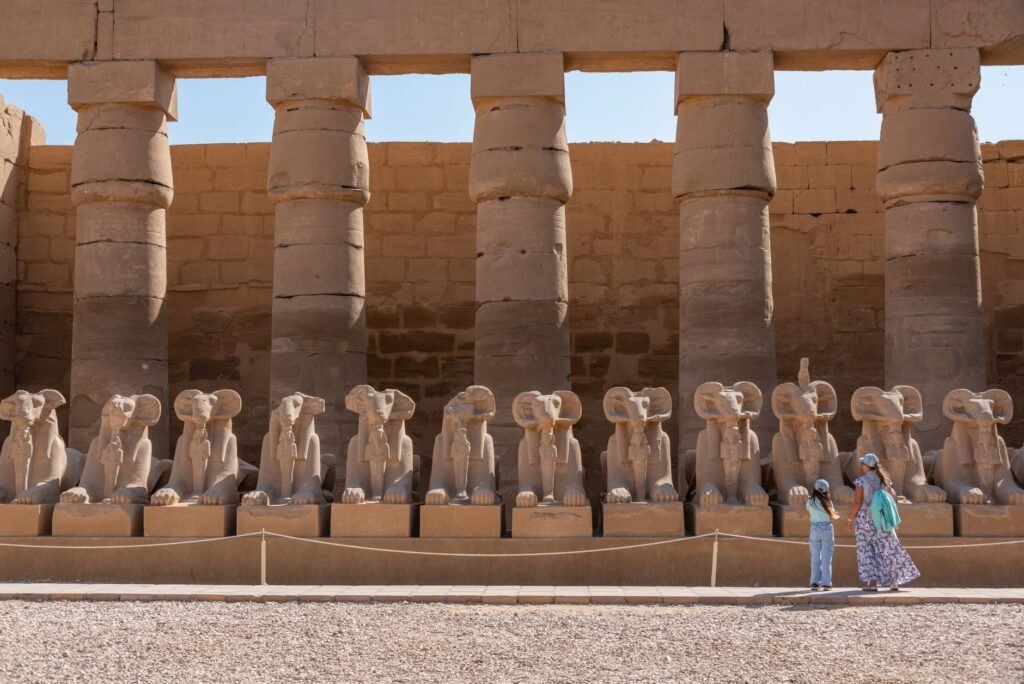
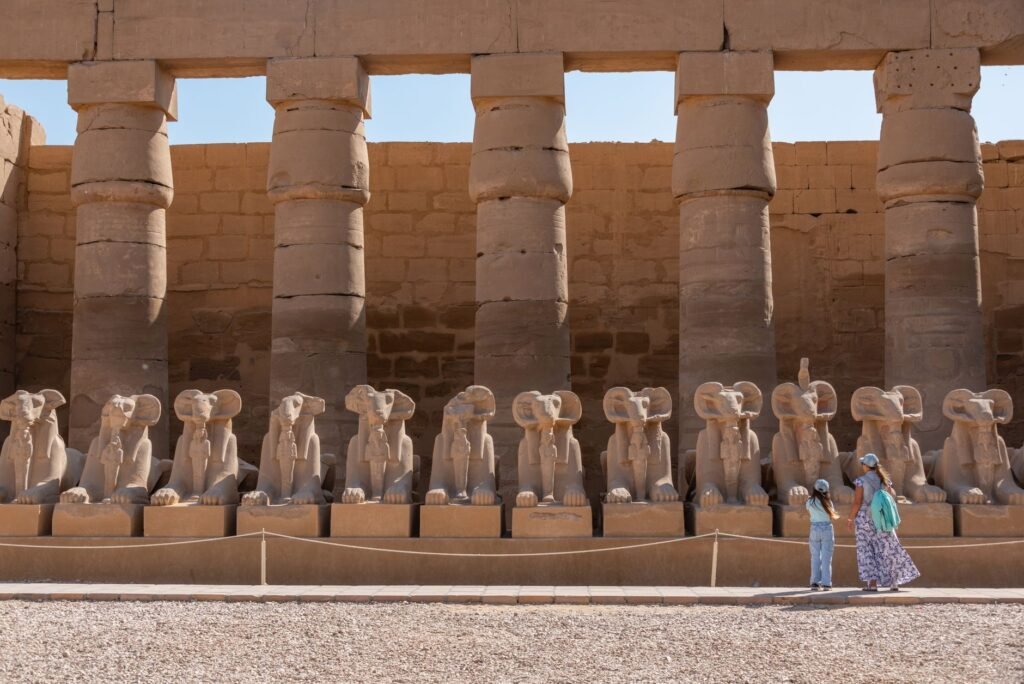
- Sometimes as a ram-headed god
- Occasionally as a sphinx-like composite figure
- In certain forms, as a goose, especially in older or local traditions
His double feathers are among his most recognizable features and became a standard symbol of his divinity.
Amun-Ra
One of the most important developments in Egyptian religion was the fusion of Amun with Ra. In this combined form, Amun-Ra represented both hidden and manifest divine power:
- Amun = the unseen, mysterious aspect
- Ra = the visible sun and cosmic order
This theological combination helped make Amun the supreme deity of the Egyptian state in many periods.
Family and Genealogy
Like many Egyptian gods, Amun’s family relationships varied by region and era.
Consort
Amun’s principal wife in Theban theology was Mut, a mother goddess. She was part of the Theban triad with Amun and their son.
Son
Their son was Khonsu, a lunar deity associated with time, healing, and the night sky.
Theban triad
The family grouping of:
- Amun
- Mut
- Khonsu
became a central religious unit in Thebes.
Other associations
Amun was also linked with:
- Amunet, an early female counterpart or companion in some traditions
- Wadjet and other goddesses through syncretic theology
- Tefnut and Nefertum in some local or interpretive traditions
Because Egyptian religion was highly flexible, Amun’s genealogy is not fixed in a single canonical form.
Symbols
Amun’s symbols reflect his invisible yet powerful nature.
| Symbol | Meaning |
|---|---|
| Double plumes | Divine majesty, elevation, and royal power |
| Ram | Fertility, strength, masculine generative force |
| Goose | Possible early sacred form, associated with the god in some traditions |
| Tall crown | Authority and transcendence |
| Sistrum and ritual emblems | Connection to temple worship and divine presence |
| Solar disk in Amun-Ra iconography | Union with the sun and cosmic sovereignty |
Double plumes
The most iconic symbol of Amun is the crown with two tall feathers. This sign appears widely in temple reliefs and royal imagery.
Ram horns
In later imagery, Amun often appears with ram horns, emphasizing fertility, potency, and divine force. Rams were powerful and respected animals in ancient Egypt, and their image helped express Amun’s generative aspect.
Sacred Animals
Amun was especially associated with the ram, but other animals also appear in his cultic world.
Ram
The ram became Amun’s most important sacred animal. It symbolized:
- Male potency
- Fertility
- Creative power
- Royal vigor
At some cult centers, sacred rams were housed, honored, and sometimes mummified after death.
Goose
Amun was also linked with the goose in some early or regional traditions. The exact importance of this connection is less central than the ram association, but it is attested in certain iconographic and textual contexts.
Symbolic significance
Animal forms in Egyptian religion were not literal “avatars” in the modern sense. They expressed qualities of the deity through visible symbols that made divine power understandable in human terms.
Sacred Plants
Unlike some gods, Amun is not strongly associated with a single universally recognized sacred plant. However, certain plants and floral motifs appear in his temples and rituals.
General associations
- Lotus: a common symbol in Egyptian religion, often linked with creation and rebirth
- Papyrus: used in ritual, temple decoration, and symbolism of Lower Egypt
- Offerings of flowers and greenery: common in temple worship
Caution on attribution
No plant has the same level of identification with Amun that the ram has. Associations with plants are usually broader Egyptian religious motifs rather than exclusive Amun-specific emblems.
Sacred Places
Amun’s cult was tied to several major locations in Egypt.
Thebes and Karnak
The most important center of Amun worship was Thebes (modern Luxor). Within Thebes, the temple complex of Karnak became the great religious heart of his cult.
Karnak featured:
- Massive hypostyle halls
- Sacred lakes
- Processional avenues
- Multiple shrines and precincts
It was one of the largest temple complexes ever built in the ancient world.
Luxor Temple
Although associated with the broader Theban religious landscape, Luxor Temple also had important connections to Amun, especially in relation to royal festivals and divine kingship.
Nubia and imperial temples
As Egypt expanded southward, Amun’s worship spread into Nubia. Temples dedicated to him were built or supported in conquered regions, reflecting the extension of Egyptian state religion.
Oracle sites
Amun became famous as an oracle god, especially in later periods. His divine will was sought through ritual processions and priestly interpretation.
Powers and Attributes
Amun’s powers developed over time and varied across religious traditions.
Major domains
- Creation
- Kingship
- Divine protection
- Hidden wisdom
- Air and breath
- Fertility
- Cosmic sovereignty
Hidden power
Amun’s identity as “the Hidden One” made him especially suited to theological speculation. He could be understood as a god whose essence transcended ordinary sight, while still sustaining the universe.
Royal legitimacy
Pharaohs often claimed that Amun selected or supported them. This made Amun central to the ideology of divine kingship.
Oracle and guidance
In later periods, Amun was also consulted for guidance. His answers were believed to come through ritual movement of sacred images or through priestly mediation.
Main Myths
Amun does not have one single myth cycle comparable to the Greek stories of Zeus or Hercules. Instead, his importance is spread across hymns, temple theology, royal inscriptions, and ritual texts.
Creation theology
In some texts, Amun is described as a primordial creator who existed before the world took shape. His hidden nature made him a suitable figure for cosmological speculation.
Amun and the king
A major religious theme is that Amun chooses and empowers the pharaoh. In royal inscriptions, the god may appear in dreams, oracles, or divine proclamations to approve a ruler’s legitimacy.
Divine birth myths
Some temple texts present the reigning pharaoh as the son of Amun. In these narratives, Amun assumes the form of the king’s father to conceive the royal child with the queen. These stories strengthened dynastic legitimacy.
Amun and imperial victories
New Kingdom kings frequently credited military success to Amun’s support. Victory stelae and temple reliefs depict the god as patron of conquest and empire.
Relationship with Other Mythological Figures
Amun’s relationships with other gods reflect Egypt’s syncretic religious system.
Amun and Ra
This is Amun’s most important theological relationship.
- Amun represents hidden divinity
- Ra represents visible solar power
- Together, Amun-Ra expresses a supreme cosmic god
Amun and Mut
Mut is Amun’s principal consort in Theban theology. She appears as a mother goddess and a royal divine partner.
Amun and Khonsu
Khonsu is often portrayed as their son, forming the Theban triad.
Amun and Ptah
In some theological systems, Amun, Ra, and Ptah could all be linked as major creator gods, each representing different aspects of divine causation.
Amun and Aten
Amun became especially significant in the background of the Amarna period, when pharaoh Akhenaten elevated the Aten and suppressed many traditional cults, including Amun’s. After Akhenaten’s reign, Amun’s worship was restored with great force.
Worship and Cult
Amun was worshipped in temples through a highly organized priestly system.
Temple rituals
Typical forms of worship included:
- Daily offerings of food and drink
- Incense burning
- Hymns and prayers
- Sacred processions
- Purification rites
- Presentation of divine statues or cult images
Offerings
Offerings commonly included:
- Bread
- Beer
- Oxen and other animals
- Wine
- Incense
- Flowers
- Fine linen and oils
Festivals
Amun was honored in major festivals, particularly those involving processions between temples.
One of the best-known events was the Opet Festival in Thebes, during which the divine power of Amun was renewed and linked to royal authority.
Priesthood
The priests of Amun became a major institutional class. Their influence extended beyond worship into administration, land management, and politics.
Ancient Sources
Amun appears in a wide range of Egyptian sources, though not in the same way as figures from Greek epic.
Egyptian primary sources
Important evidence comes from:
- Temple inscriptions
- Hymns to Amun
- Royal dedicatory texts
- Funerary literature
- Oracle records
- Papyri and liturgical texts
Major texts and traditions
Notable sources include:
- The Great Hymn to Amun, which praises him as a hidden and supreme god
- Temple inscriptions at Karnak
- Royal inscriptions from the New Kingdom
- Later theological texts that present Amun as creator and cosmic ruler
Classical authors
Greek and Roman writers also mention Amun, often under the name Ammon.
- Herodotus describes Egyptian religion and references the oracle of Ammon.
- Diodorus Siculus gives historical and religious accounts of Egypt.
- Plutarch discusses Egyptian theology in interpretive form.
- Strabo mentions cultic sites and practices.
- Roman authors refer to Jupiter Ammon in the context of the Libyan oracle.
Note on interpretation
Classical authors often interpreted Amun through their own religious categories, so their descriptions should be read cautiously and compared with Egyptian evidence.
Roman Equivalent
Amun did not have a perfect Roman equivalent, but he was commonly identified with Jupiter in Greco-Roman interpretation, especially as Jupiter Ammon.
Why Jupiter?
Roman and Greek writers often matched foreign gods with their own major deities by function:
- Amun’s supreme status
- His association with authority
- His oracle function
- His celestial and royal character
This identification, however, is an approximation rather than a true equivalence. Amun’s Egyptian theology remained distinct.
Influence on Modern Culture
Amun continues to appear in modern historical writing, fiction, art, and popular culture.
In scholarship and museums
Amun is frequently featured in:
- Museum collections of Egyptian art
- Academic studies of ancient religion
- Exhibitions on Thebes and Karnak
- Histories of the pharaohs and temples
In literature and entertainment
Amun appears or is referenced in:
- Historical novels about ancient Egypt
- Fantasy fiction using Egyptian mythological themes
- Documentaries about archaeology
- Video games with Egyptian settings
- Films and television series inspired by ancient gods
In popular imagination
Because of his association with hidden power, rams, and priestly temples, Amun is often used in modern media as a symbol of mystery, antiquity, and divine authority.
Curiosities
- Amun’s rise from local god to national deity is one of the clearest examples of religious transformation linked to political power in ancient history.
- The name Amen in some later languages has been connected by popular imagination to Amun, but this is a different word with a separate religious history.
- Amun’s temple complex at Karnak grew over many centuries and is a key source for understanding Egyptian monumental religion.
- In the Amarna period, Amun’s cult was suppressed, but after Akhenaten’s death it returned strongly.
- The title “King of the Gods” was frequently applied to Amun in hymns and temple theology.
- Some Egyptian rulers used their relationship with Amun to justify military campaigns and political legitimacy.
- The oracle of Amun at Siwa Oasis became especially famous in later antiquity, including its association with Alexander the Great in Greek tradition.
Frequently Asked Questions
1. Who is Amun in Egyptian mythology?
Amun is a major Egyptian god associated with hidden power, creation, kingship, and later with the sun god Ra as Amun-Ra. He became one of the most important gods in ancient Egypt.
2. What does the name Amun mean?
Amun generally means “the Hidden One” or “the Concealed One.” This reflects his character as a mysterious, invisible divine force.
3. What animal represents Amun?
The ram is Amun’s most important sacred animal. He is also sometimes associated with the goose.
4. Where was Amun worshipped?
His main center was Thebes, especially the temple complex at Karnak. He was also worshipped in other parts of Egypt and in Nubia.
5. Who were Amun’s wife and son?
In the Theban triad, Amun’s wife was Mut and his son was Khonsu.
6. Why was Amun so important?
Amun became important because Thebes rose to political power, and Egyptian kings linked themselves to him for legitimacy. His cult also became extremely wealthy and influential.
7. Is Amun the same as Ra?
Not exactly. They are different gods, but in many periods they were fused into Amun-Ra, a combined deity representing hidden and visible divine power.
8. Did the Greeks and Romans worship Amun?
They identified him with their own supreme gods, especially Zeus and Jupiter, and referred to him as Ammon or Jupiter Ammon.
Conclusion
Amun is one of the most significant figures in Egyptian mythology and religion. From a local Theban deity, he rose to become a supreme god of creation, kingship, and divine hiddenness. His fusion with Ra as Amun-Ra, his role in royal ideology, and the power of his priesthood made him central to ancient Egyptian civilization for centuries.
Understanding Amun means understanding more than one god. It means seeing how Egyptian religion combined theology, politics, ritual, and art into a powerful and flexible system. Amun’s legacy survives in temples, texts, museum collections, and the continuing global fascination with ancient Egypt.

Orin Vale has spent the better part of two decades tracing the threads that connect the world’s oldest stories — from the halls of Asgard to the banks of the Nile, from Olympus to the jungles of the Maya. What began as a childhood fascination with flood myths and trickster gods grew into years of independent study across comparative mythology and ancient religion, always chasing the same question: what did these stories mean to the people who first told them? Orin writes for readers who want more than trivia — the ones looking for the beliefs, fears, and truths that myths were built to carry.