Who Is Shu in Egyptian Mythology?
Introduction
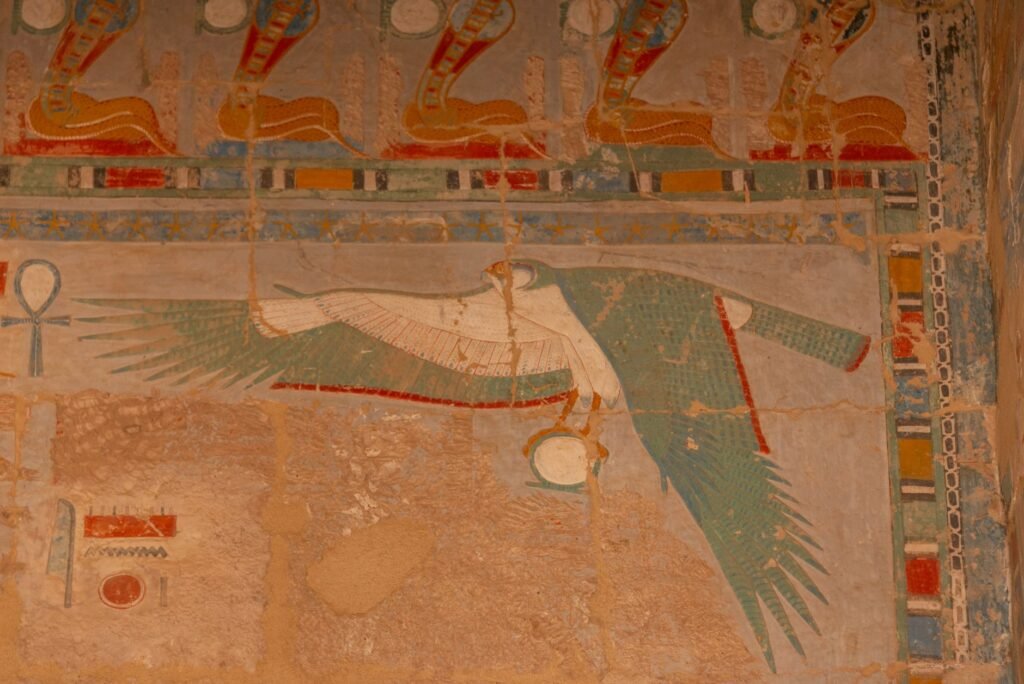
Shu is one of the most important deities in ancient Egyptian religion. He is best known as the god of air, light, and the space that separates heaven from earth. In Egyptian cosmology, Shu helped create and maintain the ordered universe by lifting the sky goddess Nut away from the earth god Geb. This act made life and movement possible in the world.
Because of this role, Shu is not only a mythological figure but also a symbol of balance, stability, and the structure of creation itself. He appears in creation myths, funerary texts, temple theology, and royal ideology. His name and image reflect the ancient Egyptian understanding of the forces that sustain the cosmos.
Origin and Meaning
The name Shu is commonly understood as belonging to one of the earliest layers of Egyptian religious language, though the precise etymology is not entirely certain. In Egyptian texts, he is written with signs associated with dryness, lightness, or air, and scholars have long linked his name to concepts of air, emptiness, or dryness. However, as with many ancient Egyptian divine names, the exact original meaning is debated.
Shu is usually identified as:
- the god of air
- the god of atmospheric space
- a force associated with light and dryness
- a divine separator who holds the sky apart from the earth
His name survived through centuries of Egyptian religion, from the Old Kingdom onward, showing that he was an ancient and enduring component of Egyptian cosmology.
Historical Context
Shu belongs to the complex religious system developed in ancient Egypt over many centuries. He is most closely associated with the Heliopolitan creation tradition, one of the best-known Egyptian cosmological systems. In this tradition, the creator god Atum brings forth the divine pair Shu and Tefnut, who in turn produce Geb and Nut, the earth and the sky.
This genealogy expresses a central Egyptian idea: the cosmos is not random, but ordered through divine relationships. Shu’s role as separator and supporter of the sky is essential to that order. Without him, the sky and earth would remain locked together, and the world as humans know it could not exist.
Shu also appears in funerary and royal contexts. Egyptian kings were often linked to the maintenance of ma’at, the principle of truth, order, and cosmic balance. Shu’s stabilizing role made him especially relevant to this ideological framework.
Shu in Egyptian Religion
Shu was not a marginal deity. He appears in:
- creation myths
- funerary spells and texts
- temple inscriptions
- cosmological imagery
- solar theology
His presence in such a wide range of sources shows that he was understood as a fundamental force in the universe rather than a local or minor god.
Main Characteristics
Shu is usually depicted as a male deity with distinctive iconography and strong cosmic associations. He is one of the Ennead of Heliopolis, a group of nine deities central to Egyptian creation theology.
Core traits of Shu
| Attribute | Meaning |
|---|---|
| Air and atmosphere | Shu embodies the space between earth and sky |
| Light and brightness | He is linked to the sun’s illumination |
| Dryness | In Egyptian thought, dryness opposed the watery chaos of the primeval world |
| Separation | He maintains cosmic boundaries |
| Stability | He preserves the structure of the created world |
Shu is often portrayed as a standing man with his arms raised. This posture is highly symbolic, because it can be read as the image of a god supporting the sky above. In other depictions, he wears an ostrich feather or feathers on his head, a feature that is strongly associated with him.
Family and Genealogy
Shu’s family relationships vary somewhat according to the source and the theological tradition, but the most common account places him in the Heliopolitan Ennead.
Parentage
In the Heliopolitan system:
- Atum is his father or creator
- Tefnut is his mother or divine counterpart
Some texts treat Shu and Tefnut as the first pair generated by Atum from himself. The tradition is not uniform in describing whether they are literally born in a biological sense or produced through divine self-creation.
Siblings and Children
Shu’s most important offspring are:
- Geb, the earth god
- Nut, the sky goddess
In many traditions, Geb and Nut are both his children and a divine pair whose separation is essential to the ordered world.
Spouse
Shu is often paired with Tefnut, his sister and counterpart. Together they represent complementary cosmic principles. Like many Egyptian divine pairs, their relationship is primarily theological rather than narrative in a modern sense.
Genealogical Summary
| Relationship | Name | Notes |
|---|---|---|
| Creator/father | Atum | In Heliopolitan theology |
| Mother/counterpart | Tefnut | Often the first divine female principle |
| Children | Geb and Nut | Earth and sky |
| Consort | Tefnut | Sometimes treated as wife and sister |
Symbols
Shu is associated with several symbols that reflect his cosmic function.
Main symbols of Shu
- Ostrich feather: one of his most recognizable emblems
- Raised arms: symbolizing the support of the sky
- Air and open space: often represented indirectly rather than through a specific object
- Sunlight and brightness: connected to his role in making the world habitable
The ostrich feather is especially important. In Egyptian art, feathers could signal lightness, truth, or divine power. Shu’s feather headdress helped distinguish him from other gods.
The image of Shu with arms extended upward appears to represent the act of holding Nut aloft. This visual tradition is one of the clearest artistic expressions of Egyptian cosmology.
Sacred Animals
Shu does not have a single universally fixed sacred animal in the way that some Egyptian deities do, but he is sometimes associated with lions.
The lion connection
In some traditions and representations, Shu’s solar and protective aspects are linked with lions. This association likely reflects the lion’s connection to:
- strength
- royal authority
- solar power
- protective force
There are also parallels between Shu and divine lion imagery in broader Egyptian religion, where powerful protective deities could take leonine form.
However, it is important to note that Shu is not primarily an animal-headed god, and his iconography is usually human. His animal associations are secondary and vary by context.
Sacred Plants
No plant is universally and exclusively sacred to Shu in the same way that certain plants are tied to other deities or cults. Egyptian religion, however, often linked gods to natural elements, and Shu’s domain of air and light may connect him indirectly to vegetation through the fertility of the world he helps sustain.
Possible symbolic associations
- Flowers and blossoms may symbolize the life enabled by light and space
- Reed imagery may appear in broader cosmological contexts related to air and marshland
- Feathers, while not plants, function in a similar symbolic way as light, elevated forms
Because the evidence is limited, any botanical associations should be treated cautiously. Shu’s identity is more strongly defined by atmospheric and cosmological qualities than by specific sacred plants.
Sacred Places
Shu was associated with major religious centers, especially those tied to solar and creation theology.
Heliopolis
Heliopolis was one of the most important centers of sun worship in ancient Egypt and the principal setting for the Ennead theology. Shu’s significance is deeply connected to this city, where the creation myth involving Atum, Shu, Tefnut, Geb, and Nut was especially influential.
Solar and cosmological temples
Shu was also conceptually linked to temples dedicated to the sun and cosmic order. As a god of light and atmospheric separation, he belonged to the theology of the sun god and his daily renewal.
Mythic space
Shu’s greatest sacred “place” is not a city but the cosmic interval between heaven and earth. In Egyptian thought, this in-between space was not empty in a negative sense; it was necessary, active, and divine.
Powers and Attributes
Shu’s powers are primarily cosmic rather than magical in the narrow sense.
Main domains of Shu
- Air
- Light
- Space between earth and sky
- Cosmic separation
- Maintenance of order
- Support of the heavens
His most famous act is the separation of Nut from Geb. This is a foundational myth because it explains why the sky is above and the earth below. Shu’s intervention creates the conditions for life, movement, and time.
Cosmic functions
Shu is responsible for:
- preventing cosmic collapse
- sustaining breathable space
- allowing the sun to travel
- preserving the structure of creation
- maintaining boundaries between divine realms
These functions make him part of the architecture of the universe itself.
Main Myths
Shu appears in several important Egyptian myths, especially those connected to creation and cosmic order.
The separation of Nut and Geb
The best-known myth involving Shu describes how Nut and Geb were once tightly embraced. This prevented the creation of the ordered world. Shu intervened by lifting Nut away from Geb, creating the space in which existence could unfold.
This myth explains:
- the separation of sky and earth
- the origin of the world’s structure
- Shu’s role as a cosmic supporter
In some versions, the sun travels through the sky because Shu holds Nut aloft.
Shu and the solar cycle
Shu is sometimes linked to the sun’s daily movement. Since light and air are essential to visibility and life, Shu’s presence supports the solar order. His connection to the sun is not always explicit in every text, but it is consistent with his place in Egyptian cosmology.
Shu in royal and funerary contexts
Shu can appear in texts related to kingship and the afterlife. Because he preserves the cosmic structure, he also supports the king’s role as maintainer of order. In funerary literature, divine stability is important for safe passage into the afterlife, and Shu’s protective function aligns with that need.
Relationship with Other Mythological Figures
Shu interacts with many of the central gods of the Egyptian pantheon.
Shu and Tefnut
Tefnut is Shu’s primary counterpart. Together they form an initial divine pair in the Heliopolitan creation scheme. Their relationship represents balance and complementarity.
Shu and Geb
Geb is Shu’s son and the earth god. Shu’s relationship with Geb is central to the myth of separation. By holding Geb apart from Nut, Shu establishes the world’s vertical structure.
Shu and Nut
Nut is Shu’s daughter and the sky goddess. She is often shown arching over the earth. Shu supports her body or holds her above Geb, making him a crucial figure in her cosmological role.
Shu and Atum
Atum is the creator god of Heliopolis and Shu’s parent or source. Shu helps extend Atum’s creative act into the structure of the world.
Shu and Ra
Shu is sometimes closely associated with Ra, the sun god. In some texts and theological developments, solar and atmospheric powers overlap. Shu may appear as part of the broader solar order, though he remains a distinct deity.
Worship and Cult
Shu was worshipped as part of the broader Egyptian religious system, but there is no evidence of a large independent cult centered exclusively on him in the same way as for some major local gods.
Forms of worship
Shu’s worship likely included:
- offerings in temple rituals
- invocation in cosmological and funerary texts
- participation in solar theology
- royal and priestly acknowledgment of his role in order
Ritual significance
As a god of order and cosmic support, Shu’s importance was often theological rather than devotional in a narrow personal sense. He was invoked because the world itself depended on the principles he embodied.
Festivals and public cult
Specific festivals dedicated solely to Shu are not well documented in surviving sources. He may have been honored within broader festivals of creation, the sun god, or royal renewal, but the evidence is incomplete.
Ancient Sources
Shu is known from a wide range of ancient Egyptian sources, though many are theological rather than narrative. Since Egyptian religion developed over millennia, no single source gives a complete picture.
Important Egyptian sources
- Pyramid Texts: among the earliest religious texts, where cosmic and royal themes involving Shu appear
- Coffin Texts: Middle Kingdom funerary spells that preserve cosmological ideas
- Book of the Dead: later funerary material containing references to gods of order and cosmic structure
- Temple inscriptions: especially those reflecting solar and creation theology
- Mythological and theological texts: including versions of the Heliopolitan creation story
Classical sources
Greek and Roman writers sometimes summarized Egyptian religion, but they often interpreted it through their own frameworks. They are useful but must be read carefully.
- Herodotus discusses Egyptian religion broadly, though not always with precise theological detail
- Plutarch offers interpretive discussions of Egyptian gods, especially in On Isis and Osiris
- Other classical authors sometimes allude to Egyptian cosmology indirectly
Because these writers were outsiders to Egyptian priestly traditions, their accounts are secondary and sometimes speculative.
Roman Equivalent
Shu does not have a perfect Roman equivalent. Egyptian gods were often compared to Roman or Greek deities only approximately, and such comparisons can be misleading.
Possible analogies
Shu has sometimes been compared in broad terms to deities associated with:
- air
- atmosphere
- sky support
- cosmic order
However, no Roman god matches Shu’s role exactly. Roman religion did not contain an equivalent deity whose primary function was to hold apart heaven and earth.
For that reason, it is better to say that Shu was adapted into Greco-Roman interpretive frameworks rather than translated into a true Roman counterpart.
Influence on Modern Culture
Shu is not as widely known in modern popular culture as Isis, Osiris, or Anubis, but he appears in works that draw on Egyptian mythology, ancient cosmology, or fantasy reinterpretations.
Modern appearances and influence
Shu may be encountered in:
- novels inspired by ancient Egypt
- educational documentaries
- museum exhibitions
- video games with Egyptian settings
- comics and fantasy fiction using Egyptian gods
- academic studies of ancient religion
His image as the supporter of the sky is especially appealing to modern reinterpretations of mythology because it is visually dramatic and cosmologically meaningful.
In scholarship and education
Shu is often used in classrooms and museum contexts to explain how the Egyptians imagined the universe. His myth is one of the clearest examples of ancient cosmological thought.
Curiosities
Here are some lesser-known facts about Shu:
- Shu is one of the best examples of a god whose role is cosmic structure, not just personality or narrative.
- His act of separating Nut and Geb is one of the most famous creation images in Egyptian religion.
- The raised-arm pose used in his iconography may symbolize the idea of a divine support beam.
- Shu’s feather crown helps connect him with lightness, elevation, and divine distinction.
- In some traditions, his name and attributes overlap with notions of dry air, which was essential in distinguishing the ordered world from the watery chaos before creation.
- He is part of the Heliopolitan Ennead, one of the most influential theological systems in ancient Egypt.
- His importance is often understated in modern popular culture, despite his central role in Egyptian cosmology.
Frequently Asked Questions
1. Who is Shu in Egyptian mythology?
Shu is the Egyptian god of air, light, and the space between heaven and earth. He is especially known for separating the sky goddess Nut from the earth god Geb.
2. Is Shu a major Egyptian god?
Yes. Shu is a major deity in Egyptian cosmology, especially in the Heliopolitan creation tradition. He is essential to the structure of the universe.
3. What does Shu look like?
Shu is usually shown as a human male standing with raised arms or wearing a feather. He is not typically portrayed with an animal head.
4. Who are Shu’s parents and children?
In the Heliopolitan myth, Shu is the child of Atum and Tefnut. His children are Geb and Nut.
5. What is Shu the god of?
Shu is the god of air, atmosphere, light, dryness, and cosmic separation. He also helps maintain order in the universe.
6. Why is Shu important in Egyptian mythology?
Shu is important because he creates the space in which life can exist. By separating earth and sky, he makes the ordered world possible.
7. Does Shu have a Roman equivalent?
Not exactly. Roman religion does not contain a direct equivalent to Shu, though he can be loosely compared to deities associated with air or sky.
8. Where was Shu worshipped?
Shu was especially associated with Heliopolis, the major center of Egyptian solar and creation theology, though he was known throughout Egypt.
Conclusion
Shu is one of the foundational gods of Egyptian mythology. As the deity of air, light, and cosmic separation, he plays a crucial role in making the ordered universe possible. His myth of holding apart Nut and Geb expresses a central Egyptian belief: that stability, balance, and divine structure sustain life.
Although he is less famous than some other Egyptian gods, Shu is indispensable to understanding Egyptian creation theology. He represents the invisible but necessary forces that shape the world, bridging mythology, cosmology, and religious thought in one of the world’s most enduring ancient traditions.

Orin Vale has spent the better part of two decades tracing the threads that connect the world’s oldest stories — from the halls of Asgard to the banks of the Nile, from Olympus to the jungles of the Maya. What began as a childhood fascination with flood myths and trickster gods grew into years of independent study across comparative mythology and ancient religion, always chasing the same question: what did these stories mean to the people who first told them? Orin writes for readers who want more than trivia — the ones looking for the beliefs, fears, and truths that myths were built to carry.