Who Is Ma’at in Egyptian Mythology?
Ma’at is one of the most important concepts and divine figures in ancient Egyptian religion. In Egyptian mythology, Ma’at is both a goddess and an abstract principle representing truth, justice, balance, order, harmony, and cosmic stability. She was central to how the ancient Egyptians understood the universe, kingship, morality, and the afterlife.
Unlike many mythological figures whose stories are primarily dramatic or heroic, Ma’at is foundational. She is not only a deity but also the name of the ideal state of the world when everything functions properly. For the ancient Egyptians, the universe was sustained by Ma’at, and society was expected to reflect it through right conduct, lawful rule, and religious devotion.
Origin and Meaning
The name Ma’at is usually written in transliterated form as mꜣꜥt. It is commonly translated as truth, justice, order, or harmony, though no single English word fully captures its meaning.
The word had a dual significance:
- As a goddess, Ma’at was a divine being personifying these ideals.
- As a concept, ma’at referred to the correct order of the cosmos, society, and moral life.
The ancient Egyptian language expressed the idea through a root associated with being true, straight, and balanced. The concept likely developed very early in Egyptian civilization, becoming formalized during the Old Kingdom and remaining central throughout later periods.
Because Egyptian religion often united ideas and divinity, Ma’at was not simply “the goddess of justice.” She was the principle that made justice, legitimacy, and cosmic order possible.
Historical Context
Ma’at emerged within a civilization deeply shaped by the rhythms of the Nile, where predictable flooding, agricultural cycles, and royal administration all depended on stability. Egyptian religion interpreted this stability as a reflection of cosmic order.
In this context, Ma’at functioned on several levels:
- Cosmic level: She maintained the proper functioning of the universe.
- Political level: She legitimized the pharaoh’s authority.
- Social level: She represented ethical behavior, fairness, and truthfulness.
- Funerary level: She played a major role in judgment after death.
The ancient Egyptians believed that chaos, often associated with forces such as isfet—meaning disorder, injustice, or falsehood—constantly threatened creation. Ma’at was the force that held chaos at bay. This made her essential not only in religion but also in royal ideology and statecraft.
Pharaohs were expected to “establish Ma’at” and “drive out isfet.” In inscriptions, kings often presented themselves as defenders of cosmic and social order. In this sense, Ma’at was inseparable from the concept of rightful kingship.
Main Characteristics
Ma’at is both abstract and personified, which makes her unusual even among ancient deities. Her main characteristics include:
- Truth: speaking and acting honestly
- Justice: fairness in judgment and social relations
- Order: the proper arrangement of the universe and society
- Balance: harmony among opposing forces
- Stability: resistance to chaos and disorder
- Legitimacy: endorsement of rightful rule
- Cosmic rhythm: alignment with divine and natural cycles
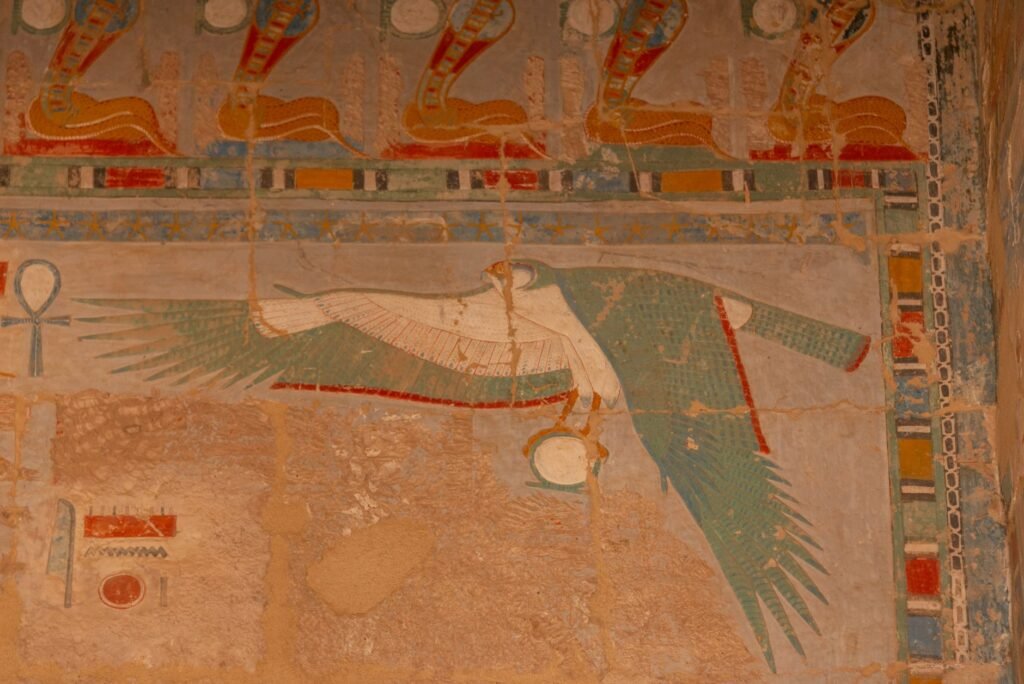
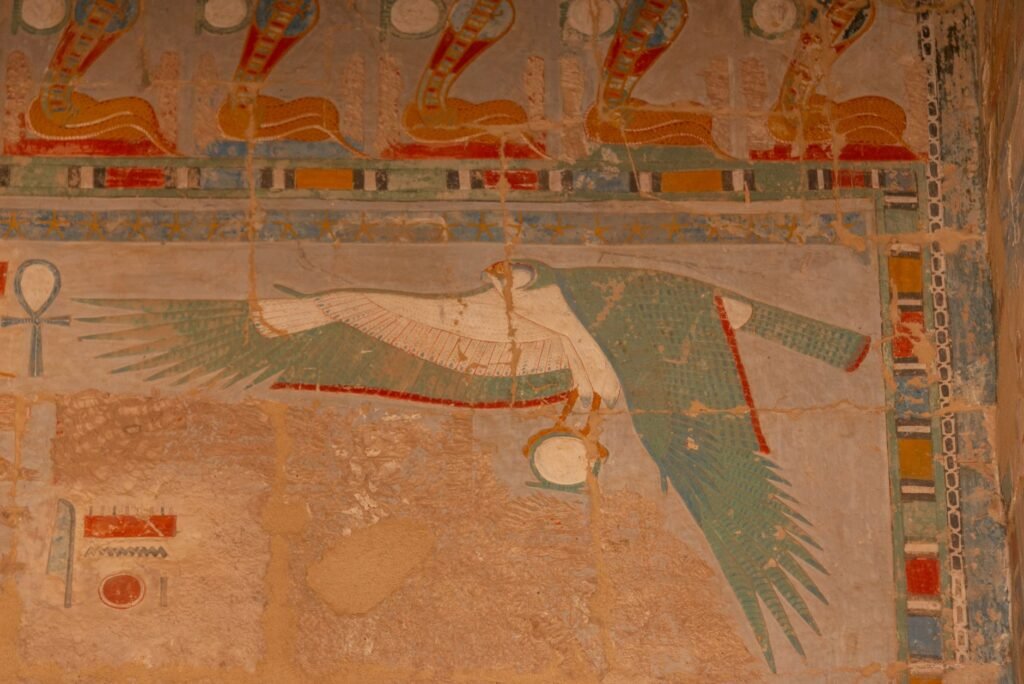
As a goddess, Ma’at is often depicted as a woman wearing a distinctive feather on her head, though sometimes the feather alone represents her. In later Egyptian art, she appears as a standing or seated female figure, often with outstretched wings or a feathered emblem.
Unlike more anthropomorphic gods, Ma’at is often represented in symbolic and ceremonial ways. Her visual simplicity reflects her conceptual depth.
Key Features at a Glance
| Aspect | Meaning |
|---|---|
| Name | Truth, order, justice, harmony |
| Role | Goddess and cosmic principle |
| Main function | Maintains balance in the universe |
| Political role | Supports legitimate kingship |
| Funerary role | Used in judgment of the dead |
| Main symbol | Ostrich feather |
| Opposing force | Isfet, chaos, falsehood |
Family and Genealogy
Ma’at does not have a single universally fixed family genealogy in the way many mythological figures do. Different traditions and texts present varying relationships.
In some sources, Ma’at is described as:
- The daughter of Ra, the sun god
- Closely associated with Thoth, god of wisdom and writing
- A partner or consort of Thoth in certain theological contexts
These relationships should be understood cautiously. Egyptian religious traditions were not rigidly uniform, and different temples and periods emphasized different associations.
In a broader symbolic sense, Ma’at can also be seen as a fundamental daughter of creation itself. Since she represents the order established at the beginning of time, her origins are often tied to the first emergence of the cosmos from chaos.
Symbols
Ma’at is one of the most symbolically rich figures in Egyptian mythology. Her most important symbol is the ostrich feather, often called the Feather of Ma’at.
Main Symbols of Ma’at
| Symbol | Meaning |
|---|---|
| Ostrich feather | Truth, lightness, balance, purity |
| Feather on the head | Identification with the goddess |
| Scales | Judgment, weighing of truth and the heart |
| Throne imagery | Stable rule and legitimate authority |
| Winged form | Protection, divine order, encompassing harmony |
The feather is especially significant because of its role in the weighing of the heart in the afterlife. A deceased person’s heart was weighed against Ma’at’s feather to determine whether they had lived in accordance with truth and moral order.
The feather’s lightness also suggests the absence of wrongdoing. A heart burdened by sin, falsehood, or disorder would not balance with the feather.
Sacred Animals
Ma’at is not strongly associated with a single sacred animal in the way some Egyptian gods are. However, certain animals appear in her iconography or symbolic environment.
Animals Connected with Ma’at
- Ostrich: indirectly important because of the feather symbol
- Birds in general: linked to lightness, ascent, and divine order
- Lion imagery in broader Egyptian symbolism: often connected with balance between power and restraint, though not uniquely Ma’at’s own
It is important not to overstate animal associations. Ma’at is fundamentally a conceptual deity, and her symbolism is more abstract than zoological.
Sacred Plants
There is no universally recognized sacred plant uniquely dedicated to Ma’at in the same way that some deities are associated with specific flowers, trees, or crops.
However, in Egyptian symbolism more broadly, plants often represented renewal, flourishing, and cosmic order. Since Ma’at was associated with life in balance and the maintenance of fertility through right order, she shared in the symbolic world of Nile agriculture, papyrus, and lotus imagery.
Because sources do not consistently identify a single plant sacred to Ma’at, any such association should be treated as interpretive rather than definitive.
Sacred Places
Ma’at was not tied to one exclusive cult center in the way some deities were. Instead, she was venerated throughout Egypt as a principle embedded in royal, temple, and funerary contexts.
Important Contexts and Places
- Temples of the major gods, especially solar temples
- Royal courts and palaces, where the king was expected to uphold Ma’at
- Judgment halls of the afterlife, especially in funerary belief
- Halls of temples, where Ma’at might be offered to the gods as a symbol of correct worship
In some religious texts, pharaohs are said to present Ma’at to gods such as Ra or Amun. This symbolic offering represented the king’s commitment to maintaining order on earth.
Ma’at was therefore present everywhere that legitimate authority and divine balance were affirmed.
Powers and Attributes
Ma’at’s powers are best understood as domains of influence rather than magical abilities in a modern fantasy sense. She governs the principles that make existence stable and meaningful.
Her Main Areas of Influence
- Cosmic order
- Truth and speech
- Justice and legal fairness
- Moral integrity
- Legitimate kingship
- Judgment in the afterlife
- Harmony between gods, humans, and nature
Ma’at is often described in scholarly literature as the glue of Egyptian civilization. She ensured that the sun rose, the Nile flowed, rulers remained legitimate, and society functioned properly.
Her role in the afterlife was especially important. During the weighing of the heart, the deceased had to prove conformity with Ma’at. If the heart was heavier than the feather, the soul could face destruction. This made Ma’at both a standard of conduct and a cosmic judge’s measure.
Main Myths
Ma’at is not the central character of many independent narrative myths in the way Osiris, Isis, or Horus are. Instead, she appears throughout Egyptian religious literature as a universal principle and divine presence.
1. Ma’at and the Creation of Order
In Egyptian cosmology, the world emerged from primordial chaos. Ma’at represents the order established by the creator god at the beginning of time. She is the condition under which life, kingship, and religious practice become possible.
2. Ma’at and the Sun God Ra
Ma’at is strongly associated with Ra, the sun god who traverses the sky each day and the underworld each night. The sun’s regular journey symbolized cosmic order. In many texts, Ra is said to live by Ma’at, or Ma’at is said to sustain his rule.
3. The Weighing of the Heart
One of the best-known afterlife scenes in Egyptian religion is the judgment of the dead, often called the Weighing of the Heart. The heart of the deceased is weighed against the feather of Ma’at.
If the heart is lighter or balanced, the dead may enter the blessed afterlife. If not, the person is denied this fate.
This mythic scene appears prominently in funerary texts and later in the Book of the Dead.
4. The King Offering Ma’at
In temple scenes, pharaohs are sometimes shown presenting a small figure or emblem of Ma’at to a god. This is not a myth in story form but a ritualized theological image: the king offers order itself to the gods, affirming that his reign supports the world.
Relationship with Other Mythological Figures
Ma’at’s importance lies partly in her relationships with many other deities.
Ra
Ra is her closest and most consistent divine partner in theological terms. The sun god embodies the daily order of the cosmos, and Ma’at sustains that order. Some texts suggest Ra “lives by Ma’at.”
Thoth
Thoth, god of wisdom, writing, measurement, and judgment, is often associated with Ma’at. Together they reflect truth, record-keeping, and lawful procedure. In judgment scenes, Thoth frequently functions as the divine scribe who records the result of the weighing.
Osiris
Osiris presides over the afterlife tribunal in many traditions. Ma’at provides the standard used in this tribunal. Without Ma’at, the judgment of Osiris would have no measure.
Pharaoh
The king is Ma’at’s primary human representative. Egyptian rulers were expected to uphold Ma’at in daily governance, military action, law, and ritual. A just pharaoh was one who maintained Ma’at against chaos.
Isfet
Isfet is not a deity in the same sense but an opposite principle: disorder, injustice, and chaos. Ma’at is best understood in relation to Isfet, since Egyptian thought often defined cosmic stability through opposition to destructive imbalance.
Worship and Cult
Ma’at was worshipped throughout Egypt, though not always in the form of a major temple cult centered on large independent shrines. Her worship was woven into ordinary and state religion.
Forms of Worship
- Offerings in temples
- Royal ceremonial offerings of Ma’at
- Prayers for justice and protection
- Funerary texts and spells
- Administrative and legal ideology
Ritual Significance
The king’s role in offering Ma’at was one of the most important religious acts connected to her. By presenting Ma’at to the gods, the pharaoh symbolically affirmed that he governed with truth and order.
Ma’at also appears in ethical formulas, courtly inscriptions, and funerary literature. Egyptians sought to live “in Ma’at,” meaning in alignment with right conduct and divine order.
Festivals
There is no single widely attested major festival exclusively devoted to Ma’at that is universally documented across Egyptian history. She was, however, implicitly present in many rituals tied to kingship, temple renewal, and funerary preparation.
Ancient Sources
Understanding Ma’at requires looking at ancient Egyptian sources rather than only later classical authors. Most direct evidence comes from inscriptions, temple reliefs, funerary texts, and wisdom literature.
Important Primary Sources
- Pyramid Texts: early royal funerary inscriptions referencing order, truth, and cosmic stability
- Coffin Texts: Middle Kingdom funerary compositions
- Book of the Dead: includes the weighing of the heart and moral declarations
- Temple reliefs and inscriptions: especially scenes of the king offering Ma’at
- Wisdom literature: instructions emphasizing truth, restraint, and proper conduct
Classical and Later Authors
Greek and Roman writers sometimes commented on Egyptian religion, but they often interpreted it through their own frameworks. Their accounts can be useful, though they do not always describe Ma’at directly or accurately in Egyptian terms.
Relevant later authors and sources include:
- Herodotus
- Plutarch
- Diodorus Siculus
- Porphyry
These authors are valuable for context, but the most reliable understanding of Ma’at comes from Egyptian texts and iconography.
Roman Equivalent
Ma’at does not have a precise Roman equivalent. Roman religion had figures associated with justice and order, such as Justitia and Pax, but these do not fully match Ma’at’s combined cosmic, moral, and political role.
When Egyptian religion was interpreted under Roman rule, Ma’at may sometimes have been compared to Roman personifications of justice or order. However, such comparisons are approximate rather than exact.
In scholarly terms, Ma’at is often described as a unique fusion of:
- goddess
- ethical principle
- political legitimacy
- cosmic law
This combination has no exact Roman counterpart.
Influence on Modern Culture
Ma’at has gained broader recognition in modern times through scholarship, museum exhibitions, novels, films, and popular media focused on ancient Egypt.
Areas of Modern Influence
- Historical writing and Egyptology
- Fiction and fantasy literature
- Documentaries about ancient Egypt
- Video games with Egyptian themes
- Art and symbolic design
- Modern spiritual and philosophical reinterpretations
In contemporary culture, Ma’at is often invoked as a symbol of justice, balance, and ethical living. Some modern spiritual movements and ethical frameworks reference her name to emphasize truth and moral order.
In fiction and games, she sometimes appears as a named goddess or as inspiration for judgment, balance, and cosmic law. These portrayals may simplify her, but they reflect the enduring appeal of her symbolism.
Curiosities
Here are some lesser-known facts about Ma’at:
- Ma’at is both a goddess and a concept, which makes her especially distinctive.
- The feather of Ma’at is one of the most recognizable symbols in ancient Egyptian art.
- Egyptian kings were expected not merely to rule but to “do Ma’at”—to act in accordance with order and justice.
- Ma’at was central to the Egyptian idea that morality had cosmic consequences, not just social ones.
- Her role in the afterlife shows that ethical life on earth was closely tied to one’s fate after death.
- Unlike many deities, Ma’at is often represented through symbolic imagery rather than elaborate myths.
- The concept of Ma’at was so important that it influenced law, governance, and literature across many centuries of Egyptian history.
- In some temple scenes, the king offers Ma’at to the gods, symbolizing that order itself is the greatest offering.
Frequently Asked Questions
1. Who is Ma’at in Egyptian mythology?
Ma’at is the ancient Egyptian goddess and principle of truth, justice, order, balance, and cosmic harmony. She was central to religion, kingship, and the afterlife.
2. What does the name Ma’at mean?
The name Ma’at refers to truth, justice, balance, and proper order. It also names the goddess who personifies these ideals.
3. What is Ma’at’s symbol?
Her best-known symbol is the ostrich feather, often called the Feather of Ma’at. It is used in the judgment of the dead.
4. What did Ma’at do in the afterlife?
In the afterlife, a deceased person’s heart was weighed against Ma’at’s feather. This determined whether the person had lived according to truth and order.
5. Was Ma’at a major goddess?
Yes, but in a unique way. She may not have had the same kind of mythic narrative prominence as Isis or Osiris, yet she was one of the most important beings in Egyptian religion because she represented the order on which everything depended.
6. Is Ma’at the same as justice?
Not exactly. Justice is only one part of Ma’at. The concept also includes truth, harmony, stability, and cosmic order.
7. Did Ma’at have a major temple?
Ma’at was widely revered, but she did not have a single universally dominant cult center. She was present in temples, royal ideology, and funerary religion throughout Egypt.
8. Why is Ma’at important today?
Ma’at remains important because she offers insight into how the ancient Egyptians connected morality, politics, and the cosmos. Her influence also continues in modern interpretations of justice and balance.
Conclusion
Ma’at is one of the most profound figures in Egyptian mythology because she embodies the very structure of existence. She is not only a goddess but also the principle that allowed the world to remain ordered, truthful, and just.
Her importance extended across Egyptian life: she shaped kingship, legal ideals, temple ritual, and beliefs about the afterlife. Through the Feather of Ma’at and the judgment of the dead, she became a lasting symbol of moral accountability. Through her association with Ra, Thoth, and Osiris, she stood at the center of Egypt’s theological system.
To ask who Ma’at is in Egyptian mythology is to encounter one of the most essential ideas in ancient Egyptian civilization: that the universe survives through balance, truth, and right action.

Orin Vale has spent the better part of two decades tracing the threads that connect the world’s oldest stories — from the halls of Asgard to the banks of the Nile, from Olympus to the jungles of the Maya. What began as a childhood fascination with flood myths and trickster gods grew into years of independent study across comparative mythology and ancient religion, always chasing the same question: what did these stories mean to the people who first told them? Orin writes for readers who want more than trivia — the ones looking for the beliefs, fears, and truths that myths were built to carry.