Who Is the King of the Egyptian Gods?
In ancient Egyptian religion, the title “king of the Egyptian gods” most often refers to Amun-Ra, the fusion of Amun and Ra, especially during the New Kingdom. However, the answer is not entirely simple. Egyptian mythology was never a single fixed system, and different cities, periods, and priesthoods elevated different deities. In some traditions, Ra was the supreme solar creator; in others, Amun was the hidden god above all; and in royal and political theology, Amun-Ra became the clearest expression of divine kingship.
As a result, the “king” of the Egyptian gods depends on the context. If one asks which deity most strongly embodied divine authority, cosmic order, and royal legitimacy, the most common answer is Amun-Ra. If one asks about the earliest and most influential solar sovereign, Ra is central. If one asks about dynastic power in Thebes, Amun is crucial. Egyptian religion often combined these roles rather than separating them.
Origin and Meaning
The name Amun-Ra
The name Amun-Ra combines two major Egyptian deities:
- Amun (also written Amen or Ammon)
Meaning “the Hidden One” or “the Concealed One” - Ra
The great solar god, whose name is usually understood as “sun”
The combination of these gods reflects theological syncretism, the process by which Egyptian religion linked powerful deities into a single divine form. This was not unusual in ancient Egypt. Gods could merge, share attributes, or be interpreted as different aspects of one supreme being.
Historical origin
Amun was originally a local god associated with Thebes. Ra was already ancient by the Old Kingdom and had become the principal sun god of Egypt. Over time, especially during the Middle Kingdom and New Kingdom, Amun’s importance grew dramatically. When Thebes became a major political center, Amun’s priests and royal ideology elevated him to national prominence. Combining Amun with Ra created a deity who united:
- hidden divine power
- solar kingship
- universal creation
- royal legitimacy
The result was Amun-Ra, often regarded in practice as the chief god of the Egyptian pantheon.
Historical Context
Ancient Egyptian religion was deeply connected to the state. Gods were not distant supernatural beings; they were active powers sustaining the universe, the king, and society. The notion of a “king of the gods” reflects this political and religious worldview.
Religious pluralism
Egypt never had a single exclusive theology. Major cult centers developed their own dominant gods:
- Heliopolis favored Ra
- Memphis emphasized Ptah
- Thebes elevated Amun
- Hermopolis revered Thoth and the Ogdoad
Each city could present its patron deity as a supreme creator or ruler. This meant that the “highest” god could vary according to place and era.
The rise of Amun
Amun’s rise was tied to Theban political expansion. During the Middle Kingdom and especially the New Kingdom, Theban kings supported Amun’s cult lavishly. His priesthood became enormously wealthy and influential. Amun was linked to royal victories, state stability, and imperial power. By the New Kingdom, the phrase king of the gods was strongly associated with him, especially in combination with Ra.
Divine kingship
Egyptian kings were themselves considered divine or semi-divine. The pharaoh was the earthly representative of the gods, maintaining ma’at, the cosmic order. In this framework, the chief god functioned as the celestial counterpart to the pharaoh. A ruler like Amun-Ra symbolized the divine source of kingship itself.
Main Characteristics
The king of the Egyptian gods is not one fixed image but a cluster of attributes, most clearly seen in Amun-Ra.
Core traits
- Supreme authority
- Creator or sustainer of the world
- Source of royal power
- Protector of order and cosmic balance
- Provider of victory and legitimacy
- Transcendent and visible aspects combined: hidden power and the sun’s life-giving force
Identifying features
Amun is commonly depicted as:
- a man wearing a tall crown with two plumes
- sometimes with ram horns
- often in human form, emphasizing divine dignity
Ra is commonly shown as:
- a man with a falcon head
- a solar disk above the head
- sometimes enclosed within a serpent, or linked with solar boats
Amun-Ra may appear as:
- Amun with solar emblems
- Ra with Theban royal insignia
- a composite theological figure rather than a single standard icon
Family and Genealogy
Egyptian gods often had overlapping family relationships that varied by tradition.
Amun
Amun was traditionally associated with the Ogdoad of Hermopolis in some cosmological systems, where he formed a primordial pair with Amunet. In Theban theology, he was later integrated into a more elaborate divine family structure.
Ra
Ra’s family relationships vary across traditions. He is often linked with:
- Hathor
- Sekhmet
- Bastet
- Nut
- Shu
- Tefnut
Some myths describe the Eye of Ra as a daughter or a powerful emanation of the god rather than a literal child.
Amun-Ra
As a syncretic deity, Amun-Ra inherited multiple traditions. He could be described as:
- father of the gods
- king of the divine council
- protector of the pharaoh
- consort of Mut
- father of Khonsu in the Theban triad
Theban triad
One of the most important divine families in Egypt was the Theban triad:
| Deity | Role |
|---|---|
| Amun | Father, chief god |
| Mut | Mother goddess |
| Khonsu | Lunar son |
This family became central to Theban religious identity and reinforced Amun’s supreme status.
Symbols
Amun-Ra and the broader kingship of Egyptian gods are associated with several powerful symbols.
Common symbols
| Symbol | Meaning |
|---|---|
| Solar disk | Life, light, creation, royal power |
| Double plume crown | Amun’s authority and divine majesty |
| Ram | Fertility, strength, vitality, concealed potency |
| Uraeus (cobra) | Royal protection, sovereignty |
| Ankh | Life |
| Was-scepter | Power and dominion |
| Djed pillar | Stability and endurance |
| Solar boat | The god’s journey through the heavens and underworld |
Symbolic significance
The most important symbolic idea is the union of:
- hiddenness and revelation
- transcendence and daily presence
- cosmic creation and royal governance
Amun’s hidden nature and Ra’s visible sun made Amun-Ra a particularly powerful theological synthesis.
Sacred Animals
Egyptian gods were frequently linked with sacred animals, and the chief deity was no exception.
Ram
The ram is the most important animal associated with Amun and Amun-Ra. It symbolizes:
- virility
- strength
- fertility
- creative force
- hidden power
Rams with curved horns often appeared in temple iconography and processional avenues.
Falcon
Ra is strongly associated with the falcon, a bird of the sky and sun. The falcon symbolizes:
- celestial sovereignty
- speed
- vigilance
- the god’s cosmic vision
Other sacred animals
Although not exclusive to the chief god, the following animals may appear in related symbolism:
- cobra: protective power and kingship
- scarab beetle: solar rebirth and transformation
- lion: destructive and protective solar force
Sacred Plants
Egyptian sacred plants were often connected to broader cosmic symbolism rather than to one deity alone.
Lotus
The lotus is strongly associated with rebirth, creation, and the sun’s daily renewal. Since solar gods are linked to dawn and renewal, the lotus naturally fits the sphere of Ra and Amun-Ra.
Papyrus
Papyrus symbolized Lower Egypt, vitality, and divine order. It often appears in temple decoration and ceremonial contexts connected with kingship and the balance of the Two Lands.
Trees and vegetation
Egyptian texts sometimes place divine beings in sacred groves or speak of cosmic trees. While no single plant belongs exclusively to Amun-Ra, plant imagery often reinforces themes of regeneration, fertility, and orderly creation.
Sacred Places
The worship of Egypt’s chief gods was centered in major cult cities and temple complexes.
Thebes
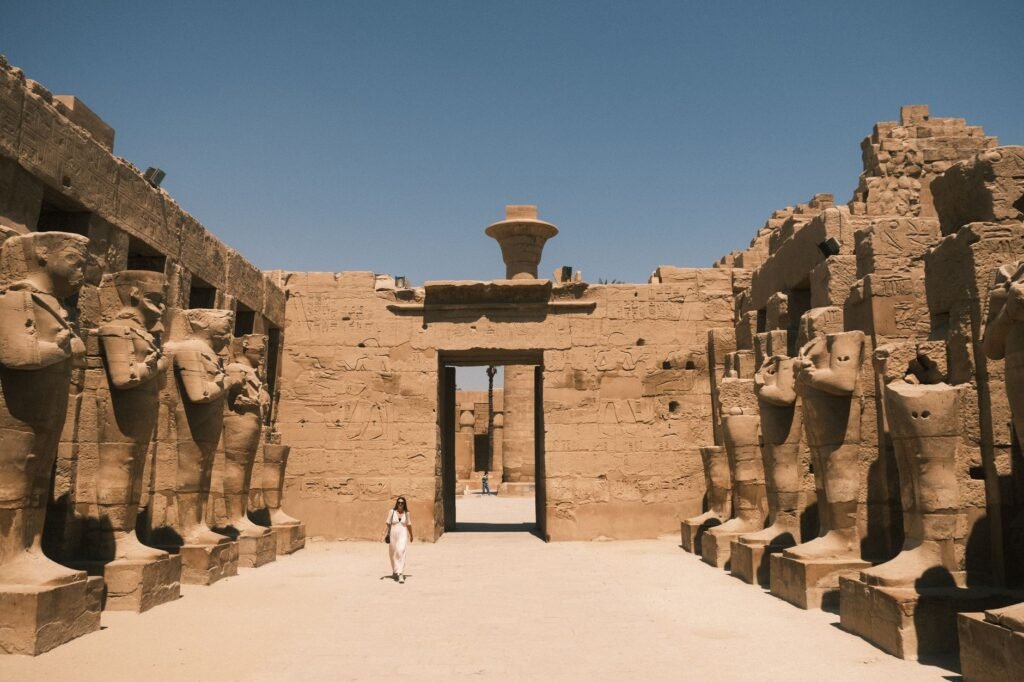
Thebes was the principal center of Amun’s cult. The great temple complexes at:
- Karnak
- Luxor
became among the most important religious sites in Egypt. Karnak, in particular, grew into an immense sacred landscape dedicated largely to Amun, his consort Mut, and their son Khonsu.
Heliopolis
Heliopolis was the ancient center of Ra worship. It was one of Egypt’s oldest theological centers and a major seat of solar creation mythology. Many ideas about kingship and the sun god developed there.
Other important sites
- Nubian temples dedicated to Amun, especially in imperial contexts
- Deir el-Bahari, where Hatshepsut promoted Amun’s cult
- Siwa Oasis, where Amun’s oracular cult was later famous in Greco-Roman times
Sacred landscape
Egyptian temples were not just places of worship. They were thought to be earthly residences of the gods. The chief god’s presence sanctified the surrounding city and affirmed the pharaoh’s role as mediator.
Powers and Attributes
If one asks, “Who is the king of the Egyptian gods?” the answer points not just to hierarchy but to power.
Divine domains
Amun-Ra was associated with:
- the sun
- creation
- kingship
- fertility
- military victory
- cosmic order
- hidden divine power
Responsibilities
In religious and political thought, the supreme god:
- sustains the universe
- legitimizes the pharaoh
- grants victory in war
- protects Egypt from chaos
- ensures the regular cycle of day and night
- supports fertility and abundance
Theological meaning
Amun-Ra is especially important because he bridges two complementary ideas:
- Amun represents the invisible, transcendent divine force
- Ra represents the visible life-giving sun
Together, they form a complete image of supreme deity: both beyond human sight and manifest in the natural world.
Main Myths
Egyptian mythology preserves many traditions, but some themes are especially relevant to the chief god.
The solar cycle
Ra’s daily journey is one of the central myths of Egyptian religion. The sun travels across the sky by day and through the underworld at night. During the night, Ra must defeat chaos and dangerous beings to rise again at dawn.
This myth expresses:
- death and rebirth
- cosmic struggle
- the victory of order over chaos
- the daily renewal of kingship
The creation myths
Different Egyptian cities offered different creation stories. In some, Ra emerges from primordial waters or is identified as the first self-created being. In others, Amun is the hidden source of creation. Later theology often treated Amun-Ra as the ultimate creator who brought the world into being through divine will.
The royal birth myths
Several temple inscriptions present the pharaoh as the child of a god, especially Amun. These scenes are not “myths” in the modern literary sense only; they are also political theology. They assert that the king’s authority comes directly from the chief god.
The hidden god and divine presence
Amun’s title as “the Hidden One” gave rise to the idea that the supreme deity is not fully visible or comprehensible. This made him an especially fitting god for universal sovereignty, since a true king rules even when not physically seen.
Relationship with Other Mythological Figures
The king of the gods in Egypt did not rule alone. He interacted with many deities in alliance, rivalry, and hierarchy.
With Ra
Amun and Ra were eventually merged, but they retained distinct origins.
- Ra: ancient solar creator and ruler
- Amun: hidden Theban god who rose to national prominence
Their fusion strengthened both deities.
With Osiris
Osiris was not usually “king of the gods,” but he was a major divine ruler of the dead and afterlife. Egyptian religion often balanced:
- Ra: solar kingship and cosmic order
- Osiris: resurrection and judgment
- Amun: hidden sovereignty and state power
With Isis
Isis is not directly part of Amun-Ra’s immediate family in the usual Theban triad, but she became one of the most important goddesses in Egyptian and later Mediterranean religion. Her cult interacted with broader royal theology.
With Set
Set represents disorder, foreign lands, and violence in many traditions. The supreme god’s role includes maintaining order against powers like Set. However, Set was not always purely evil; his status changed over time and context.
With Ma’at
Ma’at, the principle of truth, balance, and order, is essential to Egyptian kingship. The chief god and the pharaoh must uphold Ma’at against isfet, chaos and disorder.
Worship and Cult
The cult of the chief Egyptian god was highly developed and politically significant.
Temple worship
Temple ritual in ancient Egypt was usually performed by priests on behalf of the king. Daily rites included:
- purification
- opening the shrine
- clothing the cult statue
- presenting food and drink offerings
- incense burning
- hymns and prayers
Offerings
Common offerings included:
- bread
- beer
- cattle
- geese
- incense
- flowers
- wine
- oil
These offerings were not simply gifts. They maintained a reciprocal relationship between gods and humans.
Festivals
Important festivals of Amun included processions and ceremonial renewal, especially in Thebes. During these celebrations, divine statues could be carried from one temple to another, symbolizing the god’s living presence among the people.
Royal ideology
Kings often promoted Amun-Ra to legitimize their rule. Some rulers built or expanded temples dramatically, seeing religious patronage as both piety and political strategy.
The wealth of Amun’s priesthood
By the New Kingdom, the priesthood of Amun became extremely powerful. In some periods, its influence rivaled that of the pharaoh. This political dimension is essential to understanding why Amun-Ra became so prominent.
Ancient Sources
Our knowledge of Egyptian religion comes primarily from Egyptian texts, inscriptions, and later classical writers. Unlike Greek mythology, Egypt does not preserve a single canonical myth cycle.
Key Egyptian sources
Important sources include:
- Temple inscriptions at Karnak, Luxor, and other sites
- Pyramid Texts
- Coffin Texts
- Book of the Dead
- Hymns to Amun and Ra
- Royal inscriptions and stelae
Classical authors
Classical Greco-Roman writers also recorded Egyptian beliefs, though often through an outsider’s perspective.
| Author | Relevance |
|---|---|
| Herodotus | Described Egyptian customs and religion |
| Plutarch | Discussed Isis and Osiris, useful for later interpretive traditions |
| Diodorus Siculus | Preserved accounts of Egyptian gods and temples |
| Strabo | Noted important sacred centers |
| Pliny the Elder | Mentioned Egyptian religious and natural traditions |
Caution in reading sources
Classical sources should be used carefully. They often interpreted Egyptian gods through Greek categories, which can distort the original religious meanings.
Roman Equivalent
There is no perfect Roman equivalent for the king of the Egyptian gods. However, in interpretive practice, Amun-Ra was often linked to Jupiter or, in solar aspects, Sol.
Why no exact match exists
Roman religion did not have a direct counterpart to the complex Egyptian theological fusion of Amun and Ra. Roman authors and worshippers often used interpretatio romana to identify foreign gods with Roman ones, but these were approximations rather than exact translations.
Greco-Roman adaptation
In the Greco-Roman world, Amun was sometimes associated with:
- Jupiter Ammon
- or, in broader solar terms, Sol
The famous oracle of Siwa contributed to Amun’s continued fame in the Mediterranean world, especially after Alexander the Great visited it according to later tradition.
Influence on Modern Culture
The king of the Egyptian gods, especially Amun-Ra and Ra, has had a strong afterlife in modern culture.
Literature and scholarship
Egyptian mythology appears in:
- historical fiction
- fantasy novels
- children’s books
- academic studies of religion and archaeology
Ra and Amun-Ra are frequently used as symbols of ancient wisdom, power, and mystery.
Cinema and television
Egyptian gods regularly appear in:
- adventure films
- documentaries
- fantasy series
- mythological reinterpretations
They are often portrayed as powerful cosmic beings, though popular depictions sometimes simplify the complexity of Egyptian religion.
Games and comics
Modern games and comics often use:
- Ra as a solar deity
- Amun as a hidden god
- Amun-Ra as a supreme or boss-level divine figure
These portrayals are typically inspired by myth but adapted for entertainment.
Art and design
The imagery of the sun disk, ram horns, falcons, and royal crowns continues to inspire:
- jewelry
- tattoos
- fashion
- graphic design
- museum exhibitions
Curiosities
Here are some lesser-known facts about the king of the Egyptian gods:
- Amun’s name means “hidden,” which is unusual for a supreme god because it emphasizes invisibility rather than display.
- Amun-Ra was not always the supreme god. His rise was historical, tied to political power.
- Egyptian gods could merge without losing identity. Amun and Ra could remain distinct while also functioning as one.
- The pharaoh was not equal to the god. He was the god’s earthly representative, not the same being.
- Temples were thought of as divine homes. Worship was maintenance of the god’s presence, not public congregation in the later monotheistic sense.
- Different cities promoted different chief gods. Egyptian religion was locally rooted and highly flexible.
- Ra’s solar journey was a cosmic drama. It symbolized the perpetual struggle against chaos every night.
- The title “king of the gods” is interpretive. Ancient Egyptians expressed divine supremacy in various ways rather than through one standardized title alone.
Frequently Asked Questions
1. Who is the king of the Egyptian gods?
The most common answer is Amun-Ra, especially in the New Kingdom. In some contexts, Ra or Amun alone may be emphasized instead.
2. Was Ra the king of the gods?
Ra was one of the most important gods in ancient Egypt and often functioned as a supreme creator and solar ruler. In some traditions, he is treated as kingly. However, later theology often elevated Amun-Ra above him.
3. Why was Amun-Ra so important?
Amun-Ra united hidden divine power with the visible sun. He was associated with creation, kingship, and state legitimacy, making him central to Egyptian royal ideology.
4. Did all Egyptians worship the same chief god?
No. Egyptian religion varied by place and period. Different cities favored different gods, and theological hierarchies changed over time.
5. What does Amun mean?
Amun means “the Hidden One” or “the Concealed One.” This refers to the god’s invisible, transcendent nature.
6. What animal is associated with the king of the Egyptian gods?
The most important sacred animal is the ram, especially for Amun and Amun-Ra. Falcons are also important because of Ra’s solar and sky symbolism.
7. Was there a single supreme god in ancient Egypt?
Not in the same exclusive sense found in some later religions. Egypt had a flexible polytheistic system, though certain gods—especially Ra, Amun, and Amun-Ra—were often treated as supreme.
Conclusion
The answer to who is the king of the Egyptian gods is best understood as Amun-Ra, while recognizing that Egyptian religion was diverse and historically changing. Ra embodied solar creation, Amun embodied hidden divine power, and their fusion became the strongest expression of supreme godhood in ancient Egyptian theology.
Amun-Ra was more than a mythological figure. He was a religious symbol of kingship, cosmic order, and state power. His cult shaped temples, royal ideology, and public ritual for centuries. Even today, he remains one of the most important and recognizable figures in Egyptian mythology, standing at the center of ancient Egypt’s vision of divine sovereignty.

Orin Vale has spent the better part of two decades tracing the threads that connect the world’s oldest stories — from the halls of Asgard to the banks of the Nile, from Olympus to the jungles of the Maya. What began as a childhood fascination with flood myths and trickster gods grew into years of independent study across comparative mythology and ancient religion, always chasing the same question: what did these stories mean to the people who first told them? Orin writes for readers who want more than trivia — the ones looking for the beliefs, fears, and truths that myths were built to carry.